Piemontite is a striking, rarely encountered mineral that captures the attention of mineralogists and gem collectors alike. Its warm, reddish hues and association with manganese-rich geological environments make it a useful probe into the history of rock formation as well as an attractive material for ornamental use. This article examines what piemontite is, where it forms, how it is used, and several intriguing aspects of its chemistry and occurrence that make it a subject of ongoing interest in mineralogy.
Nature and mineralogy of piemontite
Piemontite is a member of the epidote group of minerals, distinguished by an abundance of trivalent manganese that imparts its characteristic coloration. Chemically, it can be described as a manganese-rich variety in which manganese (primarily Mn3+) substitutes for aluminum in the crystal structure common to epidote minerals. As a result, piemontite combines the crystal framework typical of the group with chromophoric manganese centers that absorb light and produce shades ranging from pink to deep red-brown.
The mineral crystallizes in the monoclinic system and commonly forms prismatic, elongated crystals, often terminated by well-defined faces. Habit ranges from coarse, transparent-to-translucent crystals suitable for faceting to dense, granular aggregates. Piemontite typically displays a vitreous to subresinous luster and can have a relatively high density compared with silicates low in transition metals, reflecting the presence of heavy cations like manganese.
Optically, piemontite shows noticeable pleochroism, meaning its apparent color can change when the crystal is viewed from different angles under polarized light. This property is not only aesthetically appealing in gem material but also diagnostically useful under the microscope. The red to reddish-brown hues are the result of electronic transitions associated with Mn3+ ions located in specific crystallographic sites; small variations in composition and the Fe/Mn ratio influence the exact tone and intensity.
- Crystal system: monoclinic
- Common habit: prismatic crystals, granular aggregates
- Color range: pink, red, brown-red, sometimes nearly black with high iron
- Hardness: generally similar to epidote (around 6–7 on Mohs scale)
- Group: epidote group
Geological settings and occurrences
Piemontite typically forms in environments where manganese is concentrated and available to enter silicate crystal structures during metamorphism or metasomatism. Important geological settings include:
- Skarns — contact metamorphic rocks formed by fluid interaction between intruding magmas and carbonate-rich country rocks. In skarns, manganese-bearing fluids can precipitate minerals like piemontite along with garnet, vesuvianite, and other calc-silicates.
- Metamorphosed manganese-rich sediments — sedimentary layers with high manganese content that have been subjected to regional metamorphism produce a suite of manganese silicate and oxide minerals, among which piemontite can be an accessory phase.
- Hydrothermal veins and alteration zones — hydrothermal fluid activity can introduce or redistribute manganese, leading to piemontite crystallization in veins, breccias, and altered wallrock.
Associations with other minerals are common and diagnostically useful. Piemontite is often found alongside other epidote-group minerals, as well as garnets (especially manganese-bearing varieties), vesuvianite, quartz, calcite, chlorite, and occasionally sulfide minerals in hydrothermal contexts. These parageneses reflect complex fluid-rock interactions where manganese and other transition elements are mobilized and partitioned into newly forming minerals.
The mineral was first identified and named for the region where it was initially described, the Piedmont area of Italy. Since that time, piemontite has been reported from a variety of locales worldwide, typically in relatively small but scientifically important occurrences. Some localities produce specimens of gem quality, while others yield material primarily of interest to mineral collectors and petrologists studying metamorphic processes.
Uses: gemology, collecting, and scientific applications
Although piemontite has no significant industrial uses, it occupies a distinct niche in both gemology and geological research. Its deep red and pink variants can be fashioned into attractive cabochons and occasionally faceted gems, prized for their unusual color among silicate gemstones. Because gem-quality piemontite is scarce, pieces suitable for jewelry are relatively rare and often command attention in specialized markets.
Collectors value piemontite specimens for several reasons:
- Colorful, well-formed crystals that display strong red tones.
- Associations with other interesting minerals in skarn and metamorphic assemblages.
- Rarity compared to more common silicates, making high-quality specimens desirable.
In terms of scientific utility, piemontite serves as an indicator of specific geochemical conditions. The presence of Mn3+-rich epidote typically points to environments with elevated manganese activity and particular redox conditions during mineral formation. Petrologists use piemontite occurrences to infer aspects of pressure-temperature (P–T) history, fluid composition, and the degree of metasomatic influence in rocks that record contact or regional metamorphism.
Analytical techniques such as electron microprobe analysis, X-ray diffraction, and spectroscopic methods (e.g., optical absorption, Raman spectroscopy) are employed to quantify the manganesian content, determine structural details, and distinguish piemontite from closely related epidote minerals with differing cation chemistries. Such studies can reveal subtle solid-solution behavior and the role of transition-metal substitutions in controlling physical and optical properties.
Gem-cutting considerations and care
For gem cutters, piemontite presents both opportunities and constraints. When transparent and inclusion-free, piemontite can be cut into appealing stones with a warm, wine-like color that responds nicely to careful faceting. However, several practical considerations apply:
- Cleavage and brittleness: Like other epidote-group minerals, piemontite can exhibit cleavage or parting that makes certain cutting directions more prone to chipping. Experienced cutters orient stones to minimize the risk of cleavage planes intersecting critical facets.
- Hardness and polish: With a hardness around 6–7, piemontite takes a good polish but requires cautious handling to avoid abrasion damage. Jewelry settings should protect edges and points.
- Rarity: Because gem-quality material is limited, cutters often reserve the best rough for single, high-quality stones rather than producing many small gems.
Care for piemontite jewelry is similar to that for other medium-hard gemstones: avoid harsh chemicals and extreme thermal shocks, and clean gently with warm, soapy water and a soft brush. Storage separate from harder gems will prevent scratching.
Geochemical and petrological significance
In petrology, piemontite is more than a pretty red mineral — it is a geochemical signal. The incorporation of manganese into the epidote structure, primarily as Mn3+, requires specific oxidation states and fluid compositions during mineral formation. Consequently, piemontite commonly marks episodes of manganese enrichment and oxidative conditions during metamorphism or metasomatism.
Researchers use piemontite to:
- Trace the movement and concentration of manganese in contact metamorphic terrains and skarns.
- Constrain fluid compositions, especially oxygen fugacity, because Mn3+ stability is redox-sensitive.
- Compare mineral assemblages across different localities to reconstruct metamorphic gradients and metasomatic fronts.
Analytical work often focuses on compositional zoning within piemontite crystals, which can record chemical variations during crystal growth. Such zoning, visible under electron microscopes or in high-resolution images, can document evolving conditions as fluids change composition, temperature drops, or crystallization proceeds. In some cases, piemontite coexists with iron-rich epidote variants, and the Fe/Mn ratio provides clues about the relative availability of these transition metals during formation.
Historical notes and interesting anecdotes
The name piemontite derives from the Italian region where the mineral was first characterized, echoing a common practice in 19th-century mineralogy of linking new species to their type localities. This historical connection remains a useful mnemonic for remembering both the mineral’s origin and its association with regional metamorphic and skarn environments.
Beyond formal science, piemontite has attracted attention in metaphysical and lapidary circles. Some enthusiasts ascribe emotional and healing properties to red-hued minerals. While such beliefs are outside scientific validation, they contribute to the demand for attractive piemontite specimens in niche markets and among collectors seeking stones with distinctive color and lore.
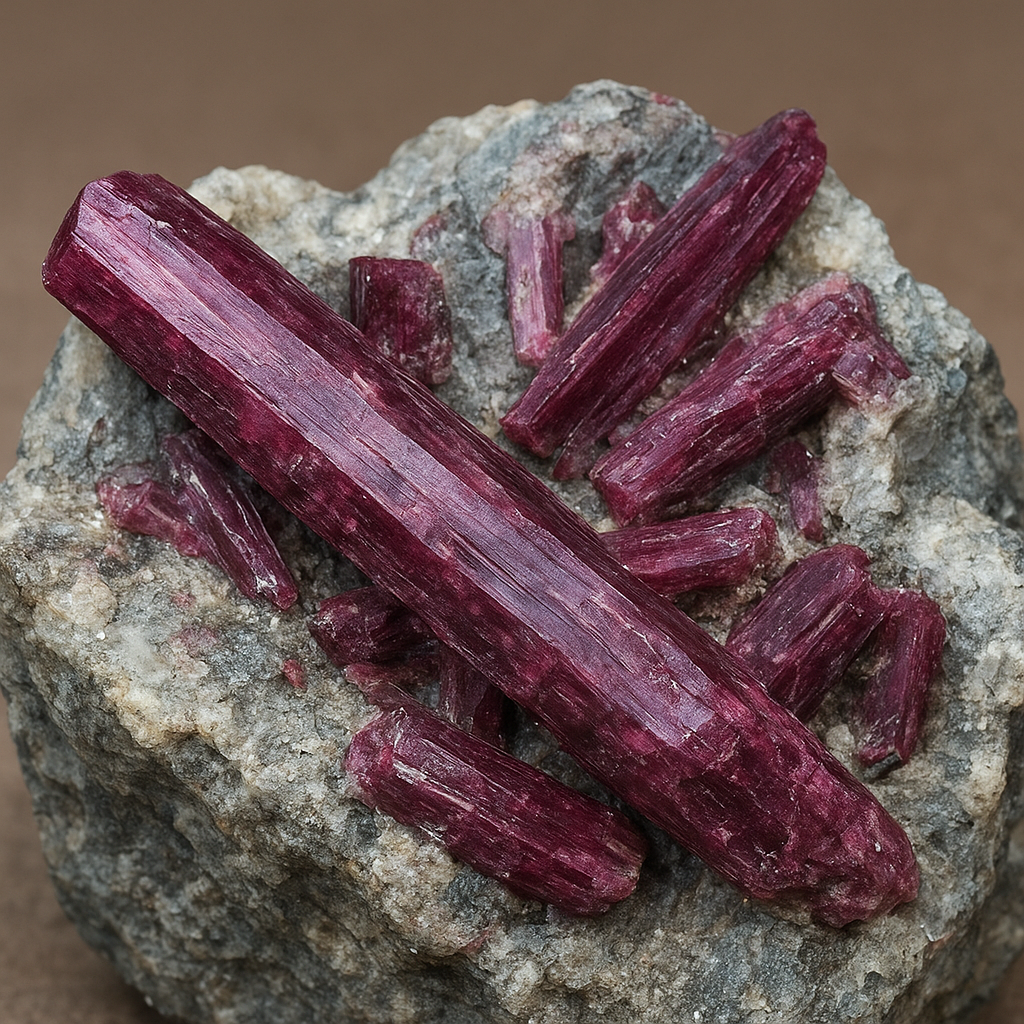
Notable museum and private-collection specimens showcase piemontite in dramatic contrasts: vivid red crystals perched on contrasting host rock, or delicate prismatic forms that reveal twinning and termination faces under magnification. These specimens often become highlights of mineral exhibitions because of their unusual color for an epidote-group mineral.
Challenges in study and collecting
Studying piemontite poses several challenges. First, occurrences are often small and localized, meaning that fresh, unaltered samples can be rare. Weathering and oxidation at the surface can obscure original colors and complicate chemical analysis. Second, the close structural relationship with other epidote minerals sometimes requires careful analytical discrimination to avoid misidentification.
Collecting responsibly also raises considerations. Many piemontite occurrences are in remote or protected areas, and extracting specimens from skarn zones or metamorphic outcrops should respect local regulations and conservation practices. Because gem-quality piemontite can be limited in supply, the trade is typically small-scale; consumers are advised to seek reputable dealers and documentation when authenticity or locality matters for valuation.
Related minerals and broader context
Piemontite is part of a broader family of minerals in the epidote group, which includes several compositions differing mainly by the dominant trivalent cation in specific structural sites. Comparisons with other members of the group help mineralogists understand substitution mechanisms, structural stability, and the range of environmental conditions that produce each variant.
Understanding piemontite also dovetails with studies of metamorphism, metasomatism, and skarn formation. These processes play significant roles in ore genesis, landscape evolution, and the distribution of economically important elements. While piemontite itself is not an ore mineral, its presence can flag zones where manganese and other transition metals have been concentrated, sometimes in association with more economically relevant minerals.
In the classroom or field, piemontite offers a visually memorable example of how a single element—manganese—can alter the appearance and properties of a common mineral framework, producing a distinct species worthy of study by both amateur rockhunters and professional geoscientists.
Further reading and avenues for research
For those interested in exploring piemontite in greater depth, recommended avenues include mineralogical journals that publish detailed compositional and structural studies, regional geological surveys reporting skarn and contact-metamorphic deposits, and gemological literature documenting cutting techniques and market occurrences. Modern analytical advances—such as high-resolution electron microprobe mapping, synchrotron-based spectroscopy, and stable-isotope work on associated carbonates—continue to refine our understanding of how piemontite forms and what it records about its host rocks.
Whether encountered as a small red crystal in a field bag, a polished cabochon in a collector’s case, or a thin section under a polarizing microscope, piemontite rewards attention. Its vivid color, chemical distinctiveness, and ties to dynamic geological processes make it an enduring point of interest at the intersection of aesthetic appeal and scientific insight.