Phlogopite is a member of the mica family whose subtle colors, layered structure and chemical composition make it both a geologist’s window into deep Earth processes and a material of practical use in industry and technology. This article explores the mineral’s chemistry and structure, where it forms and is found, the many applications that rely on its properties, and a selection of scientific and cultural details that highlight why phlogopite remains an interesting and useful mineral.
Mineralogy, Structure and Physical Properties
At the chemical level phlogopite belongs to the mica group and its idealized formula is KMg3AlSi3O10(OH)2, though natural samples often contain variable amounts of iron and other substitutions. The mineral is a trioctahedral mica, meaning that three of the octahedral sites in its crystal lattice are occupied by divalent cations — predominantly magnesium and sometimes iron. The presence of potassium in the interlayer sites helps stabilize the characteristic sheet-like structure. Because of this composition, phlogopite is commonly discussed in petrology alongside other micas as a carrier of volatile and incompatible elements.
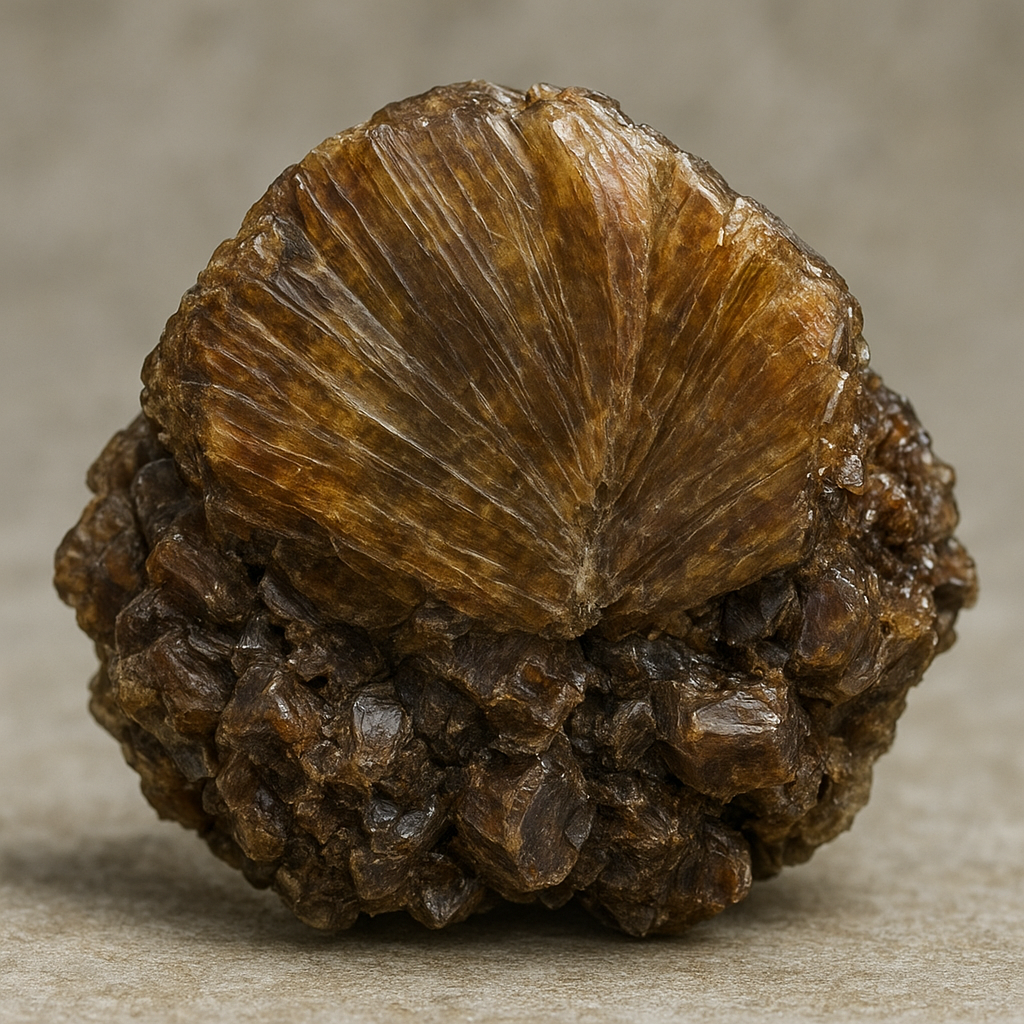
Phlogopite’s crystal system is monoclinic and it typically forms thin, flexible sheets or plates with perfect basal cleavage. These sheets separate easily along the mica layers, producing flakes that can be split to very small thicknesses. Typical physical properties include a Mohs hardness of roughly 2.5–3, a specific gravity commonly in the 2.7–2.9 range, and colors that span yellow-brown to deep brown, sometimes with reddish or greenish tones. Optical properties in transmitted light indicate strong birefringence and pleochroism in colored varieties.
Two important practical consequences arise from this structure. First, the layered nature gives phlogopite exceptional thermal and mechanical flexibility along the basal plane, and second, its chemical bonding and lack of free electrons make it an excellent electrical insulator. These traits explain both many of its industrial applications and the scientific interest in its behavior at high pressures and temperatures.
Where Phlogopite Occurs: Geological Settings and Notable Localities
Phlogopite forms in a surprisingly wide range of geological environments, from shallow crustal metamorphic rocks to the upper mantle. Key occurrences and formation settings are:
- Ultramafic and mantle-derived rocks: Phlogopite is well known from mantle xenoliths, peridotites and some kimberlites and lamproites. In these settings it often indicates metasomatic addition of potassium and other volatiles to peridotitic mantle rocks.
- Kimberlites and lamprophyres: These volatile-rich magmas commonly carry phlogopite as phenocrysts. Because such magmas sample deep parts of the mantle, phlogopite here provides a direct clue to deep metasomatic processes and volatile budgets in the subcontinental mantle.
- Carbonatites and alkaline complexes: Phlogopite occurs in some carbonatite-associated rocks and alkaline intrusive complexes, where it is associated with other K-rich minerals.
- Regional and contact metamorphism: In marbles, skarns and some high-temperature metamorphic rocks phlogopite can form by the reaction of magnesium- and potassium-bearing fluids with precursor minerals.
- Pegmatites and hydrothermal veins: Although rarer than muscovite in many pegmatites, phlogopite can occur where the chemical conditions favor higher magnesium activity.
Notable localities that have produced high-quality or abundant phlogopite include the alkaline complexes of the Kola Peninsula in Russia, certain kimberlite fields in Canada’s Northwest Territories, parts of Scandinavia, and various carbonatite and skarn localities worldwide. In many mountainous regions where regional metamorphism or contact metamorphism was widespread — for example in parts of the Alps, the Canadian Shield and select areas of the United States — significant phlogopite-bearing rocks have been documented. Collectors may also find attractive, transparent sheets of phlogopite in pegmatites and hydrothermal veins where crystals achieved slower growth and clearer habits.
Industrial and Technological Applications
Because of its flaky habit, thermal stability and electrical properties, phlogopite has been used in a number of industrial applications. Historically, natural micas (including both phlogopite and related species) were used as insulating “windows” in stoves and as mica sheets in early electrical applications. Today, the mineral’s uses fall into several broad categories:
Electrical and Thermal Insulation
- High-temperature insulating sheets: Large tabular flakes of phlogopite are used to manufacture insulating windows for furnaces and for thermal barriers where both insulating power and thermal shock resistance are required.
- Electrical insulation: Its low electrical conductivity and dielectric strength made phlogopite, and especially engineered synthetic derivatives, valuable in transformer and capacitor technologies in earlier generations of equipment. Modern electronics increasingly use synthetic mica analogs for tightly controlled dielectric properties.
Fillers, Composites and Polymers
In polymer composites, paints and rubber compounds phlogopite flakes act as a reinforcing filler that can also modify thermal behavior, improve barrier properties and provide a pearlescent effect when the flakes are oriented near the surface. For instance, specialized phlogopite is used as a filler in high-performance brake linings and friction materials where heat resistance and dimensional stability matter.
Cosmetics and Pigments
While muscovite is commonly used for pearlescent pigments, some phlogopite and fluorophlogopite varieties serve as shimmering pigments and as plate-shaped extenders in cosmetic formulations. Synthetic phlogopite analogs, particularly synthetic fluorophlogopite (a fluorine-bearing variant), are prized for purity, color stability and reduced heavy-metal content, which suit them for face powders, eye shadows and nail products.
Advanced Materials: Synthetic Micas and Electronics
Synthetic phlogopite and fluorophlogopite are engineered to improve on natural material limitations. These synthetics provide consistent composition, very low impurity levels and controlled physical properties. They find uses in:
- High-performance capacitors and dielectric layers (where consistent permittivity and temperature behavior are important).
- Polymer composites for aerospace and electronics, where both thermal stability and dielectric resilience at elevated temperature are needed.
- Specialty glass replacements and filler materials that maintain mechanical integrity at high temperature.
Because the synthetic route permits substitution (for example, replacing hydroxyl with fluorine), engineered micas can retain the layered mechanical properties while reducing hygroscopic behavior and increasing chemical resistance.
Scientific and Petrological Importance
Beyond commercial use, phlogopite plays a central role in scientific studies of the crust and mantle. It stores chemical and isotopic information that geoscientists use to reconstruct processes that are otherwise hidden from view.
Indicator of Mantle Metasomatism and Volatile Fluxes
Phlogopite commonly forms during metasomatic alteration of peridotite by K- and volatile-rich fluids or melts. Its presence in mantle xenoliths and in kimberlite-hosted mantle fragments is often taken as direct evidence for potassium-rich metasomatism and volatile addition at depths where these phases are stable. The mineral thus helps map regions of the mantle that were modified by subduction-related fluids or by small-volume melts.
Tool for Geochronology and Isotope Geochemistry
Because phlogopite contains significant potassium it is a useful target for K–Ar and Ar–Ar dating. Phlogopite ages can constrain the time of metasomatic events, emplacement ages of kimberlites and lamproites, or cooling ages of metamorphic events. Additionally, the mineral may be dated using Rb–Sr and other isotopic systems when appropriate and when accessory phases allow. These isotopic fingerprints inform on the timing and source characteristics of the material that produced the phlogopite. The term geochronology is central to such uses.
Trace Element and Noble Gas Storage
Phlogopite concentrates certain trace elements and volatiles, including large-ion lithophile elements (LILEs) and water. It can also host noble gases that record degassing and mantle dynamics. Analyses of these components in phlogopite help model volatile cycles and mantle heterogeneity.
Indicator Mineral for Diamond Exploration
In diamond exploration, mica minerals such as phlogopite in kimberlites and related rocks can provide clues about depth and composition of mantle source regions; their chemistry sometimes correlates with diamond stability fields. Thus, phlogopite is one of several indicator minerals prospectors study when evaluating potential diamond-bearing pipes.
Extraction, Processing and Environmental / Health Considerations
Mining mica — including phlogopite — is generally less hazardous than the extraction of fibrous asbestos minerals, but there are environmental and worker-safety issues that deserve attention. Mechanical processing of mica produces fine dust which, if inhaled chronically in high concentrations, can cause respiratory irritation and pneumoconioses in poorly controlled workplaces. Modern processing plants use dust suppression, ventilation and personal protective equipment to minimize exposure.
From an environmental perspective, mining can disturb habitats and generate waste rock. Many producers now prefer to process and refine mica to create consistent, high-quality flakes or milled powders that reduce the need to mine multiple deposits and that allow better traceability and regulatory compliance. The development of synthetic micas reduces reliance on natural deposits for high-purity applications and reduces variability in product chemistry.
In cosmetics and consumer products, high-grade synthetic fluorophlogopite and strict purification reduce the risk of heavy-metal contamination, which has been a regulatory and public concern for natural mining operations in some regions. For electrical and aerospace uses, manufacturers favor materials with well-characterized thermal and chemical properties, making synthetic analogs desirable.
Collecting, Varieties and Notable Specimens
Collectors value phlogopite for its warm, often bronze-like color and the ability to split sheets into broad, lustrous plates. Transparent phlogopite sheets that are clean and free of inclusions can be visually striking and occasionally are fashioned into ornamental uses. While less flashy than gem garnet or tourmaline, good phlogopite specimens display an attractive submetallic to pearly luster and can show excellent cleavage planes that reflect light beautifully.
Varieties may be distinguished by color, clarity and associated minerals. Some phlogopites are brown to amber and nearly translucent, while others are darker and more opaque. Associated minerals — such as olivine, spinel, corundum, calcite or apatite — often give clues about the rock’s origin and metamorphic or magmatic history.
- Specimen-grade sheets: Thick, transparent flakes suitable for display are prized by mineral collectors.
- Textural interest: Phlogopite in layered skarns or as large phenocrysts in lamprophyres can create visually appealing specimens that illustrate geologic processes.
- Historical artifacts: In some cultures and historical contexts, mica sheets (not always phlogopite specifically) were used as a durable, translucent material for small windows or lamp covers.
Interesting Facts and Cultural Notes
The name phlogopite comes from the Greek phlogopos meaning flame-colored or fire-like, a reference to the brownish or reddish hues common in many samples. Although that etymology evokes a dramatic color, phlogopite’s palette is actually subtle; the allure lies in its layered texture and thermal and insulating properties rather than in gaudy color.
Phlogopite’s role in deep Earth studies is important: the mineral serves as one of the few direct mineralogical indicators of potassium and volatile-rich metasomatism within the mantle. Studies of phlogopite-bearing mantle xenoliths have reshaped our understanding of how subducted material modifies the mantle wedge and how small-volume melts transfer incompatible elements across lithospheric scales.
Another modern twist is the rise of synthetic fluorophlogopite as an ingredient in cosmetics and advanced materials. Marketed under names like “synthetic mica,” these products mimic the flake shape and optical properties of natural mica while offering higher purity, lower heavy-metal content and more consistent color and particle size. In electronics, consistent dielectric behavior and temperature stability make synthetic mica attractive for specialty capacitors and insulating films.
Phlogopite is also a reminder that many industrial materials have a twin life in scientific research: the same properties that make a mineral valuable for insulation or fillers also make it a useful recorder of geological history. Studies of trace elements, isotopes and microstructures in phlogopite continue to supply insights into the chemical dialogues between crust and mantle that shape continents and volcanic provinces.
Practical Tips for Students and Enthusiasts
If you are interested in studying phlogopite:
- Examine hand specimens and thin sections: The layered cleavage and pleochroic colors are obvious in good hand specimens; thin sections under polarized light reveal extinction angles and birefringence.
- Seek out localities with mantle-derived rocks: Where kimberlites or lamproites are exposed, phlogopite is often present and can be studied in context.
- Handle sheets carefully: Because sheets split easily, good specimens are fragile along cleavage planes; storing them flat and away from moisture preserves their luster.
- Consider synthetic samples for laboratory work: For consistent chemical and physical properties, synthetic fluorophlogopite can be a reliable substitute when natural variability would complicate experiments.
Phlogopite occupies an interesting crossroads: a mineral that is both a practical industrial material and a sensitive recorder of deep geological processes. Its layered structure underpins a suite of properties that humanity has exploited for insulation, cosmetics and composite materials, while the same structural and chemical traits provide petrologists and geochemists with a tool for deciphering mantle metasomatism, magmatic histories and the timing of geological events. Whether studied for applied uses or for the story it tells about the Earth, phlogopite remains a rewarding subject for further attention.