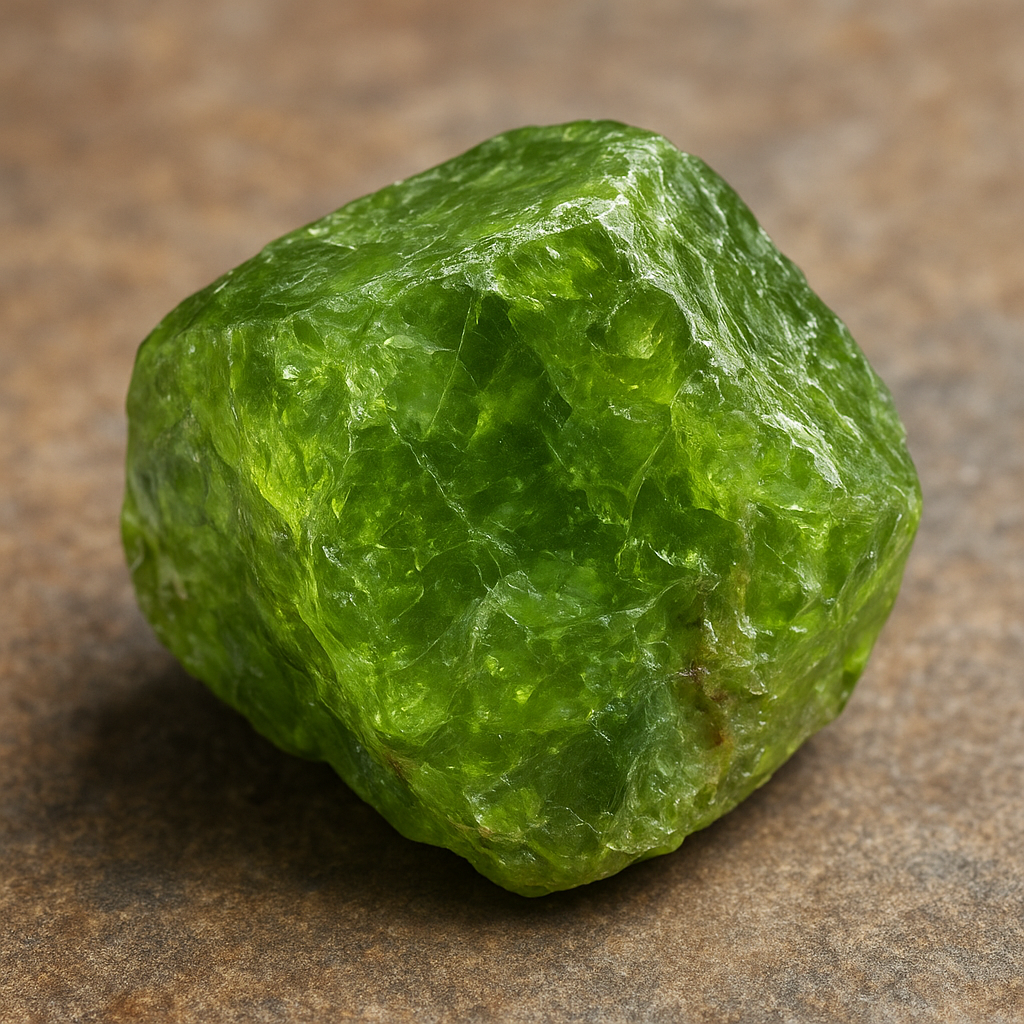
Peridot is a gem-quality variety of the mineral olivine that has fascinated cultures, jewelers and geologists for millennia. Known for its distinctive olive-green to yellowish-green color, this gemstone combines a direct link to deep Earth processes with a long human history of use in adornment and ritual. The following article explores where peridot is found, how it forms, its uses in jewelry and industry, identification and care, and a number of intriguing scientific and cultural facets connected to this radiant stone.
What Peridot Is: Mineralogy and Color
Peridot is the gem-quality form of olivine, a group of silicate minerals composed primarily of magnesium, iron and silica. The composition is commonly described as a solid-solution series between forsterite (the magnesium-rich endmember) and fayalite (the iron-rich endmember). The gem’s vivid green hues are produced by trace amounts of iron substituting into the crystal structure, and the exact shade ranges from yellow-green to deep olive depending on that iron content and the presence of any inclusions.
Key physical and optical properties that define peridot include:
- Hardness: approximately 6.5–7 on the Mohs scale, making it durable for many jewelry uses but softer than sapphire or diamond.
- Refractive index: roughly 1.65–1.69, with distinct double refraction (birefringence) that contributes to its lively sparkle when well-cut.
- Specific gravity: around 3.2–4.4, depending on iron content.
- Distinctive pleochroism: typically weak to moderate, showing slightly different green tones when viewed from varied angles.
Where Peridot Occurs: Geological Settings and Notable Localities
Peridot is unusual among gemstones because it often crystallizes in environments derived from the Earth’s upper mantle or is incorporated into volcanic rocks brought rapidly to the surface. There are three primary geological contexts where gem-quality peridot is formed and recovered:
1. Mantle-Derived Xenoliths and Nodules
Many peridot crystals originate in the upper mantle and are transported to the surface within volcanic eruptions—commonly in basaltic magmas—that carry mantle xenoliths and nodules. These crystals can survive the rapid ascent and be preserved as gem-quality olivine. Important sources in this category include:
- Arizona, USA — particularly the San Carlos Apache Reservation, historically one of the largest modern producers of gem peridot (often called “Arizona peridot”).
- Parts of China and Pakistan — host mantle-derived olivines recovered from basaltic flows and xenolith-bearing lavas.
2. Volcanic Basalts and Lava Flows
Peridot is often found in basaltic volcanic rocks where crystals grew as the lava cooled or where olivine phenocrysts were carried in an eruptive flow. Notable and visually iconic occurrences include:
- Hawaii — olivine crystals are abundant in basaltic flows on the Big Island; the gem sometimes washes up on beaches as green sand, notably at Papakōlea (Mahana) Beach near Kaʻū.
- Other basalt-hosted occurrences in the Pacific islands and volcanic provinces worldwide.
3. Meteorites and Extraterrestrial Olivine
Olivine is a major mineral in some meteorites (notably pallasites) and in the dust of comets and asteroidal material. While gem-quality peridot itself is primarily terrestrial, the presence of olivine in space offers a fascinating link between the gemstone and planetary processes beyond Earth.
Major Modern and Historical Sources
Peridot’s global supply has changed over time due to new discoveries and shifting demand. Some notable localities include:
- St. John’s Island (Zabargad), Egypt — one of the oldest known sources, used by ancient Egyptians and Greeks.
- San Carlos, Arizona, USA — large-scale modern production for the jewelry market; stones from this region tend to be a classic lime-olive green.
- Pakistan (Kohistan region) — since the late 20th century, high-quality material has been mined, often of large size and excellent color.
- Myanmar (Burma), China and Vietnam — sources of gem-quality peridot, sometimes with deeper green hues.
- Hawaiian islands — beach deposits and fresh lava contain olivine grains, and the green sands of Papakōlea are a tourist attraction.
Uses: Jewelry, Industrial Roles and Cultural Significance
Peridot’s primary use is as a gemstone in every form of jewelry: rings, necklaces, earrings and beads. Its attractive green color and good brilliance make it a popular alternative to more expensive green gems like emerald.
Jewelry and Lapidary Use
As a gem, peridot is prized for its bright green tones and clarity. Typical lapidary considerations include:
- Cutting — peridot often benefits from simple cuts that maximize color and reduce the appearance of characteristic inclusions.
- Settings — because of its moderate hardness, peridot is commonly set in protective settings for rings or used in pendants and earrings where impact risk is lower.
- Birthstone status — peridot is the traditional August birthstone, a cultural role that supports steady market demand.
Decorative and Collector Uses
Large peridot crystals and attractive specimen pieces are collected by mineral enthusiasts. Museum collections may feature historic pieces, including ancient-cut stones from Zabargad or notable large gems.
Industrial and Scientific Relevance
While gem-quality peridot has limited industrial use, olivine as a mineral plays important roles in geology and industry. Olivine is used in refractory materials, as a slag conditioner in steelmaking, and is being researched for carbon sequestration applications because of its ability to react with CO2 in weathering processes. The study of olivine and peridot crystals provides geoscientists with clues about mantle composition, melting processes and the dynamics of volcanic eruptions.
History, Myth and Cultural Stories
Peridot has an ancient and rich cultural history. The island of Zabargad supplied ancient Egyptians with gemstones that were prized and sometimes called topaz by the Greeks (a confusion of names in antiquity). Throughout history, the stone has been associated with protection, healing and prosperity.
Medieval Europeans valued peridot for its supposed ability to dispel enchantment and protect against night terrors; clerics sometimes adorned religious objects with peridot believed to bring spiritual benefits. In modern metaphysical communities, peridot is still thought to promote emotional balance, abundance and renewal, though such claims are spiritual rather than scientific.
Identification, Treatments and Imitations
Professional gemologists identify peridot by its optical and physical properties: refractive index, birefringence, specific gravity and characteristic inclusions. Under magnification, peridot often shows distinctive inclusion patterns such as “lily-pad” disk plates or negative crystals.
Treatments are rare for peridot; most stones on the market are natural and untreated. There is limited commercial production of synthetic olivine for industrial research, but synthetic peridot is not common as a gem product. Imitations and look-alikes exist, including green glass and certain green synthetic stones. Diagnostic testing, including refractive index and spectroscopy, helps separate peridot from imitations.
Care, Cleaning and Practical Advice for Owners
Peridot requires some care to preserve its color and avoid damage:
- Cleaning — use warm soapy water and a soft brush. Ultrasonic cleaners are typically acceptable for clean, inclusion-free stones, but caution is advised if the stone has fractures or surface-reaching inclusions.
- Avoid harsh chemicals — acids and bleaching agents can damage the stone’s surface or the metal setting.
- Storage — store peridot jewelry separately from harder gemstones to prevent abrasion. Wrap in soft cloth or keep in a fabric-lined box.
- Protective settings — for rings and bracelets that may receive knocks, consider bezel settings or protective prongs to lower the risk of chipping.
Scientific and Geological Fascinations
Beyond its beauty, peridot provides a direct window into Earth’s interior. Because olivine is a major constituent of the upper mantle, gem-quality peridot crystals carried to the surface deliver samples of rocks formed under high pressures and temperatures. Geologists study these grains to learn about mantle composition, melting processes that produce basaltic magmas, and the timescale of volcanic transport.
Some compelling scientific points include:
- Peridot as a mantle messenger — inclusions trapped within peridot crystals may preserve tiny mineral assemblages indicative of deep-Earth environments.
- Weathering and carbon capture — olivine weathers relatively quickly compared with many silicates; its reaction with CO2 to form carbonates has inspired proposals to use olivine in engineered carbon sequestration projects.
- Extraterrestrial olivine — studying olivine grains in meteorites and cosmic dust helps planetary scientists piece together the history of the early solar system and the composition of other planetary bodies.
Commercial Markets, Ethics and Sustainability
The peridot market is composed of small-scale miners, larger commercial operations, lapidaries and retail jewelers. Key issues in the market include fair trade sourcing, environmental impacts of mining, and the cultural rights of communities living near deposits.
As with many colored gemstones, responsible sourcing is an increasing concern among consumers. Buyers often look for information about mine origin, working conditions and the social impact of extraction. In particular, peridot mining on indigenous lands (for example, in Arizona) and in remote regions of Pakistan and Myanmar raises questions about land rights, profit distribution and environmental stewardship.
Practical buying tips
- Ask for origin information — the country or specific mine can influence value and ethical considerations.
- Request certification for high-value stones — a recognized gemological report helps confirm identity and quality.
- Consider the trade-off between size, color and clarity — larger stones are rarer, but strong, clean color often contributes more to perceived value.
Notable Peridot Gems, Cuts and Design Trends
Peridot is used in a broad range of jewelry styles. Designers often exploit its fresh green tones to create seasonal, summer-themed collections or to pair with warm metals like yellow gold to enhance the gem’s olive tones. Cushion, oval and emerald cuts are common for peridot; the stone’s single refractive behavior means that well-chosen facets can showcase color without excessive complexity.
Large, collectible peridot gems—some weighing tens to hundreds of carats—appear occasionally at auctions or in museum displays. These pieces are prized for size and crystal quality, and they often come from famous localities such as Zabargad, Pakistan, or Arizona.
Interesting Facts and Lesser-Known Connections
- Green sand beaches: The green sand at Papakōlea in Hawaii is concentrated olivine grains derived from eroding basaltic deposits; the durable grains resist weathering longer than the surrounding volcanic materials.
- Ancient confusion of names: Historical sources sometimes mixed up peridot and other green stones, resulting in complex naming histories across languages and eras.
- Meteorite links: While gem peridot is terrestrial, olivine in space connects the gem to broader planetary geology and to scientists studying asteroids and planets.
- Modern research into olivine weathering aims to use abundant olivine minerals to react with atmospheric CO2, creating solid carbonate minerals as a form of long-term carbon storage.
Conclusion of Topics to Explore Further
Peridot sits at the intersection of beauty and science: a gemstone that not only decorates but also informs our understanding of the Earth’s interior, volcanic processes and even planetary materials. Its varied sources—from ancient Egyptian islands to contemporary Pakistani mines and the volcanic sands of Hawaii—reflect a global story of geology and human use. Whether worn as an August birthstone, studied by geoscientists, or admired on a green sand beach, peridot continues to captivate through its color, origin and the many tales woven around it.