
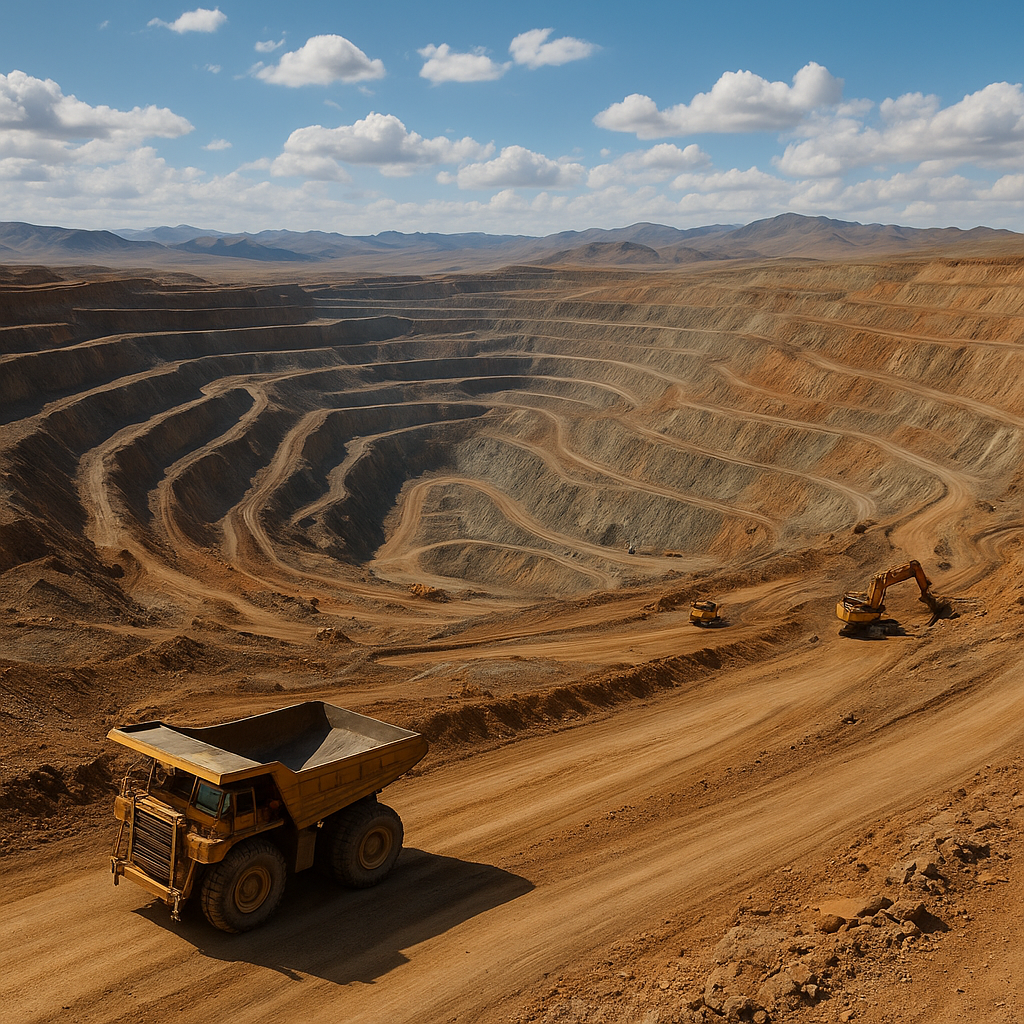
The Oyu Tolgoi complex in southern Mongolia has become one of the most talked-about mining developments of the 21st century. Combining vast mineral reserves with ambitious engineering, complex political negotiations and major socioeconomic impacts, it is a project that reshapes both the local landscape and national prospects. This article explores where Oyu Tolgoi is located, what is being extracted, how it operates technically, the economic importance for Mongolia and the wider region, and several intriguing aspects that make the project noteworthy.
Where Oyu Tolgoi is located and its geological setting
Oyu Tolgoi sits in the south-eastern part of the Mongoliaan Gobi Desert, within Khanbogd district of Umnugovi province, roughly 80–200 kilometers north of the Chinese border (depending on the specific transport route). The site occupies a remote, arid landscape of gravel plains and low hills. Its remoteness makes logistics and infrastructure development both a necessity and a challenge. Proximity to China, however, is strategically important because China is the largest regional consumer of base metals and a primary market for concentrate exports.
Geologically, Oyu Tolgoi is hosted in a porphyry copper-gold system, one of the most economically significant types of mineralization globally. The deposit comprises a large open-pit resource and extensive underground zones. Names given to major ore bodies, such as Hugo Dummett and Hugo North, reflect the scale and complexity of the system. The deposit formed in a magmatic-hydrothermal environment where copper-bearing fluids concentrated metals into broad, disseminated zones, suitable for both bulk open-pit mining and later block-cave underground extraction.
What is mined at Oyu Tolgoi: commodities and reserves
The primary products from Oyu Tolgoi are copper and gold, with by-products including silver and minor molybdenum. The mineralization is dominated by copper in the form of chalcopyrite and other sulphides, with gold commonly associated within the same sulphide assemblages. The project is considered one of the world’s largest undeveloped or newly developed copper-gold deposits at the time of its discovery and subsequent development phases.
Mining of the near-surface ore began with an open pit operation, which provided early production and cash flow. The major long-term value of the complex, however, lies in the extensive underground reserves which are planned to be mined by large-scale cave mining techniques. When fully developed, Oyu Tolgoi is expected to produce copper in the order of hundreds of thousands of tonnes per year and significant quantities of gold. These outputs position the mine among the major global copper-gold producers once underground operations are fully ramped.
Mining methods, processing and infrastructure
Mining sequence and methods
Oyu Tolgoi has been developed in phases. The initial phase was an open pit that provided early concentrate production. The longer-term development involved an extensive underground project using block caving — a bulk underground mining method that allows extraction of large, low-to-moderate grade deposits at relatively low operating cost per tonne. Block caving requires substantial upfront capital investment for shafts, declines, ore handling systems and surface processing capacity, and is technically complex because it relies on controlled rock collapse and careful geotechnical management.
Processing and export
Ore mined from both the pit and underground is crushed, ground and goes through flotation circuits to produce a copper-gold concentrate. That concentrate is then dewatered and trucked to storage before being exported, historically primarily by rail and road to markets in China and beyond. The presence of a large, consistent concentrate stream makes Oyu Tolgoi a key supplier to smelters and refineries in the region.
Supporting infrastructure
Building Oyu Tolgoi has required major infrastructure investments beyond the mine itself. These include access roads, accommodations and camp facilities for the workforce, an airport capable of supporting fly-in-fly-out rotations, power supply networks, water management systems and waste rock and tailings facilities. Power has been a particular focus: the mine’s crushing, grinding and refrigeration needs are energy-intensive, prompting long-term planning for secure electrical supply from national grids, domestic power plants or cross-border links. Reliable power and transport links are essential both for operations and for reducing overall operating costs.
Economic importance for Mongolia
Oyu Tolgoi is transformational for Mongolia’s economy. The project was negotiated through the Oyu Tolgoi Investment Agreement between the Mongolian government and the project developer, creating a framework for foreign investment, royalties, taxes and a government stake. The mine represents one of the largest foreign direct investments in Mongolia’s history and, at scale, is expected to generate substantial government revenue through royalties, corporate taxes, dividends, and other fiscal mechanisms.
Key economic impacts include:
- Significant contribution to national export earnings: Oyu Tolgoi’s copper-gold concentrate forms a major share of Mongolia’s mineral export value, helping balance trade and foreign exchange earnings.
- Job creation and local employment: The project created thousands of direct jobs and many more in supporting services, logistics and supply chains. Training programs and local hiring policies have aimed to increase Mongolian participation in skilled roles.
- Infrastructure development: Roads, air links, and utilities established for the mine benefit local communities and can catalyze broader regional development.
- Industrial and service sector growth: A large mining operation requires local suppliers, contractors and service companies, boosting small and medium enterprise opportunities across the country.
The scale of the project also affects macroeconomic planning. Large, volatile extraction revenues require careful fiscal policy to avoid boom-bust cycles, Dutch disease or inflationary pressures. For these reasons, debates about saving mechanisms, sovereign wealth funds and prudent spending rules have been prominent in Mongolia’s political discourse since project revenues began to flow.
Political, legal and social dimensions
Because of its size and importance, Oyu Tolgoi has been at the center of political negotiations and legal agreements. The project is majority-owned and operated by international companies (through corporate structures like Turquoise Hill and major shareholders), while the Mongolian state retained substantial rights and influence under the investment agreement and other contracts. Disputes over financing, taxation and development timelines led to protracted negotiations between the investor groups and the Mongolian government, especially during major capital expansions for the underground development.
Socially, the mine’s development required consultation and arrangements with local communities, including nomadic herders who depend on grazing land and groundwater. Resettlement, compensation, and livelihood restoration are complex and sensitive aspects of large mine development in pastoral regions. Community development programs, scholarships, health and education initiatives have often been part of the company’s social investment commitments, but tensions over land use, water and expected benefits can remain.
Environmental and technical challenges
Operating a large mine in an arid desert environment creates specific environmental obligations and risks. Water use and sourcing is one of the most important issues: mining and processing require water for milling and dust suppression, and groundwater systems in the Gobi are limited. Managing water sustainably, limiting drawdown that could affect wells or natural springs, and ensuring appropriate monitoring are essential components of environmental stewardship for Oyu Tolgoi.
Tailings and waste rock management are also critical. The mine produces large volumes of tailings, which must be stored safely to avoid contamination of the environment. Dust control, erosion prevention and progressive reclamation are ongoing tasks. The harsh climate — extremes of temperature, strong winds, and occasional dust storms — complicates operations and maintenance.
Technically, the underground block caving program is challenging. Block caving is cost-effective for large, disseminated orebodies but demands precision in rock mechanics, draw control, and collapse management to prevent unsafe subsidence or unplanned fragmentation. The underground development also required deep ventilation, shaft sinking, and complex ore handling systems. These engineering feats contribute to the project’s high capital intensity and long lead times.
Interesting aspects and lesser-known facts
- Hugo Dummett legacy: Part of the underground development is named in honor of geologist Hugo Dummett, credited with playing a key role in discovering or highlighting the significance of the deposit. Naming large deposits and underground blocks after influential figures is a mining tradition that ties the site to the history of exploration.
- Local cultural context: The mine operates in a region where nomadic herding traditions remain strong. Efforts to align modern industrial activity with traditional ways of life have led to creative community engagement programs, including livestock support and vocational training for herder families.
- Global copper market influence: When fully ramped, Oyu Tolgoi’s output has the potential to influence regional copper supply dynamics and pricing. Large new supplies from projects of this scale can affect smelter feedstocks and trading flows across Asia.
- Engineering scale: The underground block cave will rank among the deeper and larger block cave operations globally when completed, with associated shaft and conveyor systems that represent significant engineering investments.
- Capacity-building: The project has become a center for skills transfer, with training schemes to build Mongolian technical and managerial capacity in mining, metallurgy and engineering, aimed at reducing expatriate dependency over time.
Future outlook and strategic considerations
Looking ahead, Oyu Tolgoi’s trajectory will depend on the successful completion and efficient operation of its underground phases, the stability of fiscal and political agreements, continued access to reliable energy and water, and evolving market conditions for copper and gold. As the world seeks to electrify transport, expand renewable energy and upgrade grids — all of which increase demand for copper — large, well-situated projects such as Oyu Tolgoi gain strategic importance.
For Mongolia, converting resource wealth into long-term prosperity hinges on governance, transparent revenue management and sustained investment in human capital and infrastructure. If managed well, Oyu Tolgoi can be a cornerstone for national development; if managed poorly, it risks producing short-lived gains with limited long-term benefits. The project’s complexity — technical, environmental and political — makes it a high-stakes example of modern resource development.
Operations, workforce and local benefits
Workforce requirements for a large mine are diverse, ranging from miners and metallurgists to engineers, environmental scientists, logistics personnel and a broad range of service providers. Oyu Tolgoi has implemented recruitment and training programs aimed at increasing local participation, although specialized underground mining roles initially required experienced expatriate personnel. Over time, capacity-building initiatives seek to increase the share of Mongolian professionals in critical technical and managerial positions.
Local procurement and community investment programs have been structured to stimulate the regional economy. Small-business development support, procurement opportunities for local suppliers and community infrastructure projects (schools, clinics, water systems) are typical elements of corporate social responsibility programs connected to the mine. Whether those programs fully meet local expectations is an ongoing social dialogue.
Regional development ripple effects
Beyond direct employment and supplier opportunities, the project stimulates broader economic activity: transport corridors encourage trade, a skilled labor pool attracts complementary industries and public revenues can fund national priorities. The extent to which these ripple effects materialize depends on long-term planning and the effectiveness of public institutions in channeling resource revenues into sustainable development projects.
Key challenges that will determine success
- Securing cost-effective, reliable energy to minimize operating costs and carbon footprint.
- Maintaining environmental safeguards, particularly groundwater and tailings management.
- Efficient completion of underground development on time and on budget to unlock full value.
- Constructive, transparent relations between international operators and Mongolian authorities to ensure a stable investment climate.
- Ensuring that revenues are managed to benefit long-term development and not only short-term consumption.
Oyu Tolgoi is simultaneously a major engineering project, a dynamic geopolitical asset and a deeply local story of communities and landscapes adapting to large-scale industrial development. Its future will be shaped by geology, markets, engineering prowess and the policy choices made by stakeholders both inside and outside Mongolia.

