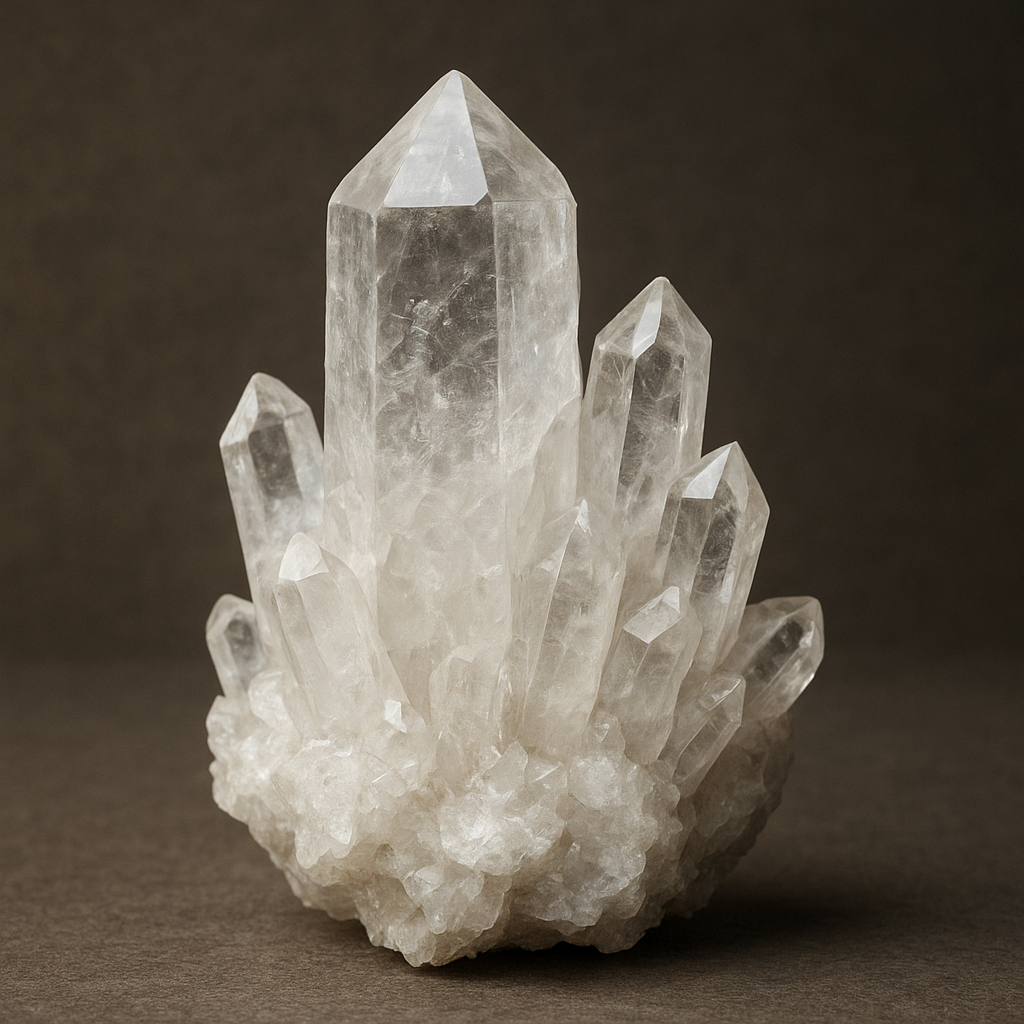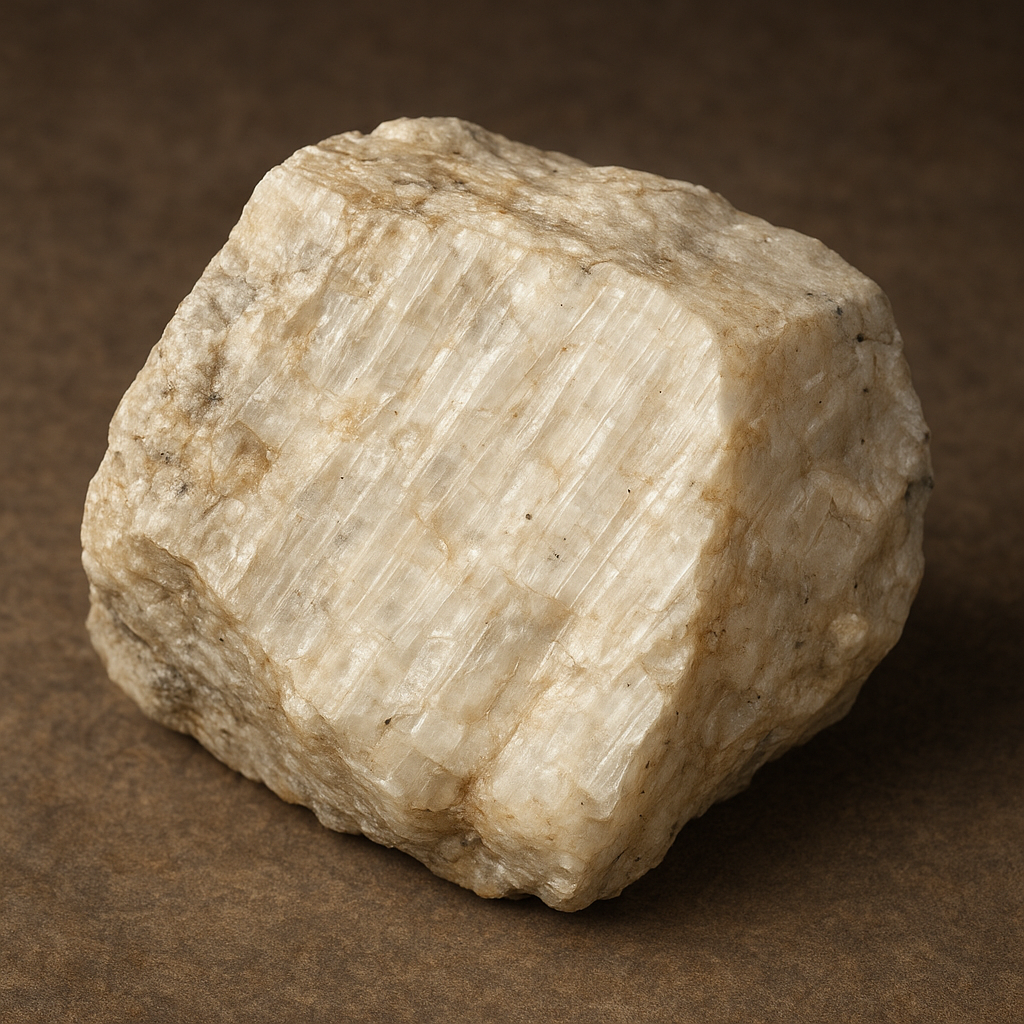
Oligoclase is a common and widely distributed member of the feldspar family that plays a central role in the makeup of the continental crust and in many human industries. It sits in the middle of the plagioclase solid-solution series and bridges the gap between sodium-rich and calcium-rich feldspars. The mineral’s physical appearance, its internal crystal chemistry, and its textural behavior in rocks carry important information for geologists, while its bulk properties make it a useful industrial raw material. Below are detailed sections that describe what oligoclase is, where it is found, how to recognize it, and how it is used — together with some interesting scientific and cultural notes connected to the mineral.
Composition, Structure, and Diagnostic Properties
oligoclase belongs to the plagioclase series of feldspars, a group characterized by a continuous solid solution between the sodium end-member albite (NaAlSi3O8) and the calcium end-member anorthite (CaAl2Si2O8). Oligoclase is defined compositionally by a molar percentage of anorthite (An) of roughly An10–An30, meaning it contains substantially more sodium than calcium but a measurable calcium component as well. The general chemical formula may therefore be written as (Na,Ca)(Si,Al)4O8, with sodium dominating the cation site.
Crystallographically, plagioclase feldspars, including oligoclase, are triclinic and typically form tabular or lath-shaped crystals. Two prominent sets of cleavage at nearly 90° are characteristic, although cleavage in oligoclase is often less perfect than in some alkali feldspars. The mineral’s luster is vitreous to pearly on cleavage surfaces, and it ranges from colorless to white, gray, or pale shades of pink, green, or yellow depending on trace impurities.
Optically, plagioclase shows polysynthetic twinning — a fine series of lamellae visible as striations under the microscope — most commonly albite-type twinning. Other twins, such as pericline or simple Carlsbad twins, can occur depending on the precise composition and thermal history. In thin section, oligoclase exhibits characteristic extinction angles and zoning patterns that reflect its sodium–calcium composition and growth history. Typical hardness on the Mohs scale is about 6–6.5, and specific gravity is approximately 2.63–2.66, values that are useful in field identification.
Geological Occurrence and Textural Behavior
Oligoclase is extremely common in continental crustal rocks and appears in a variety of geological environments:
- Igneous rocks — It is a major constituent of many intermediate to felsic igneous rocks such as igneous granites, granodiorites, syenites, and many volcanic and hypabyssal rocks like andesites and dacites. Oligoclase commonly forms as early to intermediate magmatic feldspar and can display compositional zoning that preserves magmatic conditions during crystallization.
- Metamorphic rocks — In medium- to high-grade metamorphic rocks such as gneisses and schists, oligoclase may form as a stable plagioclase phase in response to pressure–temperature conditions. Its presence and composition help petrologists constrain metamorphic P–T histories, making it a useful index mineral in regional metamorphism studies.
- Pegmatites and hydrothermal systems — Large plagioclase crystals, including oligoclase, can grow in pegmatites and in hydrothermal veins, though pure alkali feldspars and albite are often more common there. Exsolution textures and perthitic intergrowths may be present in slowly cooled intrusions.
- Skarns and contact-metamorphic assemblages — Calcium-bearing plagioclase compositions closer to oligoclase can appear in skarn systems where metasomatic reactions generate mixed Na–Ca feldspars.
Texturally, oligoclase frequently records complex histories. Compositional zoning (core-to-rim variation in An content) provides clues to changing magma chemistry, and exsolution lamellae may appear when feldspars unmix during cooling. Polysynthetic twinning produces the familiar microscopic striations that help distinguish plagioclase from other feldspars. Weathering of oligoclase commonly leads to gradual alteration to clay minerals such as kaolinite or illite, producing soils and sedimentary detritus that contribute to landscape development and nutrient cycles.
Identification Techniques: Field, Hand-Specimen, and Microscope
Recognizing oligoclase involves combining field observations with laboratory methods. In hand specimen, look for tabular crystals or lath-like grains with two good cleavages meeting at near right angles and a glassy to pearly sheen on cleavage surfaces. Fine parallel striations on crystal faces or cleavage surfaces strongly indicate plagioclase rather than alkali feldspar.
- Field tests — Hardness and specific gravity are moderately diagnostic. A streak test yields a white streak. The occurrence within a rock type (for example, in a granodiorite) narrows the likely plagioclase composition to oligoclase or nearby members of the series.
- Petrographic microscope — Thin-section study is the standard method for confident identification. Under crossed polarizers, look for twinning (albite polysynthetic), zoning, and characteristic extinction angles. Oligoclase often shows moderate birefringence and distinctive optical behavior that separates it from both albite and more calcic plagioclase.
- Electron microprobe and X-ray diffraction — Quantitative chemical analysis (microprobe) yields precise Na/Ca ratios to place a plagioclase precisely on the albite–anorthite scale. XRD can confirm crystal structure and detect ordering/disordering states and intergrowths.
Experimental techniques such as fluid-inclusion analysis, cathodoluminescence, and Raman spectroscopy are sometimes applied to oligoclase to extract details about growth conditions, trace-element zoning, and thermal history. Because oligoclase often records magmatic processes, careful textural and compositional study can reconstruct crystallization rates, magma mixing events, and cooling histories.
Industrial Uses and Economic Importance
Feldspars as a group are one of the most important industrial minerals. Although industrial products generally use feldspar concentrates without separating individual plagioclase species, oligoclase contributes to many applications through its physical and chemical properties:
- ceramics and glass — Feldspar acts as a flux in ceramic and glass manufacture, lowering the melting point of the mixture and helping control viscosity and final product properties. Oligoclase-bearing feldspar ores are ground and blended into glazes, sanitaryware, porcelains, and glass batches.
- Fillers and extenders — Ground feldspar is used as an inert filler in paints, plastics, rubber, and adhesives. Its hardness and chemical stability make it valuable where abrasion resistance and dimensional stability are required.
- Abrasives and polishing — In some formulations, feldspar contributes to mild abrasive and polishing compounds for glass and metal finishing.
- Aggregate and construction — Oligoclase-bearing rocks such as granites and gneisses are quarried for construction aggregate and ornamental stone. Some polished oligoclase-rich stones are valued for architectural and decorative purposes.
While industrial demand usually targets feldspar as a bulk commodity, certain high-quality plagioclase crystals may be desirable to collectors and lapidary artists. In addition, understanding oligoclase distribution and abundance in potential mining districts is important for evaluating the economic viability of feldspar deposits.
Gemstone and Aesthetic Varieties
Although not as famous as some alkali feldspars, oligoclase can produce attractive gem material. Two gem-related phenomena often associated with feldspars can involve oligoclase:
- Adularescence (moonstone effect) — Subtle chatoyant or floating light phenomena commonly attributed to thin-layered intergrowths of feldspar can occur in oligoclase. Feldspar displaying this soft glow is marketed as moonstone when the effect and clarity are adequate. Moonstone is more frequently orthoclase or adularia, but plagioclase members including oligoclase can also show the phenomenon.
- Aventurescence and iridescence (sunstone and schiller) — Tiny plate-like inclusions of hematite, copper, or other minerals that align within the feldspar can produce glittering reflections, creating the attractive “sunstone” effect. Some oligoclase specimens exhibiting aventurescence are faceted or cabochon-cut and used as gems or cabochons.
Examples of commercial or collector interest include some Oregon feldspars that exhibit attractive aventurescence due to native copper or copper oxides and feldspars from various locales that show adularescence. While oligoclase gems are not as widely known as top-grade orthoclase moonstones or high-quality labradorite, they do appear in the market and are appreciated by collectors for unique optical properties.
Scientific Importance and Research Uses
Oligoclase is more than a common rock-forming mineral; it is a recorder of geological processes. Petrologists exploit its composition and textures to interpret magmatic and metamorphic histories in several ways:
- Thermobarometry and geothermometry — Compositional zoning in plagioclase can indicate changes in temperature and melt composition during crystallization. Paired with other mineral chemistry, oligoclase compositions help estimate the conditions under which rocks formed.
- Diffusion and timescale constraints — Chemical diffusion profiles in zoning patterns offer constraints on cooling rates and the timescales of magmatic events. High-precision microanalytical techniques enable the derivation of timescales for magma mixing and crystallization episodes.
- Tectonic and crustal evolution — Because plagioclase is abundant in continental crustal rocks, its composition and abundance are used in large-scale studies of crustal differentiation, magma genesis, and tectonic settings.
- Paleoweathering and soil studies — The weathering products of oligoclase contribute to clay mineralogy and soil chemistry studies. Rates and pathways of feldspar breakdown influence nutrient release (e.g., potassium, sodium) and soil development over geological time.
In experimental petrology, synthetic and natural oligoclase compositions are used to study phase equilibria, diffusion, and the effects of pressure and volatile content on crystallization. The mineral’s sensitivity to composition and temperature makes it a useful monitor in laboratory studies that aim to recreate natural magmatic systems.
Alteration, Weathering, and Environmental Considerations
When exposed at Earth’s surface, oligoclase weathers chemically and physically. Hydrolysis of feldspar in soils and regolith transforms primary plagioclase into secondary clay minerals such as kaolinite, illite, and smectite, releasing silica and cations (Na, Ca, Al) into solution. These products affect soil chemistry, water quality, and sediment composition. In rock weathering profiles, plagioclase dissolution often controls the rate at which bedrock disintegrates and soils develop.
From an environmental and industrial standpoint, feldspar mining (including deposits containing oligoclase) must consider potential dust generation, landscape disturbance, and water management. Beneficiation processes to concentrate feldspar and remove unwanted minerals require careful handling of tailings and effluents. Modern mining practices typically include dust suppression, progressive reclamation, and water treatment to minimize environmental impacts.
Interesting Historical and Cultural Notes
The feldspar group has played a quiet but influential role in human history. As components of granite and other building stones, plagioclase-bearing rocks have been used in monuments, buildings, and paving for centuries. Polished oligoclase-bearing stones can take a pleasing sheen, which has made certain varieties valuable for ornamental stone.
In mineralogical history, the detailed study of plagioclase series compositions and twinning patterns helped advance crystallography and optical mineralogy. The recognition that plagioclase is a continuous solid solution between albite and anorthite informed early chemical and structural models of mineral solid solutions and contributed to the development of quantitative mineral chemistry.
Tips for Collectors and Students
If you are a rockhound or student learning to identify feldspars, keep these practical tips in mind:
- Look for striations — Fine parallel striations on cleavage surfaces are a quick field clue to plagioclase rather than alkali feldspar.
- Observe context — The rock matrix and associated minerals give useful hints: oligoclase is typical in granodioritic and andesitic contexts.
- Prepare thin sections — Under a polarizing microscope the twinning, zoning, and extinction angles become apparent and allow accurate placement on the plagioclase series.
- Use portable tools carefully — Refractometers and simple hardness kits can help in the field, but laboratory microprobe analysis is definitive for precise An percent determination.
- Handle gem material with care — Cabochons showing adularescence or aventurescence should be cut and polished to preserve optical effects; these stones can be brittle and are best set in protective jewelry settings.
Whether approached as an industrial resource, a gemstone curiosity, a subject of academic study, or a favorite specimen in a rock collection, oligoclase is a mineral whose varied manifestations link deep-earth processes to surface environments and human uses. Its presence in everyday rocks and in specialized applications makes it an accessible and instructive mineral for both professionals and amateurs.