
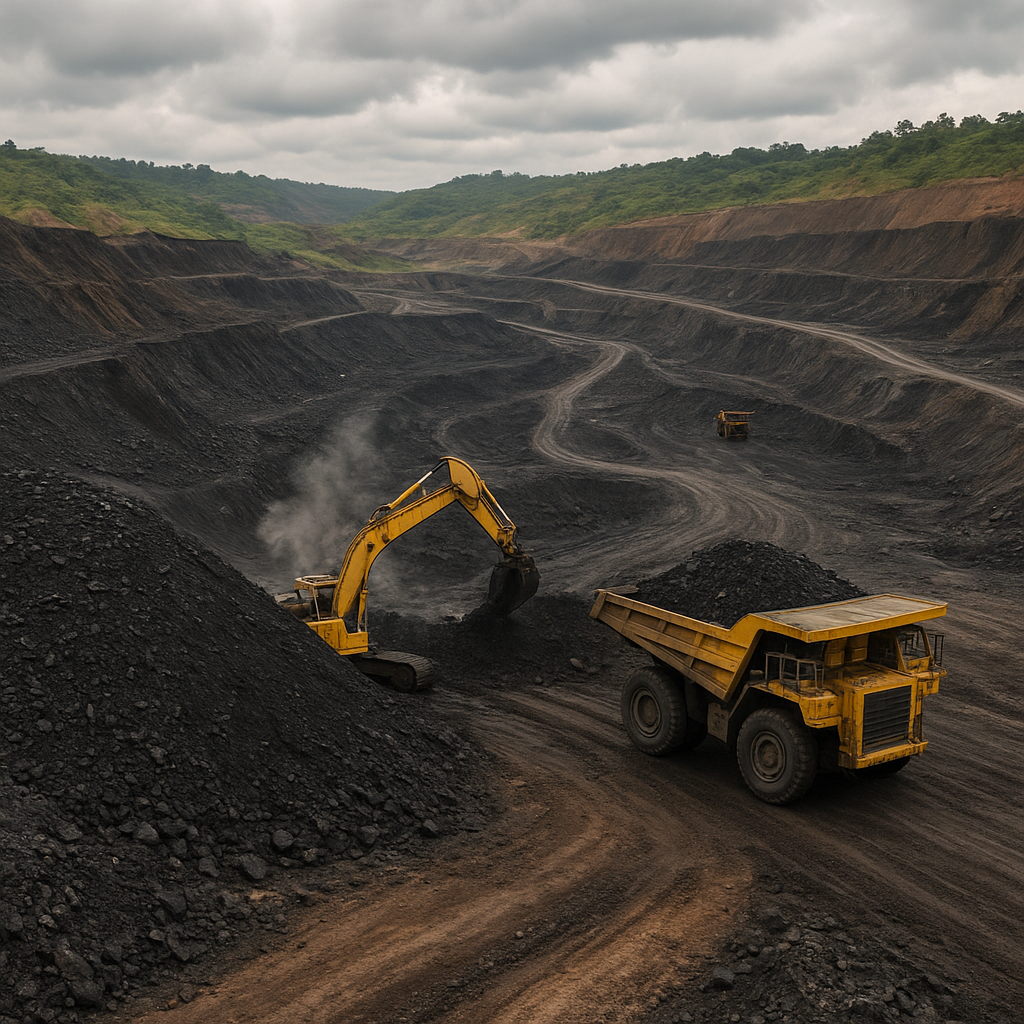
The Okaba mine occupies an intriguing place in the story of coal in West Africa. Located within Nigeria’s coal-bearing belt, the site represents both the legacy of early industrial mining in the country and a possible node for renewed energy and industrial activity. This article examines the mine’s location and geological setting, the type and uses of coal extracted there, its economic importance at local and national levels, and several interesting facets that make Okaba notable for historians, geologists and policy planners alike.
Location and geological setting
The Okaba mine lies within the broad coal-bearing provinces of southeastern and central Nigeria, an area that includes several basins known for significant coal accumulations. These basins—most famously the Enugu and Anambra Basin systems—consist of sedimentary sequences deposited during the Late Cretaceous to early Tertiary intervals. Coal seams occur in fluvial to deltaic strata where organic-rich layers were buried and transformed under appropriate pressure and temperature conditions.
The mine’s position in this coal belt places it among a string of deposits historically exploited for domestic industry and, at times, for export. The local geology at Okaba typically shows alternating sandstone, siltstone and shale horizons with discrete coal seams ranging in thickness. Although seam thickness and quality vary from one location to another, the general pattern is consistent with the rest of Nigeria’s coalfields: multiple workable seams separated by clastic sediments. This geological context underpins both the extractability and the character of the product mined.
Regional transportation and access
Access to the Okaba mine is shaped by the broader transport network in southern Nigeria. Historically, coalfields benefited from rail links built to move coal to ports or to industrial centers; today, the state of such infrastructure can determine whether a mine remains commercially viable. Proximity to roads, potential rail corridors and ports affects the economics of moving bulk coal for domestic power plants, cement factories, steelworks or international markets. Infrastructure constraints have been a recurring theme in the fortunes of many Nigerian mining operations, including Okaba.
What is extracted at Okaba
At Okaba the principal commodity is coal, a fossil fuel composed primarily of carbon along with variable amounts of hydrogen, oxygen, sulfur and mineral matter. The coals mined across the Nigerian belt are generally in the range from sub-bituminous to bituminous rank, which makes them suitable for thermal uses—burning for heat and steam—and, in some cases, for industrial feedstocks after appropriate processing.
- Thermal coal: Used to generate electricity and steam in industrial processes. Okaba’s coals are typically suited to thermal applications, although variability in heating value and ash content affects burn characteristics.
- Coking and metallurgical potential: While most Nigerian coals are not classic hard coking coals, selective seams and processed blends can sometimes be used as partial substitutes in steelmaking or in sintering processes after beneficiation.
- Industrial feedstock: Coal can be converted into coke, coal tar, and chemical precursors; smaller-scale processing near the mine can add value beyond raw coal sales.
Local variability in calorific value, ash percentage, moisture and sulfur content determines how coal from Okaba is handled commercially. Beneficiation—washing and sizing—can improve product quality, lower transportation costs per unit of energy, and reduce environmental impacts when the coal is burned.
Economic significance
The economic importance of Okaba’s coal is multi-layered. At the most immediate level it provides direct jobs for miners, supervisors and technical staff, and it supports ancillary employment in transport, equipment maintenance, and services. On a municipal and regional scale, mining can inject investment into local businesses, stimulate demand for housing and clinics, and increase revenues for local authorities through licensing and royalties.
National energy and industrial roles
Coal has historically been a component of Nigeria’s energy mix: it fueled early railways, supported local industries, and powered steam plants. In contemporary terms, coal from Okaba could serve several strategic objectives:
- Fuel for power generation: Coal-fired plants or smaller modular thermal stations can use locally mined coal to augment electricity supply in regions with limited grid access.
- Feedstock for industry: Cement plants, brickworks and certain chemical processes can use coal as an energy source or raw material.
- Export revenue: If economics and logistics permit, higher-quality coal can be moved to coastal ports for export, bringing foreign exchange into Nigeria’s economy.
Economic multiplier effects also include potential stimulation of rail and port investment, if governments and private investors see a viable corridor for bulk commodity transport. Reviving or expanding mine operations can therefore intersect with broader development plans for infrastructure and industrialization.
Challenges to realizing economic potential
Several constraints temper the economic promise of Okaba and similar mines. These include:
- Infrastructure deficits—roads, rails and reliable power—that raise extraction and transport costs.
- Competition from cheaper fuels—natural gas and imported coal—on certain markets.
- Financing and investment risks associated with commodity price volatility and regulatory uncertainty.
- Environmental and social costs that, if not addressed, can lead to community opposition or regulatory restrictions.
Addressing these hurdles often requires coordinated policy, public-private partnerships, and long-term planning so mining wealth translates into sustainable regional development.
Environmental and social aspects
Mining at Okaba, as elsewhere, carries environmental and social consequences that must be managed. Coal extraction disturbs land, can affect water tables, and may generate dust and runoff that impact agriculture and human health. The release of greenhouse gases when coal is combusted adds to climate change concerns, an aspect that shapes public and investor perceptions of coal projects globally.
Sustainable practices and mitigation
Improvements in mining methods, stricter environmental controls and post-mining land rehabilitation can substantially reduce negative outcomes. Key mitigation strategies include:
- Implementation of modern extraction techniques that limit surface impact and reduce waste.
- Water management systems to prevent contamination of streams and groundwater.
- Progressive reclamation—restoring disturbed lands during the life of the mine rather than only after closure.
- Air quality controls, dust suppression and improved handling to limit community exposures.
- Community engagement programs that ensure local people benefit from employment, infrastructure and social investments.
Where investment allows, integration of sustainability measures such as methane capture, high-efficiency combustion technologies and even carbon offsetting can reduce the mine’s carbon footprint and align its operations with evolving environmental standards.
Historical and cultural significance
Coal mining has left an imprint on local cultures across Nigeria: towns grew up around mines, rail lines were laid, and a mining workforce developed distinct skills and social networks. Okaba’s mine is part of this heritage. Mining sites often preserve memories of an early industrial era—work songs, local culinary adaptations, and multi-generational employment patterns. Understanding and documenting this intangible heritage is as important as managing the physical landscape.
Heritage tourism and interpretation
In places where mining infrastructure or historical artifacts remain, there is potential to create interpretive trails, small museums or heritage centers that recount the story of coal in the region. Such initiatives can diversify local economies, attract researchers and visitors, and foster pride in a community’s historical role in national development.
Interesting facts and lesser-known angles
- Historical linkage: Coal mining was one of the early large-scale extractive industries that tied some Nigerian communities to national and colonial-era infrastructure projects.
- Geological diversity: Coal seams in the region show variability, meaning targeted exploration can sometimes find higher-quality pockets useful for specialized industrial uses.
- Small-scale mining: Artisanal miners often operate in the periphery of larger concessions, providing livelihoods but also posing safety and environmental challenges that formalization could address.
- Potential for value addition: On-site processing, briquetting or partial gasification can create higher-value products that are easier to transport and store than raw run-of-mine coal.
- Strategic role: In scenarios where domestic gas supply or grid expansion is constrained, local coal reserves like Okaba can be part of interim strategies to improve energy access—if done with modern emissions controls.
- Scientific value: Coal-bearing strata preserve plant fossils and records of ancient environments; detailed study of Okaba’s seams can therefore inform paleobotanical and climatic reconstructions.
Prospects and policy considerations
Looking forward, Okaba’s prospects depend on a mix of technical, economic and policy choices. Priority actions that can influence outcomes include strengthening regulatory clarity for miners, investing in transport and processing infrastructure, encouraging responsible mining practices through incentives and enforcement, and exploring market niches for higher-quality, processed coal products.
At a national level, decisions about how to balance energy security, climate commitments and industrial development will shape whether coal projects receive renewed attention. For local stakeholders, the emphasis is likely to remain on creating tangible community benefits—jobs, services and environmental safeguards—so that mining activities translate into durable development gains.
Practical considerations for researchers and investors
Anyone seeking detailed technical or commercial information about Okaba should consult a mix of sources: geological surveys, government mining agencies, local land records, and on-the-ground exploration reports. Important data points include seam thickness, calorific value, ash and sulfur content, hydrology and local infrastructure capacity. Environmental impact assessments and community consultations are essential parts of any credible development plan.
Investment decisions should account for price volatility in international coal markets, potential tariffs and logistical costs, and the evolving regulatory landscape related to emissions and land use. Collaboration with local authorities and communities reduces social risk and can speed permitting and operational arrangements.
Note: Exact operational status, production figures and ownership structures for specific mines like Okaba can change over time. For the most current, site-specific details, primary sources such as official government registries, current concession documents and recent field assessments are the best references.
Okaba’s mine thus sits at the intersection of geology, history and contemporary development choices. Whether it becomes primarily a source of local jobs and industrial fuel, a node for value-added processing, or a site of careful environmental stewardship depends on the strategic decisions made by local leaders, investors and policymakers in the coming years.

