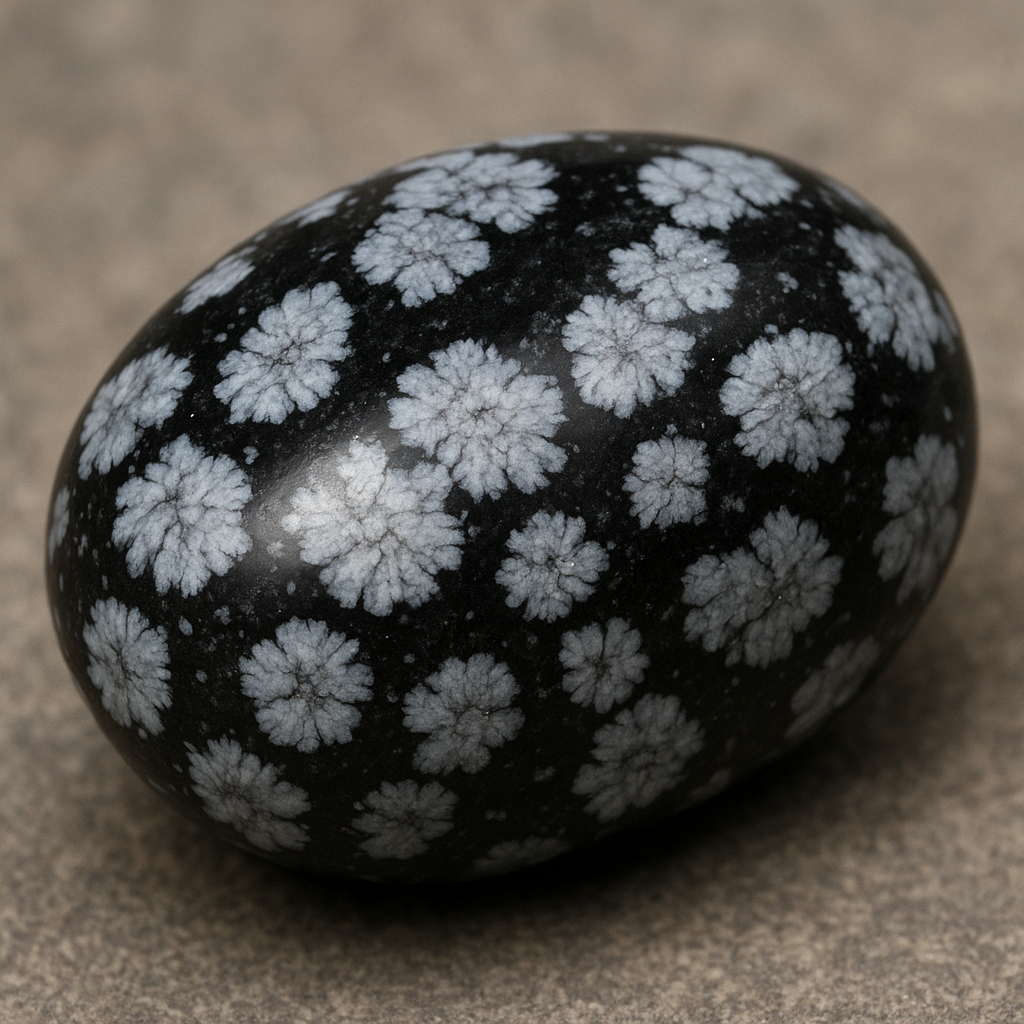
The mineral known as Snowflake Obsidian is a striking variety of volcanic glass that draws attention for its monochrome contrasts: deep, mirror-like black interrupted by delicate, flower-like white patches. Those patterns are not surface decorations but internal structures formed during the rock’s cooling and alteration. This article explores the origin, distribution, practical uses and cultural associations of Snowflake Obsidian, and highlights intriguing scientific and historical facets that make this stone both beautiful and useful.
Geology and Formation: How Snowflake Obsidian Comes to Be
At its core, Snowflake Obsidian is natural glass produced by rapidly cooled volcanic melts rich in silica. The parent material is obsidian, an amorphous and typically glassy rock formed when high-silica lava cools so quickly that crystals cannot grow. Snowflake Obsidian acquires its characteristic pattern through a process called devitrification — slow transformation of glass into crystalline phases over time — which produces small, radially arranged white crystals within the glassy matrix.
Crystalogy and chemistry
The white inclusions characteristic of the snowflake effect are commonly spherulites made up of cristobalite, a polymorph of silica (SiO2). During devitrification, silica migrates and crystallizes into tiny radiating aggregates. These aggregates scatter light differently than the surrounding black glass, producing the striking, snowflake-like contrast. The base material remains volcanic glass, predominantly silica with minor amounts of iron, magnesium and other trace elements that can influence color and opacity.
Physical properties
- Appearance: glossy black background with white to gray spherulitic patches.
- Hardness: about hardness 5–5.5 on the Mohs scale, softer than many gemstones but harder than many native metals.
- Fracture: conchoidal (shell-like), which leads to very sharp edges when fractured.
- Specific gravity: typically around 2.3–2.6, consistent with silica-rich glass.
- Structure: amorphous glass with crystalline inclusions; lacks a regular crystal lattice for the glass component.
The interplay of rapid cooling (to create glass) and later slow structural reorganization (to form cristobalite spherulites) is essential. Thus, Snowflake Obsidian represents a snapshot of both instantaneous and post-emplacement geological processes.
Where Snowflake Obsidian Occurs: Notable Deposits and Global Distribution
Obsidian forms wherever high-silica magmas are extruded and quenched quickly. Snowflake Obsidian, by requiring both glass formation and later devitrification, appears in specific environments worldwide. The stone is not restricted to a single continent; instead, it crops up in regions with a history of rhyolitic volcanism.
Well-known localities
- Mexico — Large obsidian sources in states such as Michoacán and Jalisco have produced both common and patterned varieties. Prehistoric Mesoamerican cultures prized local obsidian for tools and ritual objects.
- United States — Western states, including Utah, Oregon, California and New Mexico, host obsidian flows and deposits. Snowflake Obsidian is commonly collected from volcanic fields and older rhyolitic domes.
- Iceland — Young volcanic terrain with abundant glassy lavas provides occasional patterned obsidians.
- Central Asia and the Caucasus — Armenia and regions of Turkey preserve ancient obsidian sources exploited since the Neolithic.
- Japan and New Zealand — Island arcs with explosive rhyolitic eruptions sometimes yield interesting obsidian varieties.
- Italy (Aeolian Islands and Lipari) — Historic sources of volcanic glass used since antiquity.
Because Snowflake Obsidian forms by post-emplacement alteration, it is often associated with older, cooled obsidian flows or domes that have had time for devitrification to produce the distinctive spherulites. Prospectors and collectors look for weathered exposures, talus at the edges of old flows, and secondary deposits along slopes.
Uses: Practical, Aesthetic and Historical Applications
Snowflake Obsidian occupies a curious place between a functional material and an aesthetic object. Its unique look combined with glass properties has led to a range of applications spanning from prehistoric tools to contemporary art.
Traditional and prehistoric uses
- Tools and weapons: like other obsidians, Snowflake Obsidian can be knapped to produce extremely sharp edges. Prehistoric peoples used obsidian for cutting tools, scrapers, and projectile points.
- Ritual and symbolic objects: obsidian’s reflective qualities and black color carried symbolic weight in many cultures, used for mirrors and ritual blades in Mesoamerica.
Modern uses
- Jewelry and ornamentation: cabochons, beads, spheres and carved objects emphasize the contrast between black glass and white spherulites. Snowflake varieties are popular in contemporary artisan jewelry for their understated monochrome elegance.
- Lapidary and decorative arts: its polishability and attractive pattern make it a favorite for small sculptures, worry stones and inlays.
- Specialized blades: modern obsidian scalpels are crafted for experimental and microsurgical uses because freshly fractured obsidian edges can be significantly sharper than steel. In some niches, scalpels made from surgical obsidian provide extremely fine cuts with minimal tissue trauma; however, Snowflake Obsidian is used more often for decorative blades than standardized medical instruments.
- Collectors and museums: attractive specimens are sought after by mineral collectors, and exceptional pieces appear in natural history exhibits discussing volcanic processes and human use of volcanic glass.
While Snowflake Obsidian is not a mainstream industrial material, its cultural and artisanal value is high. Craftspeople prize stable patterns and avoid heavily fractured pieces to maintain the aesthetic integrity of the spherulites.
Identification, Treatment and Care
Distinguishing Snowflake Obsidian from other black stones or even synthetic glasses involves several approaches. Visual inspection, basic physical tests and knowledge of localities help ensure accurate identification.
How to recognize Snowflake Obsidian
- Look for the hallmark white spherulitic patches set against a glossy black matrix. These patches are typically radial and flower- or snowflake-like.
- Observe the luster: natural obsidian is glassy and vitreous; a resinous or dull luster may indicate weathering or imitation materials.
- Check fracture: a fresh broken surface displays conchoidal fracture with sharp edges, sometimes with tiny flow banding.
- Hardness and density: simple scratch tests can separate obsidian from much softer minerals; specific gravity tests can further help if necessary.
- Microscopic examination can reveal the internal structure of spherulites, confirming the presence of cristobalite or other devitrification products.
Treatments and fakes
Most Snowflake Obsidian is used unenhanced; however, low-quality glass imitations exist. Dyed glass, doublets (thin slices arranged over backing), and resin-stabilized pieces attempt to mimic natural patterns. Buyers are advised to purchase from reputable dealers and to ask about provenance.
Care and handling
- Avoid sharp impacts: while glass can be very sharp, it is brittle and can chip or break under strong impact.
- Clean with mild soap and water; avoid ultrasonic cleaners if the piece has fractures or insect inclusions.
- Keep separate from harder gemstones to prevent abrasion; store in soft cloth or padded compartments.
- High temperatures can damage the glassy structure; avoid prolonged exposure to heat sources.
Cultural Significance and Symbolism
Obsidian in general carries a rich cultural legacy. Snowflake Obsidian, with its gentle white patterns against dark glass, has been adopted more recently into symbolic and metaphysical contexts.
- Metaphysical uses: practitioners often ascribe protective, grounding and balancing properties to Snowflake Obsidian. It is said to encourage reflection, inner calm and the removal of emotional blockages. These claims are cultural rather than scientific, but they have fueled the stone’s popularity in spiritual markets.
- Artistic use: jewelers and sculptors value the stone for its dramatic visual contrast. Its monochromatic palette fits well with modern minimalist aesthetics and with pieces that emphasize texture and form.
- Historical trade and technology: in premetal eras, obsidian was a high-value trade commodity. Snowflake Obsidian would have been just one of many patterned obsidians that travelers and tradespeople exchanged across regions for tools and ornamentation.
Interesting Scientific and Cultural Notes
Snowflake Obsidian exemplifies the layered stories that a single rock can tell: rapid cooling, later chemical rearrangement, human use and modern reinterpretation. A few particularly interesting aspects:
- Natural devitrification as a record of time: the spherulites within Snowflake Obsidian record thermal histories and the presence of fluids that can accelerate recrystallization. Studying these patterns gives volcanologists clues about post-eruption processes.
- Microscopically sharp edges: the same property that made obsidian valuable for prehistoric knappers makes it attractive today in specialized surgical research. An edge produced by conchoidal fracture can be only a few nanometers across, which is why obsidian scalpels sometimes outperform steel in experimental contexts.
- Trade and archaeology: obsidian source analysis using geochemical fingerprinting has been a transformative tool in archaeology, enabling researchers to trace ancient trade and migration by matching artifacts to volcanic sources. Snowflake Obsidian items in archaeological contexts can offer the same detective work when they originate from geochemically distinct sources.
- Modern lapidary trends: artisans sometimes pair Snowflake Obsidian with metals like silver or with contrasting stones (e.g., white agate) to emphasize the natural patterns. Laser engraving and precision cutting open new design possibilities while preserving the stone’s natural character.
Practical Advice for Collectors and Enthusiasts
If you are considering acquiring Snowflake Obsidian, keep these practical notes in mind:
- Buy from sources that disclose provenance and cutting practices. Good dealers will discuss whether a piece is natural, dyed or stabilized.
- Examine pieces for uniformity of pattern and for cracks or internal stresses that could cause breakage during cutting or setting.
- For jewelry, choose settings that protect thin edges or delicate forms; bezel settings or cabochon mounts are often safer than prongs for fragile glass.
- For lapidary work, wear eye protection: the glassy chips from knapping or grinding are sharp and potentially hazardous.
Snowflake Obsidian stands at the intersection of geology, craftsmanship and cultural imagination. Its simple palette belies complex origins and a wide range of human engagements, from utilitarian tools to contemporary jewelry and ritual use. Wherever it occurs, this patterned volcanic glass continues to fascinate both scientists and artists.