
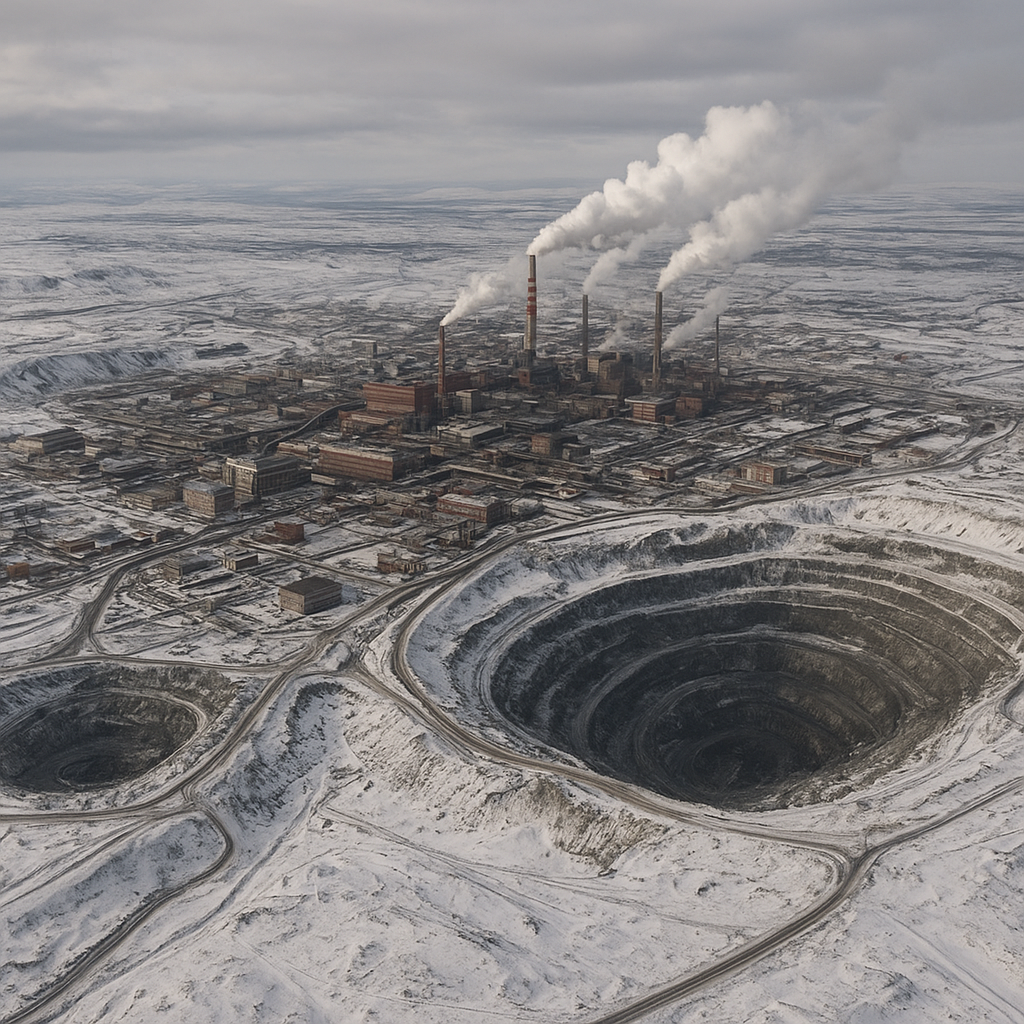
The industrial heartland of polar Siberia is dominated by an enormous mining and metallurgical complex often referred to collectively as the Norilsk-Talnakh area. Located above the Arctic Circle, this remote cluster of operations sits at the edge of the tundra and permafrost and has shaped regional life, global metal markets, and environmental debates for decades. The story of Norilsk and Talnakh is at once geological, economic, technological, and social — a nexus where the demand for strategic metals collided with some of the harshest environmental and human conditions on Earth.
Location, geology and physical setting
The Norilsk-Talnakh deposits are situated in northern Siberia within Krasnoyarsk Krai, in a zone that lies well inside the Arctic. The city of Norilsk and the adjacent settlements that service the mines are built near the Norilsk Range, with river access through the Yenisei basin and port facilities at Dudinka on the Yenisei River, which connect the complex to wider shipping routes during the ice-free months.
Geologically, the area contains one of the world’s largest concentrations of magmatic sulfide ores. These deposits formed in association with large mafic-ultramafic intrusions — massive bodies of igneous rock that crystallized from metal-rich magmas. When these magmas cooled and differentiated they concentrated sulfide minerals which trapped economically valuable elements. As a result the deposits host high concentrations of nickel, copper and a suite of platinum group elements including palladium. The stratigraphy and intrusive history give rise to both extensive near-surface orebodies and deep, high-grade underground deposits, permitting decades of extraction.
What is extracted: ores, metals and byproducts
The Norilsk-Talnakh complex is polymetallic. The main materials recovered and processed are:
- Nickel — a primary product used in stainless steel, specialty alloys and increasingly in electric vehicle batteries.
- Copper — recovered both as a main product and as an important co-product influencing the mine economics.
- Palladium and other platinum group elements — critical for catalytic converters, electronics and chemical applications.
- Secondary metals and elements such as cobalt, platinum, gold and varying quantities of iron and sulfur compounds.
The typical processing chain in the region moves from blasting and ore extraction (in both open-pit and underground settings) to crushing and flotation to produce concentrates, followed by smelting and refining. Large smelters convert concentrates into matte and refined metal products; the regional smelting infrastructure is a core part of the value chain and has been repeatedly modernized and expanded to respond to both technical challenges and environmental pressures.
Economic significance: local, national, global
At the local level, the mining complex is the dominant employer and the economic backbone of Norilsk and nearby settlements. The urban infrastructure, housing, transport and social services of the area have been built primarily to serve the needs of the extractive industry. The region operates with a high degree of vertical integration: mines, concentrators, smelters and shipping facilities are closely linked so that raw ore moves rapidly through the processing chain to market.
At the national level the complex is a strategic asset for Russia. Revenues from the extraction and sale of precious and base metals contribute substantially to exports and to the fiscal revenues of large industrial corporations. The metals produced in the Norilsk-Talnakh complex — notably nickel and palladium — occupy critical positions in global supply chains: nickel is essential for stainless steel and batteries, while palladium is central to automotive emission control technologies. Control over a significant share of these supplies gives geopolitical and economic leverage.
Globally, the complex is one of the leading sources of several strategic metals. Supply shocks, production disruptions or policy changes in this part of Siberia can reverberate through commodity markets, affecting prices for raw materials used by manufacturers worldwide. The concentration of production in a remote and climate-sensitive location adds an element of supply risk that global commodity strategists monitor closely.
Mining, processing and technical challenges
Operating in the polar environment imposes unique technical requirements and costs. The permafrost requires specially engineered foundations for heavy equipment, processing plants and housing. Seasonal cycles constrain shipping and logistics: river ports such as Dudinka operate intensively during the thaw season when the Yenisei is navigable, while supplies must be stockpiled for winter months when access is restricted.
Mining methods include large open pits where shallow deposits permit it, and extensive underground workings to access deeper, higher-grade ore. Processing challenges include managing the high sulfur content of ores — smelting releases sulfur dioxide if not properly captured and treated. Over time, operators have invested in gas treatment plants, sulfuric acid plants and emission-reduction technologies, although legacy emissions remain a concern.
Environmental and social impacts
The long history of intensive smelting and metallurgical activity has had severe environmental consequences. The region is notorious for high levels of airborne sulfur dioxide and metal particulates, which have caused widespread vegetation dieback and soil contamination over large tracts around the industrial center. Local lakes, rivers and tundra have been affected by metal-rich dust and wastewater discharges. These problems attract intense scrutiny from environmental scientists and international observers.
Permafrost thawing driven by climate change introduces additional risks. Thaw destabilizes infrastructure and changes hydrology, complicating tailings management and increasing the chance that contaminated materials could migrate into fresh waterways. The 2020 fuel spill and other high-profile incidents have underscored the fragility of industrial operations in the Arctic and prompted both domestic and international calls for stronger oversight and remediation efforts.
Socially the area has been shaped into a classic company-dominated town: housing, transport, medical care and cultural life were historically provided by the enterprise that ran the mines. The local indigenous populations, including Nenets and other northern groups, have experienced disruption to traditional livelihoods such as reindeer herding due to pollution and land use changes. The harsh climate, long polar night and social conditions have made recruitment and retention of a skilled workforce a persistent issue, addressed in part through higher wages and social incentives.
History, ownership and political context
The Norilsk-Talnakh complex has roots in Soviet industrialization projects of the early and mid-20th century, developed to secure domestic supplies of critical metals. Over decades the site grew into a large integrated complex with deep ties to central planning. In the post-Soviet era the corporate entity now known internationally as Nornickel (a shorthand for the major operator) consolidated much of the activity. Ownership and governance of this resource base have significant implications for industrial policy, export strategy and corporate responsibility debates in Russia.
Political considerations are important because the metals produced are strategically important. State and corporate motivations intertwine: securing export revenue, maintaining industrial employment in a remote region, protecting strategic mineral assets, and balancing environmental responsibilities — each of these has shaped decisions about investment in modernizing facilities, emission reduction and community support.
Interesting technical and historical details
- Many of the ores at Talnakh are associated with complex sulfide minerals that concentrate the nickel, copper and PGE elements together. This requires sophisticated metallurgical separation to recover multiple valuable products from the same ore stream.
- The scale of smelting operations historically produced some of the highest regional emission rates in the world, leading to a landscape around the smelters that in places resembles a moonscape due to extreme vegetation loss.
- Modernization programs in the 21st century have focused not only on productivity but also on emission control and resource efficiency, including the capture of sulfur to produce industrial-grade sulfuric acid rather than letting sulfur escape as atmospheric pollution.
- Talnakh ore bodies are often multi-level: superficial deposits fed open pits while enriched zones at depth have demanded elaborate underground mining networks, shaft systems and ore transport logistics adapted to sub-zero temperatures.
- The local climate, remoteness and infrastructure constraints make lifecycle planning — including tailings management and post-closure remediation — particularly challenging and costly.
Economic dynamics and market roles
Demand drivers for the key products are diverse. For nickel, stainless steel production remains a major user, but the growing electric vehicle industry has added a strategic dimension due to nickel’s role in many battery chemistries. For palladium, automotive catalytic converters have been the primary driver, and tightness in palladium markets can rapidly push prices upward, making production at Norilsk-Talnakh globally relevant.
Copper markets are sensitive to industrial activity worldwide; the co-production of copper with nickel and PGEs can provide economic resilience against price swings in any single metal. The integrated nature of the Norilsk-Talnakh complex — where multiple metals are produced simultaneously — means that production decisions take into account a basket of commodity prices, technical recovery rates and environmental compliance costs.
Remediation, modernization and future prospects
Facing both domestic policy pressure and international reputation concerns, operators have undertaken multi-year programs to reduce emissions, modernize smelters and improve waste handling. Advances include improved gas cleaning systems, sulfur capture and conversion to saleable products, upgrades to boilers and furnaces, and remote monitoring technologies. Investments aim to reduce the most visible forms of environmental degradation and to align production with evolving regulatory standards.
Nevertheless, the future is complex. The interplay of global metal demand, climate change impacts on Arctic infrastructure, geopolitical trade dynamics and rising expectations for corporate environmental and social governance will shape the next decades of activity. As demand for battery metals grows, the Norilsk-Talnakh deposits will likely remain strategically important, but continued investment and strict environmental controls will be necessary to manage long-term risks.
Notable anecdotes and curiosities
The Norilsk region has been described in literature and reportage as one of the world’s most isolated industrial hubs. Its combination of heavy industry and polar conditions has inspired accounts of human resilience and technological improvisation. The area’s smelters have historically produced such thick plumes of smoke and particulate that satellite imagery has been used to track environmental footprints decades ago. Efforts to green the operations — including programs to convert sulfur emissions into commercially useful acids and sulfates — represent interesting examples of turning pollutants into economic feedstocks.
Another compelling facet is the way local community life evolved around the mines. Sports teams, schools, cultural institutions and transport schedules have been historically synchronized with the rhythms of extractive production. At the same time, the challenge of reconciling the immediate economic benefits of mining with the long-term costs of environmental degradation and social disruption remains a persistent theme in the Norilsk-Talnakh narrative.
Key takeaways about Norilsk-Talnakh
- The region is one of the world’s major concentrations of magmatic sulfide ore, producing vital metals such as nickel, copper and palladium.
- Its operations are a cornerstone of the local economy and an important strategic asset for Russia in global metal markets.
- Environmental impacts from historic smelting activity have been severe, prompting costly remediation and modernization efforts.
- Operating in the Arctic involves substantial technical, logistical and climate-related challenges that influence both costs and long-term sustainability.
- The Norilsk-Talnakh story is a vivid example of how resource abundance, industrial ambition and environmental limits interact in a globalized economy.

