
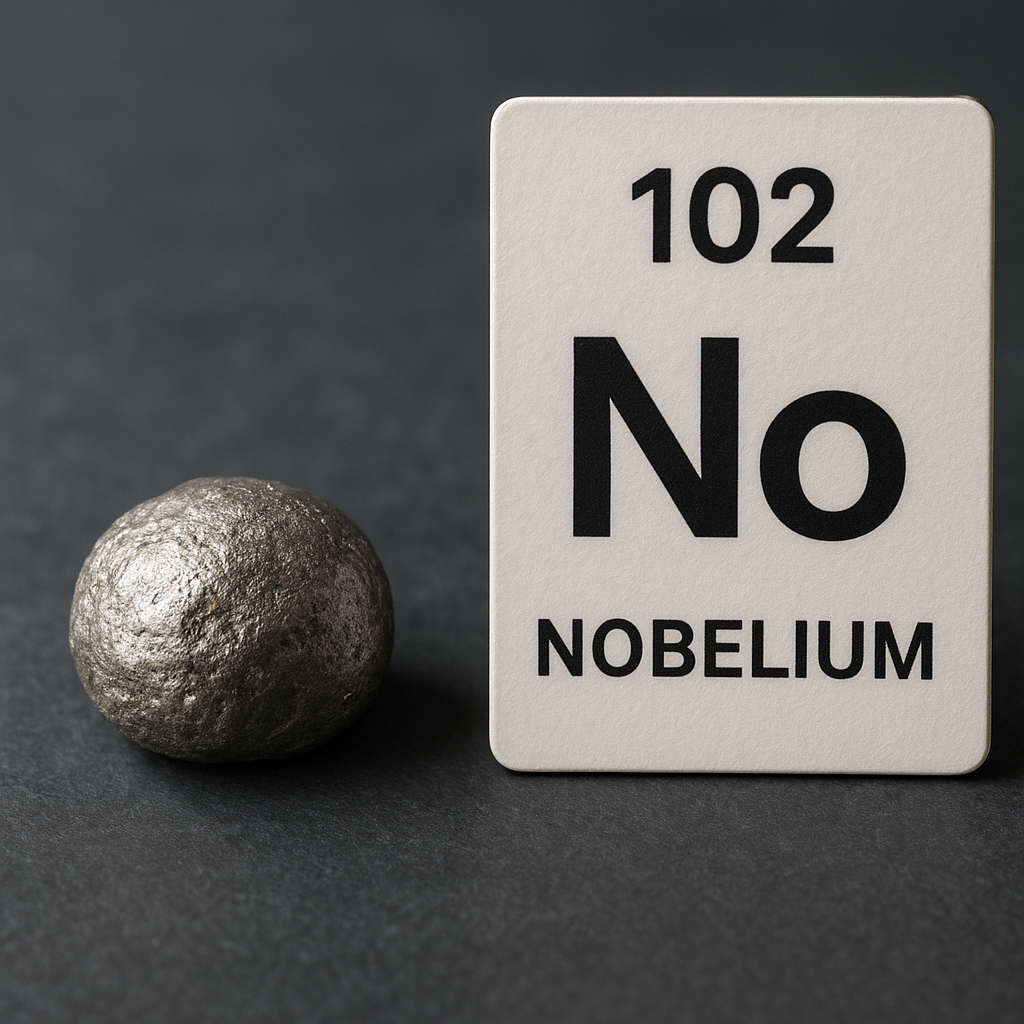
Nobelium is an intriguing member of the heavy elements, occupying a position at the frontier of synthetic chemistry and nuclear physics. As element number 102, it has fascinated researchers because of its placement among the late actinides, its complex production pathways, and the unusual chemical behavior it displays under extreme experimental conditions. This article explores where nobelium is found, how it is produced, what it tells us about the actinide series and atomic structure, and why it remains a subject of cutting-edge research despite having no commercial uses.
Discovery, Naming, and Historical Context
The discovery of what we now call nobelium took place during the era when laboratories around the world began pushing the limits of nuclear synthesis by bombarding heavy targets with accelerated ions. Throughout the mid-20th century, multiple teams reported the production of new heavy elements, and element 102 was among those that sparked debate and careful verification. Its name, chosen to honor Alfred Nobel, reflects the tradition of commemorating notable scientists or patrons in element nomenclature.
What distinguishes the discovery history of this element is not a single dramatic moment but rather a series of experiments and confirmations across a number of research centers. Laboratories in Europe, North America, and the former Soviet Union developed increasingly sophisticated techniques—such as recoil separators and on-line mass separators—to isolate tiny numbers of atoms and identify them through their decay signatures. These identification methods relied on precise measurements of emitted particles and characteristic decay chains, since only microscopic quantities of nobelium can be produced in any single experiment.
Within the context of the periodic table, nobelium marked an important data point for the late actinides. Its properties helped refine theoretical models of electron configuration, especially the behavior of the 5f electrons and the role of relativistic effects in heavy elements. The name nobelium (symbol No) serves as both a tribute and a reminder of the international, collaborative nature of modern atomic research.
Physical and Nuclear Properties
As a heavy synthetic element, nobelium has no stable isotopes. All known isotopes are radioactive, decaying by a combination of alpha emission, spontaneous fission, and in some cases electron capture or other modes. The isotopes of nobelium that have been characterized have mass numbers roughly in the range of about 250 to 260, with differing half-lives that span from fractions of a second to less than an hour. The most long-lived isotope identified to date is isotopes such as No-259, which has a half-life on the order of tens of minutes, allowing detailed chemical experiments to be performed in specialized laboratories.
Atomic number 102 places nobelium near the end of the actinide series, where strong relativistic effects reshape expected electronic structures. Those effects, combined with the filled 5f shell seen in nobelium’s ground-state electron configuration, result in subtle but important deviations from the chemical trends observed in lighter actinides. In particular, nobelium shows a pronounced tendency toward the +2 oxidation state in many experimental contexts, distinguishing it from the more commonly trivalent behavior found across much of the series.
Key nuclear properties of nobelium isotopes—such as decay energies, branching ratios, and half-lives—are determined experimentally by detecting emitted alpha particles and fission fragments. These measurements are the backbone of identifying which isotopes are present after a synthesis reaction, and they provide input for nuclear models that explore shell closures, pairing interactions, and deformation effects in very heavy nuclei.
Occurrence and Methods of Production
Nobelium does not occur naturally in any measurable abundance. Its production requires high-energy nuclear reactions in dedicated facilities. The element is manufactured by creating heavy-ion collisions between a lighter projectile and a heavy actinide target; the colliding nuclei fuse briefly and then evaporate neutrons, producing isotopes of nobelium among other reaction products. Production yields are extremely low: experiments typically generate only a few atoms to perhaps a few thousand atoms over many hours or days of beam time.
Common laboratory approaches to make nobelium include fusion-evaporation reactions using projectiles such as carbon, oxygen, neon, or magnesium aimed at targets like uranium, plutonium, curium, or californium. After formation, products are separated from the unreacted beam and other reaction residues using techniques like gas-filled separators, electromagnetic recoil separators, or rapid chemistry lines coupled to mass separators. These methods reduce background and allow scientists to register the decay sequences of single atoms.
- Production facilities: Major centers involved in nobelium research have included the Joint Institute for Nuclear Research (Dubna), Lawrence Berkeley National Laboratory (Berkeley), Gesellschaft für Schwerionenforschung (GSI, Germany), and RIKEN (Japan).
- Separation and detection: The ability to link a detected alpha particle to a specific implanted recoil nucleus within a detector array is essential. Rapid chemical separation techniques are often combined with detector arrays to study chemical properties before radioactive decay occurs.
Because of the very low production rates, experiments need long run times, intense beams, and highly optimized separation setups. The logistical and technical demands of producing nobelium make each new experimental observation an achievement of accelerator technology, separation chemistry, and detector science combined.
Chemistry and Bonding Behavior
Studying the chemistry of nobelium is challenging but scientifically valuable. Experiments target the determination of oxidation states, complex formation, and volatility, often using on-line chemistry methods that react newly formed atoms within milliseconds to seconds to probe their behavior. One of the most striking findings in nobelium chemistry is its preference for a +2 oxidation state (No2+) under a variety of conditions—an unusual trait for actinides but one that mirrors the behavior of some heavy lanthanides in certain cases.
This tendency toward divalency is attributed to the particularly stable electronic configuration associated with a filled 5f shell (5f14). When electrons are removed to form cations, forming No2+ leaves a core that is relatively stable energetically. As a consequence, nobelium can form compounds and complexes that differ from those of neighboring actinides, and comparative chemistry experiments often contrast No with elements like fermium (Z=100) and lawrencium (Z=103) to discern systematic trends.
Researchers have used techniques such as ion-exchange chromatography, solvent extraction, and gas-phase thermochromatography to probe the chemical properties of nobelium. Observations include volatility measurements and complexation behavior with common ligands. Because of the short half-lives, many experiments use tracer techniques: a tiny amount of nobelium atoms is passed through a chemical system and their distribution is measured by detecting the characteristic decay events at different points in the apparatus.
Applications, Roles in Fundamental Science, and Related Topics
There are no practical or commercial applications for nobelium. The element’s significance lies squarely within fundamental science. Studies of nobelium contribute to several important areas:
- Understanding electron shells in very heavy atoms: Observing how nobelium behaves chemically helps validate theoretical models that incorporate relativistic corrections and electron correlation effects.
- Probing nuclear structure: Measurements of decay properties and the production cross-sections help refine models of nuclear stability, shell closures, and the pathway toward the hypothesized island of stability for superheavy elements.
- Method development: Experimental techniques invented or perfected for nobelium work—rapid chemistry, single-atom detection, advanced separators—are directly applicable to the synthesis and study of even heavier elements.
Researchers have also used isotopes of nobelium as stepping stones in the synthesis of heavier nuclei. By understanding production cross-sections and decay chains, scientists can design experiments that may extend the periodic table further. Studies of nobelium further intersect with broader topics such as nuclear astrophysics (formation pathways of heavy nuclei), materials science (radiation effects), and the development of instrumentation capable of operating under extreme conditions.
Experimental Challenges and Safety Considerations
Work with nobelium is subject to strict safety and technical constraints. Experiments are carried out in heavily shielded facilities with rigorous radiological controls. Because only tiny amounts of the element are produced, contamination risks are low in terms of mass, but the radioactivity demands careful remote handling and monitoring. Personnel operate detectors, separators, and chemical systems from behind shielding and often rely on robotic or remotely actuated systems to manipulate targets and transfer materials.
The short half-life of many nobelium isotopes creates a race against decay: chemical separations and measurements must be completed rapidly, sometimes in seconds or minutes, to capture meaningful data. This has driven innovation in fast chromatography, gas-phase chemistry rigs that can work on millisecond timescales, and detectors that can correlate implantation events with subsequent decays with high temporal resolution.
From a regulatory standpoint, research laboratories follow national and international guidelines for handling and disposing of radioactive materials. Radioactive waste streams are minimized and handled by specialist teams to ensure environmental and personnel safety. Due to the lack of practical uses, there is no industrial-scale production or distribution of nobelium; all work remains within a small global network of specialized research centers.
Interesting Scientific Insights and Broader Connections
Despite its ephemeral existence in the laboratory, nobelium has yielded insights that resonate far beyond the handful of atoms produced in an experiment. Its electronic structure challenges simplified periodic trends and highlights the importance of relativistic physics in chemistry. Nobelium’s chemical preference for the +2 state underscores how small energetic differences in electron shells can shift dominant oxidation states, affecting bonding and reactivity.
Another compelling aspect is how nobelium experiments illuminate the limits of experimental technique. The ability to identify single atoms, track decay chains, and perform rapid separations at the edge of detectability represents an impressive convergence of nuclear physics, chemistry, engineering, and computation. These methods have broader implications for fields that require trace detection and manipulation—ranging from environmental radioisotope monitoring to the development of sensors capable of operating under harsh conditions.
Finally, the cultural resonance of the name nobelium—linked to Alfred Nobel and the idea of rewarding scientific achievement—serves as a poetic reminder that even the most transient elements can contribute lasting knowledge. The pursuit of nobelium research exemplifies how curiosity-driven science explores extremes of matter and energy, expanding our grasp of nature at its most extreme scales.