
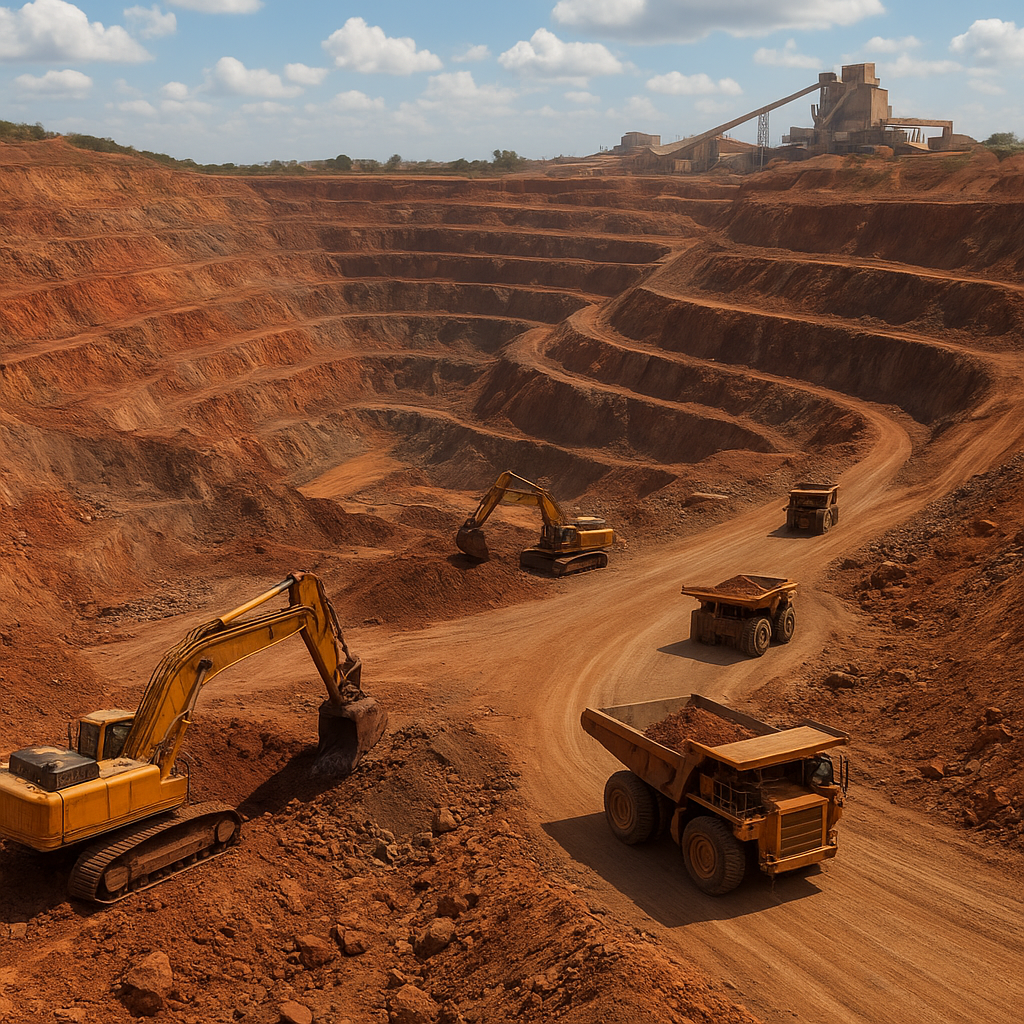
The Nkana Mine complex, located in the heart of the Zambian Copperbelt, is one of Africa’s most historically significant and productive copper mining areas. For decades it has shaped the economy, landscape and communities of northern Zambia. This article explores where the mine is, what is extracted there, how it has developed over time, its economic importance and several notable or surprising aspects of the site that illustrate the complex interplay between geology, industry and society.
Location and geological setting
The Nkana mining complex sits on the western outskirts of the city of Kitwe in central-northern Zambia. Kitwe is one of the principal urban centers of the country’s historic Copperbelt region, a continuous province of copper- and cobalt-bearing strata that stretches along the border with the Democratic Republic of Congo. The Copperbelt hosts some of the world’s largest sediment-hosted stratiform copper deposits, formed in Paleoproterozoic to Mesoproterozoic sequences.
Nkana itself is a complex of closely spaced orebodies and processing facilities rather than a single isolated pit. The orebodies occur as stratiform to semi-tabular layers within a sequence of dolomites, cherts and shales that were enriched by hydrothermal fluids and then modified by later burial and deformation. The mineralization at Nkana is typical of the Copperbelt style: copper-dominant sulphide mineral assemblages with significant cobalt and other trace metals.
- Nkana hosts primarily sulphide copper minerals such as chalcopyrite and chalcocite, with notable secondary enrichment zones.
- Cobalt is recovered as a byproduct from the same ores, an increasingly valuable complement to copper production because of cobalt’s role in batteries and high-tech alloys.
- Ore bodies are largely amenable to underground mining methods, though surface operations and satellite pits have also existed.
History and development
Large-scale exploration and extraction in the Nkana area began in the early 20th century after the discovery of extensive copper-bearing rocks across the Copperbelt. Over the following decades, Nkana developed into one of the region’s flagship mining centers, with major investment in shafts, concentrators and community infrastructure.
Through much of the 20th century the mines of the Copperbelt—Nkana included—were operated by a mix of private foreign companies and, later, nationalized entities. After independence, Zambia pursued policies of greater state involvement in the mining sector, and a consolidated state-owned company became a dominant operator. In later decades, structural reforms and privatization processes brought international mining firms, joint ventures and new operational models to the area.
The legacy of these changes is visible in the Nkana complex: older deep shafts and heritage infrastructure sit next to newer processing plants, mobile fleets and rehabilitation projects. The mine’s history is inseparable from the evolution of Zambia’s mining policy and the broader history of the Copperbelt as a resource frontier that drove urbanization and social change.
Mining methods and production
Nkana has been predominantly an underground mining complex, with a network of deep shafts, declines and horizontal development workings reaching ore zones at depth. Historically, several major shafts were sunk to access different ore bodies within the complex, each designed to provide haulage, ventilation and personnel access. Over time, mechanization and modern mining methods—such as large-scale mechanized stoping and bulk haulage systems—have been introduced to improve safety and productivity.
Ore extracted from the workings is typically sent to on-site processing facilities—a hallmark of Nkana is its concentrator and associated metallurgy infrastructure. The ore is crushed and milled, then processed by concentration circuits (flotation) to produce a copper concentrate. This concentrate historically fed smelters either locally or abroad depending on available smelting capacity and economic considerations.
- The primary metal recovered is copper, which forms the backbone of the mine’s output.
- A significant amount of cobalt is recovered as a byproduct from the same ore stream, often accounting for a meaningful share of revenue depending on global prices.
- Processing chains at Nkana have included milling, flotation, concentrate thickening and drying, with ancillary plants for water treatment and tailings management.
Production volumes at Nkana have fluctuated with ore body life, investment cycles, commodity prices and operational constraints. Periods of high investment have seen increased throughput and modernization of processing facilities; conversely, downturns and maintenance issues have reduced output at times. Despite this variability, Nkana remains one of the historically most productive copper complexes in Zambia.
Economic significance
The economic imprint of Nkana on Kitwe, the Copperbelt and Zambia as a whole is large and multifaceted. Mining in this area has long been the principal driver of export earnings, foreign exchange inflows and industrial employment in the country. Nkana’s direct and indirect contributions include:
- Employment: The mine and its allied service industries have provided thousands of jobs over several generations, including skilled, semi-skilled and artisanal roles. Employment extends beyond the mine to contractors, transport operators, smelter and processing staff, and local suppliers.
- Revenue and taxation: Mining royalties, corporate taxes, payroll taxes and customs duties generated by Nkana have been major contributors to public finances at national and provincial levels.
- Local economic stimulation: The presence of the mine catalyzed infrastructure development—roads, rail links, power lines and urban housing—helping to establish Kitwe as an industrial and commercial hub.
- Export earnings: Concentrates and refined metals from Nkana have been key export commodities, helping to underpin Zambia’s balance of payments and link the country to global metal markets.
Beyond direct economic flows, Nkana’s presence shaped social programs (health, education, housing) historically funded or administered in partnership with mining companies and the state. The mine’s workforce has been a significant constituency in local politics and labour movements, contributing to the link between mining performance and national policy debates.
Social and environmental challenges
Mining at the scale of Nkana brings complex environmental and social challenges that require sustained attention. Some of the most pressing issues include:
- Legacy pollution: Tailings storage facilities, historic waste rock dumps and smelter emissions have left enduring environmental footprints in soil and water systems. Managing acid-generating waste and preventing heavy metal contamination are ongoing priorities for operators and regulators.
- Water resources: Mining and processing demand large quantities of water; ensuring sustainable water sourcing and protecting local watersheds is essential to community health and ecosystem integrity.
- Subsidence and safety: Extensive underground workings can create subsidence hazards and require continuous geotechnical monitoring and rehabilitation efforts to protect surface infrastructure and communities.
- Social displacement and urban pressures: The rapid growth of mining towns has sometimes outpaced the provision of housing and services, leading to informal settlements, strain on clinics and schools, and social tensions.
In recent decades, attention to environmental management, corporate social responsibility and regulatory oversight has increased. Operators have invested in tailings reprocessing, water treatment plants and community programs. International financing and modern environmental standards also encourage improved practice, though translating policy into long-term, effective remediation remains a significant undertaking.
Infrastructure and processing facilities
Nkana’s industrial footprint extends beyond the shafts themselves. A full mining complex includes:
- Pre-concentration and ore-handling yards for receiving and stockpiling mined material.
- Milling and concentrator circuits for grinding and flotation to produce copper concentrates.
- Tailings storage facilities engineered to contain fine wastes from flotation; some historical facilities date to earlier operational eras and have required updates or rehabilitation.
- Workshops, maintenance yards and spare parts stores essential for keeping heavy mobile fleets and underground equipment in operation.
- Worker housing, clinics, and administrative buildings that form part of the socio-economic ecosystem of Kitwe.
Connectivity—road and rail links—has been critical to Nkana’s ability to move concentrate to smelters and markets. Historically, rail corridors from the Copperbelt connected to ports or inland smelters, while road transport provided more flexible logistics for shorter hauls.
Technology, modernization and workforce dynamics
Over its lifespan, Nkana has witnessed waves of technological change. Early operations were labour-intensive; later decades saw mechanization, electrification, improved ventilation and more sophisticated ore-processing technology. Modern mining emphasizes safety systems, remote monitoring, fleet management systems and automation where feasible.
These technological changes affect the workforce profile. Mechanization can reduce the need for certain categories of manual labour while increasing demand for technicians, engineers and skilled supervisors. Training programs, apprenticeships and partnerships with technical schools have been important to maintaining a local skilled labour pool. Labor relations—collective bargaining, strikes and negotiations—have historically been significant in shaping both working conditions and national policy.
Interesting aspects and lesser-known facts
Depth and complexity: The Nkana complex contains multiple deep shafts and adjacent ore lenses that have been mined intensively for decades. The depth and interconnectivity of these workings make Nkana a fascinating case study in long-life underground mining engineering.
Cobalt as a strategic byproduct: While copper has been Nkana’s principal product, the associated recovery of cobalt has grown in importance, especially in the era of lithium-ion batteries and growing demand for battery metals. Cobalt revenue can materially influence the economics of a copper-focused operation.
Urban-mine interface: Nkana uniquely demonstrates the close physical and social connections between a mine and an adjacent city. In many mining regions the industrial site is remote; Nkana’s proximity to Kitwe means that decisions about operations have immediate and visible effects on a large urban population.
Historical continuity: Few industrial sites in Africa have the same persistent role in national development as the Copperbelt mines. Generations of workers, engineers and community leaders have histories tied to Nkana, creating a continuity of expertise and local identity centered on mining.
- ZCCM and state legacy: Periods of state ownership under national mining companies left a legacy of social assets—housing, clinics and schools—that contribute to the broader social infrastructure of Kitwe.
- Adaptive reuse: Some older industrial spaces and infrastructure have been repurposed for new commercial or community uses over time.
- Geological research value: Because of the size, exposure and longevity of operations, Nkana has been a valuable source of geological data, contributing to scientific understanding of sediment-hosted copper systems.
Challenges ahead and prospects
The future of Nkana will hinge on a mixture of geological, technical, economic and institutional factors. Key considerations include:
- Ore life and exploration: Continued exploration for extensions, deeper lenses or satellite deposits will influence longevity. Advances in geophysical methods and targeting could discover additional resources.
- Commodity prices: Global copper and cobalt prices remain central to investment decisions that determine whether new capital is deployed for deeper or more complex mining.
- Investment and partnerships: Modernization often requires substantial capital. Partnerships between government, private operators and international financiers can mobilize funds for rehabilitation and expansion.
- Environmental remediation and sustainability: Managing legacy contamination, improving water stewardship and ensuring safe tailings storage are indispensable for long-term viability and community acceptance.
Addressing these challenges while maximizing positive economic outcomes will require coordination across multiple stakeholders: mining companies, national and local governments, communities, financiers and technical experts. The lessons learned at Nkana about managing industrial legacies, sustaining employment and integrating mining with urban life have broader relevance across resource-rich regions globally.
Further reading and sources of information
Public information about Nkana can be found in geological surveys of the Zambian Copperbelt, mining company annual reports for operators that have worked the complex, historical studies of Zambian mining policy and academic literature on sediment-hosted copper deposits. Governmental agencies and local municipal records in Kitwe and the Copperbelt province also provide data on employment, production and environmental monitoring. For the most up-to-date operational details, company releases and regulatory filings are the primary sources.
Nkana remains a living illustration of how a single mining complex can shape a region’s economy, urban form and environmental legacy. Its story continues to evolve as new technologies, markets and social expectations reshape what modern mining must deliver to communities and nations.

