
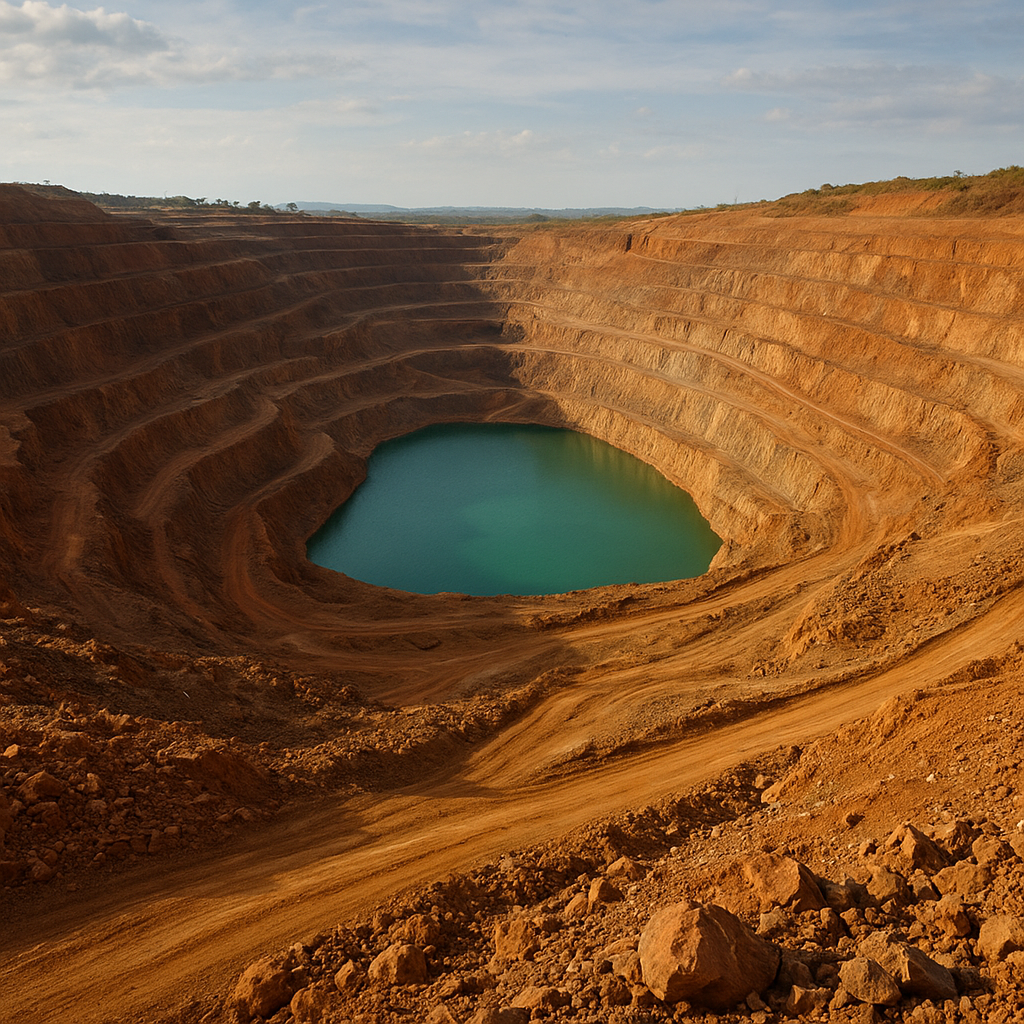
The Nkana mine complex is one of the most important and historically significant copper-producing sites in Africa. Located in the industrial heart of the Zambian Copperbelt, Nkana has shaped the urban growth of the city of Kitwe, influenced national economic policy, and played a central role in the industrial and social history of Zambia. Its underground galleries, open pits and processing facilities have produced vast quantities of mineral wealth, primarily copper and significant amounts of cobalt, while also illustrating many of the opportunities and challenges that come with large-scale extractive industries in the 20th and 21st centuries.
Location and geological setting
Nestled in the northern part of the Zambian Copperbelt Province, the Nkana complex lies adjacent to the city of Kitwe. The Copperbelt is a continuous geological band of sediment-hosted stratiform mineralization that stretches across northern Zambia into the Democratic Republic of the Congo. Nkana occupies a prime position within this belt and is part of a cluster of mines and concentrators that together form one of the world’s most productive copper provinces.
The mineralization at Nkana is typical of sediment-hosted stratiform deposits. Copper occurs in sulfide minerals, commonly chalcopyrite and bornite, often associated with cobalt-bearing minerals. These deposits formed hundreds of millions of years ago, when mineral-bearing brines migrated along favorable sedimentary layers and concentrated metals within permeable horizons. The geological continuity of the Copperbelt makes Nkana both geologically interesting and economically valuable, as extensions of ore bodies often occur at depth and laterally, allowing for prolonged exploitation.
Geologically, Nkana consists of both shallow open-pit deposits and very deep underground workings. This variety of mining methods reflects the complexity of the orebody, which can be accessed in different ways depending on depth, ore grade and economic considerations. The combination of near-surface ore and deep sulfide zones has enabled decades of continuous extraction and multiple phases of investment in infrastructure, processing and labor.
History and development of mining operations
The discovery and exploitation of the Nkana deposits date back to the early 20th century and accelerated in the 1920s and 1930s as prospecting intensified across the Copperbelt. Over the decades, Nkana evolved from early prospect pits to a fully integrated mining complex with concentrators, a smelter, and extensive underground systems. The mine’s growth paralleled the development of transport links, power supplies and urban settlements, with the city of Kitwe expanding largely to meet the needs of mine workers and their families.
Nkana’s operations have undergone several phases: initial exploration and small-scale extraction; expansion and mechanization in the mid-20th century; nationalization and state-controlled development following Zambia’s independence; and later waves of privatization, foreign investment and restructuring. Throughout these phases, the complex has hosted multiple shafts and pits, diverse processing units, and ancillary facilities essential for ore treatment and metal production.
While names of operators and exact ownership arrangements have changed over time, the complexity remained. The mine’s workforce historically included thousands of miners, engineers and support personnel. Advances in mining technology meant deeper and safer underground workings, improved ore concentration techniques and more efficient metallurgical processes, increasing recovery rates and the overall yield of copper and cobalt from the ore.
Mining methods at Nkana include:
- Underground mining: multiple shafts and levels accessing deep sulfide ores, with mechanized drilling, blasting and haulage systems.
- Open-pit mining: extraction of near-surface ore where economic and environmental conditions permit.
- Concentration and smelting: crushing, grinding and flotation to produce copper concentrates, followed by smelting and refining to produce marketable copper metal.
Economic significance
Nkana’s contribution to the national and regional economy has been substantial. As one of the largest and longest-producing mines on the Copperbelt, Nkana has generated export earnings, foreign exchange, tax revenues and employment. The mine’s output has supported broader industrial activities such as shipping, power generation, and metal processing, while stimulating service sectors in cities like Kitwe.
At the local level, Nkana underpinned urban growth, housing development, schools, hospitals and local commerce. The presence of a large mining complex created demand for goods and services, provided stable incomes for many households, and shaped labor markets across the Copperbelt. More broadly, copper exports from Nkana and neighboring mines have been a cornerstone of Zambia’s economic strategy for decades, with prices and production levels at these mines influencing national budgets and public spending.
Several economic dimensions are particularly notable:
- Employment: Direct mining jobs and indirect service-sector employment supported tens of thousands of livelihoods over many decades.
- Export revenue: Copper and cobalt extracted at Nkana have been significant export commodities, contributing strongly to foreign exchange reserves.
- Supply chain and industrialization: Local and regional suppliers benefit from contracts for equipment, transport, electricity and consumables, while metallurgical facilities linked to the mine add value rather than exporting raw ore alone.
- Fiscal impact: Taxes, royalties and dividends from mining operations have fed into national budgets, funding infrastructure and social services when well-managed.
Environmental and social challenges
Large-scale mining inevitably brings environmental and social challenges, and Nkana is no exception. The legacy of decades of extraction includes disturbed landscapes, tailings dams, the risk of acid mine drainage where sulfide-rich wastes oxidize, and contamination of soil and waterways if not properly managed. Dust and emissions from smelting operations, where present, have historically created air quality concerns for nearby communities.
Socially, the mine created both opportunities and pressures. While employment and services improved living standards for many, boom-bust cycles in the copper market exposed workers and towns to employment insecurity. When metal prices fell or operations faced shutdowns, communities that depended heavily on mine-related incomes experienced hardship. Labor relations have also been a significant aspect of Nkana’s story: the Copperbelt region has a strong tradition of unionism and worker activism that shaped labor laws, wages and social policies across Zambia.
Key environmental and social challenges associated with Nkana include:
- Managing mine tailings and preventing contamination of rivers and groundwater.
- Rehabilitating exhausted open pits and disturbed land to reduce risks and enable alternative land uses.
- Reducing air pollution from smelting and concentrating plants through modernization and emission controls.
- Ensuring stable employment and retraining opportunities during phases of closure or restructuring.
- Balancing local community needs with corporate and national economic goals, including equitable distribution of mining revenues.
In recent decades, there has been increasing international and domestic attention to environmental management standards, corporate social responsibility, and community engagement at mines like Nkana. Investments in modern tailings management, water treatment, and cleaner metallurgical technology are part of efforts to mitigate long-term impacts and improve sustainability.
Notable technical and social aspects
Beyond straightforward production statistics, several features make Nkana particularly interesting:
- Integrated complex: Nkana’s combination of underground workings, open pits and metallurgical facilities illustrates the full value chain from ore to refined metal.
- Longevity: The mine’s ability to operate over many decades demonstrates how a single rich deposit can underpin long-term regional development when paired with infrastructure and investment.
- Human capital: Nkana has been a training ground for mining engineers, geologists and technicians in Zambia, creating skill clusters that spread across the country and region.
- Labor history: The Copperbelt’s miners, including those at Nkana, were central to trade union movements that influenced Zambia’s political development and social policy.
- Geopolitical significance: Control and export of copper from Nkana and neighboring mines have periodically been central to national policy debates about privatization, foreign investment and state revenue management.
Future prospects and trends
Looking forward, the future of Nkana will be shaped by a mix of geology, market dynamics, policy decisions and investment in modernization. Several trends to watch include:
- Commodity prices: Copper and cobalt prices on global markets will continue to affect the economic viability of deep and lower-grade ores.
- Technology: Advances in ore processing, energy efficiency and emissions control can reduce operating costs and environmental impacts, potentially extending the life of the complex.
- Governance and investment: Clear, stable policies on mining rights, royalties and community benefits encourage investment. Partnerships between international firms and national stakeholders influence the degree to which local communities capture economic gains.
- Sustainability initiatives: Rehabilitation of disturbed land, improved waste management and community development programs can help align mining activities with broader environmental and social goals.
Ultimately, Nkana remains emblematic of Zambia’s mining heritage and potential. As global demand for copper grows—driven partly by electrification and renewable energy technologies—well-managed mines with established infrastructure and experienced workforces are likely to remain key assets. The extent to which Nkana’s remaining reserves are developed responsibly will influence the local economy, employment prospects, and environmental legacies for generations to come.
Interesting anecdotes and lesser-known facts
Many aspects of Nkana’s history reflect broader themes in African mining history. For example:
- Nkana helped catalyze the growth of Kitwe from a small settlement into one of Zambia’s largest cities, with neighborhoods, hospitals and schools built to support mining families.
- Technical innovations adopted at Nkana over the decades often spread to other Copperbelt mines, making the region a center for African mining expertise.
- The mine has produced significant quantities of cobalt, a metal that has grown in strategic importance for batteries and high-tech applications—linking Nkana to modern global supply chains beyond traditional copper uses.
- Community stories and oral histories from long-serving workers reveal generations of mining families whose identities and livelihoods are intertwined with the mine’s fortunes.
At the intersection of geology, technology, economics and society, the Nkana mine complex offers a rich case study in how natural resources shape places and people. Its future will depend on managing technical challenges, market pressures and the social contract between mining operators, workers, communities and the state. As one of the cornerstones of the Zambian Copperbelt, Nkana’s ongoing evolution will remain closely watched by economists, environmentalists, engineers and local communities alike.

