
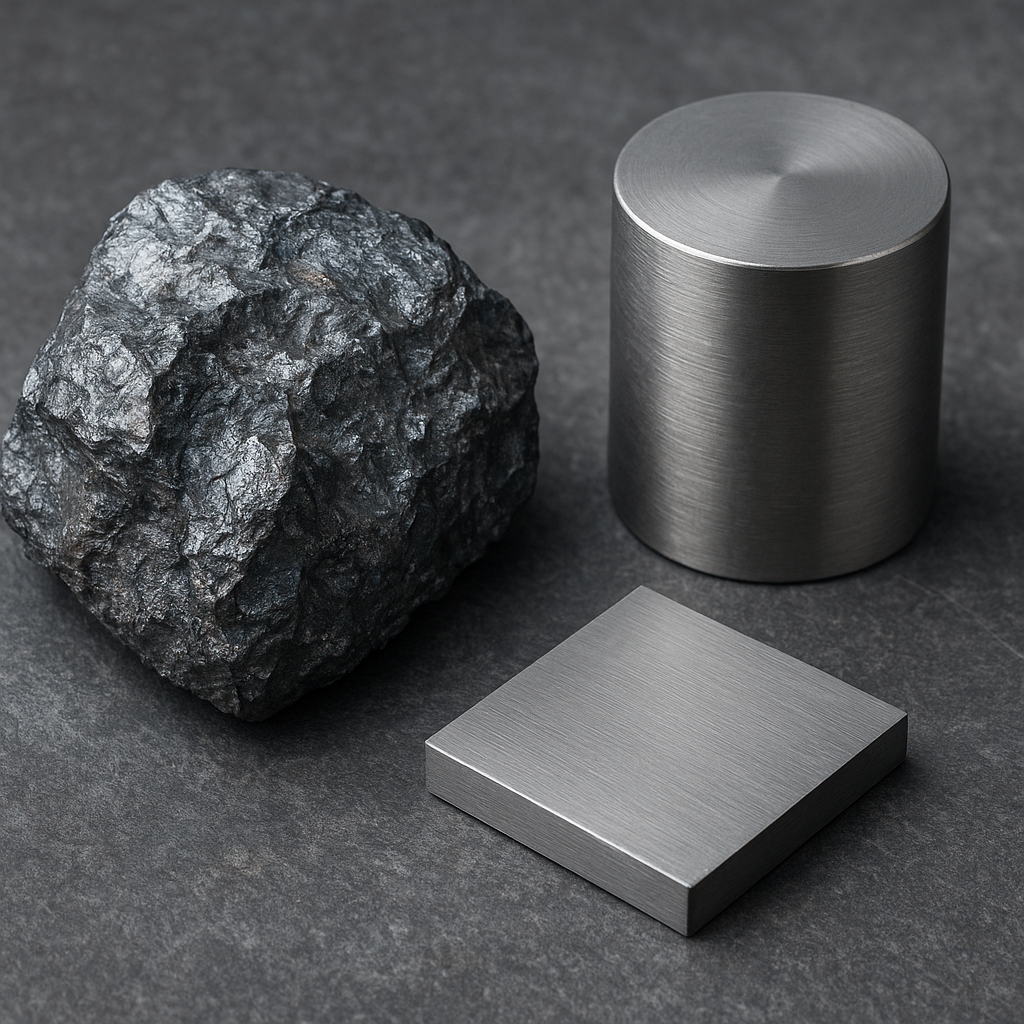
Niobium is a subtle but powerful transition metal whose properties and applications touch industries from aerospace to electronics and fundamental physics. Often overshadowed by more familiar metals like iron or copper, niobium plays an outsized role in high-performance materials, superconducting technologies, and modern electronics. This article explores where niobium is found, how it is extracted and processed, the principal and emerging applications, and several intriguing scientific and geopolitical aspects associated with this element.
Basic properties and identity
Niobium is element number 41 on the periodic table. It is a lustrous, grey-white metal with a relatively high melting point of about 2477 °C and a boiling point near 4744 °C. Its density is approximately 8.57 g/cm³. The electron configuration of niobium is [Kr] 4d4 5s1, and the only stable isotope in nature is Nb-93. Chemically, niobium is classified as a refractory transition metal and shows good resistance to corrosion due to the rapid formation of a protective oxide film on its surface. In terms of mechanical behavior, it is ductile and can be drawn into wires or foils and is readily machined when properly annealed.
Where niobium occurs and how it is mined
Niobium is most commonly found in oxide and silicate minerals rather than in its pure metallic form. Two of the principal minerals associated with niobium are pyrochlore and columbite-tantalite. These minerals often occur in pegmatites, carbonatites and alkaline igneous complexes. Major geologic settings include:
- Carbonatite deposits, which are the principal source of mined niobium worldwide.
- Pegmatitic and granitic environments where accessory niobium-bearing minerals appear.
- Alluvial deposits formed from weathering and transport of primary niobium-bearing rocks.
Today, the global supply of niobium is highly concentrated. The most important producing country is Brazil, which supplies the bulk of the world’s niobium from the Araxá, Catalão and other carbonatite-hosted deposits. Canada also has significant production (e.g., the Niobec mine in Quebec), and smaller deposits exist in countries such as Australia and Russia. Because supply is concentrated geographically, market dynamics for niobium can be strongly influenced by policy, investment decisions, and the operating status of a few large mines.
Extraction, processing and refinement
Niobium extraction typically begins with mining ore followed by physical beneficiation to concentrate the niobium-bearing minerals. Common steps include crushing, grinding and froth flotation to produce mineral concentrates.
Pyrometallurgical and hydrometallurgical routes
- Alkaline fusion and acid leaching are used to break down concentrates and separate niobium and tantalum.
- Solvent extraction techniques and ion-exchange processes are commonly used to separate niobium from other elements.
- Pyrometallurgical processes (such as reduction with carbon or aluminum) and subsequent vacuum refining produce metallic niobium or intermediate ferro-niobium alloys.
Refined niobium metal is produced either via aluminothermic reduction and electron-beam melting or by converting niobium oxide to niobium pentachloride followed by reduction with hydrogen. These steps yield high-purity metal suitable for specialty applications like superconducting cavities or high-performance alloys.
Major applications and industrial uses
Niobium’s combination of strength, corrosion resistance and superconducting behavior makes it valuable across several sectors. The following categories summarize the most significant uses:
Alloying in steel and high-strength materials
- Microalloying of steels: Small additions (often less than 0.1%) of niobium dramatically increase yield strength, toughness and grain refinement in steel. These alloys are used in pipelines, automotive structures, construction and pressure vessels.
- High-strength low-alloy (HSLA) steels: Niobium stabilizes carbon and nitrogen, enabling improved weldability and reduced weight for equivalent strength.
- Superalloys and aerospace: Niobium is used in nickel-based superalloys and in some refractory alloy formulations for turbine blades, combustion chambers and rocket components where high-temperature strength matters.
Superconductivity and high-field magnets
One of niobium’s most distinctive applications arises from its superconducting alloys and compounds. Niobium-based materials are foundational in many superconducting technologies:
- NbTi (niobium-titanium) and Nb3Sn are the workhorses for superconducting magnets used in particle accelerators and magnetic resonance imaging. NbTi, in particular, is flexible and relatively easy to manufacture into cable and wire.
- Niobium is the material of choice for superconducting radio-frequency (SRF) cavities in particle accelerators. High-purity niobium cavities can sustain high accelerating fields with low losses.
- Research-grade devices for quantum computing and sensitive detectors often utilize thin films or nanostructures of niobium or niobium compounds because of excellent superconducting properties at accessible cryogenic temperatures.
Electronics and capacitors
Niobium pentoxide (Nb2O5) is used in electronic ceramics and capacitors. Niobium electrolytic capacitors, which use niobium oxide as the dielectric, have been developed as an alternative to tantalum capacitors. They offer:
- Improved temperature stability in some designs.
- Lower cost potential—particularly relevant as tantalum faces supply constraints.
- Good volumetric efficiency for certain consumer and industrial electronics.
Ceramics, optics and chemical uses
- Niobium oxides are used in specialized glass and optical coatings to alter refractive indices and improve durability.
- Niobium compounds serve as catalysts in some chemical reactions and are used to produce dense, wear-resistant carbide or nitride coatings (e.g., NbC, NbN).
Other uses: jewelry, corrosion-resistant parts
Because niobium is hypoallergenic and takes an attractive oxide coloration by anodization, it is used in jewelry. Additionally, its corrosion resistance makes it suitable for chemical process equipment, heat exchangers and medical implants in select contexts.
Cutting-edge research and emerging technologies
Niobium continues to be at the forefront of research in condensed matter physics, materials science and device engineering. Some exciting areas of study and application include:
- Quantum materials: Layered niobium dichalcogenides (for example NbSe2) exhibit fascinating phenomena like charge-density waves coexisting with superconductivity, offering testbeds for studying correlated electron behavior.
- Superconducting nanowire single-photon detectors (SNSPDs): Niobium nitride and niobium titanium nitride (NbN, NbTiN) are used to make ultrafast, highly efficient detectors crucial for quantum communication and astronomy.
- SRF cavity advances: Techniques to improve surface purity, reduce defects and increase field gradients in bulk niobium cavities are critical to next-generation particle accelerators and free-electron lasers.
- Additive manufacturing: Research into 3D printing of niobium-containing alloys aims to produce complex, lightweight components for aerospace and defense.
Environmental, economic and geopolitical aspects
The niobium supply chain presents several noteworthy socio-economic and environmental considerations. Mining and processing can involve significant environmental footprint, driven by land disruption, tailings management and chemical use in beneficiation. Because the majority of niobium production originates in a small number of countries, the market can be susceptible to disruptions and concentrated bargaining power.
- Market concentration: With Brazil as the dominant supplier, investment or policy changes there can ripple through global industries that rely on niobium.
- Price dynamics: Niobium prices track demand from steel, aerospace and electronics. Shifts in construction, oil-and-gas pipeline projects and high-tech manufacturing affect consumption volumes and pricing.
- Recycling and substitution: Efforts to recycle niobium from scrap alloys or substitute other elements are ongoing, but alternatives often compromise performance—particularly where superconductivity or ultra-high strength is required.
Scientific curiosities and historical notes
Niobium has a history intertwined with tantalum because the two elements are often found together and were once confused. Originally named columbium, the element was later officially renamed niobium, though the older name still appears in some contexts. A few more facts that many find interesting:
- Niobium forms a stable oxide layer that gives it excellent corrosion resistance, much like titanium.
- Niobium is essential to modern high-strength pipeline steels; without it, many long-distance high-pressure pipelines would require thicker walls and heavier support structures.
- In particle physics, niobium’s role in SRF cavities and superconducting magnets makes it vital for accelerators such as the ones used at CERN and many national laboratories.
- In materials science, niobium’s intermetallic compounds and nitrides are studied for unusual superconducting and electronic properties, making it a recurring subject in top-tier research publications.
Practical considerations for industry and research
For engineers and researchers working with niobium, several practicalities are important to consider:
- Purity matters: The superconducting and high-temperature performance of niobium depends strongly on impurity levels and grain structure. Processing and post-treatment (annealing, chemical polishing) are crucial.
- Joining and fabrication: Welding niobium requires controlled atmospheres to avoid embrittlement from interstitials like oxygen and nitrogen; brazing and mechanical joining are also common.
- Compatibility: When alloyed with other refractory elements, niobium can form brittle phases—careful metallurgical design is required for demanding applications.
Outlook and future directions
Demand for niobium is likely to evolve with trends in energy, transportation and information technologies. Continued growth in electrification, lightweight structural materials, and superconducting infrastructure (for medical imaging, research and potentially power transmission) could sustain or increase demand. Additionally, advances in quantum technologies and photon detection may open new markets for niobium-based devices. At the same time, pressures to reduce environmental impacts and diversify supply will shape investments in mining, recycling and research into substitutes or more efficient uses.
Across industries, niobium remains a critical enabling element—quiet in presence but powerful in effect. From strengthening the steel that forms the backbone of modern infrastructure to enabling the superconducting magnets that peer inside the human body and probe the fundamental particles of the universe, niobium’s role is simultaneously practical, scientific and strategically important.