Neptunite is a striking and relatively rare mineral that has fascinated mineralogists, gem cutters, and collectors for more than a century. Although it rarely takes center stage like diamonds or sapphires, neptunite’s distinctive black, lustrous crystals and its close association with the famous blue gemstone benitoite give it a special place in the study of alkaline igneous and hydrothermal mineralization. This article explores where neptunite occurs, what it is made of, how it forms, its uses, and several intriguing aspects of its mineralogical and cultural story.
Occurrence and geological setting
Neptunite is most often encountered in unusual, silica-rich environments that are associated with alkaline igneous activity or low-temperature hydrothermal alteration. These settings can produce a unique suite of minerals, and neptunite commonly appears alongside members of that suite rather than in mainstream igneous or metamorphic rocks. The best-known and most celebrated association is with benitoite, a deep-blue barium titanium silicate that is also the official state gem of California.
Typical geological environments
- Hydrothermal lenses in silica-rich veins and cavities, where hydrothermal fluids alter pre-existing rocks and deposit unusual silicates
- Alkaline igneous complexes or their altered zones, where sodium- and potassium-rich fluids favor the formation of exotic silicates
- Veins cutting serpentinite or related ultramafic rocks that are retrogressed and infiltrated by silica-bearing solutions
Because of the specific chemical environment needed to stabilize neptunite—relatively high concentrations of alkali metals together with titanium, iron, manganese and silica—it is a mineral that forms only at a handful of localities worldwide. The presence of neptunite often signals a rare combination of fluid chemistry and rock composition, which is partly why neptunite-bearing deposits draw significant scientific interest.
Physical and chemical characteristics
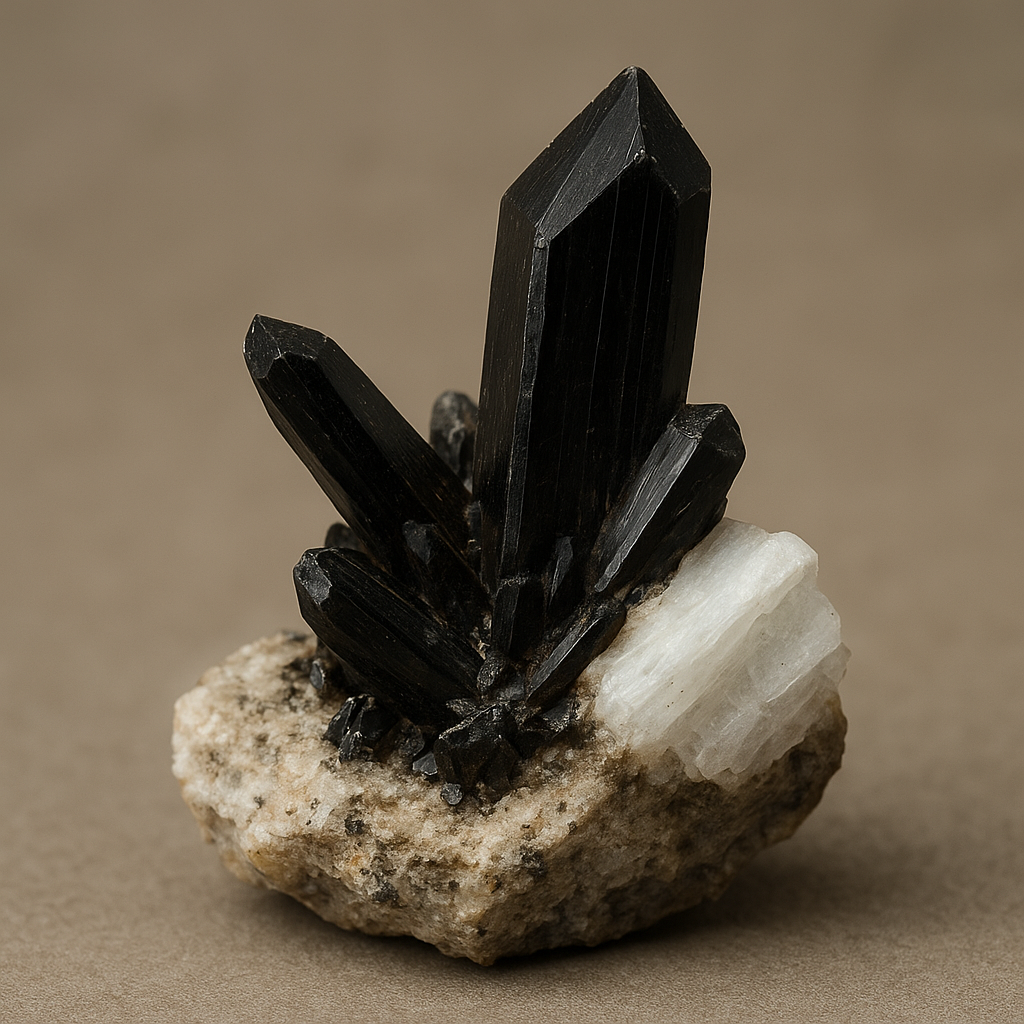
Neptunite is a complex silicate that contains several alkali and transition elements. It is commonly described as a potassium–sodium–lithium titaniferous iron silicate, reflecting the fact that it incorporates multiple cations in its structure. Physically, neptunite is notable for its black to very dark brown color, vitreous to submetallic luster, and its tendency to form well-developed, elongated prismatic crystals. These aesthetic qualities make high-quality specimens attractive to collectors.
Diagnostic properties
- Color: typically black or dark brown, sometimes with a slightly reddish tint in reflected light
- Crystal habit: elongated prismatic crystals, often striated longitudinally; radiating aggregates can occur
- Cleavage and fracture: cleavage is distinct in some directions and the mineral can be brittle
- Hardness: moderate, generally in the mid-range of the Mohs scale (commonly reported around 5–6)
- Streak: brownish to dark-colored
- Chemical composition: a complex mix of K, Na, Li, Fe, Mn, Ti and Si in a silicate framework
Its combination of moderate hardness and perfect-to-good cleavage makes neptunite less than ideal for most jewelry applications. However, gem cutters sometimes fashion unusual specimens into cabochons or collector gems, especially when the material includes aesthetic inclusions or interesting crystal faces.
Notable localities and collecting
The name most commonly associated with neptunite is the locality in central California, where it was first recognized as part of a remarkable mineral assemblage that includes benitoite. Collectors prize neptunite crystals from classic localities for their sharp faces and well-formed habits. Beyond California, neptunite has been reported—typically in smaller quantities or as less dramatic crystals—from a few other regions around the world.
Where to find neptunite
- San Benito County, California: the classic and most famous source, often found together with benitoite at gem-bearing hydrothermal veins
- Selected alkaline complexes and pegmatitic or hydrothermal localities in other regions, where rare silicate minerals concentrate
- Some deposits in Russia, Japan, Canada and Scandinavia have yielded neptunite or closely related phases, though specimens are generally less abundant than from California
Collectors seeking neptunite specimens should look for matrix pieces that include associated minerals such as benitoite, natrolite, or other rare silicates. Because many neptunite occurrences form in veins with limited extent, high-quality crystals can be quite rare and valuable within the mineral-collecting market.
Applications, uses, and scientific significance
Neptunite has no large-scale industrial applications—its rarity and the absence of economically valuable bulk properties limit its utility. Instead, its importance is concentrated in the domains of mineralogy, petrology, and gem collecting.
Scientific uses
- Indicator mineral for specific geochemical environments: the presence of neptunite helps geologists infer alkaline or silica-rich hydrothermal conditions and the mobility of elements such as titanium, iron, and alkalis during late-stage magmatic or hydrothermal processes.
- Study of crystal chemistry: as a complex silicate with multiple cations, neptunite provides an interesting case for researchers interested in site occupancy, substitution mechanisms, and structural relationships among rare silicates.
- Isotopic and geochronological work: in some contexts, neptunite-bearing assemblages can be used to constrain the timing and evolution of hydrothermal events, although neptunite itself is not a common target for radiometric dating.
Gemstone and collector uses
On the collector market, high-quality neptunite crystals—especially those with sharp form, intact faces, and attractive associations—are sought after. Some specimens are fashioned into collector gems or cabochons, but the mineral’s cleavage, rarity, and dark color restrict its use in conventional jewelry. Still, when presented with an attractive surface polish or paired with contrasting minerals (for example, a black neptunite crystal on a matrix with bright natrolite or blue benitoite), specimens can be very appealing.
Formation processes and crystal chemistry
Understanding how neptunite forms requires attention to both the chemistry of the host system and the physical conditions of formation. The mineral crystallizes in environments where alkali-rich and titanium-bearing fluids interact with silica and iron sources. These conditions often arise during the late stages of magmatic evolution or during hydrothermal alteration of alkaline volcanic rocks and related complexes.
Fluid-rock interactions and element mobility
Elements such as lithium, potassium and sodium are more mobile in alkaline fluids, while titanium and iron can be mobilized under specific redox and temperature regimes. Where those fluids intersect rocks that supply silica, the right chemical milieu for neptunite’s silicate structure can emerge. Often this occurs in small, localized pockets—hence the limited and sporadic distribution of fine neptunite crystals.
Crystal structure insights (qualitative)
Although the detailed crystallography of neptunite is a technical subject, a qualitative description is useful: the mineral’s silicate framework accommodates multiple metal cations, and substitutions among iron, manganese, titanium and alkalis can occur. This flexibility in composition is one reason neptunite appears in slightly different chemical varieties depending on the specific locality. These substitutions also affect color, luster and other physical properties, which collectors use to assess specimen quality.
Identification and practical tips
For hobbyists, students or new collectors, distinguishing neptunite from other dark silicates and oxides can be a challenge. A few practical tips help:
- Look for elongated, prismatic habit and parallel striations—these are common in well-formed neptunite crystals.
- Examine associations: if the specimen includes benitoite or other rare silicates typical of alkaline hydrothermal systems, neptunite is more likely.
- Check hardness and streak: neptunite’s moderate hardness and brownish streak can help separate it from metallic oxides that often have metallic streaks or different hardnesses.
- Professional identification: X-ray diffraction (XRD), electron microprobe analyses, or Raman spectroscopy are the standard laboratory methods to confirm neptunite and to determine its precise chemical composition.
Curiosities, history, and cultural notes
Neptunite’s story is intertwined with dramatic mineral discoveries and dedicated collectors. While it lacks the folklore of more famous gems, its connection to benitoite and to the unique geology of certain Californian localities gives it a special narrative in American mineralogy. The name itself evokes mythic imagery and the allure of rare minerals pulled from narrow veins or pockets of unusual chemistry.
- Historical association: neptunite’s discovery and fame are linked to the wider interest in the benitoite-bearing localities, where collectors and miners uncovered a treasure trove of rare and attractive minerals in the late 19th and early 20th centuries.
- Aesthetic pairings: museum displays and private collections often highlight black neptunite crystals beside the electric-blue of benitoite, creating a striking visual contrast that highlights the diversity of mineral forms produced by unique geological processes.
- Educational value: specimens of neptunite and its associated minerals serve as excellent teaching tools for illustrating the complexity of mineral formation, chemical substitution in silicate frameworks, and the interplay of hydrothermal fluids with host rocks.
Practical advice for collectors and curators
If you are acquiring neptunite for a collection, consider these points:
- Provenance matters. Specimens with well-documented locality and matrix associations are more valuable and scientifically useful.
- Preserve fragile specimens carefully: because neptunite can be brittle and exhibit distinct cleavage, avoid rough handling and store pieces flat or cushioned.
- Display with contrast: pairing neptunite with lighter-colored associated minerals (for example, natrolite or benitoite) showcases its deep black color and crystal habit.
- Documentation: for museum or research collections, accompanying chemical analyses, images and locality data enhance the specimen’s utility and value.
Related minerals and broader context
Neptunite belongs to a family of rare silicate minerals that form under specialized chemical conditions. Studying it alongside benitoite, natrolite, joaquinite-group minerals, and various titanosilicates provides insight into how alkaline magmatism and hydrothermal alteration generate mineral diversity. For researchers, neptunite is one piece of a larger puzzle about element distribution and crystallization in exotic geological niches.
The mineral’s rarity, distinctive appearance and scientific relevance ensure that neptunite will continue to attract interest from collectors, mineralogists and educators. Whether admired as a sculptural black crystal in a display case or examined under an electron microscope, neptunite offers a window into the complexity of Earth’s mineral-forming processes and the specialized environments that produce nature’s more unusual gems.