Natrolite is a fascinating member of the zeolite family whose delicate, often needle-like crystals, unique internal channels, and dynamic behavior under heat and moisture have attracted geologists, mineral collectors, and materials scientists alike. This article explores the mineral’s identity, how and where it forms, its structural and chemical properties, practical and research applications, and some intriguing aspects that make natrolite more than just another white mineral in a basalt cavity.
What is natrolite?
At its core, natrolite is a framework aluminosilicate known for having a highly ordered, microporous structure. Its idealized chemical formula is Na2Al2Si3O10·2H2O, meaning it contains sodium, aluminum, silicon, oxygen and water molecules tightly bound within a crystalline lattice. As a member of the zeolite group, natrolite shares the general zeolite characteristic of open frameworks made up of linked tetrahedra (AlO4 and SiO4) that create channels and cavities capable of hosting water and exchangeable cations.
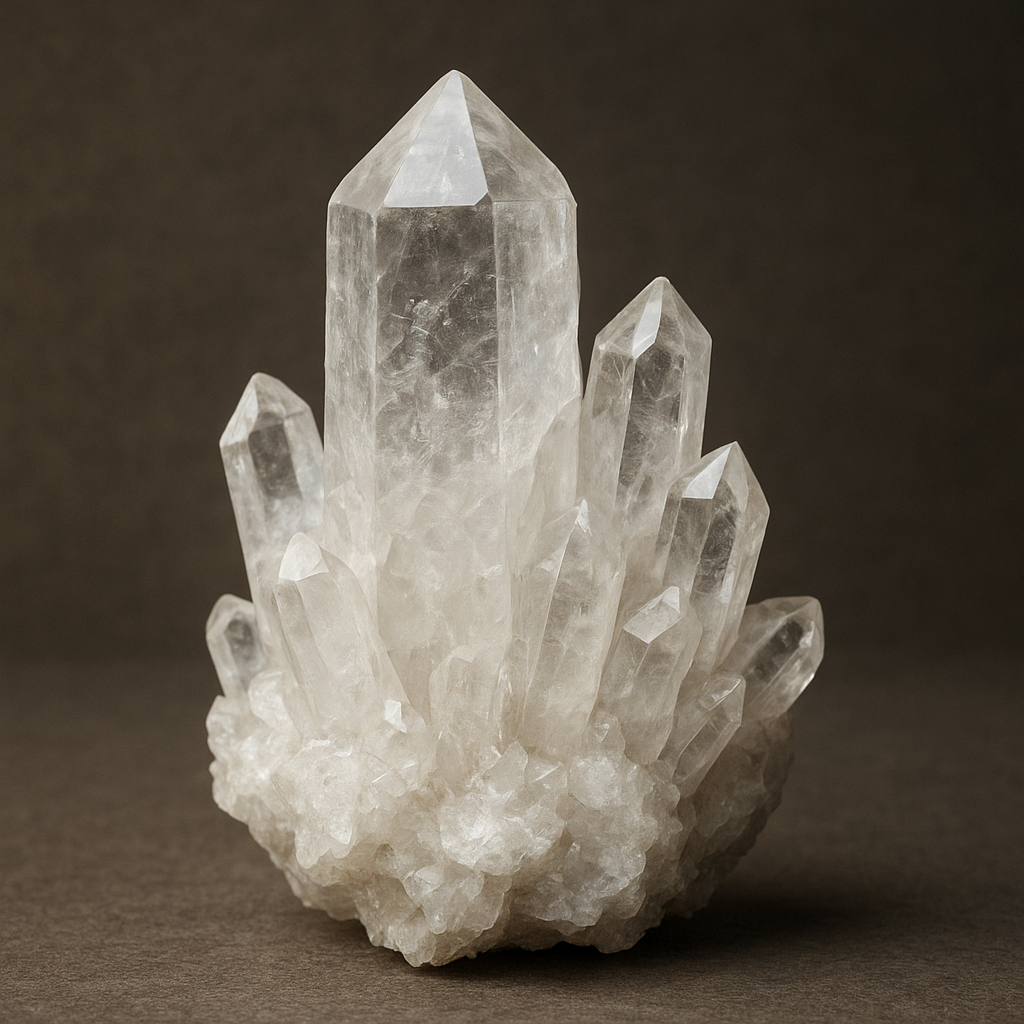
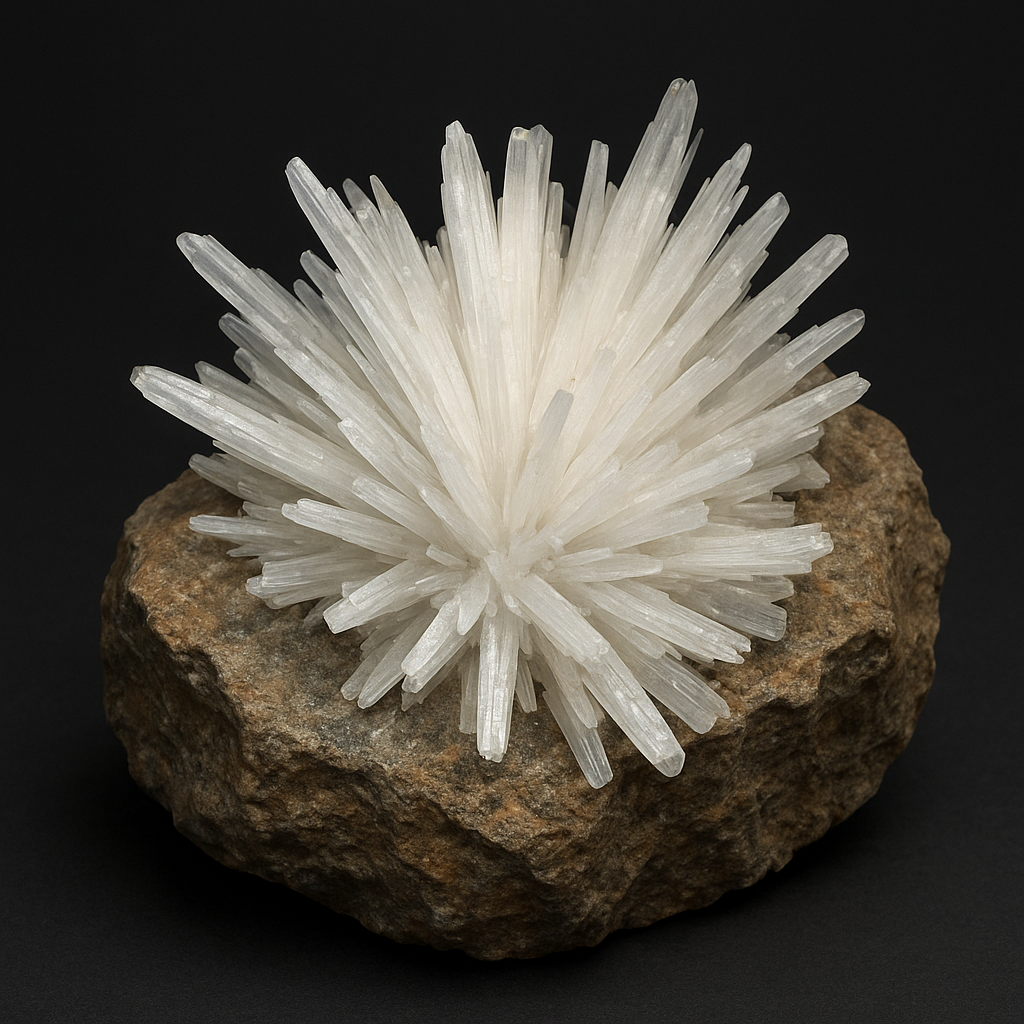
Physically, natrolite most commonly appears as white or colorless material, though it can show pale shades of yellow, pink, or gray when impurities are present. It often forms in acicular or fibrous habits, creating radiating sprays or compact felted aggregates. The luster is usually vitreous to silky on fine fibers. Typical physical parameters include a hardness in the mid-range (around 5 to 5.5 on the Mohs scale) and a specific gravity near 2.2, values that reflect its porous, hydrated framework.
Formation processes and typical environments
Natrolite most commonly forms as a secondary mineral in cavities and vesicles of volcanic rocks, especially in basaltic and other mafic lavas. After volcanic emplacement, hydrothermal fluids or low-temperature alteration solutions percolate through the rock, leaching elements and depositing zeolites and other secondary minerals in open spaces. Under these conditions, the framework of natrolite grows as silica, alumina, sodium and water reorganize into the stable natrolite topology.
Beyond volcanic settings, natrolite can occur in hydrothermal veins and as a late-stage mineral in certain plutonic rocks where alkaline compositions allow zeolite formation. It is also associated with low-grade metamorphic processes in the zeolite facies, where burial and fluid-rock interaction convert primary glassy or feldspathic material into zeolite assemblages that sometimes include natrolite.
Representative environments and occurrences:
- Basaltic vesicles: the most common setting; natrolite lines cavities left by gas bubbles in lava flows.
- Hydrothermal veins: precipitated from low-temperature, alkaline fluids in fractures and open spaces.
- Zeolite facies metamorphism: regional or contact metamorphism at relatively low temperatures and pressures producing zeolite assemblages.
- Alkaline intrusive rocks: nepheline syenites and related rocks where silica-undersaturated magma provides the chemistry for zeolite formation.
Notable localities
Natrolite is widely distributed because the processes that create zeolites are common in basaltic provinces worldwide. Well-known regions for natrolite specimens include parts of northern and central Europe, Russia’s polar and subpolar localities, many localities in India tied to the vast Deccan Traps, and basaltic provinces in North America. Collectors prize natrolite from areas where crystals are large, transparent, or form dramatic radiating clusters.
- Basaltic provinces with rich zeolite mineralization often yield fine natrolite specimens.
- Localities where natrolite forms with unusual colors or habits become sought-after collector pieces.
- Regions with long histories of mineral collecting tend to have the best-documented natrolite occurrences.
Crystal structure and physical behavior
The defining feature of natrolite’s structure is its system of channels and cavities formed by an aluminosilicate framework. The framework is negatively charged due to the substitution of aluminum for silicon in tetrahedral sites; this charge is balanced by extra-framework sodium cations and water molecules that occupy channels. These channels give rise to several important behaviors:
- Ion-exchange: sodium in the channels can be swapped with other cations (K+, Ca2+, etc.), enabling natrolite to participate in chemical exchange reactions with surrounding fluids.
- Adsorption and desorption: water and small molecules can be reversibly taken up or released, leading to observable changes in mass and sometimes subtle structural modifications.
- Thermal behavior: heating causes loss of water (dehydration), which can trigger structural changes. Some of these changes are reversible on rehydration; others can be irreversible depending on temperature and exposure time.
These characteristics make natrolite an intriguing subject for solid-state chemistry research. Its microporosity and controlled chemistry are analogous to synthetic molecular sieves, and variations in hydration and cation occupancy lead to measurable changes in lattice parameters and optical properties.
Optical and mechanical properties
Optically, natrolite is biaxial with low refractive indices compared to many silicates, reflecting its relatively open, hydrated structure. In hand specimens, natrolite can be distinguished by its needlelike habit, silky to pearly luster on fibrous surfaces, and its reaction to heat (loss of water and potential whitening or cracking). Mechanical properties are moderate — not a tough mineral, nor extremely fragile, but its acicular aggregates can be delicate and easily damaged if mishandled.
Uses, applications, and industrial relevance
While some zeolites such as clinoptilolite, mordenite, and synthetic frameworks enjoy broad industrial use, the direct industrial application of natural natrolite is more limited. Nevertheless, natrolite’s intrinsic properties — ion-exchange, adsorption, and thermal stability within certain ranges — make it relevant across several areas:
- Scientific research: natrolite serves as a model system for studying water mobility, ion exchange, and reversible dehydration in zeolitic frameworks. Researchers use natrolite crystals to investigate transport within narrow channels and host–guest interactions at the nanoscale.
- Educational and reference specimens: well-formed natrolite crystals are valuable in teaching mineralogy and crystallography, demonstrating typical zeolite behavior in hand samples.
- Collector and lapidary use: while not a mainstream gemstone, attractive transparent natrolite crystals are cut or cabbed on occasion; more commonly they are curated by mineral collectors for display and study.
- Potential environmental applications (research stage): zeolites in general have been investigated for removal of heavy metals and radionuclides from water because of their ion-exchange potential. Natural natrolite, and more often synthetic analogs, have been researched for their capacity to immobilize certain cations in polluted waters or to act as selective sorbents. These investigations are typically at the laboratory or pilot scale rather than widespread commercial deployment specifically using natrolite.
In practice, many industrial roles traditionally associated with zeolites — such as catalysis in petroleum processing, large-scale gas separation, and industrial water treatment — rely on specialized synthetic zeolites engineered for particular pore sizes and chemical stabilities. Natrolite’s niche lies more in scientific inquiry and collecting than in broad industrial replacement of synthetic materials.
Identification, analysis, and distinguishing from related minerals
Proper identification of natrolite relies on a mix of visual, physical, and analytical techniques:
- Visual and tactile clues: acicular habit, radiating sprays, vitreous to silky luster, and a white to colorless appearance.
- Simple tests: moderate hardness (~5–5.5) and relatively low density help distinguish it from heavier, harder minerals.
- X-ray diffraction (XRD): provides definitive structural identification and distinguishes natrolite from other zeolites with similar habits.
- Infrared spectroscopy and Raman: can identify framework vibrations and water signatures characteristic of natrolite.
- Thermogravimetric analysis (TGA): helps quantify water content and studies dehydration behavior.
- Electron microscopy and microprobe: reveal morphology and precise chemistry, including trace element substitutions and cation occupancy.
Natrolite can be confused with other acicular zeolites such as mesolite and scolecite, which differ mainly in composition (e.g., calcium or other cations) and subtle differences in crystal habit and optical properties. Accurate identification is especially important in research contexts where small compositional differences change physical behavior.
Related minerals and synthetic analogs
Natrolite is part of a larger family of zeolitic frameworks, many of which have closely related topologies or chemical compositions. Minerals such as mesolite and scolecite share similar habits and formation environments but differ by cation content (e.g., Ca2+, K+) or hydration states. Synthetic zeolites, engineered for controlled pore sizes and chemical properties, borrow the same fundamental topology ideas and are tailored for catalysis, adsorption, and separation technology.
The study of natrolite has also informed the synthesis of novel zeolitic materials. Insights into how natural frameworks accommodate water and ions, as well as how they respond to thermal cycling, guide chemists designing robust, application-specific molecular sieves and host frameworks for catalysis or molecular separation.
Interesting phenomena and research frontiers
Several features make natrolite of continuing interest beyond its collectors’ value:
- Reversible dehydration/rehydration: Some natrolite samples exhibit reversible structural changes with loss and regain of water. These processes are model systems for understanding guest mobility in microporous solids and have implications for gas storage and molecular transport research.
- Ion mobility and conduction: the movement of sodium and other cations within channels raises questions about ionic conduction mechanisms in constrained geometries, relevant for battery and ionic transport studies.
- Topology-driven chemistry: the way natrolite’s framework accommodates guests informs the design of host–guest chemistry, where small molecules or ions are trapped, exchanged, or catalytically transformed within rigid channels.
- Twinning and crystallographic anomalies: twinning and subtle disorder in some crystals make natrolite a challenge and joy for crystallographers, who study these phenomena to better understand growth dynamics.
Natrolite in cultural and hobby contexts
Beyond scientific and industrial arenas, natrolite occupies a place in the world of mineral collecting and metaphysical practices. Collectors prize well-formed natrolite sprays and transparent crystals for display and for study of zeolitic etching and growth. In metaphysical circles, natrolite is sometimes used in practices centered on clarity, grounding, or energy work; these uses are cultural and belief-based rather than scientifically supported, but they contribute to the mineral’s continued popularity among a broad audience.
Practical tips for collectors and researchers
Handling and conserving natrolite requires attention to its hydrated nature and physical delicacy:
- Keep specimens away from extreme heat and prolonged direct sunlight; dehydration may alter appearance or structural integrity.
- Avoid aggressive cleaning that could fracture acicular aggregates; gentle water rinses and soft brushes are preferable.
- Store natrolite in stable, moderate humidity to minimize repeated dehydration/rehydration cycles that could cause microcracking.
- When preparing samples for analysis, document initial hydration state and appearance; thermal or vacuum preparation can change the specimen irreversibly.
Closing thoughts
Natrolite sits at an intriguing intersection between natural beauty and scientific relevance. Its elegant needlelike crystals catch the eye of collectors, while its open aluminosilicate lattice and dynamic water and ion interactions attract researchers exploring porous materials. Though not the workhorse of industrial zeolite applications, natrolite’s role as a model system and a noteworthy natural zeolite ensures it remains a subject of ongoing curiosity and study in mineralogy and materials science.