
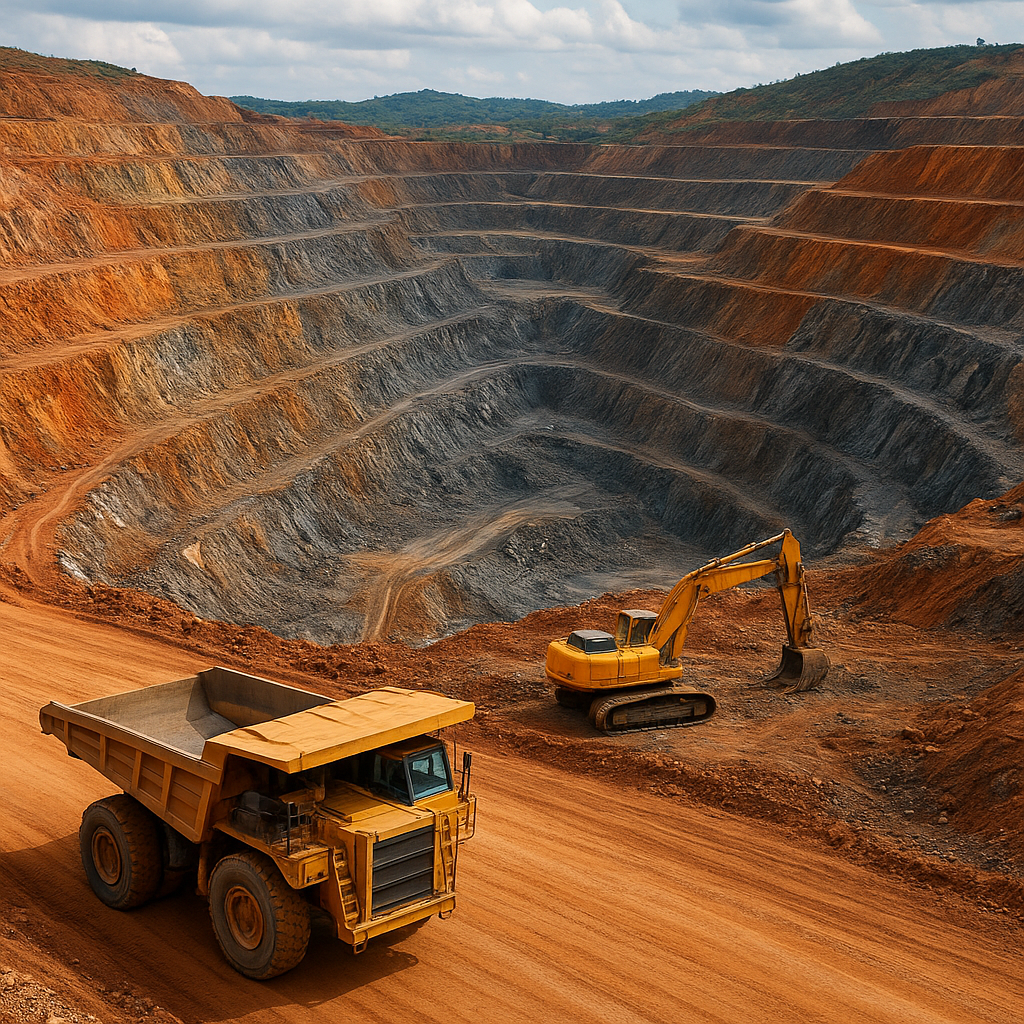
The Mutanda Mine, located in the copper- and cobalt-rich heartland of the Democratic Republic of the Congo, is one of the most consequential mineral projects on Earth for the modern energy transition. Its reserves and output have placed it at the center of global supply chains for two strategic metals: copper and cobalt. The mine’s operations, economics, and controversies illuminate both the promise and the challenges of extracting critical raw materials in a resource-rich but institutionally fragile region.
Where Mutanda Is and the Geology Behind It
Mutanda sits near the city of Kolwezi in Lualaba Province in southeastern DRC, within the region historically known as Katanga. This territory forms part of the Central African Copperbelt, a continuous geological province stretching from northern Zambia into the southern DRC that hosts some of the world’s richest sediment-hosted stratiform copper and cobalt deposits.
The mineralization at Mutanda is characteristic of the Copperbelt: laterally extensive, layered stratiform sulfide horizons hosted in Proterozoic metasedimentary rocks. These horizons often present attractive combinations of high-grade copper with appreciable concentrations of cobalt — a by-product that has become increasingly valuable because of its role in lithium-ion battery cathodes. The deposit’s near-surface extensions and thick, continuous mineralized lenses have made it amenable to large-scale, mechanized mining.
What Is Extracted and How Operations Are Structured
At Mutanda, the two headline commodities are copper (in the form of copper sulfide ore and concentrate) and cobalt (commonly recovered as a cobalt-bearing copper concentrate and later refined). Production typically follows a sequence familiar to modern hard-rock mining:
- Exploration and delineation drilling to define the ore body and grade distribution.
- Open-pit and underground extraction methods depending on ore geometry and depth.
- Crushing and milling to produce fine ore.
- Concentration by flotation to create a copper-cobalt concentrate suitable for smelting or hydrometallurgical processing.
- Further hydrometallurgical refining in smelters, refineries, or third-party facilities to recover refined copper metal and cobalt chemicals (sulfate, hydroxide or metal depending on processing choices).
Mutanda has supported large-scale milling and concentrator facilities and has been integrated into regional logistic networks that move concentrates to smelters and refineries, sometimes within the DRC and sometimes to international partners. The technical complexity of recovering cobalt alongside copper has driven continuous investments in processing technology to improve recovery rates and produce battery-grade cobalt products.
Mining Methods and Scale
The mine has employed both open-pit and underground techniques. Open pits allow for high-throughput extraction of near-surface ore, while deeper, high-grade lenses are accessed underground. The combined approach enables operators to blend ores for consistent feed to the concentrator and to optimize unit operating costs. Mutanda’s scale has required heavy investments in earthmoving fleets, conveyor systems, and water- and tailings-management infrastructure.
Economic Significance: Local, National, and Global
Mutanda matters at multiple scales. Locally, it is a major employer and a source of infrastructure spending. Regionally and nationally, it contributes meaningful export earnings, tax revenue, and foreign investment into the DRC economy. Globally, Mutanda’s output feeds supply chains for electrification and electronics and helps determine market dynamics for both copper and cobalt — metals that are increasingly critical to renewable energy and electric vehicle (EV) technologies.
Key aspects of its economic footprint:
- Export earnings — The mine’s concentrate shipments have historically been a major component of the DRC’s mineral exports, helping to finance imports and government budgets.
- Employment and indirect jobs — Direct employment at the mine and indirect opportunities in trucking, services, and local commerce can be substantial, though the scale of benefits varies with local procurement policies and company-community relations.
- Government revenue — Royalties, taxes, and dividends (where joint ventures include state actors) provide important income to provincial and national authorities.
- Value chain impact — Beyond raw material exports, Mutanda’s production fuels downstream industries: refiners, chemical processors, and battery manufacturers reliant on consistent cobalt and copper supplies.
Because cobalt is a relatively scarce element concentrated geographically in the DRC, a single large mine like Mutanda can influence price swings and supply security. That influence has attracted attention from buyers and investors seeking to secure long-term supplies of battery metals.
Social and Environmental Dimensions
The Mutanda Mine, like many large mining projects in the region, presents a mix of development opportunities and environmental and social challenges. These dimensions are central to ongoing debates about mining governance in the DRC.
Community and Labor
Mining operations generate jobs and can stimulate local economies by building roads, clinics, or schools when companies implement community development programs. However, the quality and distribution of benefits have been points of contention. Concerns have arisen about worker safety, the displacement of households, and equitable sharing of mining revenues. The presence of informal or artisanal miners in and around concessions is another source of social complexity: artisanal mining can provide livelihoods but also creates safety risks and complicates formal operations.
Environmental Issues
Environmental impacts from mining include landscape disturbance, tailings and waste-rock management, water use and potential contamination, and biodiversity loss. Tailings facilities and effluent controls are particularly important in a region where heavy rainfall and limited regulatory capacity can raise the risk of contamination to rivers and local water supplies. Concerns about tailings stability, acid rock drainage, and the handling of metallurgical effluents have prompted scrutiny from regulators, NGOs, and downstream buyers focused on sustainable sourcing.
Human Rights and Supply Chain Ethics
Because cobalt is critical to batteries, the global electronics and automotive industries have placed pressure on supply chains to ensure responsible sourcing. Reports over the years about child labor and unsafe conditions in artisanal cobalt production elsewhere in the DRC have catalyzed due-diligence efforts. For large industrial mines such as Mutanda, buyer requirements and investor expectations have encouraged more transparent reporting, certification efforts, and community engagement strategies. The mine’s practices have been examined by civil society and industry alike as part of broader efforts to improve traceability and social performance in mineral supply chains.
Interesting and Less-Obvious Aspects of Mutanda
Several features of Mutanda make it notable beyond simple production figures.
- Strategic metal pairing: The co-occurrence of high-grade copper and cobalt makes Mutanda unusually valuable in two markets simultaneously. While copper supports electrification through grid infrastructure and wiring, cobalt is a key input for many battery chemistries. That dual role increases the mine’s strategic importance.
- Supply-chain leverage: Because global cobalt supply is heavily concentrated in the DRC, large, reliable producers can exert meaningful influence over downstream manufacturers seeking stable sourcing for EV batteries. This has positioned Mutanda as a supply anchor for long-term offtake agreements.
- Technology and hydrometallurgy: Advances in hydrometallurgical processing have allowed operators to focus on producing battery-grade cobalt sulfate and other refined products rather than exporting raw concentrates. Such processing shifts more value down the chain and can change the economic proposition for local beneficiation.
- Price sensitivity: Cobalt prices are notoriously volatile. Mutanda’s economics are sensitive to swings in cobalt and copper prices; when cobalt is strong, the mine’s by-product revenue can transform project economics, while low prices can pressure margins.
- Geopolitical interest: The location and commodity mix attract attention from international governments, industrial buyers, and commodity traders because of minerals’ centrality to industrial policy and national security considerations tied to clean-energy technologies.
Challenges and Future Outlook
Looking forward, several forces will shape Mutanda’s trajectory:
- Demand for batteries: Continued growth in electric vehicles and energy storage could sustain or amplify demand for cobalt and copper. However, battery-chemistry shifts (e.g., lower-cobalt cathodes) could moderate cobalt demand per vehicle even as overall battery capacity rises.
- Decarbonization and governance: Buyers will increasingly require transparent, low-carbon and responsibly sourced raw materials. Investments in cleaner processing and robust community programs can improve market access and valuation.
- Resource depletion and exploration: Like any mine, long-term viability depends on ongoing exploration success, efficient mine planning, and investments to access deeper or more complex ore.
- Local stability and regulation: The institutional environment in the DRC — including mining codes, taxation regimes, and security — plays a critical role in the project’s economics and investor appetite. Constructive engagement between operators, government bodies, and communities is essential for stable operations.
Practical Note for Stakeholders
For investors, manufacturers, and policy makers, Mutanda exemplifies both opportunity and risk. Its mineral profile offers access to metals central to modern industry, while its location demands careful attention to governance, environmental management, and human-rights due diligence. Increasingly, stakeholders along the supply chain are learning that securing raw materials involves more than contracts: it requires transparent practices, local investment, and concerted efforts to mitigate environmental and social impacts.
Final Observations on Mutanda’s Role
Mutanda Mine is more than a site of extraction: it is a node in a complex global system linking geological endowment, industrial demand, local communities, and international markets. Its production of copper and cobalt feeds industries that are transforming energy and transport. At the same time, the mine illustrates the trade-offs faced by resource-dependent regions: the potential for significant economic gain balanced against social and environmental responsibilities. How Mutanda is managed in the years ahead will help define both regional development in Lualaba Province and the integrity of global supply chains for critical metals.

