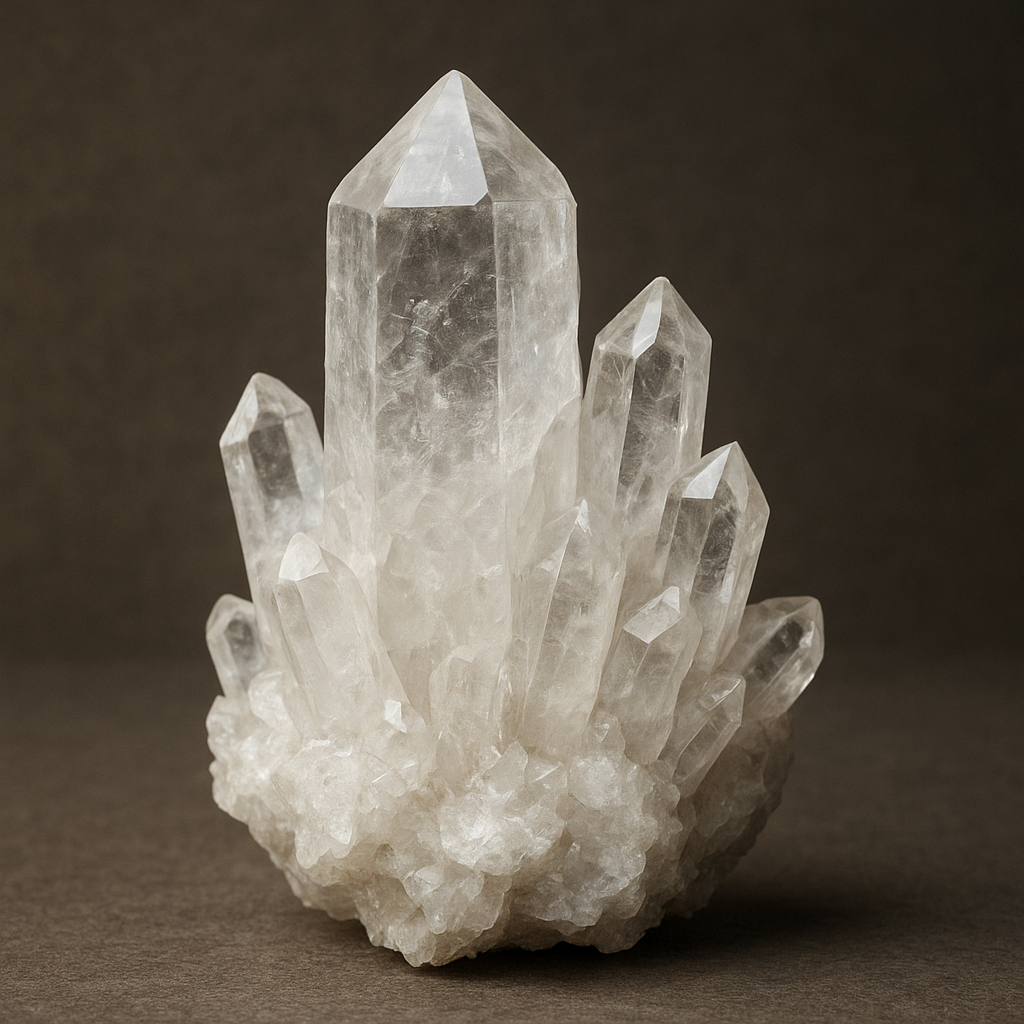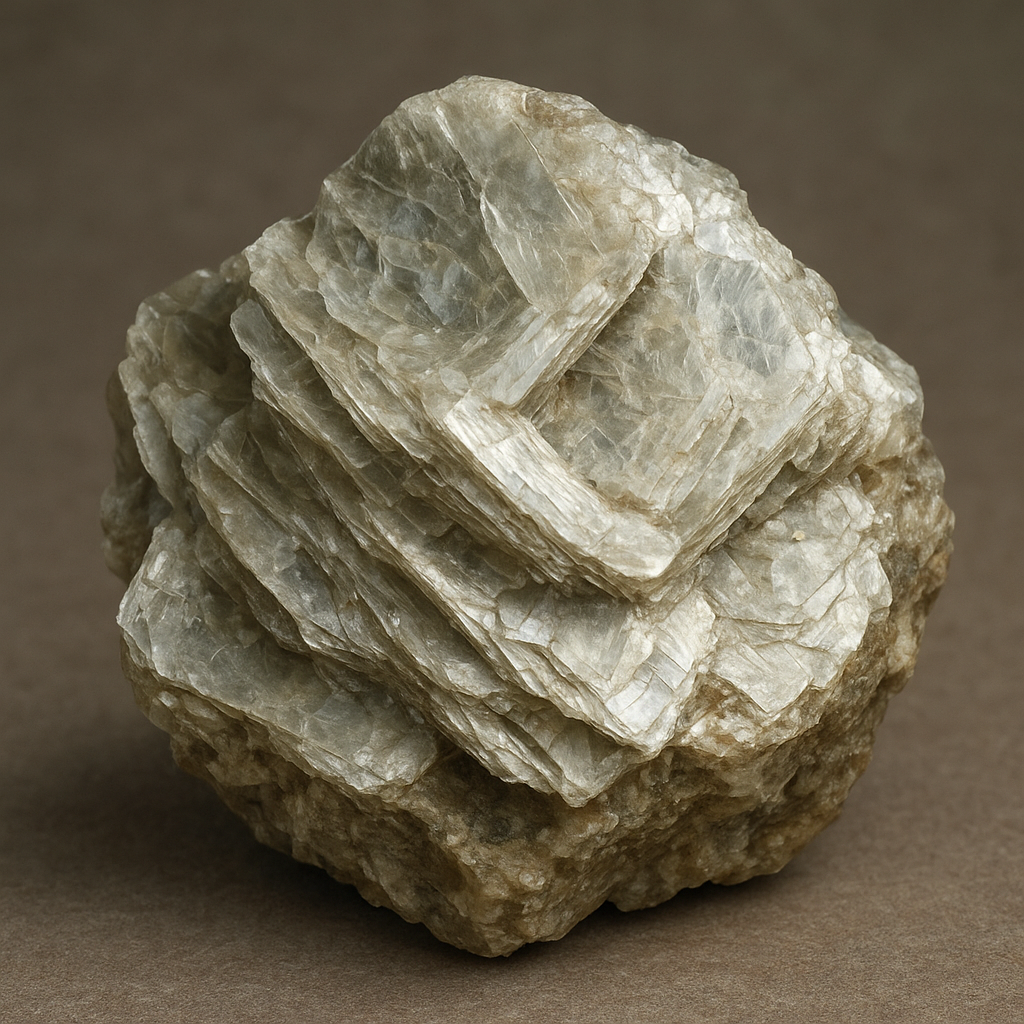
Muscovite is a common and versatile mineral whose influence crosses geology, industry and technology. Known for its thin, flexible sheets and remarkable combination of thermal, electrical and optical properties, muscovite has been used since antiquity and continues to find new roles in modern research and manufacturing. This article explores the mineral’s chemistry and structure, where it forms and is mined, its broad range of applications, and several intriguing scientific and historical connections that make muscovite more than just another rock-forming mineral.
Chemistry, structure and physical properties
The mineral most people call mica includes several related species; among them, muscovite is the archetype of sheet-like micas. Its ideal chemical formula is KAl2(AlSi3O10)(OH)2, which identifies it as a phyllosilicate (a sheet silicate) in which tetrahedral silicon-oxygen sheets are bonded to octahedral aluminum sheets, with interlayer potassium balancing charge. Because potassium sits between the sheets, muscovite can be cleaved easily into thin, continuous layers.
Key physical and optical attributes of muscovite include:
- Monoclinic crystal system and extremely good basal cleavage that permits separation into transparent sheets only a few micrometres thick.
- Mohs hardness of roughly 2–2.5, making it quite soft and easily split.
- Specific gravity typically around 2.8–3.0.
- Variable color from colorless or silvery to pale green, brown or yellow, depending on trace elements.
- Excellent thermal stability up to several hundred degrees Celsius, and very low electrical conductivity, giving it strong dielectric properties.
Because individual sheets are atomically smooth and chemically inert on their basal faces, muscovite is prized in laboratories as a stable, flat surface for microscopy and surface-science experiments. The sheets are also naturally flexible and resistant to heat, which underlies many of their industrial applications.
Where muscovite forms and where it is mined
Muscovite forms in a variety of geologic environments where aluminum- and potassium-rich compositions are available. It is abundant in igneous, metamorphic and sedimentary rocks, and commonly appears as part of the matrix or as phenocrysts in granites, pegmatites and schists.
Typical geological settings
- Granites and granite pegmatites: muscovite often crystallizes from evolved, water-rich melts and forms large, well-developed sheets in pegmatites.
- Metamorphic rocks: muscovite is stable in low- to medium-grade metamorphic rocks such as schists and phyllites and can be produced by metamorphism of clay-rich sediments.
- Sedimentary deposits: detrital muscovite grains persist in sandstones and other clastic rocks because of their resistance to chemical breakdown.
Major mining regions
Large, commercially significant deposits of muscovite occur around the world. Historically and presently important sources include:
- Russia (the historical namesake region, Muscovy)—early large sheets were exported and used as window material.
- India—one of the largest modern producers of both sheet and ground mica.
- Brazil and Madagascar—noted for high-quality sheet mica and gemmy specimens.
- China and the United States—industrial-scale production of ground mica and specialty mica products.
- Finland, Canada and parts of Africa—sources of both sheet and exfoliated mica.
In pegmatites, muscovite can form exceptionally large crystals, sometimes several metres across, which are sought after by collectors and occasionally used directly where large sheets are required. Conversely, much of the global mica market is dominated by smaller flakes and powders produced by mining and milling muscovite-bearing rock.
Industrial and technological applications
Muscovite’s combination of chemical inertness, thermal stability and electrical insulation has led to a surprisingly wide range of uses. Below are the principal categories and specific applications with explanations of why muscovite is chosen.
Electrical and thermal insulation
- Mica sheets and tapes: Because muscovite resists heat and is an excellent electrical insulator, it is made into sheets and tapes for insulating furnace windows, heating elements and electrical coil windings.
- High-voltage applications: Mica’s stable dielectric constant and low loss tangent make it valuable in capacitors, bushings and packing materials for high-voltage transformers and radio-frequency devices.
- Electronic substrates: Thin mica sheets serve as stable, atomically smooth insulating substrates in laboratory work and in specialized electronics where an inert, flat surface is needed.
Construction and industrial fillers
- Paints, coatings and joint compounds: Ground muscovite improves workability, reduces cracking, and provides a subtle sheen. In exterior coatings it can increase the water resistance and durability of films.
- Plastics and rubber: Mica acts as a reinforcing filler that enhances dimensional stability and thermal resistance.
- Roofing materials: Ground mica provides weather resistance and improves the mechanical properties of roofing shingles and membranes.
Cosmetics and pigments
One of the most visible modern uses of muscovite is in cosmetics, where very finely ground muscovite is coated with oxides (for example, titanium dioxide or iron oxides) to produce pearlescent and opalescent pigments. These mica-based pigments impart shimmer and a luminous look in eye shadows, lipsticks and nail polishes. The production of these pigments uses exfoliation and coating techniques to create thin, reflective flakes with controlled optical effects.
Oil and drilling industry
Exfoliated and ground mica is added to drilling fluids to help seal porous formations and control fluid loss; the platey particles bridge fractures and fragile zones in the borehole wall. Ground mica also improves the rheology of certain drilling muds and helps stabilize hole integrity under difficult conditions.
Scientific and high-tech uses
- Substrates for 2D materials and microscopy: Researchers often use freshly cleaved muscovite surfaces when studying graphene, transition-metal dichalcogenides and other two-dimensional crystals because the mica is atomically flat and electrically insulating.
- Laboratory windows and sample holders: Transparent mica sheets can serve as observation windows in vacuum systems and as temporary covers for small samples under heat or mechanical loading.
- Synthetic and engineered mica: Fluorphlogopite and other synthetic mica analogues have been developed to provide consistent optical and physical properties where natural variability is problematic—for example, in high-end cosmetic pigments and aerospace insulation.
Geological and scientific significance
Muscovite is more than a useful industrial mineral; it is an important recorder of geological history and a tool in geological investigation.
Geochronology and thermochronology
Because muscovite contains potassium, it is commonly used in K–Ar and Ar–Ar dating methods. These isotopic systems allow geologists to determine the timing of metamorphism, cooling and deformation events in the crust by dating mica separates. Muscovite’s closure temperature (the temperature below which argon is retained) makes it particularly useful for constraining medium-temperature thermal histories.
Metamorphic indicators
The presence, composition and texture of muscovite in metamorphic rocks provide information about pressure-temperature conditions and fluid histories. Mineral assemblages that include muscovite can be used with thermodynamic modelling to estimate metamorphic conditions, and the growth or replacement textures of mica help unravel deformation and fluid episodes.
Petrological and structural uses
Muscovite’s distinctive cleavage and habit make it an important phase in thin-section petrography: it is easy to recognize under the microscope and its optical properties (such as birefringence and extinction angles) are diagnostically useful. Muscovite can also influence rock mechanical behavior: mica-rich schists, for instance, often exhibit pronounced planar anisotropy that affects slope stability and engineering performance.
Processing, products and quality control
From raw mica to finished products, the industry applies a series of mechanical and chemical treatments tailored to the desired end-use.
- Splitting and sorting: Large muscovite sheets are sorted by size and quality; sheet mica is evaluated for continuity, transparency and absence of inclusions.
- Exfoliation: Heat or chemical treatment expands mica into lightweight, accordion-like flakes that are used as fillers or sealants.
- Grinding and milling: Controlled milling produces particle sizes ranging from coarse flakes to sub-micron powders used in paints and cosmetics.
- Coating and surface treatment: To make pearlescent pigments, mica flakes are coated with oxides; to improve dispersibility in polymers, surface treatments can add coupling agents or polymeric coatings.
Quality control often focuses on particle size distribution, aspect ratio (platelet thickness vs. diameter), whiteness or color, and absence of contaminants (including fibrous minerals that could create health concerns).
Health, environmental and ethical considerations
Muscovite is chemically benign in bulk form, but industrial processing can generate fine dusts that are harmful if inhaled in large quantities. Prolonged exposure to mica dust has been associated with lung disease (pneumoconiosis) among workers in poorly controlled mining and milling environments. Distinguishing mica from friable asbestos is important because asbestos fibers are far more hazardous at low concentrations; however, cases of mica pneumoconiosis underline the need for proper dust control and respiratory protection in processing plants.
Environmental concerns about mica mining include habitat disruption, water use and tailings management. Social and ethical issues have also arisen in certain regions where artisanal mica mining employs vulnerable populations. In response, some manufacturers source mica from certified, audited suppliers and invest in traceability programs, while research continues into synthetic mica and alternative pigments to reduce pressure on natural supplies.
Interesting historical and modern facts
- The name muscovite derives from Muscovy (an old name for a region of Russia), where large sheet mica had long been used as an inexpensive substitute for glass—hence the historic term “Muscovy glass”.
- Large flakes of muscovite were once used for small windows in stoves and lanterns because of the mineral’s heat resistance and transparency.
- Modern research uses thin muscovite sheets as substrates for studying the physics of atomically thin materials like graphene. The atomically flat mica surface reduces charge traps and provides a clean insulating support.
- Muscovite is used as an argon-bearing phase for K–Ar dating, making it a recorder of geological time for metamorphic and igneous events.
- Advances in synthetic mica manufacture (e.g., fluorphlogopite) are supplying industries that require highly consistent optical and thermal behavior, such as aerospace insulation and premium cosmetics.
Research frontiers and future directions
Two main threads define much of the contemporary scientific interest in muscovite:
- Fundamental surface science and nanotechnology: Fresh, cleaved muscovite offers an exceptional platform for probing low-dimensional physics, friction at the nanoscale, and the behaviour of adsorbed molecular layers. Its role as a near-ideal insulating substrate means muscovite will remain important in investigating 2D heterostructures and novel electronics.
- Materials replacement and sustainability: As cosmetics, paints and electronics expand, demand for consistent, non-contaminating mica increases. Synthetic mica analogues and improved recycling of mica-containing composites are active areas of applied materials research aimed at reducing environmental footprint and supply-chain vulnerability.
In short, muscovite is both an ancient and a modern material: a simple sheet silicate whose straightforward crystal chemistry gives rise to a mix of properties exploited across industries and scientific fields. From the pegmatite crystal cleaved by a collector to the micron-scale flake that makes an eyeshadow shimmer, muscovite’s versatility keeps it relevant in very different human contexts.