
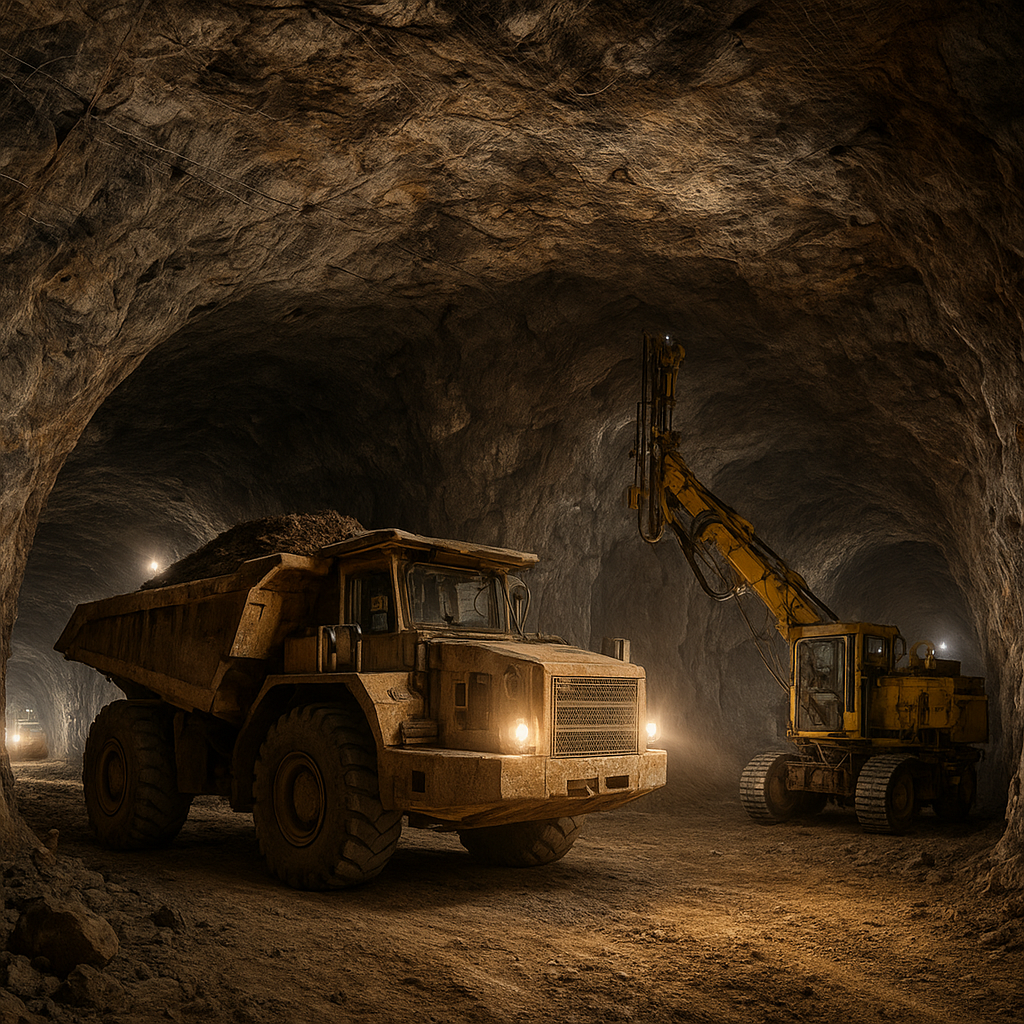
The Mponeng Mine is one of the most extraordinary and technically challenging mining operations on the planet. Located in the mineral-rich heart of South Africa, this mine has captured global attention for its extreme depth, its role in extracting world-class gold from the ancient rock of the Witwatersrand, and the engineering innovations required to keep men and machines operating kilometres below the surface. The following article explores where Mponeng is situated, what is mined there, its economic significance, and a selection of the most compelling and unusual aspects of the operation.
Location and geological setting
Mponeng lies roughly to the west of Johannesburg, in the Gauteng province of South Africa, and is part of the much larger Witwatersrand Basin — a geological formation that has produced the majority of the world’s gold over the past century. The basin comprises ancient sedimentary rocks and conglomerate layers that were deposited roughly 2.8 to 2.9 billion years ago. Within these layers, narrow, laterally extensive reefs — often called auriferous conglomerates — concentrate gold particles and make extraction economically viable even where individual grades are low.
The mine itself comprises an intricate network of shafts, tunnels and underground infrastructure descending to depths of around four kilometres beneath the surface. Mponeng’s location on the Witwatersrand is significant because this region forms the backbone of South African gold mining history: decades of prospecting and mining here have produced enormous quantities of the precious metal, and Mponeng represents the extreme vertical expression of that history. Sitting over a dense and mature urban-industrial region, the mine also provides an interface between deep-rock mining and modern metropolitan economies and logistics.
What is mined and how it is extracted
At Mponeng the primary commodity is gold, recovered from the ancient conglomerate horizons. The ore bodies are not massive bulk deposits but are instead composed of relatively thin, extensive bands that require precise mine planning and selective extraction. The geological model relies on high-resolution drilling, sampling and assaying to map the distribution of gold-bearing reefs and to guide development.
Mining at such extreme depths demands specific techniques. Conventional deep-level methods such as longitudinal or transverse stoping, modified as mechanisation advanced, have been employed to extract ore. Modern mechanised underground equipment — including mechanised drill rigs, loaders, and high-capacity hoisting systems — move ore from working faces to underground rockbreakers and then to skips that lift it to surface processing plants. Ventilation systems supply fresh air, while sophisticated pumping networks manage groundwater inflows. The rock temperature at depth can be very high, so active cooling systems, refrigeration plants, and chilled water circuits are essential to maintain working conditions for crews and equipment.
On the surface, the extracted ore is crushed and run through milling circuits, gravity concentration where applicable, and further chemical processing to isolate gold — typically through cyanidation and carbon-in-pulp or carbon-in-leach processes, followed by smelting to produce doré bars. Waste material, tailings and process effluents are managed through engineered tailings facilities monitored for environmental compliance. Continuous improvement in recovery techniques, metallurgical testing and process optimisation helps maintain economic viability despite the depth-related cost pressures.
Economic significance
Mponeng’s contribution to the economy operates on several levels. At the most direct level it produces significant quantities of gold for export and sale, contributing to the country’s foreign exchange earnings and to corporate revenues for the operator. The mine has historically supplied high-grade ounces relative to many other global projects, although ore grades in the Witwatersrand have generally declined over decades of exploitation. Nevertheless, deep-level mining at Mponeng often produces economically attractive ounces because of concentrated reefs and intensive recovery processes.
Employment and livelihoods are another key channel. A large workforce — comprising miners, engineers, geologists, technicians, and support personnel — relies upon the operation for wages and benefits. Beyond direct employment, there is a considerable multiplier effect: local suppliers, transport services, smelting and refining contractors, maintenance firms, and community development projects all depend on the mine’s activity. In regions around deep mines, municipal revenues and small-business development often correlate with mining success.
At the national scale, mines like Mponeng also influence policy discussions around energy supply, labour law, environmental regulation, and industrial strategy. Capital expenditure on underground infrastructure, ventilation and refrigeration has ripple effects in the heavy manufacturing and engineering sectors. Mines commission extensive surface infrastructure — power substations, water treatment plants, roads — that can be leveraged for broader regional development when properly coordinated with government planning.
Challenges: technical, environmental and social
Operating at nearly four kilometres beneath the earth’s surface brings exceptional technical challenges. Increased rock pressure at depth produces a heightened risk of rock bursts and seismic events — sudden, violent failures of high-stress rock that can cause damage to underground workings and threaten worker safety. Managing seismicity is a daily technical priority, involving rock engineering, monitored blast design, controlled destress techniques, and real-time seismic monitoring networks.
Thermal conditions also present a complex problem. The geothermal gradient means that ambient rock temperature increases with depth; without intervention, working areas would become inhospitably hot. For this reason, large-scale refrigeration systems and chilled-water circuits are deployed to reduce intake air temperatures and keep equipment and personnel within safe operating limits. Energy consumption for ventilation and refrigeration is a major component of operational cost, and the mine’s dependence on reliable electrical supply makes it vulnerable to broader grid challenges in South Africa.
Water inflows and groundwater management are further concerns. Even small seepages can accumulate and require continuous pumping; larger inflows can present acute operational hazards. Tailings management and surface environmental stewardship — including dust control, water quality monitoring and rehabilitation of disturbed land — are also essential to meet regulatory standards and community expectations.
Social and labour-related challenges have historically affected many South African mines. Ensuring safe working conditions, addressing industrial relations, and supporting the social infrastructure of surrounding communities — housing, healthcare, education — remains central to maintaining a sustainable operating environment. Mines must navigate complex stakeholder relationships involving workers, local governments, landowners and civil society.
Interesting facts and technical innovations
Among the most striking characteristics of Mponeng is its status as one of the world’s deepest operating mines. This depth creates conditions rarely encountered elsewhere in the mining industry and drives innovation in safety, automation, and engineering. A selection of noteworthy points follows:
- Depth and engineering: Descending several kilometres below surface, the mine operates in a high-stress thermal environment. The sheer scale of the shafts, hoisting systems and ventilation networks places Mponeng among a very small group of operations globally that face such challenges.
- Cooling and climate control: To manage heat, the mine uses industrial-scale cooling plants and complex air-distribution systems. Without these systems, crews would be exposed to temperatures and humidity levels incompatible with sustained manual labour.
- Seismic monitoring: Mponeng has invested in advanced seismic arrays and real-time analytics to detect and respond to rock-mass movement. Such systems inform scheduling and are used to reduce exposure to hazardous zones when seismic risk is elevated.
- Remote and autonomous technology: Like many modern deep mines, Mponeng has experimented with more remote-controlled and semi-autonomous equipment to limit personnel exposure to dangerous workplaces and to increase efficiency. Tunnel-boring, drilling and load-haul operations increasingly incorporate automation and tele-remote control where practicable.
- Research partnerships: The mine serves as a platform for research in geomechanics, mining engineering and metallurgy. Collaboration with universities and research institutions helps to develop new approaches to deep mining safety and ore recovery.
- Historical and cultural context: Mponeng’s workings connect to a century-long history of gold extraction in South Africa, a narrative that profoundly shaped the country’s economy and society. The mine continues to be a modern continuation of that legacy.
Ownership, governance and the future
Over the years Mponeng has been operated by various companies as part of the dynamic corporate landscape of South African gold mining. The mine’s governance involves a mix of corporate management, regulatory oversight and engagement with local and national authorities. Looking forward, several themes will likely shape its trajectory:
- Cost pressures and commodity cycles: Global gold prices, input cost inflation (notably energy and labor), and exchange rates influence profitability. Deep-level mines have high fixed costs that make them sensitive to price swings.
- Technological displacement and the labour mix: Increased automation may alter the composition of the workforce, reducing the need for some labour types while increasing demand for skilled technicians and data specialists.
- Sustainability and environmental regulation: Tighter standards for water management, emissions and rehabilitation will influence operating costs and procedures. Mines that innovate in energy efficiency and environmental performance may gain competitive advantages.
- Life-of-mine and resource management: As accessible ore is depleted, decisions about decline development, ore-recovery methods and potential closures will determine long-term viability. Reprocessing of tailings and exploration for deeper or adjacent reefs may extend operational life.
Community ties and broader impact
Mponeng’s influence extends beyond its immediate workplace. Mining companies typically invest in community development, health initiatives and educational programmes aimed at improving local living standards. Infrastructure such as roads, power connections and water treatment, when aligned with municipal planning, can contribute to regional improvements. In addition, the mine’s tax and royalty payments support broader public services. Responsible engagement with surrounding communities and transparent benefit-sharing arrangements are crucial to maintaining social licence to operate.
Notable human elements
Stories from deep-level mines often highlight the resilience and skill of workers who operate in extreme conditions. The logistics of moving people and materials over vertical distances of several kilometres, scheduling shifts, and maintaining morale and safety protocols are all part of the human side of mining life. Mponeng embodies both the difficulties and the ingenuity of deep mining communities, where pride in technical skill is matched by a constant focus on safety.
Conclusion remarks
Mponeng is more than a mining operation; it is a testament to the limits of human engineering beneath the earth. The mine demonstrates how geology, technology and economics interweave to produce a complex industrial enterprise. Its production of gold contributes to national and corporate revenues, while the technological solutions developed to manage depth, heat and seismicity feed back into global mining practice. Although the challenges are formidable, the lessons and innovations emerging from Mponeng continue to shape the future of deep mining worldwide. The mine stands as an illustration of how ancient geological fortune can sustain modern industry — but also how much effort and ingenuity are required to unlock those riches safely and responsibly.

