
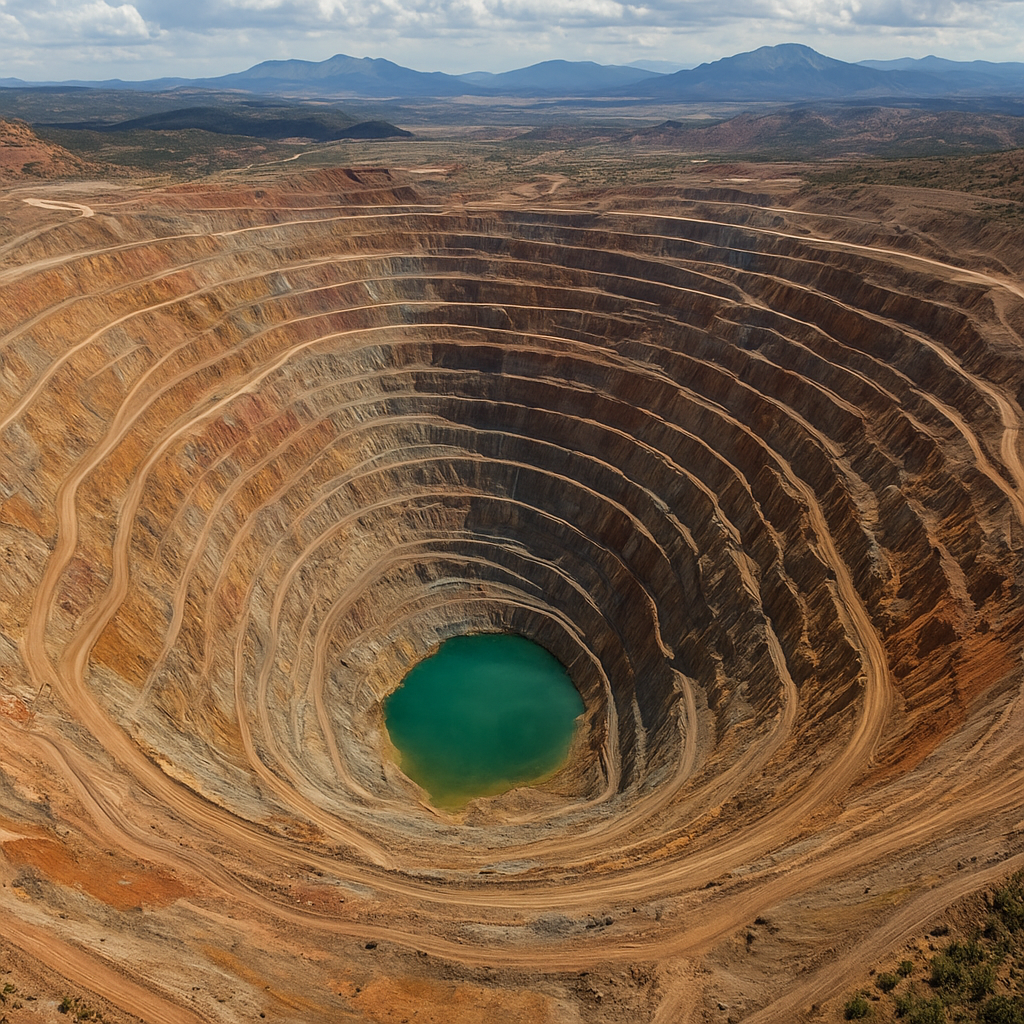
The Morenci area in the United States is home to one of the most important copper mining complexes in North America. This article examines the location, geology, operations, and broader significance of the mine, as well as several notable and sometimes surprising aspects of its history and technology. Readers will find a detailed picture of how a single mining complex can shape a region’s industry, workforce and contribution to global metal supply chains.
Where Morenci Is Located and Why the Geology Matters
The Morenci mining complex sits in the southeastern corner of the state of Arizona, in Greenlee County near the small towns of Clifton and Morenci. The landscape is characterized by rugged hills and high desert that gave way, over geological time, to a concentration of metal-bearing rocks. The deposit mined at Morenci is a classic example of a porphyry copper system: a large, disseminated body of mineralization formed by magmatic-hydrothermal processes that produced copper, with associated molybdenum and minor precious metals.
Porphyry deposits are geologically extensive rather than rich in very high-grade pockets. That means they are amenable to large-scale, low-grade mining methods, which is why Morenci developed into a massive operation. The rock types and alteration zones typical of porphyry systems control where miners locate pits and processing facilities. Over more than a century of exploration and development, the Morenci complex has expanded into multiple open pits that exploit this broad mineralized envelope.
Mining Methods and On-Site Processing
The Morenci operation is primarily an open-pit complex that uses large-scale earthmoving equipment: electric shovels, hydraulic excavators, and fleets of high-capacity haul trucks. Open-pit mining allows economical extraction of low-grade ore over wide areas. After removal, ore is usually crushed and processed on site.
Comminution and Concentration
Once extracted, ore from Morenci is delivered to crushing and grinding circuits where it is reduced to a size suitable for mineral separation. The main metallurgical route for much of the ore involves flotation in concentrators to produce a copper-rich concentrate. The presence of associated molybdenum and trace precious metals is managed by separation steps in the mill, which increase the value recovered from each ton of ore.
Hydrometallurgy and Electrowinning
In some parts of the operation, especially for certain ore types and satellite deposits, hydrometallurgical techniques such as heap leaching followed by solvent extraction and electrowinning (SX/EW) are used to produce high-purity copper cathodes. These processes can be more flexible and have smaller surface footprints than smelting for some ore types, and they are an important complement to traditional concentrate production.
Support Infrastructure
A large mining complex requires substantial infrastructure: tailings storage, water treatment and recycling systems, electrical substations, maintenance facilities, and transport links. Morenci’s concentrators, stacking areas, and processing plants are integrated with extensive roads and conveyors. Tailings and water management are critical components of ongoing operations and regulatory compliance.
Ownership, Workforce and Economic Role
Morenci is operated by a major international mining company; the site’s ownership and corporate structure influence investment, technology adoption, and market access. The mine has a long history with successive operators that have invested to expand reserves and modernize equipment. As one of the largest copper-producing operations in the United States, Morenci contributes significantly to the national supply of copper.
The local workforce is a mix of skilled tradespeople, engineers, metallurgists, and support staff. Mining towns in the Morenci-Clifton corridor developed to serve the mine, and although population levels have fluctuated with commodity cycles, the operation remains a primary employer in the region. The mine’s economic ripple effects include:
- Direct employment for hundreds to thousands of workers across mining, processing and maintenance roles.
- Indirect jobs in services, transportation, construction and supply chains supporting the operation.
- Significant contributions to local and state tax bases, permitting public services, schools and infrastructure.
- Export revenues and trade linkages through sale of copper concentrate and refined copper to domestic and international markets.
The strategic importance of copper for electricity transmission, electronics, telecommunications, and increasingly for clean energy technologies and electric vehicles means that large producers like Morenci have value beyond local economies. Copper mined in Arizona ends up in a broad range of industrial supply chains, influencing manufacturing and energy projects worldwide.
Economic Importance and Market Context
Copper is a base metal with a wide variety of industrial uses, making steady production essential to many sectors. The Morenci complex’s output helps stabilize the domestic supply of copper, reducing dependence on imports for certain downstream industries. In times of tight global supply, large, reliable mines in politically stable regions like the United States play an outsized role in market balance.
Several economic dimensions stand out:
- Supply security: domestic mines like Morenci anchor U.S. access to copper for critical infrastructure projects.
- Price sensitivity: Morenci’s production can influence regional concentrate availability and therefore pricing for smelters and refiners.
- Investment flows: the capital-intensive nature of mining supports suppliers of heavy equipment, engineering services and contractors.
- Technological demand: growth in renewable energy and electrification places a premium on reliable copper supply, increasing strategic interest in the operation.
Environmental Management, Regulation and Community Relations
Large mining operations face rigorous environmental and permitting requirements. Morenci has had to manage a range of environmental topics such as water use and treatment, air quality and dust control, tailings storage, and progressive reclamation of disturbed land. Modern mining practice emphasizes minimizing impacts through water recycling, treatment plants, dust suppression systems and careful design of tailings facilities.
Community relations are central, too. The mine supports local schools, healthcare and other community projects, but it also has to manage expectations about employment, land use and long-term environmental stewardship. Responsible operators engage in continuous dialogue with local governments, residents and stakeholders to ensure mine closure and reclamation plans are realistic and funded. Reclamation in arid environments aims to stabilize slopes, restore native vegetation where possible, and repurpose former mine lands for compatible uses.
Technology, Innovation and Safety
Morenci has been a site for technological adoption in large-scale mining. The drive for higher productivity, improved safety and lower environmental footprint has led to investments in modern equipment and systems:
- Digitization of operational data, enabling real-time monitoring of equipment and process performance.
- Deployment of autonomous or remotely operated haul trucks and monitoring systems to reduce on-site risks and increase efficiency; automation has been an important trend in large open-pit operations globally.
- Advanced metallurgical techniques to improve recovery rates and reduce energy consumption per unit of metal produced.
- Improvements in tailings and water management technologies to reduce long-term environmental liabilities.
Safety programs focus on reducing fatality risks, improving behavioral safety, and integrating emergency response capabilities. Mining operations like Morenci continually update training and equipment to adapt to new technologies and regulatory standards.
History and Interesting Facts
The mining history in the Morenci area stretches back to the late 19th century, when prospectors and early companies discovered copper and began small-scale extraction. Over decades, the operation was consolidated, expanded and modernized, transforming from a cluster of small claims to a large industrial complex. Some points of interest:
- Morenci is among the most enduring examples of a mining district that transitioned from small-scale early workings to an industrial-scale operation that continues to evolve.
- The mine operates in a region with challenging topography and climate, requiring careful logistical planning for transport, supplies and workforce housing.
- Technological milestones at the site reflect the wider history of 20th- and 21st-century mining: mechanization replaced pick-and-shovel mining, and later decades brought process refinements and automation.
- The complex has had to navigate commodity cycles: expansions during periods of strong copper demand and careful cost-management during downturns.
Broader Impacts and Future Outlook
Looking forward, the role of large copper mines in supplying raw materials for decarbonization and digitalization is likely to grow. Demand for copper is closely tied to electrification—power grids, electric vehicles, renewable energy generation and battery technologies all require substantial copper. That means established mines with remaining life-of-mine and potential to expand reserves are strategically important.
For Morenci, this translates into continued scrutiny of resource longevity, permitting for new pits or extensions, and investment in technologies that lower per-ton environmental impacts while maintaining profitability. The integration of more efficient processing, broader recycling of water, and reduced energy intensity per unit of metal will be key management objectives.
Notable Social and Cultural Dimensions
Mining communities develop distinct identities shaped by their relationship to the mine. The towns around Morenci have histories tied to the rhythms of production, labor movements and company-community partnerships. Skills developed in mining—machinery maintenance, metallurgy, heavy construction—often translate into regional human capital that persists beyond the life of any single mine. At the same time, such towns face challenges if production declines: diversifying local economies, securing long-term public services, and ensuring environmental cleanup are ongoing concerns.
Finally, the story of Morenci illustrates how a single mineral deposit can influence regional development, national resource security and global industrial supply chains. Its combination of geological fortune, engineering achievement, and continuous adaptation to economic and environmental pressures makes the complex an instructive case for anyone interested in the modern mining industry.

