
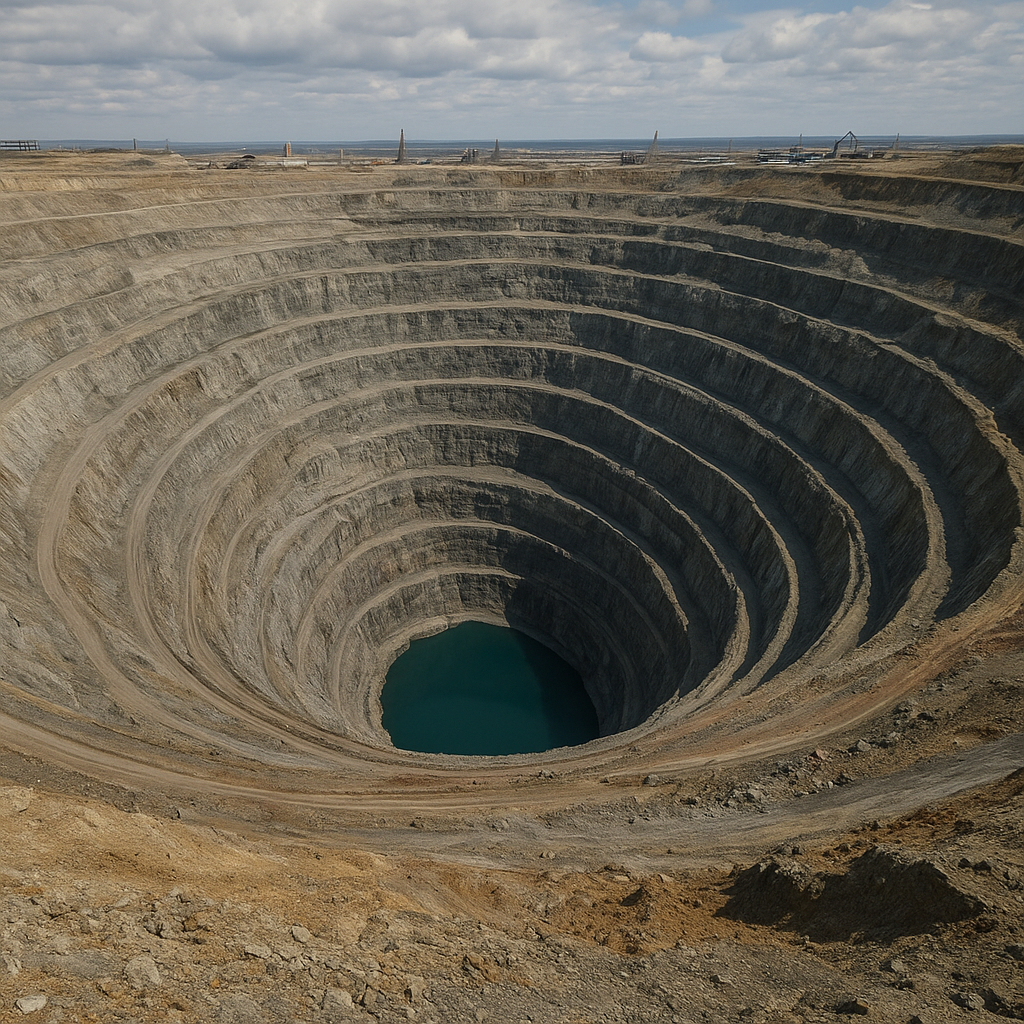
The Mirny Mine is one of the most iconic industrial landmarks of the Russian Arctic, a colossal excavation that symbolises decades of mineral wealth extracted from the permafrost of Siberia. Located in the heart of the Sakha Republic, this remarkable site has shaped local communities, influenced global diamond supply, and become a potent symbol of both human engineering and the environmental challenges associated with large-scale mining. The following sections explore where Mirny is, what is extracted there, how the mine developed and operated, its broader economic role, and a selection of intriguing facts that make Mirny more than just a pit in the ground.
Location and Geological Background
The Mirny Mine sits near the town of Mirny in the Sakha Republic (also known as Yakutia), a vast federal subject of the Russian Federation in northeastern Siberia. The site lies within the Siberian craton, a geologically ancient block of the Earth’s crust that hosts several diamondiferous volcanic pipes. The mine itself is a classic example of a kimberlite pipe—an intrusive volcanic formation that brought deep-mantle material to the surface during explosive eruptions millions of years ago, carrying diamonds formed under extreme pressure and temperature conditions.
Kimberlite pipes are the primary source of naturally occurring diamonds, and the Mirny pipe was discovered during systematic geological exploration carried out in the mid-20th century. The formation is remarkable not only because it contains economically recoverable concentrations of gem- and industrial-grade diamonds, but also because of the scale of the deformation and excavation required to access them. The local geology is complicated by the presence of continuous permafrost, extreme seasonal variation in temperatures, and the challenges posed by remote Arctic logistics.
History and Development
The Mirny deposit was identified during a period of intense geological prospecting. The discovery and subsequent development occurred within the context of Soviet-era resource extraction, when securing strategic mineral supplies was a national priority. The development of the mine led to the rapid growth of the nearby settlement that took the same name, designed to house the workforce and provide essential services in an otherwise remote region.
To exploit the pipe, engineers created a massive open-pit excavation. Over the decades the pit grew into a circular crater hundreds of meters deep and more than a kilometre in diameter, making it one of the largest human-made holes on earth. Mining operations evolved over time: initial surface mining exposed ore, followed by mechanised excavation and eventually transitions in techniques as economic conditions, ore quality and depth forced changes in approach.
Key milestones in Mirny’s development
- Exploration and discovery in the mid-20th century, as part of systematic Soviet geological work.
- Rapid construction of infrastructure and the town to support large-scale mining operations.
- Expansion into a massive open pit that dominated the local landscape and became internationally renowned.
- Later transitions to deeper mining methods and adjustments driven by economic and safety considerations.
Mining Operations and Production
Mirny operated primarily as an open-pit mine for many years. The excavation strategy focused on removing overburden and extracting the kimberlite ore, which was then processed to separate diamonds from the host rock. Over its operational lifetime, Mirny produced significant quantities of diamonds used for both gem-quality jewellery and a wide range of industrial applications (cutting, grinding, drilling).
Operational challenges at Mirny included extreme cold, seasonal logistics, and the technical difficulties of managing a very large open pit in a region prone to frost heave and permafrost thaw. Equipment and personnel needed to adapt to long, dark winters and short, intense summers. The logistical network included roads, air links, and specialised maintenance facilities designed to keep heavy machinery running in subarctic conditions.
The mine’s scale influenced the technological approaches used on-site: heavy haul trucks, large shovels, crushing and sorting plants, and flotation or dense media separation systems for diamond recovery. Over time, as the pit deepened and natural resource economics changed, operators evaluated shifts to underground mining or the gradual closure and rehabilitation of surface facilities.
Economic and Social Importance
Mirny’s contribution to the regional and national economy has been substantial. The diamonds recovered from the pipe provided a steady source of export revenues and helped to create entire supply chains—processing, cutting, trade and distribution—that extended beyond the Sakha Republic into the broader Soviet and later Russian economy. The mine was, and to a degree still is, a key asset in the inventory of Russian diamond companies, influencing global markets for both gem and industrial stones.
The local town of Mirny owes its existence to the mine. Housing, schools, medical facilities, and cultural institutions were established to serve a workforce and their families. For many decades, the mine offered relatively high-paid employment compared with other regional options, attracting skilled workers and specialists from across Russia. This concentration of activity provided economic stability to a remote Arctic community where alternative livelihoods are limited.
At the national level, control over diamond production has strategic implications. Diamonds are not only luxury items but also essential industrial materials. The long-term supply of these minerals underpins various sectors, including manufacturing and construction, and has geopolitical resonance when considering export revenues and trade balances.
Environmental and Safety Challenges
Large-scale mining in polar and subpolar regions raises complex environmental issues. The Mirny pit became a landmark example of potential impacts: landscape alteration, the creation of a permanent crater, and the need for managing tailings and water in a setting where thawing permafrost can destabilise engineered structures. Remediation and closure of such a site require careful planning to avoid groundwater contamination, subsidence, and the uncontrolled release of sediment.
Safety concerns were also prominent. The huge open pit posed risks for workers and for aircraft; indeed, aviation authorities have historically restricted flights and helicopters from flying too low over the pit and nearby operational areas. Steep walls, rockfalls, and equipment hazards required strict protocols. As the open pit aged and deeper ore bodies were sought, operators considered underground alternatives to mitigate some of the physical exposure risks associated with surface excavation.
Environmental management measures
- Control and containment of waste rock and tailings to prevent erosion and seepage.
- Monitoring of permafrost and ground stability around industrial infrastructure.
- Rehabilitation plans that include recontouring and revegetation where climate permits.
- Water management systems to manage runoff and to protect local waterways.
Interesting Facts and Cultural Impact
Mirny has generated a number of stories and images that resonate beyond technical mining literature. The open pit—a circular hole hundreds of metres deep and over a kilometre across—has been captured in photographs from satellite and plane and often appears in lists of the largest man-made excavations on Earth. This visual prominence has fed public fascination and several urban tales about the site.
- Visibility from space: The scale of the excavation makes it visible in satellite imagery, contributing to the mine’s notoriety among space-based observers and the public.
- Iconic crater: The pit is frequently referred to as a crater because of its shape and sheer size. Its dimensions are often cited in comparisons with natural and human-made depressions worldwide.
- Symbol of Soviet industrialisation: The rapid discovery, development and exploitation of Mirny is often presented as an example of mid-20th-century Soviet capacity to mobilise resources in remote regions.
- Local identity: The town of Mirny centres its cultural identity and history around mining; museums and monuments recall the human effort that built the community.
The mine also raised the profile of companies specialising in diamond extraction and processing. One of the major players associated with diamond production in the region is Alrosa, a corporate group that emerged as a dominant force in Russian diamond mining. The broader industry spawned technological innovations in cold-weather mining and ore processing that were transferable to other northern projects.
Continuing Legacy
Although the peak period of surface extraction at Mirny has passed, the site continues to influence mining strategies, regional economics and cultural narratives. The lessons learned about environmental stewardship, remote logistics and the socioeconomic effects of a single-resource town are referenced in debates about responsible mining in extreme environments. Mirny remains a striking example of how geology, human ambition and industrial technology intersect to produce both wealth and long-term responsibilities.
Even as new deposits are found and global diamond markets evolve, the legacy of the Mirny Mine endures: an emblematic hole in the Siberian landscape that tells a story of geological fortune, human endeavour and the tensions between extraction and conservation. Its history offers insights for future projects that will have to balance profit, people and the fragile Arctic environment in which they operate.

