
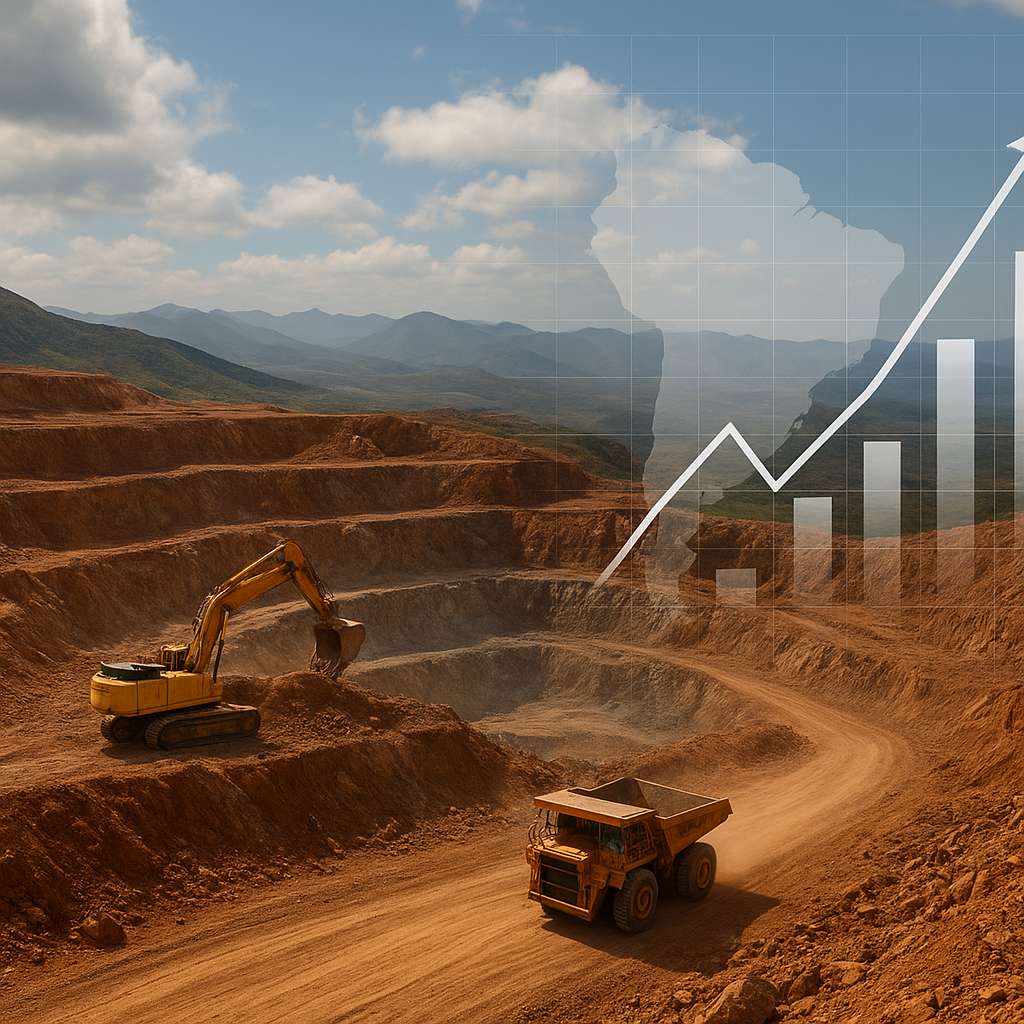
The South American mining sector is undergoing a period of pronounced transformation as global demand for critical minerals grows and producers respond to shifting economic, political and environmental pressures. Investors, governments and communities are reassessing priorities across projects that range from large-scale copper operations in the Andean belt to emerging lithium developments on salt flats. Understanding the patterns shaping capital flows requires attention to commodity cycles, local politics, infrastructure bottlenecks and evolving standards of sustainability. This article maps the principal trends, country-level dynamics and practical considerations for stakeholders active in the region.
Investment landscape and primary drivers
South America retains strategic importance for global mineral supply chains because of its endowment of high-quality ores, scale of deposits and proximity to key markets. Several forces are driving new investment and reshaping existing portfolios:
- Rising demand from electrification and renewable energy transitions, particularly for copper, lithium, nickel and cobalt.
- Commodity price volatility that alternately incentivizes rapid project expansion and enforces capital discipline.
- Heightened importance of governance and transparency as global financiers condition lending on environmental and social benchmarks.
- Technological advances in exploration, processing and tailings management that change project economics and risk profiles.
- Shifts in trade patterns and strategic sourcing policies in North America, Europe and Asia that affect which projects receive priority.
Investors increasingly adopt differentiated strategies: some seek quick exposure via junior developers and royalty streams, others favor long-term positions in large integrated assets operated by major mining companies. Sovereign wealth funds and state-owned enterprises in South America are also reshaping capital allocations, creating a mix of public and private capital participation. The pursuit of finance from multilateral institutions and green bond markets is driving a subset of projects to meet higher environmental standards, while pure commodity-driven deals still proceed under classic cost-plus frameworks when margins permit.
Country-level dynamics and commodity focus
Each country in South America presents unique opportunities and constraints. Investors must combine geological assessment with political and social due diligence.
Chile
Chile remains the world’s largest producer of copper and a global hub for mining know-how. New investments concentrate on deepening resources, decarbonizing operations and expanding lithium capacity in the north. Key considerations include royalty and tax proposals under review, water access constraints in arid zones and permitting timelines. Major players pursue electrification of fleets and integration of renewables to meet both operational goals and investor expectations around sustainability.
Peru
Peru is a top-tier destination for copper and gold. Its large-scale projects attract multinational capital, but social conflict around community consultation and environmental impacts often delays development. The country’s regulatory architecture is evolving, with changes in fiscal terms and contracting frameworks periodically proposed. Robust stakeholder engagement strategies and adaptive community programs are increasingly decisive in securing project continuity.
Argentina and Bolivia
Both countries are central to the burgeoning lithium supply chain. Argentina has seen a surge of exploration and development driven by private investment and the presence of international battery players. Bolivia possesses some of the largest brine reserves but faces governance and operational constraints that limit rapid commercialization. Policy clarity, partnerships with experienced operators and investment in processing capacity are necessary to unlock value.
Brazil
Brazil’s mining mix is dominated by iron ore, but reserves of nickel, copper and critical minerals are attracting interest. Infrastructure gaps and regulatory complexity can increase project costs. However, Brazil’s strong domestic industrial base and port infrastructure in some regions provide comparative advantages for downstream processing and integrated operations.
Colombia and smaller jurisdictions
Colombia and Ecuador are growing as exploration frontiers with potential for gold, nickel and copper discoveries. Political stability, security considerations and land-rights clarity are immediate determinants of whether early-stage prospects translate into financed projects.
Financing, technology and infrastructure considerations
Access to capital is being reshaped by new risk appetites and financing instruments. Traditional bank loans, project finance and equity placements are complemented by streaming, royalties and green finance mechanisms. Institutional investors and export credit agencies increasingly require demonstrable ESG performance, pushing developers to allocate capital to mitigation measures early in project design.
- Project financiers place greater weight on regulatory certainty and robust permitting to reduce the risk of value-destroying stoppages.
- Investment in infrastructure — roads, ports, power and water systems — remains a recurring bottleneck. Public-private partnerships and corridor strategies can unlock stranded projects.
- Adoption of modern technology such as remote sensing, automation and digital twins can materially lower operating costs and reduce environmental footprints, improving bankability.
- Local processing and beneficiation are becoming more attractive as countries seek greater value capture, but they require higher upfront capital and skilled labor.
For financiers, scenario analysis that includes permitting delays, commodity cycles and carbon-price pathways is essential. Deals structured with flexibility — declinable capex tranches, off-take agreements with minimums, and staged development plans — are proving more resilient in the current environment.
Environmental and social governance, and operational risks
ESG considerations now feature in every investment committee memo. Environmental constraints in many resource-rich zones are acute: water scarcity in northern Chile and Argentina, fragile high-altitude ecosystems across the Andes and rainforest considerations in parts of Brazil and Colombia present both compliance and reputational risks.
- Community relations are a central determinant of project timelines. Meaningful engagement with indigenous groups and local stakeholders can reduce costly disputes; failure to do so can halt operations.
- Tailings management emerged as a critical priority after several high-profile dam failures globally. Investors and operators are moving to filtered tailings and dry-stack technologies despite higher costs, to mitigate catastrophic risk.
- Climate risks — including changing precipitation patterns and extreme weather — affect both asset valuation and operational reliability. Integrating climate resilience into design preserves long-term value.
Regulatory volatility is another source of uncertainty. Periodic proposals to raise royalties, adjust contract terms or change permitting rules mean investors need active policy monitoring and scenario planning. In some jurisdictions, the presence and role of state-owned enterprises complicate commercial terms but can also provide stable partners when alignment exists. Strong institutional governance and transparent reporting are increasingly viewed as preconditions for securing lower-cost capital.
Practical guidance for investors, operators and policymakers
Stakeholders looking to engage in South American mining projects should align commercial objectives with operational realities and social expectations. The following points summarize pragmatic approaches:
- Due diligence: Conduct integrated technical, social and political due diligence early. Understand land tenure, community expectations and latent litigation risks.
- Partnerships: Consider joint ventures with local firms or sovereign entities to navigate permitting and community landscapes more effectively.
- Value chain thinking: Where feasible, invest in downstream processing to capture more value locally, but account for greater capex and workforce needs.
- ESG by design: Bake sustainability and community benefit programs into project budgets from the outset rather than as add-ons; this reduces delays and improves access to green finance.
- Flexible financing: Use a mix of equity, debt, royalties and offtake to balance dilution, leverage and downside protection.
- Infrastructure coordination: Coordinate with governments and other projects to optimize shared infrastructure, lowering unit costs and environmental impact.
Policymakers who wish to attract high-quality investment should prioritize clear, stable fiscal frameworks and efficient permitting processes. Transparent consultation protocols that respect indigenous rights and environmental baselines reduce conflict and accelerate development. Programs that incentivize local content and processing, while avoiding protectionism that deters foreign expertise, can increase national value capture.
Emerging patterns and strategic outlook
Investment activity will continue to cluster around projects that can demonstrate low execution risk, credible social consent and pathways to decarbonized operations. Demand for battery minerals ensures lithium and copper will remain focal points, but diversification into nickel, manganese and even rare earths is likely where geology permits. The competitive edge in South America will go to projects that combine technical excellence with forward-looking community and environmental strategies. Ultimately, the winners will be those that can convert resource endowment into resilient, responsibly operated assets that satisfy both immediate market needs and long-term stakeholder expectations.
