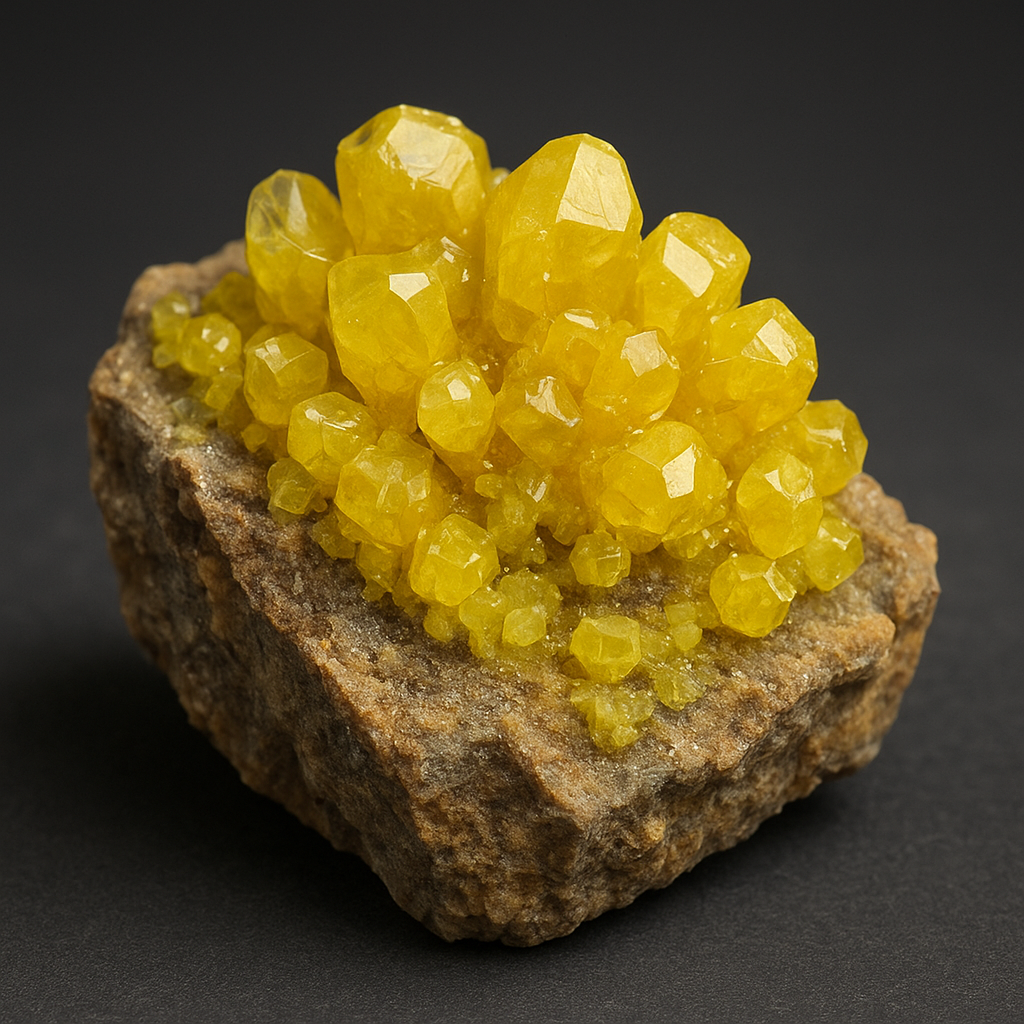
Mimetite is a striking and scientifically intriguing mineral that belongs to the broader family of lead-bearing apatite-group minerals. Known for its brilliant yellow, orange and brown hues and often perfect hexagonal crystals, mimetite attracts collectors and researchers alike. This article examines the mineral’s physical and chemical properties, the geological environments where it forms, its practical uses and implications for environmental science, and several curiosities that make mimetite a fascinating subject for mineralogists and hobbyists.
Physical and Chemical Properties
Mimetite’s formal chemical formula is Pb5(AsO4)3Cl, indicating that it is a lead arsenate with chlorine occupying an apatite-type site. It crystallizes in the hexagonal system, commonly adopting the same structural family as the apatite group. The mineral’s space group is typically P63/m, and its crystals can appear as short hexagonal prisms, barrel-shaped or curved “campylite”-type forms, acicular groups, or botryoidal crusts.
Typical physical characteristics include a Mohs hardness around 3.5–4, a high specific gravity (often between 6.5 and 7.1) due to the presence of heavy lead, and a resinous to subadamantine luster. Colors vary from pale yellow to deep orange and brown; trace-element substitutions and various degrees of oxidation can influence these hues. Optical properties show significant refractive indices, and many specimens reveal sharp crystal faces with excellent terminations—attributes that delight collectors.
Solid Solution and Chemical Variability
Mimetite forms a continuous solid-solution series with other Pb5(TO4)3Cl minerals, most notably pyromorphite (Pb5(PO4)3Cl) and vanadinite (Pb5(VO4)3Cl). In nature, compositional zoning is common: crystals may show phosphorus, vanadium, and arsenic varying across growth zones, producing subtle color and habit changes. This chemical flexibility is central to mimetite’s identity and its capacity to record geochemical conditions in the oxidized zones of lead deposits.
Where Mimetite Occurs
Mimetite is a secondary mineral that typically forms in the oxidized zones above and around primary lead ore bodies. It is generated by the weathering and alteration of arsenic-bearing galena (PbS) and associated sulfides, when arsenic and chlorine are available in the local geochemical environment. Arid and semi-arid climates often yield the most spectacular and well-crystallized specimens because low rainfall favors the preservation of delicate crystal habits.
Common paragenetic associates include cerussite (lead carbonate), anglesite (lead sulfate), vanadinite, pyromorphite, wulfenite, and various arsenates and vanadates. Mimetite is frequently encountered as crusts or clusters coating cracks and vugs in the oxidized portions of carbonate-hosted and hydrothermal lead deposits.
Notable Localities
- Tsumeb, Namibia — Tsumeb is famous for producing many world-class mimetite specimens with well-formed crystals and vivid colors, often in association with a broad suite of secondary minerals.
- Ojuela Mine, Mapimí, Durango, Mexico — One of the most celebrated sources for bright yellow to orange mimetite crystals; the arid environment and complex mineralization yield outstanding collector pieces.
- Mibladen and Touissit, Morocco — These Moroccan localities are well-known for producing fine secondary lead minerals, including mimetite, often in attractive small crystals on matrix.
- Broken Hill, Australia — A large, historic lead-zinc deposit where mimetite appears among the oxidized secondary mineral assemblage.
- Berg Aukas, Namibia and various European localities — Additional important sources that have supplied fine mimetite specimens to collections worldwide.
- China and other mining regions — In recent decades, Chinese localities have supplied many well-crystallized mimetite specimens for the market.
Uses and Practical Significance
Unlike many industrial minerals, mimetite’s primary value is as a collector’s specimen and a subject of mineralogical research rather than as a major ore from which lead or arsenic are extracted. Nevertheless, it is a minor ore of lead and arsenic in some settings and can be important in local mass-balance calculations for weathered ore deposits.
Collector and Aesthetic Value
Exceptional mimetite crystals are sought after by mineral collectors and museums for their vivid colors, well-defined habits, and the rarity of some localities’ quality specimens. The variety historically called “campylite” refers to the distinctive curved, barrel-shaped crystals often prized for their aesthetics. Because mimetite can form attractive crystal groups on matrix and sometimes contrast dramatically with dark host rocks, it is a staple in many fine mineral collections.
Environmental and Remediation Relevance
Mimetite’s composition and stability make it relevant to environmental geochemistry. In mine wastes and contaminated soils where arsenic and lead are present, the natural formation or engineered precipitation of apatite-type lead-arsenate phases can immobilize these contaminants in relatively insoluble mineral forms. Researchers have studied mimetite-like minerals and synthetic analogs as potential agents in remediation strategies, attempting to lock arsenic into stable, low-bioavailability solid phases.
Because mimetite contains both lead and arsenic, handling large volumes of the mineral or high-grade ore must be done cautiously to prevent environmental release. Its low solubility under neutral to alkaline conditions aids stability, but changing redox or acidic environments can destabilize arsenate minerals and mobilize contaminants.
Crystal Growth, Synthesis, and Research
Laboratory studies of mimetite and related apatite-group minerals explore crystal growth mechanisms, solid-solution behavior, and trace-element partitioning. Synthetic mimetite and pyromorphite analogs are used to test immobilization strategies for contaminated soils and waters: by encouraging the formation of stable, tightly bound arsenate or phosphate lattices, these approaches aim to reduce arsenic mobility.
Crystallographic studies have detailed how the large lead cations and arsenate tetrahedra arrange into apatite-like frameworks, and how chlorine and other halogens occupy channels within the structure. These structural channels provide sites for substitution and disorder, which in turn influence optical properties, color, and chemical stability.
Analytical Techniques
Modern mineralogists employ a range of tools to study mimetite: X-ray diffraction (XRD) for phase identification and structural refinement, electron microprobe and LA-ICP-MS for chemical zoning and trace-element analysis, and scanning electron microscopy (SEM) for detailed morphological study. These techniques help unravel growth histories recorded in crystal zoning and microscopic textures, and they clarify the extent of solid solutions with pyromorphite and vanadinite.
Associated Minerals and Paragenesis
Mimetite commonly forms in assemblages that tell a story of oxidation and secondary mineral formation. Primary sulfide assemblages (galena, sphalerite, chalcopyrite) undergo oxidation to generate sulfate, carbonate, phosphate and arsenate species. The availability of chlorine in porewaters or from evaporitic sources promotes the stabilization of chloride-bearing apatite-group minerals such as mimetite, vanadinite and pyromorphite.
- Primary ore: galena (PbS), often the source of lead and arsenic after weathering
- Secondary lead minerals: cerussite (PbCO3), anglesite (PbSO4), pyromorphite
- Vanadates and arsenates: vanadinite, wulfenite (a lead molybdate with visual association in some deposits)
- Silicates and carbonates: limestones and host rocks that control local pH and buffering capacity
Safety, Handling and Ethical Considerations
Because mimetite contains both lead and arsenic, caution is warranted when handling specimens. Collectors should avoid inhaling dust from broken pieces, avoid prolonged skin contact with powdery material, and wash hands after handling. Displayed whole crystals on matrix generally pose little risk if handled responsibly, but cutting, grinding, or polishing mimetite should be avoided or done with appropriate respiratory protection and ventilation.
From an ethical and conservation standpoint, responsible collecting at active or abandoned mine sites should respect landowner and regulatory restrictions, avoid contributing to unnecessary environmental disturbance, and prioritize safety. Many of the world’s best mimetite specimens were recovered in earlier eras when collecting practices were less regulated; modern collectors and institutions aim to balance enthusiasm with stewardship.
Interesting Facts and Cultural Notes
The name “mimetite” derives from the Greek mimetes, meaning “imitator,” a nod to its resemblance to pyromorphite and other members of the apatite group. The historical varietal name “campylite” (from Greek kampylos, “curved”) is still used informally by collectors for the distinctive curved barrel-shaped crystals that many value highly.
In mineralogical detective work, mimetite can record subtle geochemical shifts. Zoned crystals may preserve evidence of changing fluid composition—phosphorus or vanadium enrichment at different growth stages, or variations in halogen content—that reveal aspects of the depositional environment over time. These micro-scale records make mimetite a small but valuable archive of local geochemical history.
Although not a gemstone in the traditional sense—its softness and toxicity limit jewelry use—mimetite’s brilliant colors and crystal forms continue to inspire artistic and scientific appreciation. For museums and serious collectors, a high-quality mimetite specimen is prized not only for its visual appeal but also for the geological story it tells about oxidation, mobility of arsenic and lead, and mineral stability in surface environments.
Further Directions in Study
Ongoing research addresses how mimetite and related minerals respond to environmental change, how solid solutions influence long-term stability, and how synthetic analogs can be used in remediation. Advances in microanalytical methods continue to reveal finer details of crystal growth and trace-element distribution, while field studies at classic localities refine our understanding of the geologic conditions that favor spectacular mimetite formation.
Collectors, researchers, and environmental scientists alike will continue to find mimetite rewarding—whether as a beautiful museum piece, a window into the geochemistry of oxidized ore deposits, or a potential participant in strategies to immobilize toxic elements in contaminated environments.