
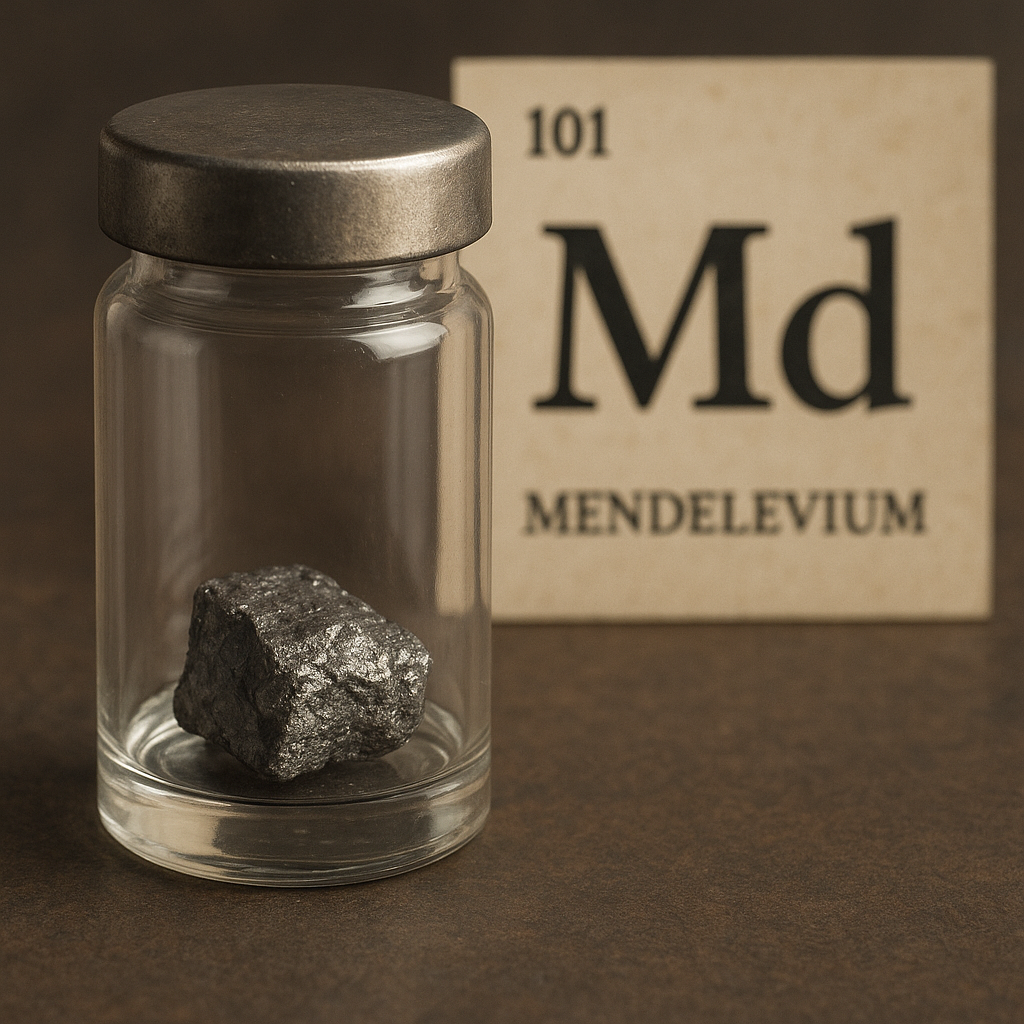
Mendelevium is an element that sits near the end of the actinide series and exemplifies many of the challenges and fascinations of modern nuclear and inorganic chemistry. Although invisible in everyday life, it has played an outsized role in shaping our understanding of heavy-element behavior, the limits of nuclear stability, and the techniques required to produce and characterize atoms that exist only fleetingly. This article explores where Mendelevium comes from, how it is made, what scientists have learned from it, and why such an ephemeral substance continues to attract attention.
Discovery, name and historical context
The discovery of element 101 was announced in 1955 by a team at the University of California, Berkeley, led by Albert Ghiorso and colleagues. They produced the new element by bombarding heavier transuranic targets with light ions in a particle accelerator, and they detected its presence through distinctive decay signatures. The element was named in honor of the Russian chemist Dmitri Mendeleev, creator of the periodic table, reflecting both the tradition of commemorating pioneers and the desire to emphasize the systematic place of new heavy elements in the periodic scheme.
The mid-20th century context is important: research on transuranic elements was advancing rapidly, fueled by improvements in accelerator technology, radiochemical separation methods, and nuclear detection. The discovery of transuranium elements like mendelevium highlighted the interplay between nuclear reactions, atomic structure, and laboratory ingenuity. The early work at Berkeley and other laboratories set standards for producing and chemically characterizing elements that do not occur in bulk form on Earth.
Where mendelevium occurs and how it is produced
In nature, mendelevium is essentially absent. It is a synthetic element created in extremely small quantities under controlled laboratory conditions. Natural geological processes do not produce measurable amounts of this element; any primordial mendelevium that might have existed has long since decayed. Therefore, discussions of where it “occurs” focus on the laboratories and facilities that can make it.
Mendelevium is typically synthesized in particle accelerators or nuclear reactors by nuclear reactions that add particles (protons, neutrons, or alpha particles) to heavy target nuclei. A few typical production routes include bombardment of actinide targets with light ions or by neutron capture followed by beta decay chains. Early synthesis used cyclotrons to accelerate helium nuclei or other light ions into heavy targets such as curium or einsteinium. Modern techniques may employ heavy-ion fusion reactions and sophisticated separation and detection systems to isolate single atoms or tiny ensembles.
- Targets: actinide isotopes such as curium and einsteinium are common starting materials because they are heavy enough that particle capture can reach atomic number 101.
- Projectiles: alpha particles (helium nuclei), heavy ions like carbon or oxygen, or neutron irradiation in reactors can create the requisite nuclear transformations.
- Facilities: specialized cyclotrons, heavy-ion accelerators, and hot-cell radiochemistry laboratories are necessary to generate and handle mendelevium safely.
Because production yields are extremely low—often only single atoms or a few atoms per experiment—mendelevium is one of the rarest substances that scientists can intentionally create. Each successful synthesis is followed immediately by chemical separation and measurement before the atoms decay.
Isotopes, radioactivity and nuclear properties
All isotopes of mendelevium are radioactive. The element has a range of isotopes with mass numbers spanning roughly from the mid-240s to the low-260s; many of these isotopes have been identified, each with its own decay modes and half-life. The most commonly studied isotopes are those with half-lives long enough to allow chemical experiments—typically ranging from minutes to a few months.
- Isotopes: Several isotopes have been synthesized and characterized in decay studies. Some decay by alpha emission, others by beta decay or spontaneous fission.
- Radioactivity: Because every isotope is radioactive, handling mendelevium requires strict radiological controls and specialized containment facilities.
- Nuclear structure: Studies of mendelevium isotopes have informed nuclear models for heavy nuclei, providing data on shell effects, deformation, and the competition between decay channels.
Scientists study decay sequences to confirm the production of mendelevium and to learn about nuclear stability near the limits of the periodic table. Precision measurements of decay energies and lifetimes contribute to our general understanding of how protons and neutrons arrange themselves in very heavy nuclei, an area where many theoretical questions remain open.
Chemistry and chemical behavior
As a member of the actinide series, mendelevium shares chemical characteristics with its neighbors but also displays subtleties that reflect the progressive filling of the 5f electron shell. In aqueous solution and in many compounds, the +3 oxidation state is predominant, consistent with other late actinides. Under strongly reducing conditions, lower oxidation states such as +2 have been observed or inferred—this tendency to stabilize a divalent state increases for the heaviest actinides and parallels trends seen in the lanthanide series.
- Oxidation states: +3 is the most common; +2 can be stabilized in certain ligands and reducing environments.
- Complexation: Mendelevium forms coordination complexes with typical hard ligands (oxygen- and nitrogen-donor ligands) similar to other actinides, and its chemical separations often use ion-exchange and solvent-extraction techniques.
- Separation techniques: Radiochemical methods such as ion-exchange chromatography, extraction chromatography, and solvent extraction are crucial because quantities are minute and rapid handling is required before decay.
Because only picogram to nanogram quantities are typically available, chemical studies of mendelevium use tracer techniques and rely on highly sensitive detectors. These experiments test theoretical predictions about electron configurations and bonding for heavy elements, and they refine our models of f-electron participation in chemical bonding.
Applications and scientific importance
There are no large-scale or commercial applications for mendelevium—the element is produced only in amounts far too small for practical use and is too radioactive for everyday applications. Its significance is primarily synthesis-driven and scientific:
- Fundamental research: Mendelevium provides a testing ground for theories of electronic structure, chemical bonding, and relativistic effects in heavy atoms.
- Nuclear physics: Isotopes of mendelevium help map the landscape of nuclear stability and support searches for new phenomena such as exotic decay modes.
- Method development: The techniques developed to produce, separate, and study mendelevium—advanced radiochemistry and single-atom detection—have broader value for research on other superheavy elements.
In short, mendelevium’s primary role is as a tool for scientists exploring the extremes of matter. Insights gained from its study contribute to the broader knowledge base that underpins nuclear science, radiochemistry, and the periodic system itself.
Techniques used to study mendelevium
Because of the tiny amounts available and the short time windows before decay, researchers have developed specialized experimental techniques to observe and characterize mendelevium atoms and ions. These include:
- On-line separation and detection, where reaction products are rapidly transported from the production site to detection and chemistry stations.
- Automated radiochemical separation systems that operate quickly to isolate the element from a sea of other reaction products.
- Single-atom detection techniques, such as alpha spectroscopy, mass spectrometry adapted for heavy species, and nuclear decay correlation methods.
- Advanced theoretical calculations employing relativistic quantum mechanics to predict chemical and spectroscopic properties, which guides experimental work and helps interpret results.
These methods demand interdisciplinary expertise—nuclear physics, analytical chemistry, and theoretical chemistry all play crucial roles. Progress in instrument sensitivity and reaction-target preparation continues to expand what is possible, even for elements that exist only atom-by-atom.
Safety, handling and environmental considerations
Working with mendelevium requires rigorous safety practices. Even though only minute quantities are generated, the radioactivity of the atoms and the radioactive nature of target and byproduct materials necessitate containment, shielding, and careful waste management. Laboratories use gloveboxes, hot cells, remote manipulators, and specialized detectors to protect personnel and the environment. Additionally, stringent regulatory frameworks govern the transport, use, and disposal of radioactive materials used in these experiments.
Because of the tiny amounts involved, environmental release is not a realistic concern for mendelevium itself, but the production processes involve materials with broader radiological hazards that must be controlled. The focus, therefore, remains on minimizing exposure and ensuring secure, well-documented handling of all radioactive substances.
Connections and curiosities
Mendelevium sits at an interesting juncture in the periodic table where relativistic effects, 5f-electron behavior, and nuclear structure interact in complex ways. A few points of curiosity and connection:
- Periodic placement: As element 101, mendelevium is part of the actinide series and offers insight into how the actinides gradually transition toward chemistry that resembles the heavy transition metals and lanthanides.
- Comparative chemistry: Comparing chemical experiments on mendelevium with those on neighboring elements such as fermium and nobelium reveals subtle trends in oxidation energetics and ionic radii.
- Instrumental legacy: Techniques honed to study mendelevium have been instrumental in the discovery and characterization of heavier superheavy elements, pushing the periodic table to ever higher atomic numbers.
- Educational value: Mendelevium illustrates the iterative nature of scientific discovery—how experiment and theory advance together, and how knowledge often grows from the effort to create and study the extremely small and short-lived.
Selected facts and recorded milestones
- Element number: 101
- Series: Actinides
- Discovery: First synthesized at Berkeley in the 1950s
- Naming: Honors Dmitri Mendeleev, creator of the periodic table
- Chemistry: Predominantly +3 oxidation state; +2 accessible under reducing conditions
- Applications: Purely scientific—no commercial uses
Why scientists remain interested
Even though mendelevium itself will never be part of industry or consumer products, its continued study is valuable for multiple reasons. It helps refine models of electron correlation and relativistic effects in heavy atoms, provides experimental checks for nuclear theory near the limits of existence, and drives innovation in radiochemical methodology. Each new isotope measured or chemical behavior observed contributes a piece to the larger puzzles of how matter organizes under extreme nuclear and electronic conditions.
Finally, the story of mendelevium is a reminder of the human dimensions of science: the creativity of experimental design, the care required to coax information from a handful of atoms, and the enduring curiosity that leads researchers to explore the far reaches of the periodic table. The element is a testament to the lengths scientists will go to answer fundamental questions about the nature of atoms and nuclei—questions that continue to shape our understanding of the material world.