
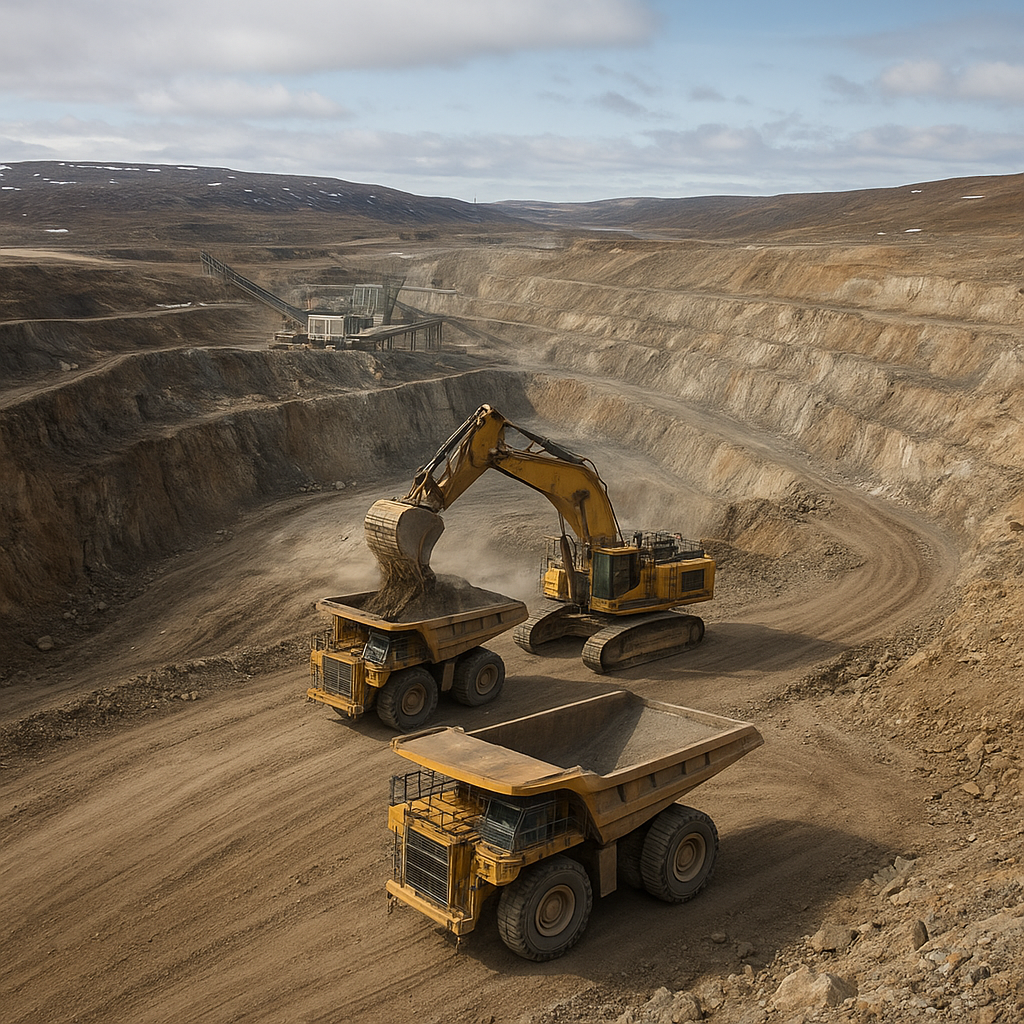
The Meliadine mine is a major modern gold operation in Canada’s Arctic, representing both a technical achievement in northern mining and a focal point for economic activity in Nunavut. Located within a remote, sensitive landscape, Meliadine combines underground mining methods, year-round processing, and extensive community partnerships. This article explores where the mine is located, what is extracted there, its broader economic significance, and several interesting facets that illustrate why Meliadine matters beyond simply producing ounces of gold.
Where Meliadine is located and the regional setting
The Meliadine mine sits in the Kivalliq region of Nunavut, on the southern shore of a peninsula that juts into Hudson Bay. The nearest sizable community is Rankin Inlet, which functions as the principal regional service centre. The site is remote by southern Canadian standards: access relies on a combination of air transport, seasonal sealift for heavy goods, and winter roads for certain logistics. This remoteness shapes nearly every aspect of the operation, from workforce logistics to supply chain planning and emergency response.
Geographical and climatic context
- The mine is located in a sub-Arctic to Arctic climate zone, with long, cold winters, short summers, and ground conditions influenced by permafrost. Seasonal daylight extremes are also a factor.
- Surface infrastructure must be designed for freeze-thaw cycles, with foundations, roads and pipelines adapted to local geotechnical realities.
- Logistics planning takes into account limited shipping windows for sealift, reliance on air freight for personnel and urgent supplies, and the need to stockpile essentials before the winter season.
Geology in plain terms
Meliadine’s mineralization is part of the broader geological framework of the Canadian Shield and adjacent terranes where gold-bearing veins and associated host rocks are present. The deposit comprises zones of gold-bearing sulfide and host rock that are amenable to underground mining methods. While geological jargon can be dense, the key point is that the deposit is sufficiently concentrated and continuous to justify a modern, multi-year mining operation with underground development and a processing plant on site.
What is produced at Meliadine and how it is mined
The primary commodity at Meliadine is gold. Production is achieved through underground mining methods feeding a processing facility where ore is milled and gold is recovered using conventional techniques. The mine is designed to operate year-round, with underground access and processing facilities that are maintained in Arctic conditions.
Mining methods and processing
- Underground mining: declines, ramps, and stopes are developed to access the ore zones below surface. This reduces surface footprint compared with large open pits and helps manage permafrost and seasonal surface impacts.
- On-site processing: a concentrator or mill processes the ore to extract gold. Standard unit operations such as crushing, grinding, flotation or gravity recovery and leaching are tailored to the local ore characteristics.
- Tailings and water management: because of the sensitive northern environment, modern tailings management and water treatment systems are integral to operations, with continuous monitoring and mitigation measures.
Supporting activities
Beyond direct mining, the operation requires a wide range of support services: maintenance workshops, power generation (often diesel-based with increasing emphasis on fuel management), camp and accommodation facilities for fly-in/fly-out workers, and well-developed emergency and health services. The operator also conducts exploration around the main deposit to extend resource life and identify satellite targets.
Economic significance: local, regional and national impacts
Meliadine is not only a producer of gold; it is an economic engine for the Kivalliq region and a strategic asset for the company that operates it. Its significance can be seen across employment, local business development, government revenues and long-term regional planning.
Employment and training
- The mine creates direct jobs in mining, processing, maintenance and administration. It also supports indirect employment through contractors, local suppliers, and service providers.
- Training and skills transfer are emphasized in modern Arctic projects. Programs aimed at building local capacity — including technical training, apprenticeship opportunities, and on-site career development — help ensure that benefits accrue to nearby communities.
- Workforce logistics — fly-in/fly-out rotations — mean that employment can span a broad geographic area, drawing both local residents and southern workers. The balance between them is often a focus of local agreements and regulatory oversight.
Community benefits and agreements
In northern Canada, large projects commonly enter into formal agreements with Indigenous organizations and local governments. These arrangements typically include employment targets, business and contracting opportunities for local companies, and financial benefits such as royalties or revenue sharing. At Meliadine, partnership arrangements aim to deliver long-term social and economic value to the region. Such agreements also often include provisions for cultural sensitivity, training for traditional lifestyles, and support for local education and health services.
Regional development and infrastructure
Beyond direct employment, mines like Meliadine contribute to regional infrastructure. Roads, improved air services, and communications upgrades built for the mine can also serve communities. Procurement of local goods and services stimulates small business growth. On a territorial and national level, mineral exports contribute to trade balances, tax revenues and the broader resource sector’s role in investment and GDP.
Environmental management and challenges
The Arctic environment presents both regulatory scrutiny and operational challenges. Mines must operate under stringent environmental frameworks, with careful planning for reclamation and long-term stewardship.
Managing permafrost and water
- Permafrost requires special engineering approaches to avoid thawing that could destabilize infrastructure or release trapped greenhouse gases.
- Water management is critical: water used in processing is recycled and treated, with monitoring programs designed to track effects on local watersheds and aquatic life.
- Tailings facilities are designed, monitored and reclaimed according to contemporary standards, often incorporating progressive reclamation approaches to reduce long-term footprints.
Regulatory and social expectations
Regulators, communities and environmental organizations expect transparent monitoring, reporting and engagement. Impact assessments completed before construction set conditions for operations and closure planning. Ongoing engagement with local stakeholders, including Indigenous groups, helps ensure that environmental and cultural values are considered in operational decisions.
Interesting aspects and lesser-known details
The story of Meliadine includes technical ingenuity, community relationships, and some operational features that make it notable beyond its gold output.
Arctic engineering and logistics
Operating a mine in the far north demands creative engineering solutions. Buildings, pipelines and roads are designed to cope with extreme cold, and maintenance schedules take into account limited daylight and weather constraints. Logistics planning for fuel, spare parts and food requires long lead times because of limited sealift windows and dependence on air transport. These constraints mean project teams must be excellent at forecasting and contingency planning.
Community partnerships and cultural integration
In many successful northern projects, companies work with local people to integrate cultural knowledge into environmental monitoring and operational practice. That can include traditional knowledge in wildlife monitoring programs, using local harvesters to support monitoring of caribou or marine species, and incorporating Inuit cultural training for non-local staff to foster respectful workplace relations. These elements strengthen social license and often yield operational benefits through local insight.
Exploration upside
One compelling aspect of Meliadine is the potential for exploration to extend the life of the project. Many northern camps host multiple mineralized zones; systematic exploration around a producing mine can identify satellite deposits that are amenable to relatively low-cost development. Exploration success not only adds ounces in the ground but can justify incremental infrastructure upgrades that benefit the camp as a whole.
Operational resilience and long-term outlook
The long-term viability of a northern mine depends on commodity prices, ongoing exploration success, the strength of community agreements, and the rigour of environmental management. Meliadine’s model — underground mining, local engagement, and technical adaptation to the Arctic — exemplifies how modern projects seek to balance production with stewardship.
Economic levers and risks
- Commodity prices: higher gold prices increase project cash flow and can make lower-grade resources economic to mine.
- Exploration: discovering additional resources near the main deposit can extend mine life and justify investments in infrastructure.
- Operational costs: northern operations face higher costs for energy, logistics and workforce mobilization. Efficiency gains and local procurement can mitigate some of these pressures.
Why Meliadine matters beyond the mine site
Meliadine serves as an example of how resource development in sensitive environments can be approached with a combination of rigorous engineering, community partnership, and environmental oversight. The project’s existence stimulates local economies, helps build regional capacity, and contributes to Canada’s mineral production. At the same time, the challenges it must manage — from permafrost to workforce logistics — offer lessons for other projects in high-latitude settings.
Concluding observations
Although this article does not attempt to summarize every technical detail or provide exhaustive financial data, the overarching picture is clear: Meliadine is a strategically important Arctic gold operation that illustrates the complexities and opportunities of mining in Nunavut. It produces gold through modern underground methods, supports local employment and businesses, and operates within a framework of stringent environmental standards and community agreements. Its continued future depends on a range of factors — from exploration success to effective stakeholder engagement — but it already stands as a noteworthy example of contemporary northern resource development.

