
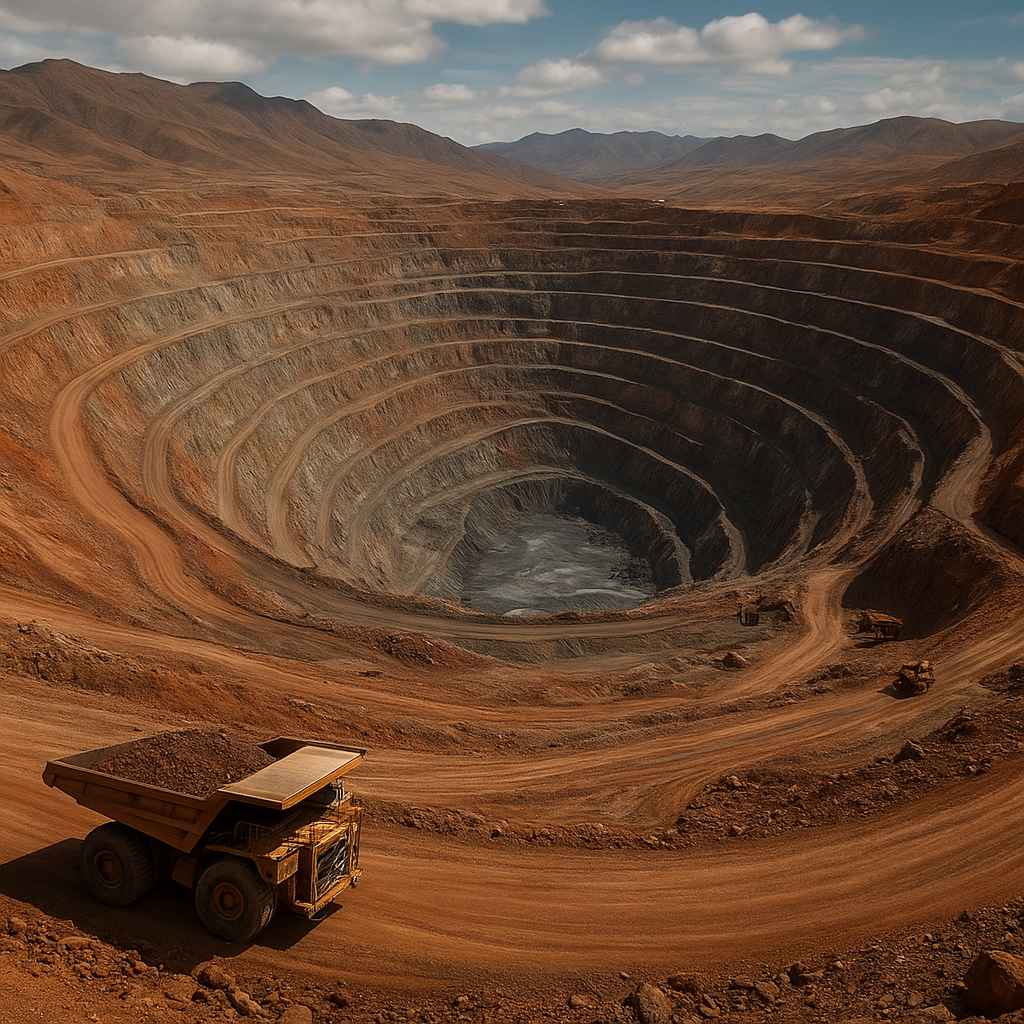
The Marcona mine sits on the arid Pacific coast of Peru and is one of the country’s best-known mineral operations. This article describes where the mine is located, what is extracted there, the mine’s broader economic role and some of the more interesting technical, social and historical aspects surrounding it. Throughout the text, key terms are highlighted to emphasize central themes.
Location, geology and physical setting
The Marcona deposit is located in the coastal province of Nasca, in the greater Ica region of Peru. The facility lies near the fishing town of San Juan de Marcona on the southern desert coastline, a landscape defined by stark sand plains, rocky outcrops and the cold, nutrient-rich waters of the Humboldt Current. The climate is hyper-arid, with very little rainfall and persistent coastal fog on some mornings, which affects both logistics and the local ecology.
Geologically, Marcona is dominated by massive, iron-rich bodies of rock, composed largely of compact, high-grade hematite. These iron ores occur as extensive near-surface deposits that are amenable to open-pit extraction. The character of the ore—dense, coarse-grained and relatively low in impurities—makes it particularly suitable for export directly as a bulk iron product or after modest processing. The deposit type has been the subject of geological study because of its lateral continuity and concentration of iron, offering important insights into ore-forming processes along the western margin of South America.
The mine and its associated infrastructure occupy a narrow coastal corridor: the open pits and processing facilities lie a short distance inland, while a privately operated deep-water port and stockyard complex sits at or near San Juan de Marcona, enabling direct maritime shipment. The coastline here is an important commercial and ecological interface—fishing communities use the same maritime zone that handles massive carriers loaded with iron ore.
What is mined and how operations work
The primary product of the site is high-grade iron ore, predominantly in the form of natural hematite. Mining is carried out in large open pits using conventional drill-and-blast methods, followed by load-and-haul with hydraulic shovels and large dump trucks. Because much of the ore is of high natural grade, the need for complex beneficiation is reduced compared with lower-grade taconite-style deposits; however, sorting, crushing and screening stages are still used to produce a consistent product for customers.
Once processed to the required specification, ore is transported via conveyor systems, private haul roads or in some cases rail links to the export terminal. The port at San Juan de Marcona is a critical link in the logistics chain: it hosts stockyards, conveyors and ship-loading facilities that can accommodate large bulk carriers. A significant share of the material produced is exported overseas, particularly to markets in East Asia where demand for iron-making raw materials is strong.
Operationally, the mine functions as an integrated complex: exploration and reserve evaluation continue in parallel with mining, a processing circuit adjusts product size and quality, and a marine terminal manages storage and shipment. The company operating the mine has invested in maintenance yards, workshops and residential facilities for staff, along with security and environmental control measures intended to reduce dust and manage runoff in the fragile coastal desert environment.
Economic importance and regional impacts
Marcona is a major contributor to the local and national economy. As one of Peru’s principal iron-producing sites, it generates export revenues, provides jobs and stimulates the development of regional services. Key economic roles include:
- Export earnings: Bulk shipments of iron ore from Marcona bring in foreign exchange, supporting Peru’s trade balance and linking the national economy to global steelmaking markets.
- Employment and livelihoods: The mine provides direct employment in mining, processing and logistics, as well as indirect jobs in transport, maintenance and local commerce. For nearby towns, the operation is often one of the largest single employers.
- Infrastructure and services: Mining investment spurs improvements in roads, port facilities and sometimes local utilities. These upgrades can benefit other industries—particularly fishing and small-scale trade—by reducing transport costs and improving access to markets.
- Supply-chain effects: Companies providing fuel, mechanical parts, engineering services and catering benefit from a steady demand generated by the mine.
Because much of Marcona’s product is exported to industrial customers abroad, the mine acts as a bridge between Peruvian natural resources and global manufacturing value chains. Major purchasers historically include steel mills in Asia, which rely on high-grade hematite for efficient ironmaking. The presence of a long-term, large-scale customer base has encouraged sustained investment in the mine’s infrastructure and operational continuity.
Social dynamics and environmental considerations
The Marcona operation exists at the intersection of industrial activity and coastal communities, and that proximity has produced complex social and environmental dynamics. Many local residents depend on the sea for their livelihoods, principally artisanal and industrial fishing. Mining activity, with its heavy truck traffic, dust generation and risk of coastal discharges, has sometimes strained relations between the company and local fishers, communities and civic groups.
Environmental issues commonly associated with coastal iron mining include dust emissions from open pits and stockpiles, potential impacts to the marine environment from port operations, and freshwater use in a water-scarce coastal setting. Because the area receives negligible rainfall, groundwater and any desalinated or transported water become valuable resources. Responsible water management, dust suppression systems, and strict controls on any contaminated runoff are central to mitigating local environmental effects.
Socially, the mine has a mixed record: it brings employment, local investment and public works, but there have also been disputes over labor conditions, community consultations and benefit sharing. Labor unrest has periodically affected production, reflecting broader issues in the mining sector—job security, wages and workplace safety. At the same time, mining companies at Marcona have engaged in community programs, funding local infrastructure, health and education projects intended to build longer-term goodwill and social license to operate.
Regulation, ownership and global ties
Ownership of the Marcona mine places it squarely within the context of global capital flows and foreign direct investment in minerals. The controlling company operating the complex is a large international firm, which has invested in extraction, processing and port infrastructure to serve export markets. That relationship underscores how a local deposit can be integrated into multinational supply chains, with capital, product and technical expertise moving across borders.
Regulatory oversight includes national mining laws, environmental permitting and local municipal ordinances. Compliance with environmental impact assessments, community consultation procedures and labor regulations is essential to lawful operation and long-term viability. Because the mine’s product is destined for global steelmakers, compliance with international expectations on responsible sourcing and environmental stewardship has also become an increasing focus.
Interesting facts and wider context
Several aspects of Marcona and its setting are notable beyond the strictly industrial details:
- Marcona sits in a coastal desert that is ecologically productive offshore; the same currents that sustain large fish populations make the port a busy commercial node.
- The ore’s high natural grade means less intensive beneficiation is required compared with lower-grade iron deposits in other parts of the world, which influences the mine’s economics and carbon footprint per tonne of product.
- Because shipments are predominantly maritime, port efficiency and maritime logistics are as important as pit design to the mine’s daily throughput and profitability.
- Social and labor dynamics at Marcona have mirrored larger trends in Latin American mining—periodic strikes, negotiations over royalties and benefits, and attempts to formalize community-development agreements.
- Marcona is an example of how natural-resource wealth in coastal zones can create both opportunity and tension when industrial-scale mining and traditional marine-based livelihoods occupy the same space.
Technological and operational notes
The mine employs a range of heavy-equipment technologies common in large open-pit operations: fleet management systems, scheduled maintenance regimes, and monitoring of dust and water. Advances in ore-sorting and remote monitoring continue to be applied at many modern mines; these can increase efficiency, lower costs and reduce environmental footprints by minimizing waste movement and optimizing processing. Investments in conveyors and shiploaders reduce truck traffic along public roads and thereby limit local disturbance.
Regional significance
The presence of Marcona contributes to the diversification of Peru’s mineral export base. While the country is widely known for copper and gold, the mine highlights Peru’s role as a supplier of iron to global steelmaking markets. The relationship between domestic resource development and international demand illustrates how commodity cycles and infrastructure investments shape regional economies.
Concluding observations
Marcona stands as an important industrial site in coastal Peru, producing high-quality iron ore that feeds global steel mills and supports local and national economic activity. Its combination of geology, coastal logistics and social context makes it a compelling example of modern bulk-minerals development. Key names connected to this operation include the operating firm—an international steel and mining investor often identified by the name Shougang in public reporting—and the port and community of San Juan de Marcona, which together form the operational backbone of ore export. The mine illustrates both the opportunities of resource extraction—jobs, infrastructure and export revenues—and the challenges: environmental management, water use, dust control and respectful engagement with coastal communities. Through continued attention to technical efficiency and social license, Marcona will likely remain a significant node in Peru’s mining landscape and in the global iron-ore trade.

