
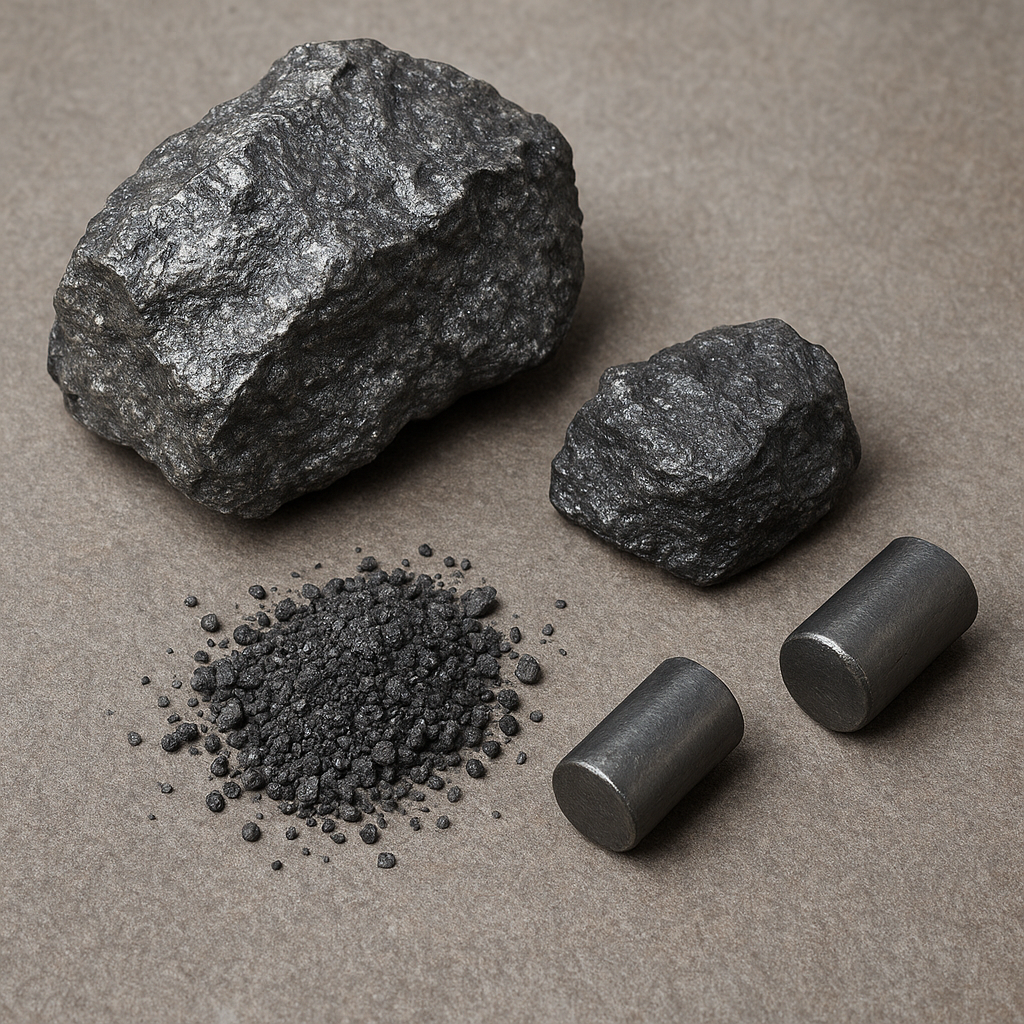
Manganese is a transition metal with a wide range of roles across industry, geology, biology, and environmental systems. Its versatility arises from multiple stable oxidation states and its ability to form a diverse set of compounds. The following text explores where manganese is found, how it is extracted and used, its importance to living organisms, and several intriguing facts that illustrate the element’s multifaceted character.
Occurrence and geology
Manganese occurs naturally in the Earth’s crust at average concentrations comparable to more familiar metals such as copper. It is rarely found as a free metal in nature; instead, it is concentrated in a variety of minerals and deposits that form under different geologic conditions.
Common minerals and deposit types
- Pyrolusite (MnO2) — one of the most abundant manganese minerals and an important ore.
- Rhodocrosite (MnCO3) — a manganese carbonate that can form colorful banded deposits.
- Hausmannite (Mn3O4) and manganite (MnO(OH)) — oxides and hydroxides commonly found in weathered profiles.
- Manganese nodules — hydrogenous deposits found on the deep ocean floor that contain Mn, Fe, Ni, Cu, and Co.
- Marine sediments and residual lateritic deposits — where manganese can be enriched through leaching and secondary concentration.
Manganese ores are mined around the world. Major producers include South Africa, China, Australia, Gabon, and Brazil. In many deposits the manganese occurs together with iron and can be processed as part of iron ore operations. Economically viable ores are processed to produce ferroalloys or refined metal depending on the intended use.
Geochemical behavior
The element’s behavior in soils, sediments, and water is strongly controlled by its oxidation state. Mn(II) is relatively soluble and mobile under reducing conditions, while higher oxidation states (Mn(III), Mn(IV)) form sparingly soluble oxides and particulates that scavenge other trace elements. This redox flexibility leads to manganese acting as a key tracer of redox processes in environmental studies and contributes to the formation of characteristic black manganese oxide coatings on rocks and sediments.
Mining, extraction, and production
Global manganese production supports a large steelmaking industry and growing high-technology applications. Mining methods vary from open-pit and underground to deep-sea exploration for nodules, although commercial exploitation of nodules remains limited.
Processing routes
- Ore concentration by gravity separation, flotation, or hydrometallurgical methods.
- Production of ferroalloys — ferromanganese and silicomanganese — in submerged-arc furnaces using coke, quartz, and iron sources.
- Electrolytic manganese metal (EMM) — produced by leaching ores and electrolytic deposition for applications requiring high purity manganese metal.
- Chemical routes — production of manganese dioxide for dry-cell batteries, and potassium permanganate via oxidation processes.
Most mined manganese (~80–90%) is consumed by the steel sector, where it is indispensable as an alloying element. The remainder is used in chemicals, aluminum alloys, batteries, and specialized applications.
Industrial applications
Because manganese confers important mechanical and chemical properties when combined with other metals and compounds, its industrial footprint is broad and deep.
Steel and alloys
Manganese is vital for the production of strong, wear-resistant steel. Even small additions change the behavior of steel during hot working and improve tensile strength, toughness, and resistance to abrasion. Manganese acts as a deoxidizer and helps remove sulfur and oxygen impurities by forming sulfides and oxides that can be separated from molten steel. Ferroalloy products — such as ferromanganese and silicomanganese — supply the alloying manganese needed for most steel production.
Batteries and energy storage
Manganese dioxide (MnO2) has long been a primary component of alkaline and zinc–carbon cells as a depolarizer. In modern lithium-ion batteries, manganese is a key element in cathode materials such as lithium manganese oxide (LiMn2O4) and layered mixed oxides where manganese contributes to capacity, stability, and rate capability. Research into sodium-ion and other alternative battery chemistries also explores manganese-based cathodes due to the metal’s relatively low cost and favorable electrochemistry. The rise of electric vehicles and grid storage has increased interest in sustainable manganese supply and recycling of manganese-containing batteries.
Chemical industry and catalysts
Potassium permanganate (KMnO4) is a versatile oxidizing agent used in water treatment, organic synthesis, and disinfection. Manganese compounds serve as catalysts in oxidation reactions, polymerizations, and environmental remediation processes. In organic chemistry, permanganate and manganese-based catalysts are classical reagents for selective oxidations.
Other uses
- Glass and ceramics — manganese compounds can decolorize glass by neutralizing green iron impurities or provide violet and brown pigments.
- Aluminum and copper alloys — small manganese additions refine grain structure and improve mechanical properties.
- Fertilizers and animal feeds — manganese is an essential micronutrient added in controlled amounts.
- Electronics and pigments — specialized manganese compounds appear in electronics, pigments (e.g., manganese violet), and magnetic materials.
Biological role and health
Manganese is an essential trace element for virtually all living organisms. It participates in enzyme catalysis, metabolic pathways, and antioxidant defense systems. At the same time, both deficiency and excess carry health risks, so understanding its physiological balance is important.
Biochemical functions
Manganese is a cofactor for numerous enzymes, including arginase, pyruvate carboxylase, and manganese superoxide dismutase (Mn-SOD), a critical mitochondrial antioxidant enzyme. Its roles include:
- Carbohydrate and amino acid metabolism.
- Synthesis of connective tissue components.
- Detoxification of reactive oxygen species via Mn-SOD.
- Bone formation and reproductive function.
Biological systems typically use the Mn(II) oxidation state, and cells tightly regulate manganese uptake and export through transporters and binding proteins to avoid toxicity.
Dietary sources and deficiency
Typical dietary sources include whole grains, nuts, legumes, tea, and leafy vegetables. Deficiency is rare in humans but can cause impaired growth, skeletal defects, and reproductive issues in animals. Recommended intakes vary by age and region; supplements are used when required but should be managed to avoid overexposure.
Toxicity and occupational exposure
Excessive manganese exposure — particularly to airborne particulates in mining, welding, and ore processing — can lead to a neurological condition known as manganism. Symptoms include motor dysfunction, irritability, and cognitive changes. Manganism shares certain features with Parkinsonism but differs in pathology and treatment response. Environmental exposures via contaminated drinking water or food can also raise concerns, particularly in communities near mining or industrial sites. Public health measures include monitoring airborne and waterborne manganese, enforcing occupational safety limits, and controlling emissions.
Environmental aspects and remediation
Manganese cycles through the lithosphere, hydrosphere, and biosphere. Its redox-sensitive nature makes it both a natural participant in geochemical cycles and a factor in pollution scenarios.
Mobility and contamination
Under reducing conditions, Mn(II) is soluble and can leach into groundwater, sometimes reaching concentrations that affect drinking water taste, staining, or health. In oxidizing environments, manganese precipitates as oxides that coat sediments and surfaces, often acting as scavengers for trace metals and influencing heavy metal transport.
Treatment and removal
Common methods for manganese removal from water include aeration followed by filtration (to oxidize soluble Mn(II) to insoluble oxides), chemical oxidation with chlorine or ozone, and biological filtration approaches that harness manganese-oxidizing bacteria. Permanganate is used for in-situ oxidation of certain contaminants but must be carefully dosed and managed.
Recycling and sustainability
Recycling manganese from steel scrap is routine within the steel industry, but recovering manganese from spent batteries and complex electronic wastes is an emerging priority. Advances in hydrometallurgical recycling and closed-loop supply chains aim to reduce the need for new mining and to limit environmental impacts. The geopolitics of manganese supply — dependence on a handful of producing countries and concentrated deposits — motivates investment in recycling and alternative sources.
Interesting and lesser-known facts
Manganese is full of intriguing quirks that reveal how broadly an element can influence technology, art, and natural history.
- Electron configuration — Manganese has a half-filled 3d shell ([Ar] 3d5 4s2) in its neutral state, which helps explain its varied oxidation states and magnetic interactions in compounds.
- Manganese nodules — Large areas of the deep seafloor bear potato-sized nodules rich in manganese, iron, nickel, copper, and cobalt. Their exploitation poses technical, environmental, and legal challenges.
- Role in glassmaking — Historically, manganese dioxide was added to glass to counteract green tints from iron impurities; it is sometimes called a “glassmaker’s soap.”
- Historic pigments — Manganese compounds produced distinctive pigments used in 19th-century ceramics and paintings; some conservationists study their aging and degradation patterns.
- Isotopes — 55Mn is the only stable isotope of manganese and is NMR-active, allowing certain spectroscopic applications. Radioisotopes such as 54Mn have been used as tracers in environmental and physiological studies.
- Catalytic surprises — Manganese complexes have been developed as earth-abundant alternatives to noble-metal catalysts for hydrogenation, oxidation, and C–H activation reactions in organic synthesis.
- Planetary science — Manganese oxides on Mars and other planetary surfaces are of interest because they can indicate past redox conditions and possibly the presence of oxygen-rich environments.
Research directions and future challenges
Contemporary research on manganese spans several fronts. Materials science seeks to optimize manganese-containing cathodes for next-generation batteries, balancing capacity, lifetime, and safety while minimizing resource intensity. Environmental science examines manganese cycling in a warming climate and the implications for water quality. In medicine, research aims to better understand the mechanisms of manganese neurotoxicity and how to protect at-risk workers and populations.
Supply chain concerns are stimulating innovation in recycling technologies, alternative chemistries, and demand-side management. For example, improving the efficiency of manganese use in steel and promoting closed-loop recovery in battery systems could significantly reduce the environmental footprint associated with manganese extraction and processing.
Practical tips and considerations
Individuals and professionals interacting with manganese-related materials should be aware of practical safety and sustainability measures.
- Occupational hygiene — Use respiratory protection, ventilation, and dust control in mining and processing environments to limit inhalation exposure.
- Water testing — If living near mining or industrial areas, test private water supplies for manganese, and follow recommended treatment approaches if elevated.
- Recycling participation — Support and use battery and electronics recycling programs to reduce demand for primary manganese and recover valuable materials.
- Balanced nutrition — Maintain a varied diet to ensure adequate but not excessive manganese intake; consult health professionals before using supplements.
This overview highlights manganese as an element of contrasts: essential yet potentially harmful, abundant in the crust yet concentrated in specific deposits, and historically mundane in some uses while cutting-edge in others. Its centrality to steelmaking, emerging roles in energy storage, and involvement in environmental and biological systems make manganese a subject of continuing technological and scientific importance.