Magnetite is one of the most widely recognized and scientifically significant iron oxides on Earth. This mineral combines an intriguing set of physical and chemical properties — chief among them persistent natural magnetism — which have made it important since antiquity and indispensable in many modern technologies. The following text explores its nature, global occurrence, practical uses, and several fascinating scientific and industrial facets associated with it.
Basic properties and crystal chemistry
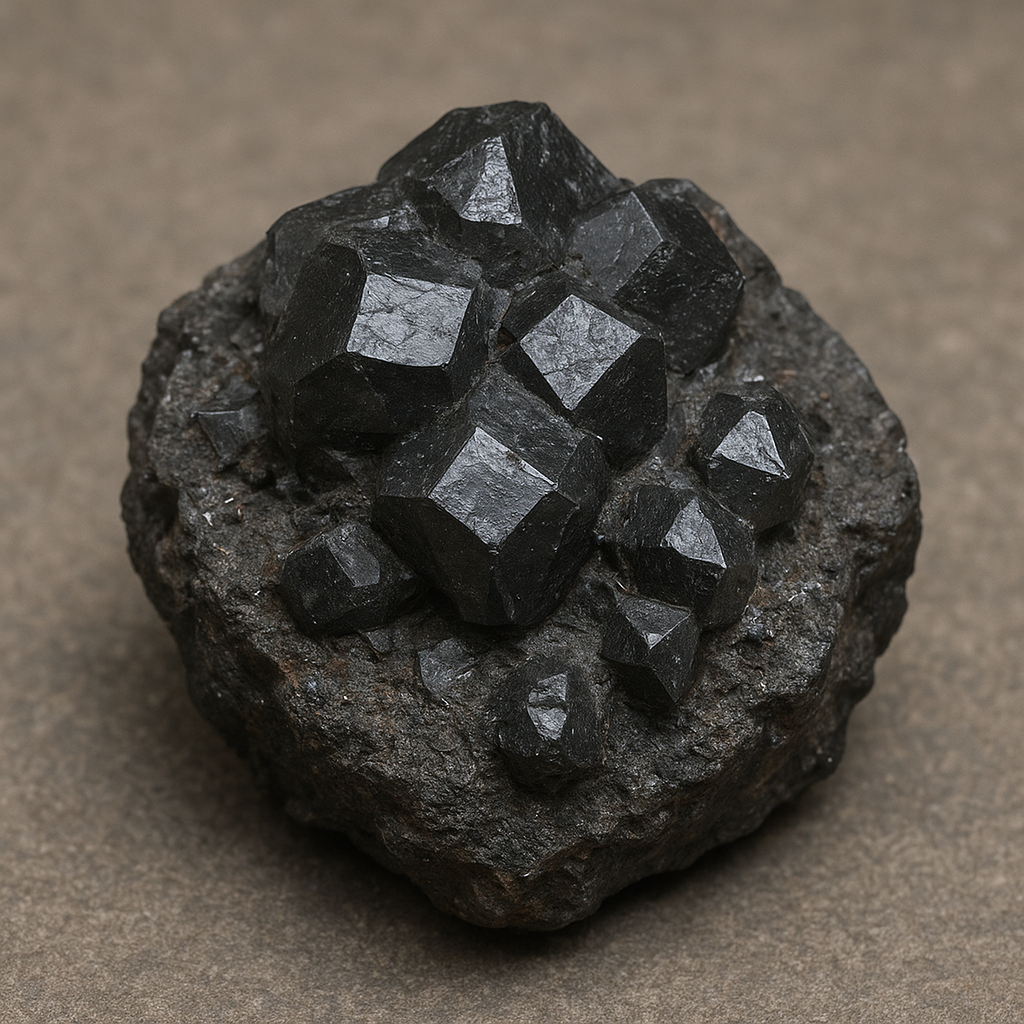
Magnetite is an iron oxide with the chemical formula Fe3O4, often described as a mixed-valence compound containing both Fe2+ and Fe3+ ions in an inverse spinel structure. The mineral belongs to the spinel group and typically crystallizes in the isometric system, producing octahedral, dodecahedral, or more commonly granular and massive habits. Its color ranges from black to brownish-black and it has a metallic to submetallic luster. Key measurable properties include a high specific gravity (about 5.2), a hardness of roughly 5.5–6.5 on the Mohs scale, and strong magnetism, visible even in hand-specimens (magnetite is the principal natural magnetic material and is often termed a lodestone when naturally magnetized).
Cation distribution and electronic behavior
The inverse spinel arrangement places Fe3+ ions on tetrahedral sites and a mixture of Fe2+ and Fe3+ on octahedral sites. This arrangement yields electronic conductivity via electron hopping between Fe2+ and Fe3+ on adjacent octahedral sites, which leads to unique temperature-dependent electronic transitions. Notable is the Verwey transition around 120 K, where the conductivity drops and the crystal undergoes subtle structural distortions. Another important thermal property is the Curie temperature, near 580 °C, above which magnetite loses its ferrimagnetic order.
Geological occurrence and distribution
Magnetite forms in a variety of geological environments, from igneous and metamorphic rocks to sedimentary deposits and hydrothermal veins. It is a major component of banded iron formations (BIFs), an important ore mineral in magmatic iron deposits, and appears as accessory grains in igneous rocks such as gabbros and basalt. Magnetite is also widespread in metamorphic rocks like skarns and in contact-metamorphosed limestones. Additionally, it forms through secondary processes such as oxidation of other iron minerals and precipitation from hydrothermal fluids.
Notable global localities
- Kiruna and Dannemora, Sweden — historically important iron mining districts with high-quality magnetite-rich ores.
- Brazil (Quadrilátero Ferrífero) — large banded iron formations and magnetite-rich deposits.
- Mesabi Range, Minnesota, USA — massive magnetite and hematite ores that fueled the American steel industry.
- Kursk Magnetic Anomaly, Russia — a vast iron ore district dominated by magnetite-bearing rocks.
- South Africa, Australia, and India — multiple magnetite-rich stratabound and magmatic deposits exploited for iron production.
- Extraterrestrial occurrences — magnetite has been identified in meteorites and Martian samples/analogs, and it plays a role in planetary magnetism studies.
Formation processes and environmental settings
Magnetite can crystallize from magma, precipitate from hydrothermal solutions, or grow authigenically in sediments. In BIFs, it is commonly interpreted as the product of chemical precipitation in ancient oceans, sometimes influenced by microbial activity. In skarn deposits, magnetite forms by metasomatic replacement when iron-bearing fluids interact with carbonate rocks. Sedimentary magnetite grains also survive transport and concentration, forming placer deposits that can be mined directly.
Industrial and historical applications
Because of its high iron content and magnetic properties, magnetite has been a valuable resource throughout human history. It served as the original natural magnet or lodestone, enabling early navigational compasses. Today its principal industrial role is as a primary ore of iron for steelmaking and iron-based materials.
Iron and steel industry
Magnetite ores are beneficiated and processed into sinter, pellets, or direct reduced iron for modern steelmaking. High-grade magnetite concentrates are favorable for pelletizing due to their consistent chemistry and magnetic separability. Magnetic separation techniques enable the concentration of magnetite from gangue minerals, producing feedstock for blast furnaces or direct reduction plants. Because magnetite often occurs in massive and disseminated forms, open-pit and underground mining methods are used depending on deposit geometry.
Other commercial uses
- Dense media separation: Magnetite is used in coal preparation plants and mineral separation as a heavy medium to separate materials by density.
- Pigments and polishing: Finely ground magnetite, often called “black iron oxide,” serves as a pigment and is used in polishing compounds.
- Concrete and radiation shielding: Magnetite aggregate improves density for radiation shielding concrete, useful in medical and nuclear installations.
- Electronics and magnetic recording: Historically, magnetite-forming materials were investigated for early magnetic recording and primitive magnetic components.
Advanced technological and environmental applications
Modern science and engineering have repurposed magnetite beyond simple ore use. The mineral’s combination of magnetic response, chemical reactivity, and electronic conductivity has enabled diverse applications from environmental remediation to biomedical tools.
Nanoparticles and biomedical uses
Synthetically produced nanoparticles of magnetite are widely studied for biomedical applications. Their strong magnetic response and relatively low toxicity (after appropriate surface coating) make them attractive as MRI contrast agents, carriers for targeted drug delivery, and agents for magnetic hyperthermia cancer treatment. Magnetite nanoparticles are often surface-functionalized with polymers, silica, or biomolecules to improve biocompatibility, prevent aggregation, and provide targeting functionality. Clinical implementation requires rigorous control of size, surface chemistry, and dosage due to potential risks like oxidative stress and unwanted cellular uptake.
Environmental remediation and catalysis
Magnetite acts as an effective sorbent and catalyst in environmental contexts. Its surface can adsorb heavy metals (e.g., arsenic, lead) and phosphates, and magnetite nanoparticles provide the convenience of magnetic separation after treatment. In advanced oxidation processes, magnetite can act as a heterogeneous catalyst for Fenton-like reactions, generating reactive radicals that degrade organic pollutants. Additionally, microbially mediated redox interactions with magnetite influence the mobility of contaminants in soils and aquifers.
Geophysics, paleomagnetism and planetary science
Magnetite is central to the study of Earth’s magnetic history. Because it records the ambient magnetic field when it forms or cools below its Curie temperature, magnetite grains in igneous and sedimentary rocks are primary carriers of paleomagnetic signals. These records have been essential for reconstructing plate tectonic movements, geomagnetic reversals, and ancient field intensities. On other planets and meteorites, magnetite occurrences inform scientists about past thermal, hydrothermal, and potentially biological processes. For example, magnetite in Martian meteorites and terrestrial analogs is a key line of evidence in debates about past habitability and aqueous alteration.
Synthesis, processing and analytical techniques
Both natural and synthetic magnetite are characterized and processed using a broad suite of analytical methods and beneficiation techniques. Understanding these approaches is important for mineral processing, materials science, and research.
Synthetic routes
- Coprecipitation: A common laboratory and industrial method where ferrous and ferric salts are co-precipitated under alkaline conditions to form magnetite nanoparticles.
- Thermal decomposition: Produces highly uniform nanoparticles through decomposition of organometallic precursors at elevated temperatures in organic solvents.
- Hydrothermal and solvothermal synthesis: Enables controlled crystallinity and particle morphology by using high-temperature aqueous or non-aqueous solutions in sealed vessels.
- Biogenic synthesis: Magnetotactic bacteria biomineralize magnetite within organelles called magnetosomes, producing uniform, single-domain crystals that inspire biomimetic approaches.
Analytical and characterization tools
Characterizing magnetite’s structure, chemistry, and magnetic behavior uses multiple complementary techniques:
- X-ray diffraction (XRD) for crystal structure and phase identification.
- Mössbauer spectroscopy to discern iron oxidation states and magnetic ordering.
- Scanning and transmission electron microscopy (SEM/TEM) for morphology and nanoscale structure.
- Vibrating sample magnetometry (VSM) and SQUID magnetometry for detailed magnetic measurements.
- Raman and infrared spectroscopy for molecular and lattice vibrational information.
- Geochemical assays and bulk chemical analyses for iron content and impurities.
Biological and ecological aspects
Magnetite is not only an abiotic mineral; it is intimately connected to living systems. Certain organisms synthesize magnetite biologically and exploit its properties for orientation and navigation.
Magnetoreception in animals
A variety of animals — from migratory birds to marine animals and some bacteria — appear to sense Earth’s magnetic field. In many cases, magnetite particles located in specific tissues are implicated in this ability, forming nanoscale compass needles aligned with the geomagnetic field. Although the exact mechanisms remain an active area of research, the presence of magnetite-based sensors provides a striking example of nature’s use of a mineral property for navigation.
Magnetotactic bacteria and magnetosomes
Magnetotactic bacteria synthesize intracellular chains of magnetite or greigite crystals enclosed in lipid membranes called magnetosomes. These chains act as nanoscale compasses, directing bacterial movement toward favorable redox zones in aquatic sediments and water columns. The highly controlled biomineralization process produces crystals with consistent size and shape, making magnetosomes of interest for nanotechnology and biotechnology applications.
Interesting scientific and cultural tidbits
Magnetite has inspired myths, technological breakthroughs, and deep scientific inquiry:
- Ancient navigators used naturally magnetized magnetite (lodestone) to orient early compasses, revolutionizing maritime navigation.
- Magnetic anomalies over magnetite-rich provinces (e.g., the Kursk Magnetic Anomaly) played a role in regional geological exploration and economic development.
- Fine-scale magnetite grains in sediments are used to interpret past climate changes and sedimentary processes because they respond sensitively to transport, diagenesis, and redox conditions.
- The study of magnetite in Martian meteorites and soils contributes to debates about water-rock interactions and the ancient habitability of Mars.
- Because natural magnetite grains can record the geomagnetic field, paleomagnetists use them to date tectonic events and model plate motions over geological time — an application central to the theory of plate tectonics and the study of paleomagnetism.
Challenges, safety and sustainability
While magnetite is widely useful, its extraction and use carry environmental and safety considerations. Mining activities can disturb landscapes, produce tailings, and mobilize associated contaminants. Nanoparticles of magnetite, though promising technologically, raise concerns about environmental persistence, toxicity, and human exposure. Responsible mining practices, life-cycle analyses, and careful regulation of nanomaterials are necessary to maximize benefits while minimizing risks. Advances in recycling, beneficiation efficiency, and low-impact mining techniques aim to improve sustainability. Additionally, researchers explore green synthesis routes and biogenic production to reduce environmental footprints.
Magnetite’s combination of rich geological occurrences, practical utility, and deep scientific interest ensures it will remain a focal point across disciplines, from geology and materials science to environmental engineering and biomedicine. Its story connects ancient navigation and modern nanotechnology — a mineral that is both foundational and continually reinvented through human ingenuity.