
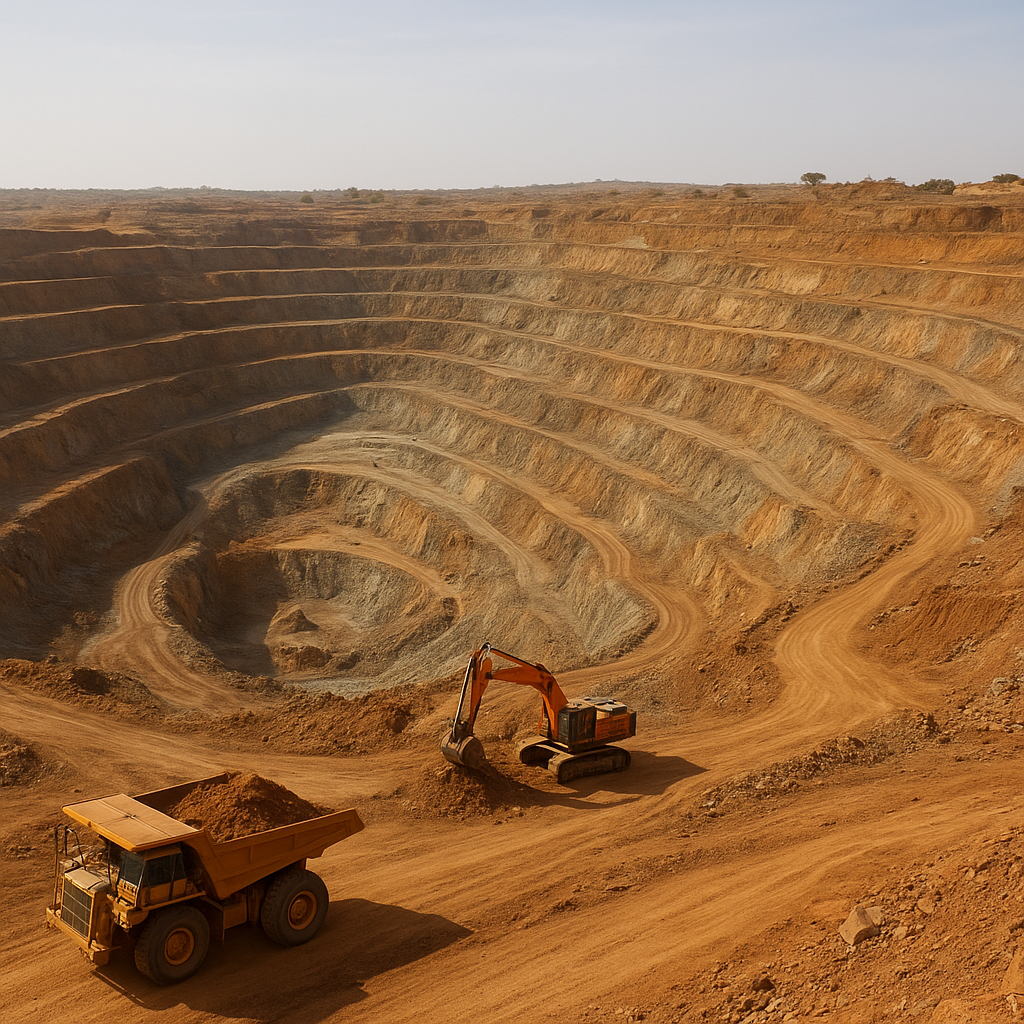
The Loulo-Gounkoto mining complex in western Mali is one of West Africa’s most important gold-producing operations. Located within the prolific West African gold belt, the complex combines multiple open-pit and underground operations and has been a major contributor to Mali’s mining sector for years. This article examines where the complex sits geographically and geologically, what is mined and how it is extracted, the operation’s economic and social importance, and several technical and historical details that many find compelling.
Location and geological setting
The Loulo-Gounkoto complex is located in the western part of Mali, within the broader West African craton and the Birimian greenstone terranes that host much of the region’s gold wealth. The mining leases sit inside the Kéniéba district (often referred to as the Kéniéba inlier), a recognized gold-producing area that stretches towards neighboring countries. Proximity to regional towns and trade routes has shaped the mine’s logistics and community relationships.
From a geological perspective, the deposits exploited at Loulo-Gounkoto are typical of the Birimian-style gold systems: they are structurally controlled, associated with volcanic and metasedimentary sequences, and concentrated along shear zones and quartz-carbonate veins. These geological controls create both near-surface mineralization amenable to open-pit mining and deeper, higher-grade shoots that are best accessed by underground methods. The combination of deposit styles has allowed operators to develop a complex with long mine life and diverse mining methods.
Operations, mining methods and processing
Loulo-Gounkoto is an integrated gold-mining complex that historically combined several pits and underground workings. The production chain typically includes drilling and blasting for open pits, mechanized loading and hauling, and specialized development and stoping methods for underground areas. Ore from both sources is processed at on-site facilities using conventional gold recovery techniques.
Mining methods
- Open-pit mining for shallower, disseminated mineralization that can be extracted with large earthmoving fleets.
- Underground mining to access deeper, narrow, and higher-grade zones using longhole stoping, cut-and-fill, or other selective methods suitable for structurally-hosted veins.
- Attention to sequencing and pit-to-underground transition planning to maximize recovery while managing costs.
Processing and metallurgy
Ore from the pits and underground is typically crushed, milled and subjected to carbon-in-leach (CIL) or similar cyanide-based processes to extract gold. Tailings management, water recycling and cyanide detoxification are standard features of modern processing plants to reduce environmental risk. The scale of the milling operation at Loulo-Gounkoto has supported steady production over long periods, with the plant configured to treat a blend of ores from different sources to optimize throughput and recovery.
Ownership, management and evolution
The Loulo-Gounkoto complex rose to prominence under the stewardship of international mining companies. Following corporate consolidations and industry changes, the operation is now operated by global mining interests—most notably by the company formed after the merger that brought together Randgold and other global players; the complex is managed under the umbrella of that larger international operator in Mali. Local management teams oversee day-to-day activities, with support from international technical and corporate offices.
Over time the complex has evolved through expansion projects, resource definition drilling, and the conversion of near-surface reserves into underground mines to extend life of mine. Continuous investment in exploration both inside and around existing lease boundaries has been a priority to maintain production and replace mined ounces.
Economic significance for Mali and the region
Gold production at Loulo-Gounkoto plays a meaningful role in Mali’s economy. As a high-value commodity, gold accounts for a substantial share of national export receipts and foreign exchange earnings, and operations like this are major contributors to national mining revenues through taxes, royalties and profit-sharing arrangements. The complex also generates direct and indirect economic activity:
- Direct employment of hundreds to thousands of workers in mining, processing, maintenance and administrative roles.
- Indirect jobs in local services, construction, logistics, and small-scale supply chains that support mine operations.
- Local procurement and contracting that stimulates regional businesses and service providers.
- Government revenue via royalties, corporate taxes and permit fees that support public budgets at national and regional levels.
- Community investment programs and infrastructure improvements, such as roads, water projects and clinics financed or co-financed by the company.
At the regional level, the mine anchors a cluster of mining-related activity in western Mali, attracting supporting industries and encouraging complementary investments. The operation’s export of refined gold has a direct impact on Mali’s trade balance and helps underpin macroeconomic stability, particularly during periods when other commodity prices are volatile.
Social programs, community relations and local development
Large-scale mining projects in Mali, including Loulo-Gounkoto, usually undertake community development programs designed to mitigate impacts and share benefits. These programs commonly include:
- Education initiatives such as school construction, scholarships and vocational training aligned with mine skills needs.
- Healthcare projects ranging from clinic construction to vaccination campaigns and maternal health programs.
- Infrastructure investments, including roads, potable water systems and electrification projects that benefit host communities.
- Support for small and medium enterprise development to diversify local economies beyond mining dependence.
Community relations are an ongoing priority. The company operating the complex maintains communication channels with village leaders, landowners and civil society organizations to manage land use, compensation, artisanal mining activity and cultural site preservation. These relationships are complex and require continual negotiation and responsiveness to local needs and concerns.
Environmental management and reclamation
Environmental stewardship at modern gold mines involves comprehensive strategies to manage water, biodiversity, waste rock and tailings. At Loulo-Gounkoto, environmental management practices typically include:
- Water management plans that control process water and stormwater, aiming to recycle water and limit discharge.
- Tailings storage facilities designed, monitored and maintained according to prevailing international standards to prevent failures and contain cyanide and heavy metals.
- Progressive rehabilitation of disturbed land and mine closure planning to restore vegetation and reduce long-term environmental liabilities.
- Monitoring programs for air, water and soil quality to detect and respond to potential impacts.
Environmental performance is scrutinized by regulators, financiers and civil society. The company’s public reporting and independent audits help maintain transparency, while investments in best-practice engineering and monitoring reduce the risk of major environmental incidents.
Security, governance and regulatory context
Mali’s political and security environment has been dynamic in recent years, and mining operations such as Loulo-Gounkoto must navigate that context carefully. Security considerations can include protecting personnel and assets, safeguarding transport routes for concentrate and refined product, and managing the interface with artisanal miners who often operate near formal concession areas.
Regulation of mining in Mali is conducted under national mining law and through permit systems that define exploration, exploitation, environmental obligations and community commitments. The government’s role includes monitoring compliance, collecting revenue and facilitating local employment and supplier development. Effective governance is critical to ensuring that mining revenues translate into broad-based development outcomes.
Challenges and risks
Like other large-scale mines, Loulo-Gounkoto faces an array of risks:
- Market risk tied to global gold prices, which affect revenue and project economics.
- Operational risk related to ore grade variability, equipment failures and the transition between open-pit and underground mining domains.
- Environmental and social risk linked to water scarcity, land use conflicts, and community expectations regarding benefits and impacts.
- Security and political risks arising from regional instability and changes in national governance frameworks.
- Exploration and resource-replacement risk, because sustaining production depends on continued discovery and conversion of resources into reserves.
Interesting technical and historical notes
Several aspects of the Loulo-Gounkoto complex are technically and historically noteworthy:
- The integration of both open-pit and underground operations within a single complex demonstrates flexible mine planning and the ability to optimize recoveries across different ore types and depths.
- Resource definition and reserve conversion have been ongoing priorities; systematic drilling and mine-site exploration have extended mine life and improved orebody knowledge.
- The site is part of the extensive Birimian belt, which is a globally significant Archean-Proterozoic terrane for gold and explains why the region hosts multiple large gold deposits.
- Following corporate consolidation in the global mining sector, the operation has benefitted from access to international capital, geotechnical expertise and management systems that prioritize safety, efficiency and environmental control.
- Adaptive approaches to water scarcity and tailings management reflect evolving industry practices for arid and semi-arid environments, including water recycling and incremental rehabilitation.
Employment, skills and local capacity-building
Beyond immediate jobs, the operation promotes skills transfer and local capacity-building. Training programs for technicians, plant operators and mine supervisors increase local content over time and help develop a skilled regional workforce. In many cases the mine’s human-resources policies prioritize local hiring for entry-level roles while sourcing specialized skills internationally when necessary. The economic multiplier effect from these training and hiring policies tends to be substantial for host communities.
Regional mining ecosystem and downstream effects
Loulo-Gounkoto sits within a broader regional mining ecosystem in western Mali. The presence of a major operation encourages ancillary industries—fuel suppliers, mechanical workshops, transportation companies and catering services—creating a local industrial base that persists beyond the mine itself. In addition, local artisanal and small-scale mining (ASM) communities often interact with large-scale operations, for better or worse: there can be cooperative arrangements for small-scale employment or purchase of services, but there can also be tension over land and water resources and safety risks where ASM occurs close to working pits.
Notable milestones and project expansions
Over its operational life, the complex has undergone multiple investment phases to expand throughput, develop underground infrastructure and extend mine life. Expansion projects typically target deeper ore shoots or satellite deposits within the concession. These developments require careful economic justification, regulatory approvals and community consultation. The cumulative effect of iterative expansions and continuous exploration has kept the complex as one of the anchor mines in Mali’s mining landscape.
Why Loulo-Gounkoto matters beyond Mali
Large-scale, long-life mines in West Africa play roles beyond national borders. They attract international investment, transfer mining expertise to developing economies, and connect local production to global commodity markets. The Loulo-Gounkoto complex exemplifies how modern mining operations can both generate significant export earnings and bring technical and managerial capabilities into a regional context. It also illustrates the balancing act required to maximize economic benefits while managing environmental, social and security risks.
Key takeaways (not a summary)
- The Loulo-Gounkoto complex is a major gold operation in western Mali situated on Birimian geology that is characteristic of the West African gold belt.
- It combines open-pit and underground mining methods and uses conventional processing techniques to produce significant amounts of gold.
- The operation is run by an international mining company (post-merger global group) and contributes important employment, exports and fiscal revenue to Mali.
- Environmental management, community engagement and security are ongoing priorities given the regional context and long operational horizon.
- Continuous exploration and targeted expansion projects have sustained the complex’s importance in the regional mining sector.

