
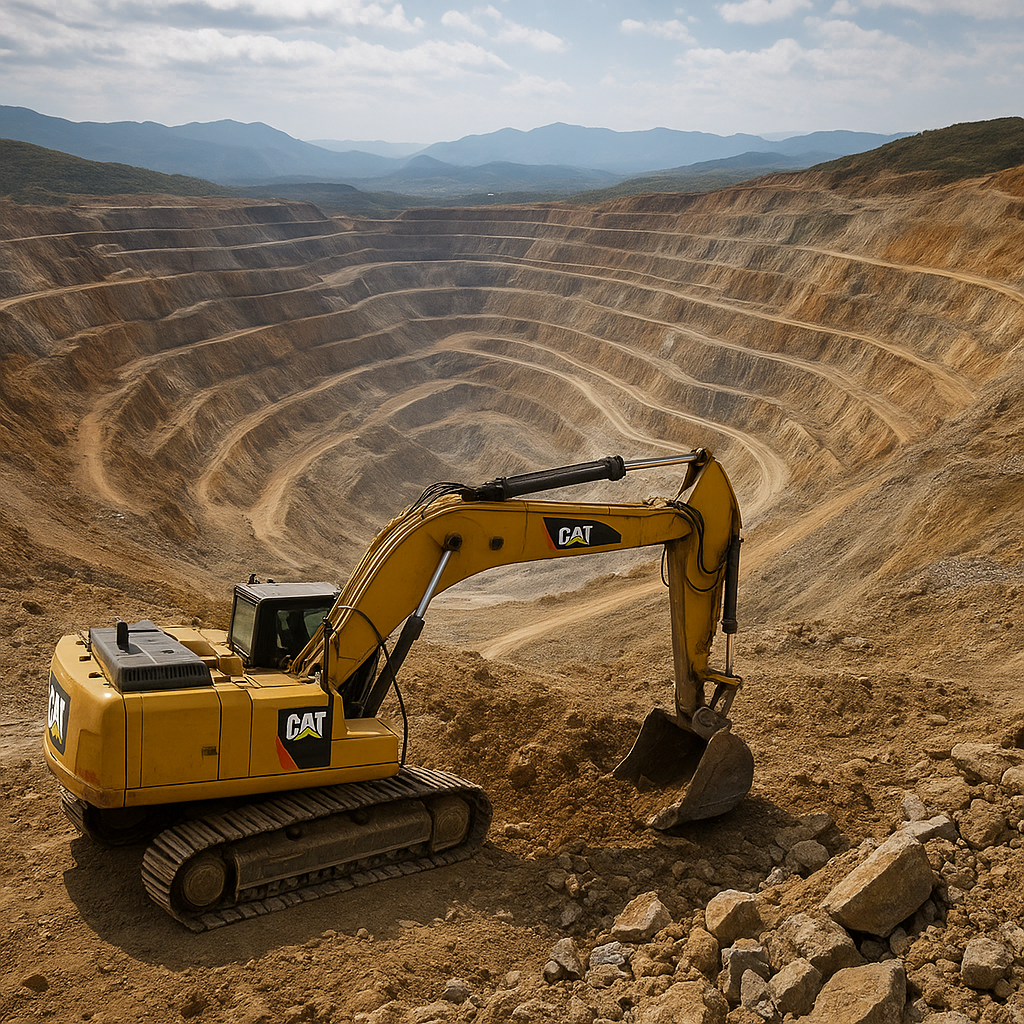
The Los Filos mining complex is one of the most prominent gold-producing sites in southern Mexico. Located in the rugged hills of the state of Guerrero, the operation has drawn international attention for its size, geology and the way it has intersected with local economies and communities. Over decades the site has produced significant amounts of gold using large-scale open-pit methods and heap-leach processing while changing hands among multinational operators and regional firms. This article explores where Los Filos is, what is extracted there, the mine’s economic role, and a number of technical and human-interest aspects that make the site notable.
Location, Access and Regional Setting
Los Filos sits in southwestern Mexico within the mineral-rich belt of the Sierra Madre del Sur. The site is inland from the Pacific coast in a mountainous area characterized by steep valleys, seasonal streams and mixed pine-oak forest at higher elevations. The closest population centers are small, predominantly rural towns that have historically depended on subsistence agriculture, local commerce and artisanal mining. Access to the mine is typically by paved and unpaved roads that connect the site to larger regional hubs and ports on the Pacific coast.
Geologically, the property lies within one of Mexico’s important gold-silver provinces. Hydrothermal systems associated with volcanic and intrusive activity during the Tertiary produced mineralization hosted in volcanic rock sequences, creating disseminated gold and silver that can be economically recovered by large-scale surface mining and heap-leach processing. The combination of accessible, low-to-moderate grade disseminated mineralization and favorable logistics made Los Filos attractive to industrial miners.
What Is Mined and How It Is Processed
The primary product at Los Filos is gold, typically accompanied by smaller quantities of silver as a by-product. The deposit type is best described as low- to medium-grade, bulk-tonnage disseminated gold within volcanic and subvolcanic rocks, suitable for extraction by large open pits. Mining methods at the site have focused on:
- Open-pit excavation of multiple benches and contiguous pits, optimized for steady throughput.
- Crushing and coarse ore agglomeration when required, followed by heap leaching with cyanide solutions to solubilize gold.
- Recovery circuits that may include carbon-in-leach (CIL) or carbon-in-column, electrowinning and smelting to produce doré bars for shipment to refineries.
Heap leaching has been a central element of processing at Los Filos because of the nature of the mineralization: disseminated gold amenable to percolation of cyanide solutions. Heap leach pads, irrigation systems, and solution collection circuits are extensive at the complex. Adjacent processing infrastructure has included crushing facilities, agglomeration plants, reagent storage, carbon-processing facilities and doré production. Tailings deposition for finer fractions has required separate containment facilities and ongoing water management.
History and Ownership
The Los Filos property entered modern industrial production under the control of international and national mining companies that recognized Mexico’s attractive mineral endowment. Over time the mine has passed through multiple ownership structures. A sequence of operators included larger global gold firms and smaller focused producers that invested in life-of-mine extensions through open-pit expansions and satellite deposits.
In recent corporate history the operation was owned and operated by companies that invested capital to optimize throughput and extend mine life. Those ownership changes brought fresh infusions of capital and changes in operating strategy, sometimes including the commissioning of satellite pits, sustaining capital projects to improve water and tailings management, and programs aimed at community investment and environmental mitigation. The development story at Los Filos illustrates a common pattern in mining: a large, long-lived deposit that attracts successive owners who apply different technical and social strategies to realize value.
Economic Importance and Regional Impact
Los Filos has major economic significance at multiple scales. For the regional economy it is a major employer and a source of contracting work that supports local businesses—including transport, catering, equipment maintenance and construction services. Mines of this scale also stimulate secondary economic activity: worker wages support retail, housing and service sectors in nearby towns; contractors and suppliers expand operations to service the project; and governments collect taxes, royalties and permit fees that support public budgets.
At the national level, mining contributes to Mexico’s export profile and brings foreign investment into resource-rich states. Gold production has macroeconomic benefits such as foreign exchange earnings, investment in infrastructure (roads, power, water works) and the development of skilled labor. For mining companies, Los Filos provides a strategic asset: a producing operation with potential for life-of-mine extensions and associated cash flow that can finance corporate growth or exploration in other regions.
- Employment: The site has provided direct jobs in mining, processing and administration and indirect employment among contractors and suppliers. Training programs at the mine have improved local skills.
- Government revenue: Taxes, royalties and permit fees contribute to state and federal budgets, though the specific fiscal flows depend on contractual arrangements and tax structures.
- Local procurement: The mine’s purchasing of goods and services supports small and medium-sized enterprises in the surrounding municipalities.
Environmental Management and Technical Challenges
Large-scale gold mining using heap leach and open-pit methods brings environmental responsibilities and technical challenges. At Los Filos, typical concerns have included water management in a region with variable rainfall, containment of cyanide and leach solutions, dust control from open pits and haul roads, and progressive rehabilitation of disturbed land.
Operators at the site have implemented multiple measures to manage environmental risk:
- Engineered liner systems and collection ponds for heap leach and solution circuits to prevent seepage to groundwater.
- Water treatment systems and careful monitoring of surface and groundwater to meet regulatory limits.
- Progressive reclamation of disturbed benches and waste-rock storage facilities, with recontouring and revegetation where feasible.
- Dust suppression measures including water sprays, road paving, and vegetation buffers.
Despite controls, environmental and social scrutiny has been intense. Community groups and non-governmental organizations have raised concerns about potential impacts on water supplies, agricultural lands and culturally significant areas. Compliance with Mexican environmental regulations and international best practices has been a continuing focus of mine management and external auditors.
Social Relations, Security and Community Engagement
Interaction between large mining operations and rural communities is complex. Los Filos operates in an area where local livelihoods, land use and community identity are deeply rooted. Successful social performance requires long-term engagement, transparent communication, and shared benefits. Typical elements of community relations at the site include employment of local residents, procurement from local suppliers, support for infrastructure projects such as schools and clinics, and community development programs designed in consultation with local leaders.
At times, the mine has faced protest, land claims and disputes over access and benefit-sharing—issues common in resource-rich rural regions. Operators have undertaken stakeholder mapping, grievance mechanisms and negotiated benefit agreements intended to reduce conflict and create durable partnerships. Security concerns in some parts of Guerrero have also influenced operations and logistics, prompting companies to work closely with local authorities while emphasizing safety and respect for human rights.
Technical Innovations and Operational Improvements
Over the life of the project, technology and practice at Los Filos have evolved. Improvements have included:
- Optimized pit design and grade-control strategies to maximize recoverable ounces while reducing waste movement and costs.
- Advances in heap leach irrigation and reagent management to increase recovery rates and reduce cyanide consumption.
- Use of digital mine planning tools, fleet management systems and remote monitoring to improve efficiency and safety.
- Programs to recover and reprocess historical heaps and tailings where economically feasible, extracting additional ounces from previously processed material.
These operational improvements have extended mine life and enhanced the economic returns of the operation, while also providing lessons for other similar deposits across Mexico and Latin America.
Interesting Facts and Lesser-Known Aspects
Los Filos has a number of features that make it an interesting case study beyond pure production statistics.
- Multi-generational influence: The mine has changed the local socio-economic fabric, with entire families working in or around the operation, and local schools adapting vocational programs to mining opportunities.
- Satellite deposits: Exploration around the main pit led to discovery and exploitation of nearby satellite zones, turning what began as a single-pit operation into a multi-pit complex.
- Reprocessing potential: Advances in metallurgical recovery and economics have allowed operators to evaluate and reprocess previously mined heaps and fine tailings, recovering additional gold that would have been uneconomic decades earlier.
- Logistical footprint: The mine required substantial investment in access roads, power lines and water management infrastructure, some of which has been designed to benefit local communities as well as the operation.
- Role in local mining culture: The presence of the industrial operation has influenced artisanal and small-scale mining in the region—both through formal employment opportunities and through tensions around access to concessions and land-use rights.
Future Prospects and Strategic Considerations
The future of Los Filos depends on a combination of geology, economics and societal factors. Key determinants include gold prices, operating costs (especially energy and reagent costs), the success of exploration in expanding resources, permitting and regulatory frameworks, and the quality of relations with local communities. Mining companies often pursue strategies to extend life of mines like Los Filos by:
- Pursuing regional exploration to find additional resources contiguous with existing pits.
- Optimizing processing recoveries and reducing costs through capital investments and operational refinements.
- Implementing progressive reclamation and sustainability projects that reduce long-term liabilities and improve social acceptance.
- Evaluating opportunities for value-added processing, such as tolling arrangements with refineries or local value chains that could increase local economic benefits.
From a strategic standpoint, Los Filos exemplifies how a single deposit can support decades of production if operators maintain a balance between technical excellence and responsible environmental and social management.
Conclusion
Los Filos is more than a mine; it is a significant economic and social landmark in southern Mexico. Its combination of large-scale gold production, evolving ownership, environmental and social challenges, and ongoing technical improvements provides a compact example of the opportunities and responsibilities of modern mining. For the region and for Mexico’s mining sector, the site has delivered jobs, investment and export earnings, while also prompting sustained attention to environmental stewardship and community engagement. Observers of the mining sector will continue to watch Los Filos for developments in exploration, technology and the evolving relationship between extractive industry and rural communities.

