
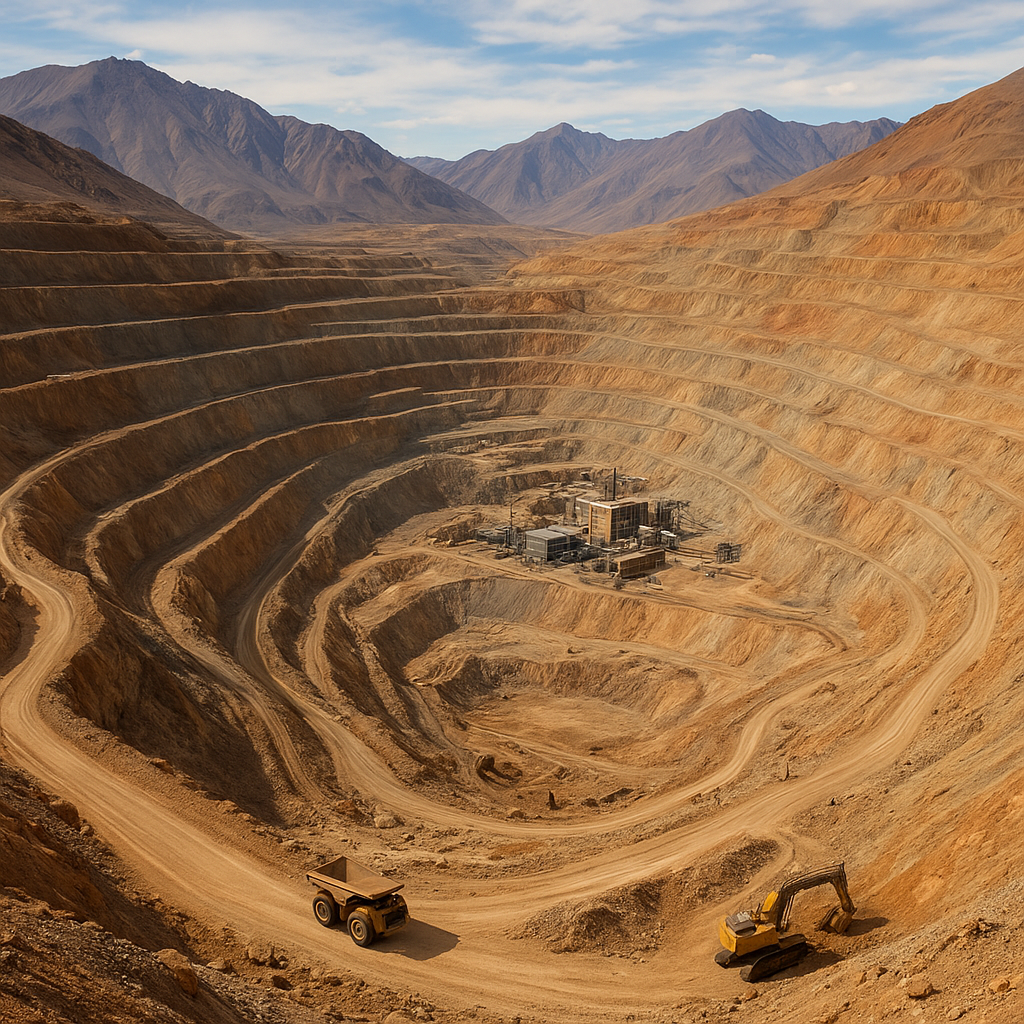
The Los Bronces mine, set high in the Andes just to the northeast of Santiago, is one of Chile’s most important copper operations. Its long lifespan, significant production, and continuous investment in deeper resources make it a focal point for both national industry and the global copper market. This article explores where Los Bronces is located, what is mined there, its broader economic role, and a number of technical and human-interest details that make the site compelling to engineers, economists, and environmental planners alike.
Location, Setting and Geology
Los Bronces is situated in the central Chilean Andes, within the Santiago Metropolitan Region, at elevations that commonly exceed 3,000 metres above sea level. The mine lies roughly northeast of the Chilean capital, accessible via mountain roads that climb from the Maipo River valley. Its Andean setting gives the operation a dramatic landscape of steep valleys, glaciated ridges, and high-altitude plateaus.
The deposit at Los Bronces is classically a porphyry-type copper system — a large, disseminated body of sulphide mineralization formed by magmatic-hydrothermal processes. Porphyry deposits are prized for their vast tonnages and relatively low to moderate grades, which make them ideal for large-scale bulk-mining techniques. While copper is the principal metal of interest, the ore contains a suite of valuable co-products such as molybdenum, and measurable quantities of gold and silver that are recovered in processing.
Geologically, Los Bronces displays typical zonation: oxide minerals nearer the surface, transitioning into primary sulphide-dominated rocks at depth. This stratification has influenced mining strategy over time, beginning with surface operations and moving progressively deeper through both open-pit cutbacks and studies into underground extraction techniques to access the sulphide core.
Mining Methods and Metallurgy
Los Bronces has historically been mined primarily by large-scale open pit methods. Open-pit mining suits porphyry deposits because of their horizontally extensive mineralization and the economic advantage of extracting large volumes at relatively modest grades. Over the life of the operation, pit limits have expanded through a series of cutbacks as shallower ore has been extracted and deeper ore targeted.
Because the mineralization includes both oxide and sulphide phases, the mine’s processing plants are designed to treat sulphide ore by flotation to produce a copper concentrate. Modern concentrators at Los Bronces include milling circuits, flotation cells, concentrate dewatering, and filtering systems. The resulting concentrate is then transported by road to smelters — in Chile or abroad — where it is refined into copper metal.
Important technological trends at Los Bronces include:
- Thickened tailings and other water-saving technologies in the concentrator circuit, to reduce freshwater demand.
- Continuous upgrades of comminution and flotation equipment to boost recovery and reduce energy consumption.
- Trials and development of underground mining options (including concepts such as block caving or other mass-mining methods) to access deeper sulphide ore bodies more economically than open-pit expansion would allow.
- Automation and remote-operation technologies that improve safety and productivity in the high-altitude environment.
Processing recovers copper in a concentrate that contains other valuable elements; molybdenum is often recovered separately from the rougher concentrate circuit, while precious metals like gold and silver report to the copper concentrate and are paid for by smelters.
Economic Importance — Local, National and Global
Los Bronces is a major contributor to Chile’s status as the world’s largest copper producer. Although exact production numbers vary year to year, the mine consistently supplies hundreds of thousands of tonnes of copper-equivalent output during its most productive years. Its role can be examined at several scales.
National impact
- Los Bronces provides direct employment to thousands of workers and supports many more jobs indirectly through contractors and service companies. The mine’s payroll and procurement generate income in the Santiago metropolitan area and surrounding communities.
- Revenue from copper exports at operations like Los Bronces is crucial for Chile’s economy. Copper exports fund public budgets, infrastructure projects, and social programs across the country.
- The mine contributes technology transfer and skills development in sectors such as geology, metallurgy, and heavy engineering, strengthening Chile’s industrial capabilities.
Global role
On the world stage, Los Bronces helps meet the sustained global demand for copper — an essential metal for electrical transmission, electronics, building construction, and increasingly, the green-energy transition. With the rise of electric vehicles, renewable energy systems, and electrified transport infrastructure, copper demand projections have strengthened, raising the strategic value of mines that can deliver stable production.
Social and Infrastructure Aspects
Operating in a mountainous region close to a major urban centre brings a particular set of social and logistical considerations. Los Bronces supports regional infrastructure such as roads, power lines, and expanded communications networks. These improvements can have positive knock-on effects for tourism, agriculture, and other economic activities around small mountain communities.
Community engagement is a constant activity: mining companies typically invest in local health, education, and community projects as part of social licensing strategies. Employment and contracting give immediate economic benefits, while community programs aim to build long-term relationships and mitigate social impacts from noise, dust, and changed land use.
Environmental Management and Challenges
High-elevation mining in a semi-arid region close to Santiago places environmental stewardship at the centre of Los Bronces’ operating philosophy. Water is the single most sensitive resource in the area: snowmelt and Andean streams feed local watersheds, and freshwater scarcity is a growing concern that mines must address.
To manage environmental impacts, operators at Los Bronces have employed multiple approaches:
- Water recycling and reuse within the plant, coupled with thickened tailings to minimize losses and reduce the footprint of water containment.
- Progressive rehabilitation of disturbed land where feasible, and careful design of waste rock and tailings facilities to reduce the risk of acid rock drainage.
- Monitoring programs for air quality, noise, and aquatic ecosystems in downstream catchments to ensure compliance with regulatory standards and to detect potential impacts early.
- Investment in energy-efficiency and carbon-reduction measures, contributing to corporate decarbonization goals and national climate commitments.
Nevertheless, the mine faces challenges common to large mining operations in fragile environments: managing dust and visual impacts on the landscape, coping with the pressures of water allocation in dry years, and maintaining a social license when local stakeholders demand stricter protections or greater benefits.
Regulatory and Ownership Context
Los Bronces operates within Chile’s robust mining legal framework and environmental permitting system. The country’s regulations cover water rights, environmental impact assessments, and community consultation. Large projects commonly negotiate agreements with regional authorities and local communities to define investment and mitigation commitments.
Operational control rests with an international mining company that operates Los Bronces as part of a joint venture with local and international partners. This collaborative ownership model means management decisions balance corporate strategy, partner priorities, and national interest — all under the scrutiny of investors and regulators.
Interesting Technical and Historical Notes
Los Bronces has several features that make it interesting from both historical and technical perspectives:
- Long operational history: The site has been a focus of exploration and extraction for many decades, evolving from earlier, smaller-scale operations into a modern, integrated mining complex.
- High-altitude engineering: Working at elevations above 3,000 metres requires accommodation for worker health and performance, specially adapted equipment, and attention to weather extremes that can complicate supply chains and construction.
- Investment in an underground extension or deep mining project has been a recurring theme, as near-surface ore becomes depleted and operators seek to prolong the mine’s life by accessing deeper, higher-grade sulphide ore bodies.
- Los Bronces demonstrates the evolution of mining technology: as metallurgical recovery, automation, and environmental engineering have advanced, the operation has continually modernised its facilities to remain competitive.
- The mine’s proximity to Santiago creates an unusual juxtaposition of major urban population and high-mountain mining activity, making it a case study in how metropolitan regions and primary-resource industries coexist.
Future Prospects and Strategic Importance
The outlook for Los Bronces reflects both opportunity and challenge. On the one hand, continued global demand for copper, especially driven by electrification and renewable-energy infrastructure, supports the economic rationale for sustaining and expanding operations. On the other hand, the industry-wide trend of declining average ore grades and the need to go deeper increase technical complexity and capital intensity.
Key determinants of the mine’s future include:
- Successful permitting and development of deeper mining methods to access sulphide resources economically.
- Ongoing investment in processing improvements to raise recovery rates and lower per-unit costs.
- Robust environmental management, especially water stewardship, to navigate regulatory and stakeholder expectations in a water-sensitive region.
- Market dynamics: copper price trends, geopolitical developments, and the pace of global decarbonization will influence investment decisions and production profiles.
Strategically, mines like Los Bronces occupy an essential role in national development strategies: they provide export revenue, technological leadership, and employment, while also presenting complex environmental and social governance tasks that require transparent and adaptive management.
Technical Innovations and Research
Los Bronces has been the site of continuous technical research and innovation aimed at improving operational efficiency and environmental outcomes. Areas of active work include:
- Research into lower-energy comminution circuits and the application of novel grinding technologies that reduce electricity consumption.
- Advanced flotation chemistries tailored to improve copper and molybdenum separation, raising payable metal content in concentrates.
- Water treatment and reuse systems that enable the capture and recycling of process water, cutting freshwater demand in a region prone to hydrological variability.
- Digitalisation projects — predictive maintenance, fleet automation, and process optimisation algorithms — which enhance safety, reduce downtime, and lower operating costs.
These innovations are typical of large modern mining operations that must compete on efficiency and environmental performance while extracting increasingly challenging orebodies.
Conclusion
Los Bronces stands as a prominent example of a large Andean porphyry copper mine where geology, engineering, economics, and community concerns intersect. Its copper output supports both Chile’s economy and the global transition to more electrified systems. At the same time, the mine faces the universal challenges of modern mining: extending the life of the operation into deeper, more complex ore, managing scarce water resources responsibly, and maintaining social and environmental trust in a visible metropolitan context. The site will likely remain a bellwether for how large copper producers adapt to evolving technical, regulatory, and market landscapes in the decades ahead.

