
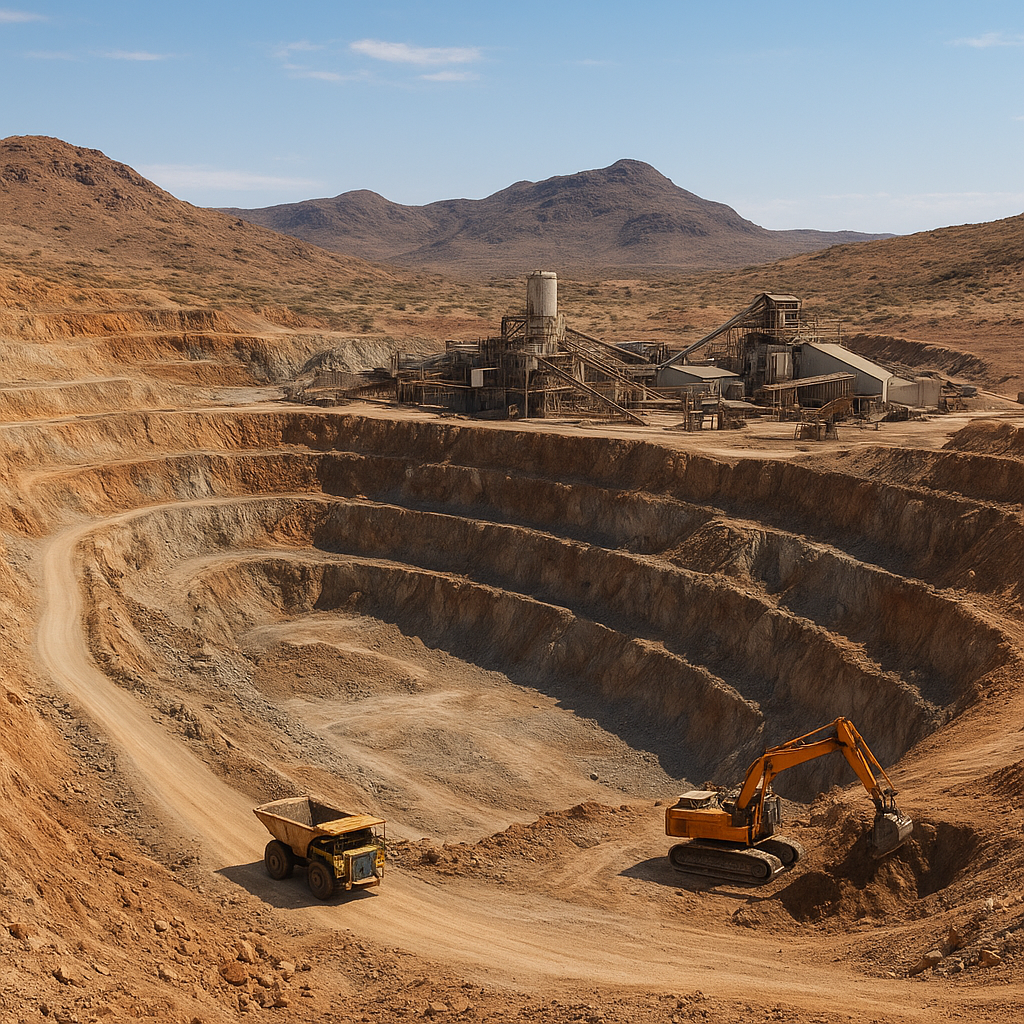
The Lofdal project, situated in northwestern Namibia, has emerged as one of the country’s most discussed prospects for rare earths. This article examines where Lofdal is located, what minerals are present, the economic role it could play for Namibia and the global market, and a series of technical, environmental and historical details that make the project particularly interesting.
Location and geological setting
Lofdal lies in the remote reaches of northwestern Namibia, within a region characterized by arid to semi-arid climate, sparse population and broad expanses of ancient bedrock and desert plain. The project area is accessible from regional towns and ports by gravel and secondary roads, but its remoteness has both advantages and constraints for exploration and eventual development.
Geologically, the Lofdal target area is part of southwestern Africa’s complex Precambrian to Phanerozoic terranes where a variety of igneous and metamorphic rocks interface with younger sedimentary units and weathered surfaces. The mineralization at Lofdal has been described in exploration literature as hosting appreciable concentrations of rare earth elements (REEs) hosted in specific rock types and alteration zones. The distribution of REEs can reflect primary magmatic processes or secondary concentration through weathering, each of which influences mining and processing methods.
Why the geology matters
The type of host rock and style of mineralization directly affect economics. Deposits hosted in carbonatites, alkaline intrusions or associated with weathered zones have different processing requirements. Lofdal’s geological setting suggests a complex interplay of primary mineralization and later alteration, which may produce both light and heavy rare earths in varying proportions. Understanding this distribution is crucial because different REEs have markedly different market values and industrial uses.
What is present at Lofdal — the mineral inventory
The primary focus of exploration at Lofdal has been on the suite of elements collectively known as the rare earths. These include a range of 15 lanthanide elements, typically grouped into light rare earth elements (LREEs) such as neodymium (Nd) and praseodymium (Pr), and heavy rare earth elements (HREEs) such as dysprosium (Dy) and terbium (Tb). Some project reports also mention concentrations of cerium, lanthanum and other associated elements.
Exploration work at Lofdal has included surface mapping, trenching, drilling and geochemical sampling. These methods help delineate the lateral and vertical extent of mineralized zones and quantify grades and tonnage. Results reported during different exploration phases indicate the presence of mineralized intervals with appreciable REE grades, though the exact composition and economic cut-offs depend on continued work and metallurgical test results.
Associated minerals and potential by-products
- Some REE deposits are associated with trace amounts of radioactive elements such as uranium and thorium. Where present, these require additional environmental controls and regulatory compliance.
- Accessory minerals hosting REEs—such as bastnäsite, monazite, allanite or xenotime—determine processing pathways; their mineralogical character influences the choice of physical separation and chemical extraction processes.
- Other metallurgical by-products could emerge depending on the exact mineralogy, which can enhance project economics if recoverable at reasonable cost.
Mining and processing considerations
Developing a rare earth project requires not only delineating a resource but also proving that material can be economically and sustainably mined and processed. In arid regions like Lofdal, water management and energy supply are particularly important. The options for mining methods include open-pit extraction—common where mineralization is near-surface—or more selective underground techniques if higher-grade pockets are deeper.
Processing REE-bearing ore typically involves:
- Comminution and physical separation to concentrate the REE-bearing minerals;
- Mineralogical liberation and chemical leaching to extract REEs from host minerals;
- Solvent extraction and ion-exchange circuits to produce individual REE oxides or mixed REE concentrates suitable for downstream customers.
Metallurgical test work is essential at Lofdal to determine the most efficient route from ore to saleable product. The presence of particular mineral hosts, gangue minerals and contaminants will dictate which reagents and flowsheets are most suitable and whether on-site beneficiation or shipping concentrates to off-site processors is the best economic path.
Economic and strategic significance
Rare earths are central components in the manufacture of modern technology, and their strategic value has grown with the global energy transition. Key end uses include:
- Permanent magnets for electric vehicle motors and wind turbine generators (principally neodymium and praseodymium).
- Alloys and catalysts in industrial and automotive applications.
- Phosphors, polishing powders, and components in electronics, optics and defense systems.
For Namibia, the development of Lofdal could diversify the mining sector beyond traditional commodities such as diamonds, uranium and base metals. Benefits might include foreign exchange earnings from exports, job creation in exploration, mining and processing, and the development of local supply chains. On a global scale, new African sources of REEs contribute to supply diversification and can reduce overreliance on a single dominant producer—this carries geopolitical and industrial significance.
Local economic impacts
Potential local benefits include:
- Employment for skilled and unskilled labor during exploration, construction and operation stages.
- Infrastructure investment (roads, power, communications) that can have spillover benefits for remote communities.
- Opportunities for local contractors and service providers in catering, transport and maintenance.
However, realizing these benefits depends on transparent governance, clear community agreements, local content policies and effective revenue management.
Environmental and social issues
Mining of rare earths brings specific environmental challenges that must be planned for and managed at Lofdal. In an arid environment, the impacts of water use and dust can be significant. Other concerns stem from the potential for radioactive elements in the deposit requiring strict controls to limit human and ecological exposure.
Key environmental considerations include:
- Water sourcing and recycling plans to minimize stress on scarce regional water resources.
- Tailings management and containment to avoid long-term contamination of surface and groundwater.
- Dust suppression and rehabilitation strategies for disturbed land.
Socially, mining in remote regions requires careful engagement with traditional communities, local authorities and conservation agencies. Transparent benefit-sharing, employment training and respect for cultural heritage are essential to build durable social license to operate.
Interesting historical and technical notes
Lofdal’s profile has drawn attention partly because REE deposits in Africa are less common in the public eye than major global producers. The exploration history at Lofdal reflects repeated cycles of interest driven by changing market prices and global demand for critical minerals. A few notable aspects:
- The remoteness that complicates logistics also offers a relatively undeveloped landscape where a well-planned project can incorporate modern environmental and social best practices from the outset.
- Mineralogical complexity: many REE projects require detailed mineralogical mapping because the precise mineral hosts determine whether conventional or novel processing routes are necessary. Lofdal’s mineralogy has prompted targeted metallurgical test programs to optimize recovery.
- Potential for regional industrial linkages: if multiple Namibian or southern African REE projects advance, there is an opportunity to develop shared processing hubs or smelting facilities that add value within the region rather than exporting raw concentrates exclusively.
Scientific and exploration interest
From a scientific perspective, Lofdal offers opportunities to study REE mineralization processes in an African context. Research undertaken in tandem with exploration can yield better models for predicting high-value zones and inform environmental baseline studies. This has academic and practical value: improved exploration targeting reduces surface disturbance and enhances the probability of economically viable discoveries.
Challenges and uncertainties
Several challenges could influence Lofdal’s path from exploration prospect to operating mine:
- Market volatility: REE prices fluctuate with demand, technological shifts and policy initiatives, which can affect project financing.
- Capital intensity: building processing facilities for REEs is capital-intensive, and companies must demonstrate robust economic cases to attract investment.
- Regulatory landscape: compliance with environmental, health and safety, and mining laws is mandatory; additional hurdles may arise if radioactive materials are present.
- Local engagement: sustainable development requires meaningful consultation and agreements with communities, which can be time-consuming but indispensable.
Addressing these challenges requires rigorous feasibility studies, transparent stakeholder engagement, and partnerships that can combine technical, financial and social expertise.
Future prospects and strategic considerations
If Lofdal advances to development, strategic choices will shape its long-term value. These include whether to:
- Export concentrates for downstream separation and refining abroad, or invest in local processing capacity to capture more value domestically.
- Form partnerships with technology and manufacturing companies that secure offtake agreements for specific REE mixes needed by magnet and battery manufacturers.
- Integrate renewable energy to power processing and reduce the carbon footprint, which is increasingly important to global buyers.
Investors and policymakers will weigh regional economic development against environmental stewardship. Innovative financing, such as public-private partnerships or green financing instruments, could help align project development with sustainability goals.
Concluding observations
Lofdal represents a compelling example of how a single mineral prospect can touch on geology, technology, economics and geopolitics. While the path from discovery to production is long and complex, the combination of increasing global demand for rare earths and Namibia’s stable mining jurisdiction makes Lofdal worthy of close attention. Continued exploration, thorough metallurgical work and careful social and environmental planning will determine whether the site becomes a new source of strategically important elements for the 21st century.

