
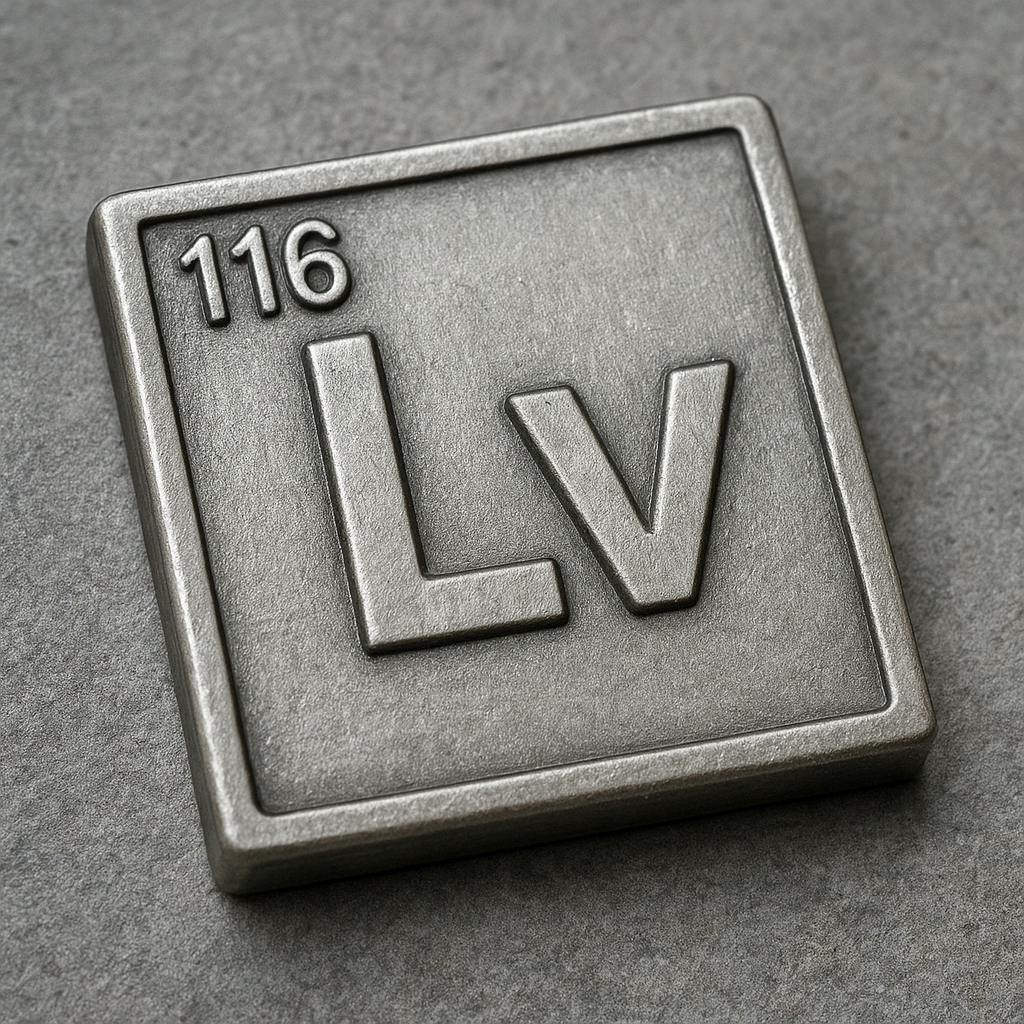
The element known as Livermorium occupies a fringe yet fascinating corner of modern chemistry and nuclear physics. As one of the heaviest and most exotic entries in the modern periodic table, it raises questions about the limits of matter, the behavior of electrons under extreme conditions, and the techniques required to create and study atoms that exist for only fractions of a second. This article explores where livermorium comes from, how it is produced and detected, what scientists expect from its chemistry and physics, and why this fleeting element continues to attract curiosity from researchers around the world.
Place in the periodic table and basic properties
Located in group 16 beneath oxygen, sulfur, selenium, tellurium and polonium, livermorium is officially recognized as element 116. Because it sits so far down the table, the atom is extraordinarily massive and its electrons move at velocities where classical approximations fail. Theoretical studies predict that such motion gives rise to strong relativistic effects that significantly alter the element’s electronic structure compared with lighter congeners.
Physically, livermorium is a true representative of the category often called superheavy elements: chemical elements with atomic numbers greater than about 104 that must be created in laboratories. It does not occur in nature and all known isotopes have extremely short lifetimes, typically decaying by alpha decay or spontaneous fission on timescales ranging from a few milliseconds to, in the most stable cases, perhaps a few seconds. Because of these fleeting existences, direct macroscopic observations of bulk properties such as melting point, density or color are impossible with current technology.
Where livermorium is found and how it is produced
Natural occurrence
Livermorium does not exist naturally on Earth. Its spontaneous synthesis by natural nuclear processes is essentially impossible due to both the improbability of assembling such a large nucleus and the rapid decay of its possible isotopes. Any mention of naturally occurring livermorium is speculative and unsupported by experimental evidence.
Laboratory production
The only practical way to obtain livermorium atoms is by creating them in particle accelerators. The standard method is the fusion-evaporation reaction, in which a high-energy beam of a relatively light nucleus is fired at a heavier target nucleus. When the two nuclei briefly fuse, they may form a very heavy compound nucleus that, after evaporating a few neutrons, becomes an atom of the desired superheavy element.
One of the most successful reaction schemes for producing livermorium has been to accelerate synthetic calcium-48 ions and strike them against actinide targets such as curium-248 or americium isotopes. Calcium-48 is a particularly valuable projectile because it is neutron-rich and helps produce heavier, more neutron-rich isotopes that tend to have slightly longer-lived decay chains. Reactions of the form 48Ca + 248Cm → 296Lv* → 293Lv + 3n (where * denotes the excited compound nucleus and n denotes neutrons evaporated) have been widely used in experimental campaigns.
These experiments require specialized facilities: powerful ion sources and accelerators, targets composed of rare and sometimes highly radioactive actinide material, and systems to separate and detect the few produced atoms from overwhelming backgrounds of other reaction byproducts. Laboratories that have been central to these efforts include the Joint Institute for Nuclear Research (JINR) in Dubna, Russia, in collaboration with the Lawrence Livermore National Laboratory, among others.
Discovery, naming and experimental confirmation
The path leading to the recognition of livermorium as a chemical element involved multiple experimental campaigns, international collaboration, and careful analysis of decay data. Early experiments at Dubna reported the production of element 116 in the early 2000s; subsequently, further experiments and cross-checks helped build a convincing case for the existence of the new element.
For some time the element was referred to by its systematic temporary name, ununhexium (Uuh), following IUPAC conventions. After review and confirmation of experimental results, the international scientific authorities approved the permanent name livermorium in honor of the contributions made by scientists at the Lawrence Livermore National Laboratory and their partnership with Dubna researchers. The formal discovery history and naming process reflects how modern big-science collaborations operate: discovery claims are scrutinized through independent replication, decay chain assignments, and rigorous statistical analysis.
How livermorium atoms are detected and studied
Because experiments may produce only a few atoms — sometimes just a handful over many days or weeks of beam time — detectors and analysis methods must be exceptionally sensitive and selective. The main experimental signatures for identifying livermorium are chains of radioactive decays: an atom of an isotope of Lv typically decays by successive alpha decay steps, producing a sequence of lighter daughter nuclei with characteristic energies and lifetimes. By correlating signals in space and time and matching observed alpha energies to expected decay patterns, researchers can assign events to a particular nuclide.
Detectors used in these experiments include silicon semiconductor arrays for alpha and spontaneous-fission detection, recoil separators that steer the wanted heavy reaction products away from unreacted beam and unwanted fragments, and position-sensitive detectors that allow decay chains to be linked to single implanted recoil nuclei. High-resolution alpha spectroscopy, time-of-flight measurements and chemical separation techniques (for those superheavy elements amenable to chemistry experiments) are combined to extract as much information as possible from each rare event.
Chemical behavior: predictions and limited experiments
Because only a few atoms of livermorium have ever been produced, direct chemical studies are largely absent. Instead, theoretical calculations and extrapolations from lighter congeners guide expectations. As a member of group 16, livermorium might be considered the heaviest homologue of polonium. However, strong relativistic effects are expected to shift orbital energies, contracting inner s and p1/2 orbitals and expanding others, which can change bonding tendencies and oxidation-state preferences compared with lighter chalcogens.
Predictions often indicate that livermorium may favor lower oxidation states, with a possible prevalence of a +2 oxidation state over higher states that are common for lighter group 16 elements. In other words, Lv may behave more metallic and less chalcogen-like than, say, tellurium or polonium. Computational chemistry suggests notable differences in bond strengths, ionization potentials and electron affinities relative to periodic trends extrapolated without relativistic corrections.
Experimental chemistry on superheavy elements has been successful in a handful of cases (for example, simple gas-phase chemistry on elements like copernicium and flerovium), but for Lv the experimental window is extremely narrow. Any chemical experiment must be conducted within seconds or less after production, and the number of produced atoms limits the types of techniques that can be applied. As of today, the chemical properties of livermorium remain largely theoretical, with limited or no direct chemical observations.
Applications and scientific significance
In practical terms, livermorium currently has no applications outside fundamental research. Its isotopes are too short-lived and too difficult to produce in sufficient quantities for technological or medical use. Nevertheless, the element is scientifically valuable for several reasons:
- Understanding nuclear stability: Studies of superheavy nuclei probe how nuclear forces behave at extreme proton numbers and help test models of nuclear structure, shell closures and the hypothesized island of stability where longer-lived superheavy nuclei might exist.
- Testing theoretical physics and chemistry: Livermorium provides an extreme environment in which relativistic quantum mechanics predicts unusual behavior. Comparing theoretical predictions with experimental observations refines computational methods and our understanding of electron-nucleus interactions.
- Advancing experimental techniques: Producing and detecting atoms at the limit of stability drives the development of high-sensitivity instrumentation, advanced target fabrication, and fast chemical separation methods that can benefit other areas of nuclear science.
In short, the value of livermorium lies not in products or devices but in the insights it offers into fundamental science and in the technological innovations it spurs in instrumentation and methodology.
Related topics and wider context
The island of stability
One of the most compelling frameworks for studying superheavy elements is the idea of an island of stability. Nuclear models suggest that certain combinations of proton and neutron numbers may confer extra stability due to closed nuclear shells — analogous to electron shell closures that make noble gases chemically inert. If such shell effects are strong enough, they could yield superheavy isotopes with half-lives far longer than neighboring nuclides, possibly surviving for years or longer.
Livermorium sits in a region of the nuclear chart where shell effects are of particular interest. Observations of its decay properties and of neighboring isotopes help test predictions about magic numbers and shell closures in the superheavy region. Discovering longer-lived isotopes in this region would be transformative, opening possibilities for more detailed chemical studies and perhaps novel applications.
Role of relativistic quantum chemistry
Theoretical treatments of superheavy elements must include relativistic corrections to describe electron behavior accurately. These corrections become increasingly significant as nuclear charge increases, altering orbital energies, spin-orbit splitting, and ultimately the chemical properties of an element. Livermorium provides an important test case for these theories: discrepancies between predicted and observed properties (or decay behaviors) inform improvements in computational techniques that are applicable across chemistry and materials science where heavy elements play a role.
Comparisons with neighbors in the periodic table
Comparative studies among superheavy congeners — such as comparing flerovium (element 114), moscovium (115), livermorium (116) and roentgenium (111) in their respective groups — help clarify trends and anomalies introduced by extreme nuclear charge. For instance, flerovium attracted interest for possibly exhibiting noble-gas-like behavior in some experiments, while theoretical studies suggest varying degrees of metallic character for neighboring elements. Livermorium’s placement under polonium means it serves as a benchmark for how chalcogen behavior evolves at the top end of the table.
Technical challenges and experimental frontiers
Producing and studying livermorium involves a cascade of technical challenges. Targets made from curium, americium or other heavy actinides are themselves rare, expensive and radioactive. Ion beams must be highly intense and stable for long periods to yield even a few atoms. Recoil separators must reliably distinguish the wanted heavy species from an enormous flux of undesired particles and background radiation. Detectors must register alpha particles, spontaneous fission fragments and electromagnetic signals with high resolution and temporal precision to reconstruct decay chains unambiguously.
Increasing the yield of superheavy element production is a central experimental frontier. Strategies include optimizing beam energies, exploring alternative projectile-target combinations, and developing more efficient separators that minimize losses. Another avenue is to search for pathways to produce more neutron-rich isotopes, which might lie closer to the theorized island of stability and thus live longer.
Notable historical and cultural points
The naming of livermorium underscores the international and collaborative nature of contemporary heavy-element research. While experimental work often takes place in national facilities such as Dubna in Russia or Berkeley in the United States, the recognition of discoveries and assignments of names involve global committees that synthesize results, debate priority, and adopt nomenclature that honors contributors and institutions. The choice of livermorium commemorates the partnership between laboratories and the shared effort to expand human knowledge at the outer limits of the periodic table.
Beyond formal naming, superheavy elements have captured public imagination for their exotic names, the dramatic images of detectors and accelerators, and their role in exploring fundamental questions about matter. While science-fiction tales sometimes imagine superheavy elements as sources of energy or exotic materials, the real story is subtler and more intellectual: these elements are probes of the underlying principles that organize matter in the universe.
Practical considerations, safety and environmental aspects
Handling the materials and facilities used to produce livermorium involves strict safety protocols. Targets and beamlines deal with radioactive actinides and high-energy radiation fields. Shielding, remote handling, and careful waste management are mandatory. Because only a few atoms of true livermorium are ever created, the direct radiological hazard from Lv itself is negligible, but associated materials and activation products require proper controls and regulatory compliance.
From an environmental perspective, the production of superheavy elements occurs on a tiny scale and does not present a broad ecological risk. The primary concerns are occupational safety for laboratory personnel and safe management of radioactive targets and byproducts.
Why livermorium matters and what to watch next
Livermorium matters because it sits at an intersection of experimental ingenuity and theoretical challenge. Studying it helps refine nuclear models, tests the limits of chemical periodicity, and drives improvements in instrumentation. Future directions to watch include attempts to synthesize more neutron-rich isotopes with potentially longer half-lives, any experimental chemical characterization that might finally probe electron-driven behavior, and advances in theoretical modeling that better integrate relativistic and quantum effects for the heaviest elements.
As experimental techniques advance and international collaborations continue, livermorium and its neighbors will remain fertile ground for discoveries. Each new data point — a measured decay energy, a subtle chemical interaction, a theoretical insight — contributes to a broader narrative about how atoms behave when pushed to their limits and how the periodic table, far from being a closed book, continues to evolve with human ingenuity.