Linarite is an eye-catching mineral prized for its intense color and intriguing chemistry. Its vivid appearance and rare occurrence in the oxidized zones of ore deposits make it both a desirable specimen for mineral enthusiasts and an object of scientific interest. This article explores the mineral’s composition, global occurrences, formation processes, practical uses, and the surprising ways it contributes to research into novel physical phenomena.
Composition, structure and physical properties
The mineral known as linarite has the chemical formula PbCuSO4(OH)2 and is a secondary mineral that forms in the oxidation zones of sulfide deposits. Its formula reveals the presence of both lead and copper combined with a sulfate group and hydroxide units. The arrangement of these atoms produces the striking visual and physical properties that make linarite unmistakable.
Crystal system and habit
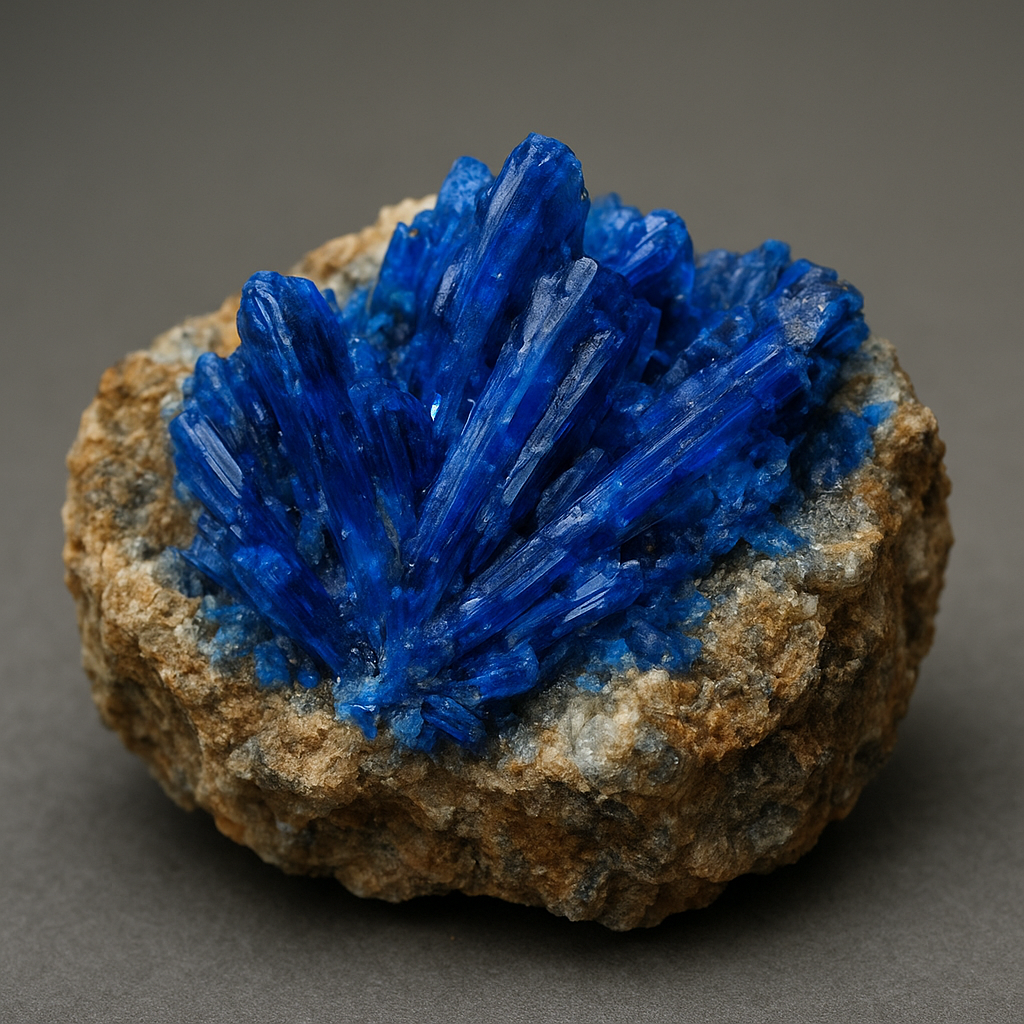
Linarite crystallizes in the monoclinic system, typically forming prismatic or tabular crystals that exhibit a bright, saturated blue color. Crystals can be slender and elongated or appear as crusts and compact masses. Well-formed specimens show good luster and transparent to translucent clarity, which enhances their desirability for both display and study. The mineral’s distinctive color and habit help distinguish it from other blue copper minerals such as azurite or chalcanthite.
Hardness, density and optical characteristics
- Mohs hardness: generally low (around 2.5 to 3), making linarite relatively soft and fragile.
- Specific gravity: comparatively high because of the lead content; typical values are around 5.2 to 5.4.
- Streak: light blue to bluish-white.
- Optical properties: strong color and often noticeable pleochroism under polarized light, which is of interest to mineralogists examining optical tensors and anisotropy.
Typical occurrences and notable localities
Linarite is not a common mineral; it forms under relatively specific geochemical conditions in the oxidized zones where primary sulfide minerals such as galena (PbS) and chalcopyrite (CuFeS2) are altered by weathering. Because of this, linarite is localized to particular deposits around the world where those oxidation processes have produced the right combination of mobile lead and copper ions in the presence of sulfate-bearing solutions.
Classic and famous localities
- Type locality: Linares (Jaén province), Spain — the mineral’s name is derived from this town and it remains an important historical locality.
- Bisbee and other mining districts in Arizona, USA — notable for fine linarite specimens associated with copper-lead deposits.
- Broken Hill, Australia — another classic mining district with occurrences of attractive linarite crystals.
- Cornwall and other British localities — well-known among European mineral collectors.
- Chile and certain South American polymetallic deposits — occurrences are less frequent but significant when large crystals are present.
Because linarite forms under oxidative conditions, it is often found in the upper parts of ore veins or in gossans above sulfide orebodies. Its presence can indicate the oxidation and mobility history of lead and copper in a deposit, which geologists can use when reconstructing paragenetic sequences.
Formation, paragenesis and associated minerals
Formation of linarite is fundamentally linked to the weathering and oxidation of primary sulfide minerals. When groundwater or meteoric water percolates through sulfide-bearing rock, sulfate ions are produced through oxidative breakdown; these sulfate-rich solutions can then mobilize lead and copper from primary minerals. Under the right pH and redox conditions, these ions recombine to precipitate sulfate-hydroxide minerals, among which linarite is one possibility.
Common associations
- Other secondary lead minerals: anglesite, cerussite
- Secondary copper minerals: brochantite, malachite, chrysocolla, azurite
- Various sulfate minerals: gypsum and less commonly other copper sulfates
These associations reflect a typical supergene mineral assemblage. Linarite may form as a late-stage phase overgrowing earlier oxidation products, or as discrete crystals in cavities and fractures where microenvironments supported its stability.
Uses, collecting and safety considerations
In practical terms, linarite has limited industrial use. It is not mined for ore because it generally occurs only in small quantities and is unstable in many environments. Its primary value is as a collector’s mineral and as a subject for mineralogical and crystallographic study. Exceptional specimens can fetch significant sums at mineral shows, auctions, and from specialized dealers.
Collector interest and specimen care
- collectors prize linarite for its vibrant blue color and often sharp crystals.
- Specimens should be protected from humidity and strong light, which can sometimes alter the appearance or stability of secondary sulfate minerals.
- Because linarite is relatively soft and brittle, mechanical protection in a display case or padded storage is essential.
Health and handling
Because linarite contains significant amounts of lead, it should be handled with care. Avoid ingestion, prolonged skin contact, or inhalation of dust from powdered or friable specimens. Washing hands after handling and using gloves when preparing or moving specimen matrices is good practice. For educational displays where the public might touch minerals, clear labeling and secure display cases reduce risk.
Scientific interest beyond mineralogy
In recent years linarite has attracted attention outside classical mineralogy because its copper sublattice exhibits interesting low-dimensional magnetic interactions. Researchers studying quantum materials have used synthetic and natural linarite samples to investigate exotic magnetic phases that arise in frustrated spin systems. The material’s combination of structural motifs and exchange interactions makes it a useful magnetism model system for condensed matter physics.
Why a mineral matters to physicists
The copper ions in linarite behave approximately as one-dimensional chains of spin-1/2 moments with competing ferromagnetic and antiferromagnetic interactions. Under applied magnetic fields and at low temperatures, such systems can display nontrivial ground states, including helical orders and possible spin-nematic phases that are the subject of active research. Natural linarite provides an opportunity to study these behaviors in a real, chemically complex lattice rather than in an idealized theoretical model.
Laboratory synthesis and experiments
- Researchers synthesize linarite or related compounds to obtain sufficiently pure and well-characterized samples for physical measurements.
- Techniques such as neutron scattering, magnetization measurements, and muon spin rotation are applied to probe magnetic order and excitations in linarite-like materials.
- Studies have helped refine theoretical models of frustrated one-dimensional magnets and contributed to the broader understanding of correlated electron systems.
Aesthetics, cultural relevance and identification tips
For many people the most immediate attraction of linarite is purely visual: a saturated, electric blue that competes with the best azurites. The combination of color, crystal form, and sometimes striking contrast with white anglesite or green secondary copper minerals creates specimens that are museum-quality. Because of the potential for confusion with other blue minerals, a careful approach to identification is necessary.
Practical identification tips
- Observe the color: linarite is a distinctive deep blue, but color alone is not definitive.
- Check hardness: linarite is soft — it will scratch with a copper coin or a fingernail more readily than azurite.
- Look for associations: if the specimen occurs with obvious lead minerals like cerussite, linarite becomes a more likely candidate.
- Streak and density: a light blue streak and a relatively high density point toward a lead-bearing copper sulfate like linarite.
- When in doubt, analytical techniques such as X-ray diffraction or electron microprobe analysis provide definitive identification.
Collecting ethics and legalities
Responsible collecting respects landowner rights, local laws, and environmental considerations. Because linarite often occurs in old mining districts, collectors should avoid protected sites, seek permission, and follow safety guidelines around unstable mine workings. Well-documented provenance adds value to specimens and helps preserve scientific context for future study.
Concluding remarks about linarite’s appeal
Linarite stands at a crossroads of beauty and science. Its chemical composition and crystal structure yield a color that fascinates the eye, while its geological and physical properties reward deeper investigation. Whether appreciated as a specimen in a private cabinet, studied by mineralogists to unravel supergene processes, or used by physicists probing the frontiers of quantum behavior, linarite continues to be a small but meaningful player in the diverse world of natural materials.