
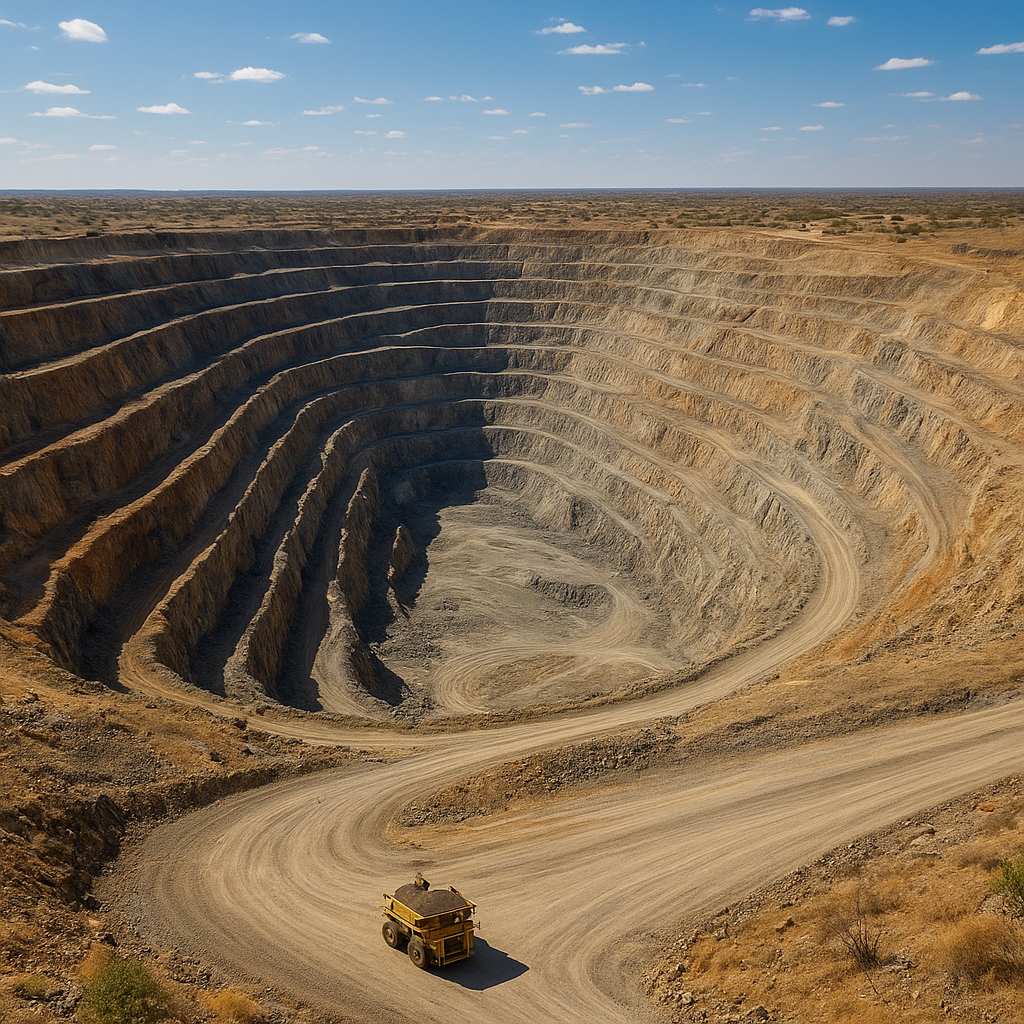
The Letlhakane mining complex sits at the heart of Botswana’s diamond-producing belt and has played an important role in shaping the modern economy of the country. Located among a cluster of kimberlite pipes and open pits, the mine extracts high-quality stones that feed global markets and support local development. This article explores where Letlhakane is located, what is mined there, its economic significance, and a selection of noteworthy and sometimes surprising facts about the operation and its broader context.
Where Letlhakane Mine Is Located and Its Geological Setting
Letlhakane is situated in central eastern Botswana, roughly between the well-known Orapa mine and the country’s capital, Gaborone. The mine area lies within the Kalahari region, a landscape of semi-arid savannah underlain by some of the world’s most ancient and stable continental crust. That stability is part of why the area hosts numerous diamondiferous pipes: intrusive volcanic bodies known as kimberlite and related rocks that brought diamonds from deep in the mantle to the surface in geological time.
The mine is part of a broader cluster that includes the Orapa and Damtshaa operations; that cluster forms one of the most productive diamond provinces on Earth. Kimberlite pipes in the Letlhakane area vary in size and mineralogy, and their individual diamond contents and quality can differ significantly. Geologists working in the region combine airborne surveys, drilling, and core sampling to map pipe geometries and estimate resource grades. The combination of geology and modern exploration methods keeps the area attractive to both state-backed and private mining interests.
What Is Extracted: Diamond Quality and Characteristics
The primary commodity mined at Letlhakane is, of course, diamonds. The stones recovered span a spectrum from industrial-quality to high-value gem stones suitable for international jewelry markets. The mine’s recovery process begins with conventional open-pit mining where overburden and weathered rock are removed to expose ore. Ore is then crushed and processed in recovery plants that use dense media separation, x-ray sorting, and other technologies to concentrate and recover the stones.
Diamonds from Letlhakane and its neighboring mines are prized for their clarity and size distribution in specific pipes; certain parcels may yield larger gem-quality crystals, while others produce smaller but still highly marketable goods. After recovery, gems undergo sorting and valuation before being channeled into the sale mechanisms that Botswana uses in partnership with its mining partners.
Ownership, Operation and Mining Methods
The Letlhakane complex has been developed and operated under partnerships and joint ventures typical of Botswana’s mining industry. The most recognized operator in the country is Debswana, a partnership between the Government of Botswana and De Beers. Debswana manages multiple mines and plays a central role in coordinating exploration, extraction, and sales, often ensuring that national policy goals such as employment, beneficiation, and revenue sharing are embedded into operations.
Mining at Letlhakane has historically relied on open-pit techniques. Large earth-moving fleets remove overburden and haul ore to crushers and primary treatment facilities. Advances in processing, including automated sorting and improved water- and energy-efficient recovery circuits, have incrementally improved both recovery rates and environmental performance. Tailings management, pit wall stability, and progressive rehabilitation are elements of modern mine management plans required by Botswana’s regulatory framework.
Economic Significance for Botswana
The role of diamond mining in Botswana’s national economy cannot be overstated. While Letlhakane is one of several productive mines, the aggregate contribution of the diamond sector has historically been a dominant portion of the country’s GDP and foreign earnings. Revenues from mining have financed highway construction, educational expansion, public health programs, and public sector capacity building. For many years Botswana stood out among resource-rich countries for its relative fiscal prudence and reinvestment of mineral proceeds into development.
- Export revenues generated by diamonds are a mainstay of Botswana’s balance of payments.
- Joint ownership structures, such as the partnership between the state and international operators, allow the nation to capture a larger share of value.
- Local content requirements and social investments tied to mining concessions aim to promote equitable growth and social stability.
The Letlhakane mine specifically contributes to local and regional employment, spending on services and supplies, and infrastructure development around the mine village. Jobs range from on-site technical and operational posts to secondary employment in logistics, housing, retail, and education. Mining wages and community investments raise local living standards, but the industry also creates the policy challenge of managing resource dependency and planning for a post-mining economy.
Employment, Communities and Social Programs
Letlhakane supports a local community ecosystem that includes housing compounds, clinics, schools, and recreational facilities for both employees and local residents. The mine often partners with government and civil society to fund health clinics, HIV/AIDS awareness and treatment programs, and vocational training. Through such programs, mining companies and state agencies attempt to magnify the social benefits of extraction beyond direct wages.
Local employment is prioritized through training programs and procurement policies that encourage the use of Botswana-based contractors and suppliers. The aim is to build a local skills base that remains useful even after the mine’s life ends: tradespeople, technicians, and managers trained at Letlhakane can be valuable assets in other sectors. Still, the community faces the standard mining-era challenges—economic dependence on a finite resource, potential social tensions when workforce demands fluctuate, and the need for careful environmental stewardship.
Environmental Management and Rehabilitation
Mining in a semi-arid environment like the Kalahari poses specific environmental considerations. Water is scarce, and dust management, biodiversity protection, and responsible tailings handling are priorities. Modern operations at Letlhakane implement monitoring systems to track water use, groundwater impact, and dust emissions. Progressive rehabilitation—restoring sections of the mine footprint as operations move—reduces long-term liabilities and helps the local landscape recover more quickly after closure.
Regulatory oversight in Botswana requires that mining leases include mine closure and rehabilitation plans. These plans typically cover revegetation, recontouring of pits or waste dumps where safe and stable, and measures to prevent acid rock drainage where applicable. For Letlhakane, the emphasis has been on minimizing the mine’s footprint and ensuring that, where practical, land can be used for grazing and other local livelihoods after rehabilitation.
Interesting Facts and Lesser-Known Details
Some aspects of Letlhakane and Botswana’s diamond economy are especially noteworthy:
- Regional synergy: Letlhakane benefits from its proximity to the larger Orapa complex. Shared infrastructure like roads, power lines, and sorting facilities reduces per-mine costs.
- Geological age: The kimberlites that host diamonds in Botswana formed more than a hundred million years ago, transporting stones from deep within the mantle to near-surface levels where mining later became possible.
- State-model: Botswana’s approach—partnering with experienced global firms while securing a majority of economic benefits for the nation—has been lauded as a model for responsible resource governance.
- Varied production: Different pipes at Letlhakane vary in diamond size and quality; some parcels have produced stones that command a premium on the market due to clarity and size distributions.
- Technology adoption: The mine has increasingly incorporated automated sorting and recovery technologies that improve efficiency and reduce human exposure to hazardous tasks.
Markets, Sales and the Value Chain
Diamonds recovered at Letlhakane enter a tightly regulated sales chain that begins with valuation and sorting into parcels. Botswana, through arrangements with its partners, participates in both the sale of rough stones and in downstream conversations about beneficiation—the idea of adding value domestically by cutting and polishing stones locally rather than exporting all rough product. While cutting and polishing historically occurs in established global centers, Botswana has invested in local sorting houses and training to capture a larger slice of the value chain.
Diamond sales are typically conducted through tenders and long-term contract mechanisms. Global demand—driven by luxury markets and retail trends—affects prices and revenue streams, but governments and operators use budgeting and sovereign funds to smooth revenue volatility and invest in long-term projects.
Future Prospects and Strategic Considerations
Looking forward, Letlhakane and similar operations face several strategic dynamics. First, the finite nature of kimberlite pipes means resource depletion is always a planning factor; companies and governments must plan for eventual closure and economic transition for host communities. Second, technological change—from improved recovery methods to digital supply-chain tracking—will continue to reshape operational efficiency. Third, global market dynamics, including competition from lab-grown diamonds and shifting consumer preferences, prompt producers to emphasize provenance, ethical sourcing, and traceability.
Botswana’s policy toolkit—so far centered on joint ventures, local content, savings during boom years, and investment in public services—remains central to ensuring mines like Letlhakane yield long-term national benefit. Diversification into tourism, services, and non-mineral sectors is a declared national priority to reduce overreliance on mining revenues.
Notable takeaways about Letlhakane
- Letlhakane is an integral node within Botswana’s network of kimberlite-hosted diamond mines.
- The mine extracts gem-quality and industrial diamonds that flow into global markets.
- Its operation reinforces a national model of public-private partnership that has delivered measurable development outcomes.
- Environmental stewardship, community programs, and efforts at employment creation and capacity building are key components of the mine’s operating philosophy.
As commodities go, diamonds mined at Letlhakane are more than jewelry inputs; they are the raw material of national development strategies, a case study in resource governance, and a continuing example of how geology and policy intersect to shape a country’s future.

