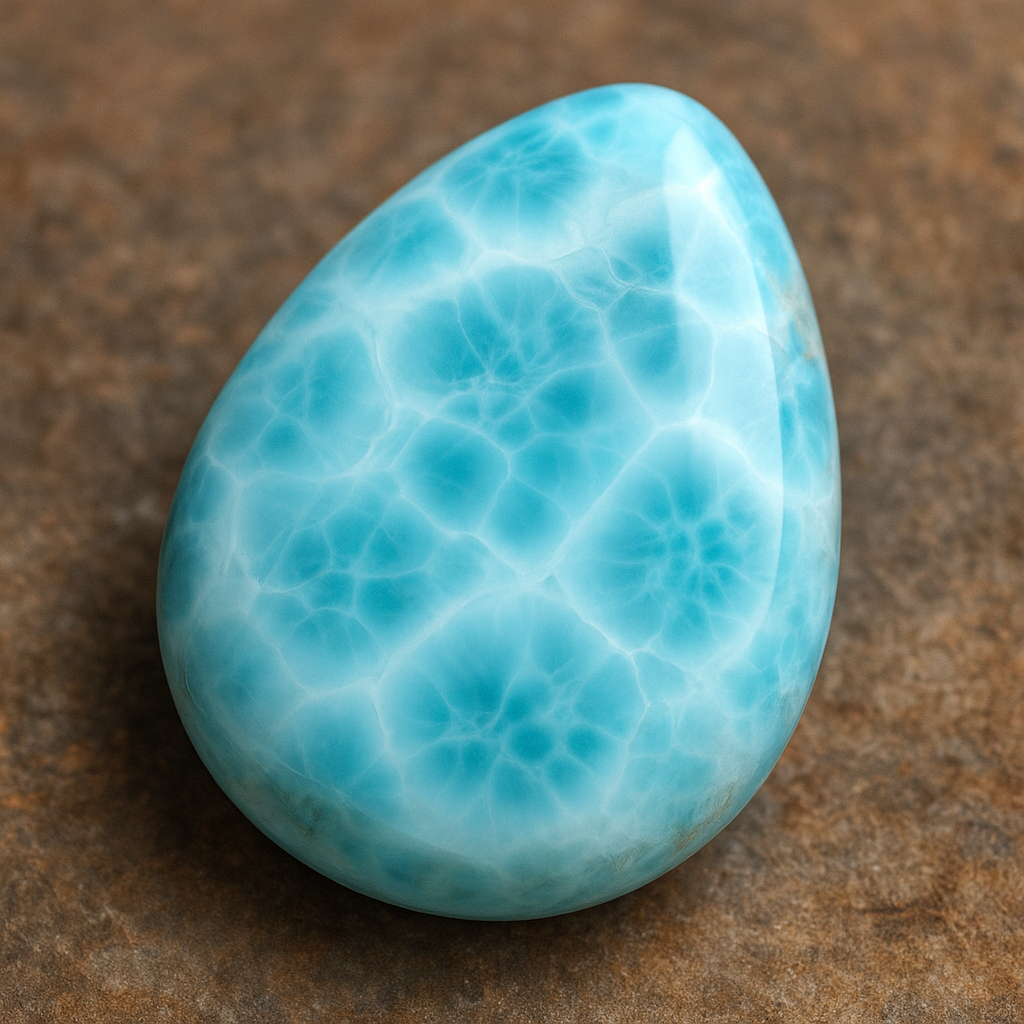
Larimar is a captivating and relatively rare blue gemstone that evokes the colors of tropical seas. Known for its soft sky-blue tones, intricate white veining and occasional green or brown inclusions, this stone has grown from a local curiosity into an internationally sought-after gem. The pages that follow explore what makes this mineral unique, where it forms, how it is used, how to care for it, and a number of interesting cultural, scientific and economic aspects related to its extraction and trade.
What is Larimar and how did it get its name
Larimar is a blue to blue-green variety of the mineral pectolite, a silicate mineral that crystallizes in radiating fibrous aggregates. The color palette ranges from pale sky-blue and aqua to deep, almost cerulean tones, often with contrasting bands or patches of white and ochre. These patterns and colors give polished specimens the appearance of waves, cloud-scapes, or the shifting tones of shallow tropical water, which contributes heavily to the stone’s aesthetic appeal and market demand.
The familiar name was coined in the 1970s by the Dominican miner Miguel Méndez who combined his daughter’s name, Larissa, with the Spanish word mar (sea) to evoke the stone’s marine hues. Prior to that popular name, specimens were often described simply as blue pectolite or identified by local names. Over time the trade name became established and is now used globally by gem dealers, lapidaries and collectors.
Geology and occurrence
Where Larimar is found
Globally the most significant and essentially exclusive commercial deposits of Larimar are located in the Caribbean island of the Dominican Republic, particularly in the mountainous southwestern area of the island, in and around the Sierra de Bahoruco and the province of Barahona. Although small occurrences of pectolite exist elsewhere in the world, the distinct blue variety called Larimar has only been mined in meaningful quantities in the Dominican Republic, which makes it both geologically and commercially distinctive.
How Larimar forms
The formation environment for Larimar is intimately linked to volcanic activity. It typically forms in cavities and vesicles of volcanic rocks where silica-rich hydrothermal fluids interact with other elements and crystallize as radiating needle-like crystals. These open-space deposits allow pectolite to grow with a fibrous habit. The characteristic blue coloration is associated with trace element substitutions—most notably small amounts of copper and other transition metals that alter the way the mineral absorbs and reflects light.
- Host rock: basaltic to andesitic volcanic rocks with vesicles and fractures.
- Formation: hydrothermal activity and mineral deposition in cavities.
- Texture: radiating, fibrous aggregates that produce the stone’s silky to lustered surfaces when polished.
Mining history and local context
Accounts of blue pectolite in the Dominican Republic date back to the early 20th century, with periodic discoveries and small local finds. The modern commercial interest originated in the 1970s when the stone was rediscovered and began to be actively collected and marketed. Since then, small-scale artisanal mining operations and local lapidaries have driven the extraction, cutting and sale of Larimar. The extraction is often physically demanding: miners work steep slopes and tunnels, chisel out rock, and sort for veins and pockets of gem-quality material.
The mining landscape is predominantly artisanal rather than industrial. Local communities rely on Larimar mining as one of several income sources, often combining stone extraction with agriculture and tourism-related crafts. This artisanal character also means the industry is decentralized: individual miners or small groups remove material, while local cutters and jewelers produce finished pieces sold both domestically and to the international market.
Physical and gemological properties
Understanding the basic physical properties of Larimar helps gemologists, buyers and enthusiasts evaluate and care for specimens.
- Mineralogy: Larimar is a variety of pectolite, a sodium calcium silicate hydroxide mineral with a fibrous habit.
- Hardness: Relatively soft compared to many gemstones, generally around 4.5–5 on the Mohs scale, which means it is prone to scratching and should be set and worn with care.
- Specific gravity and density: Moderate, typical of silicate minerals of this class.
- Cleavage and fracture: Pectolite has good cleavage and a splintery, brittle fracture, reflecting its fibrous internal structure.
- Appearance: Silky to sub-vitreous luster when polished; the internal radiating fibers give Larimar its characteristic sheen and patterning.
Under magnification a trained eye can often detect the fibrous, needle-like crystals that identify pectolite and distinguish Larimar from many lookalikes. Transparency ranges from opaque to translucent, with the most desirable commercial material being evenly colored and richly blue with attractive white patterning.
Uses and applications
Jewelry and lapidary work
The primary commercial use of Larimar is in jewelry. Cabochons, pendants, beads and inlays are the most common forms. Because of the stone’s softness and cleavage, lapidaries generally prefer to shape Larimar as cabochons with smooth domes rather than faceting it. This enhances the play of color and pattern while reducing risk of chipping. Designers often pair Larimar with silver and other metals that complement its cool blue tones.
Collectors and museums
Specimens are prized by collectors for their range of blues and the patterning reminiscent of ocean waves. Exceptional, intensely blue pieces with defined contrast can command significantly higher prices. Museums with mineral collections sometimes feature Larimar as an example of a regionally distinctive gemstone formed in a volcanic setting.
Metaphysical and cultural uses
In metaphysical and new-age communities Larimar is associated with calming energy, communication, and emotional healing. Practitioners and enthusiasts often link it to throat chakra work or to a sense of connection with the sea. While these uses are not scientifically verifiable, they have helped build a market for polished crystals and carved items beyond mainstream jewelry channels.
Grading, quality and identifying value
Several factors determine Larimar’s value in the marketplace:
- Color: deep, vivid blues are most prized; light blues and greenish tones are less valuable.
- Pattern: strong, contrasting white veining or wave-like patterns that enhance the sea-like appearance increase desirability.
- Clarity and homogeneity: fewer cracks and inclusions raise the price and durability.
- Size: larger, well-colored pieces are comparatively rare and command higher prices.
Terminology used by dealers includes phrases like “royal blue” or “electric blue” to describe top-tier material. However, these trade terms lack formal standardization, so buyers should rely on reputable sellers, photographs, and, when necessary, gemological testing to verify authenticity and quality.
Treatments, imitations and care
Treatments and stabilization
Most Larimar is sold untreated. Its natural color and pattern are the principal attractions, and deliberate color treatments are uncommon. However, because of its porosity and relative softness some stones may be stabilized with clear resins to improve durability or polish. Provenance and disclosure are important: reputable sellers should report any stabilization or impregnation.
Common imitations and lookalikes
Because the market values the blue color, unscrupulous sellers may attempt to pass off dyed materials such as dyed howlite or magnesite, or altered jasper and calcite, as Larimar. These imitators are often softer white minerals that take dye easily. Ways to detect imitations include:
- Examining under magnification for unnatural uniformity of color or dye residues in surface cracks.
- Testing hardness—dyed soft stones may scratch more easily than genuine pectolite.
- Looking for the characteristic needle-like fibrous texture of pectolite under a loupe or microscope.
Care and maintenance
Given its moderate softness and cleavage, Larimar requires thoughtful care:
- Avoid harsh chemicals, household cleaners and chlorine that can damage the surface.
- Remove Larimar jewelry before strenuous activity to prevent scratches and impacts.
- Clean gently with warm water, mild soap and a soft cloth; avoid ultrasonic cleaners and steam treatments unless you know the piece has been stabilized and is robust enough.
- Store Larimar separately from harder gemstones like diamonds or sapphires that could scratch its surface.
Cultural significance and interesting facts
Larimar carries strong symbolic weight in the Dominican Republic: it is viewed as a gem emblematic of the island’s natural beauty and marine surroundings. Local artisans produce carved figures, jewelry and souvenirs that draw tourism interest. For many visitors, acquiring a Larimar piece is an appreciated tangible memory of the Caribbean.
Several intriguing facts add to Larimar’s mystique:
- Uniqueness: The gemstone’s effective exclusivity to the Dominican Republic makes it both a geological curiosity and a valuable commodity for regional identity.
- Name origin: The trade name evokes the sea and family, combining Larissa and mar—an origin story that enhances the stone’s romantic appeal.
- Color range: Beyond blue, Larimar can display white, cream, greenish or brown tones depending on mineral inclusions and weathering.
Sustainability, economics and community impact
Artisanal extraction of Larimar supports local livelihoods but also raises concerns about environmental impact, worker safety and equitable economic returns. Because most operations are small-scale, miners often lack formal equipment, safety gear and environmental safeguards. Issues that arise include slope instability, waste rock management and lack of reclamation plans for exhausted pits.
In response, some initiatives and stakeholders emphasize better practices:
- Promoting traceability and fair-trade channels to ensure miners receive reasonable compensation.
- Encouraging safer mining methods and basic safety training for artisanal miners.
- Supporting community-based lapidary workshops that keep higher-value processing and crafting local rather than exporting raw stones exclusively.
Buyers who prioritize ethical sourcing can seek vendors that provide provenance information and who work cooperatively with Dominican artisans, thereby supporting local economies and cultural continuity.
Scientific and collector interest
For mineralogists and collectors, Larimar remains a topic of interest for several reasons. Its formation in a volcanic hydrothermal context offers clues about local geology and fluid chemistry. The striking coloration—related to trace elements and structural factors—raises questions that geochemists and spectroscopists explore to better understand color centers and elemental substitution in pectolite. Collectors prize high-quality specimens and often seek pieces that illustrate excellent radiating fibrous structure, dramatic coloration and unusual patterns.
Where to buy and authenticate
When purchasing Larimar, consider the following guidelines to reduce the risk of buying imitations or misrepresented material:
- Buy from established dealers or directly from reputable Dominican artisans and lapidaries.
- Ask about provenance, whether the piece has been stabilized, and request clear photographs or in-person inspection.
- When in doubt, request a gemological report or consult an independent gemologist who can confirm mineral identification and any treatments.
Ethical considerations also matter: choose sellers who demonstrate transparent sourcing, fair compensation practices for miners, and environmental sensitivity.
Final observations and future outlook
As interest in distinctive, regionally emblematic gemstones persists, larimar is likely to remain a symbol of Caribbean beauty and a sought-after material for jewelry and collecting. Its limited geographic occurrence ensures scarcity, which supports both its commercial value and the need for responsible sourcing. Continued collaboration between miners, lapidaries, scientists and ethical buyers can help protect the stone’s natural origins while maintaining livelihoods and cultural heritage. For anyone drawn to the tranquil color of the sea in a polished mineral form, Larimar offers an alluring combination of geological story, artistic potential and cultural resonance.