
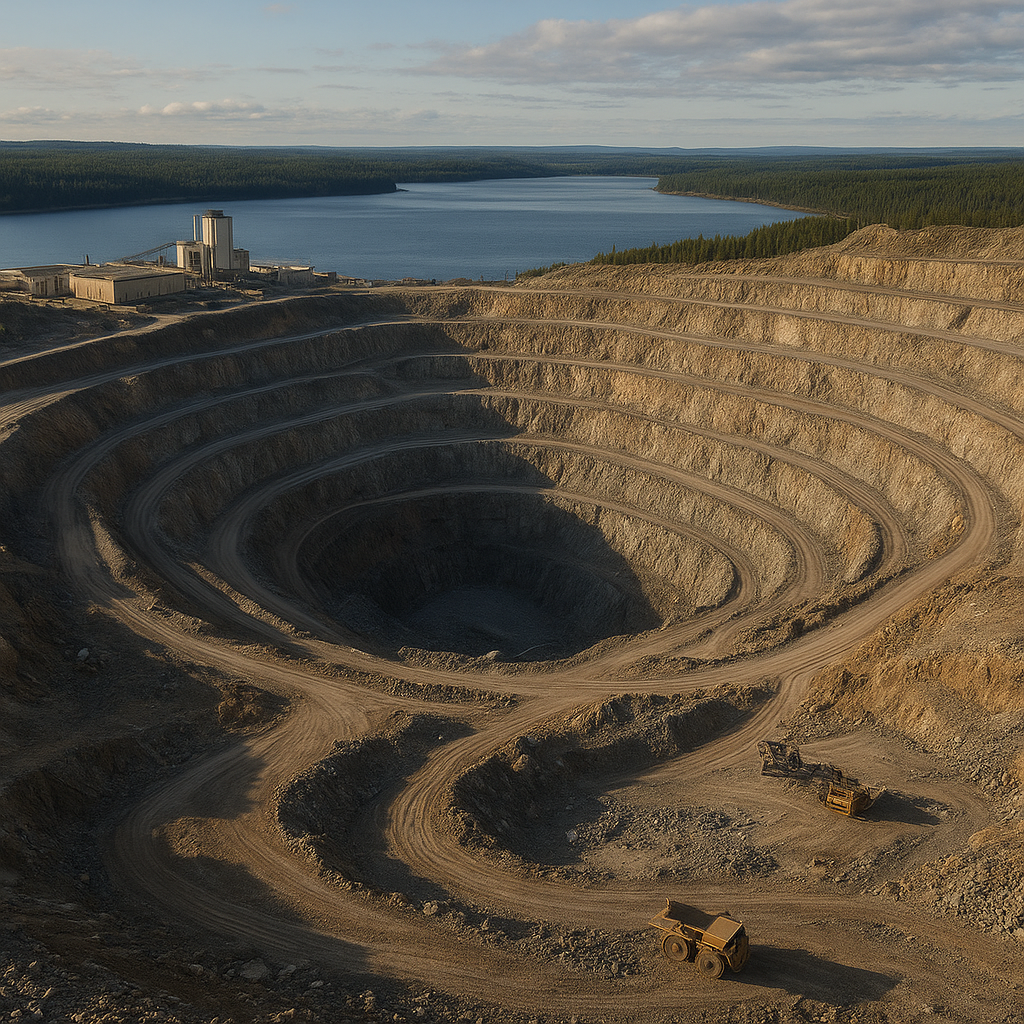
The Lac des Iles mine is one of Canada’s most notable sources of platinum group elements and plays an outsized role in the global market for palladium. Located in the vast landscape of the Canadian Shield, the operation combines open-pit and underground mining methods, producing a concentrate that supports key industrial sectors worldwide. This article examines where the mine sits geographically and geologically, what is produced there, its economic importance for local and national economies, and some of the technical, environmental and community aspects that make Lac des Iles an interesting case study in modern mining.
Location and geological setting
The Lac des Iles operation is situated in northwestern Ontario, within the ancient bedrock of the Canadian Shield. The mine is named after a nearby lake and sits in a region characterized by rugged forests, lakes, and a climate typical of the boreal zone. Geologically, the deposit is hosted in a mafic–ultramafic intrusive complex. These rock types are favourable hosts for magmatic sulphide mineralization that concentrates platinum group elements (PGEs) together with base metals.
Geology and mineralization
The ore at Lac des Iles is dominated by disseminated and net-textured sulphide mineralization within rocks that crystallized from mafic and ultramafic magmas. Such settings commonly concentrate metals like palladium and platinum, along with economically significant amounts of nickel, copper and traces of gold. The sulphide minerals typically include pyrrhotite, pentlandite and chalcopyrite, which carry the PGEs either as discrete PGE-bearing grains or as inclusions within sulphide phases.
This geological model—an intrusion-hosted PGE-rich sulfide system—explains both the distribution of ore and the technical approach used for extraction and processing. The mine features both surface (open pit) and underground components, reflecting the variable geometry and depth of ore bodies within the intrusive complex.
Mining methods, processing and output
Extraction methods
Lac des Iles has been developed using a combination of open-pit benches and underground stopes. Open-pit mining is used where the ore is near surface and amenable to bulk mining, while underground methods allow access to higher-grade zones at depth. Modern equipment fleets, drilling and blasting programs, and ore-waste management strategies support continuous feed to the mill.
Processing and refining
Once ore is delivered to the on-site processing plant, a multi-stage comminution and flotation circuit concentrates the sulphide minerals into a PGE-rich concentrate. That concentrate is typically shipped to specialized smelters and metallurgical refineries where complex hydrometallurgical and pyrometallurgical processes separate and refine individual elements—most importantly palladium and platinum—into saleable metal products. The final refining may occur domestically or at international facilities depending on contractual arrangements and refinery capacity.
Products and typical production profile
The primary metal of economic interest at Lac des Iles is palladium, although it yields a basket of metals that includes platinum, nickel, copper and by-product gold. Palladium is the highest-value product and consequently drives many operational and development decisions. Historically, the mine has produced several tens to hundreds of thousands of ounces of palladium annually, making it one of Canada’s largest palladium producers.
- Primary metal: palladium
- Secondary PGEs: platinum
- Base metal by-products: nickel, copper
- Minor by-products: gold and other trace elements
Economic significance and market role
Contribution to local and regional economies
Lac des Iles provides direct employment in a remote region, supporting a workforce of tradespeople, technicians, geoscientists and support staff. Beyond payroll, the mine stimulates local economies through procurement of goods and services (transportation, catering, equipment maintenance, construction) and through payments to governments in the form of taxes and royalties. For small communities in northwestern Ontario, such operations can be anchor employers and a key source of infrastructure investment.
National and international economic importance
On a national scale, Lac des Iles contributes to Canada’s status as a supplier of strategic metals. Globally, its output influences the supply side of the palladium market—an element used in catalytic converters and other high-tech applications. Changes in production at a few significant mines can affect global balances and prices because the total market for palladium is relatively small compared with base metals. The mine’s concentrate contributes to the material flows that feed automotive, chemical, and electronics industries worldwide.
Link to the automotive sector and market dynamics
Palladium is a critical component in catalytic converters used to reduce exhaust emissions in gasoline-powered vehicles. Demand from the automotive sector has, for many years, been the dominant driver of palladium prices. Supply disruptions, changes in vehicle technology (e.g., electrification, hybridization), and substitution dynamics (notably the potential substitution of palladium with platinum) create price volatility that affects the mine’s revenue forecasts and investment appetite.
Ownership, investment and corporate context
The Lac des Iles operation has passed through different corporate structures during its history. It was developed and operated for many years by a North American company focused on palladium production, and in recent years has been part of the portfolio of a major global PGM (platinum group metals) producer operating in Canada. The corporate owner provides technical expertise, capital for sustaining and expansion projects, and access to global marketing networks that are essential to monetizing the mine’s output.
Capital investment and lifecycle economics
Mining at Lac des Iles requires continuous capital investment for equipment, underground development, metallurgical plant upgrades, and environmental controls. Lifecycle economics depend on metal prices, operating costs (energy, labour, consumables), recovery rates in the mill, and the size and grade of remaining reserves and resources. Projects to extend mine life or increase throughput are evaluated against prevailing market prices and long-term forecasts.
Environmental management and community relations
Environmental practices
Operating in the Canadian Shield presents challenges and responsibilities for water and land stewardship. Environmental programs typically include:
- tailings management and water treatment to prevent acid rock drainage and metal leaching;
- progressive rehabilitation of disturbed areas;
- monitoring of surface and groundwater quality;
- air quality and dust control measures;
- biodiversity protection measures for the boreal ecosystem.
Modern mines in Ontario must comply with provincial and federal environmental regulations and obtain permits that often include requirements for long-term closure plans, financial assurance for rehabilitation, and ongoing environmental monitoring after closure.
Engagement with Indigenous and local communities
Community relations are an essential component of Lac des Iles’ social license to operate. The mine’s proximity to Indigenous traditional lands necessitates active engagement, participation agreements, and opportunities for local employment and contracting. These arrangements can include training programs, cultural awareness initiatives, and benefit-sharing mechanisms. Meaningful consultation and collaboration are central to the project’s social sustainability.
Innovation, safety and technological aspects
Operational technology and efficiency
To remain competitive and safe, Lac des Iles employs evolving technologies in drilling, blasting, haulage and processing. Automation, remote monitoring, predictive maintenance and improved grinding and flotation technologies help reduce costs and environmental footprints. The mining industry’s move toward electrification of equipment—where feasible—can lower direct greenhouse gas emissions, an area of growing importance to both operators and regulators.
Safety culture
Safety is a core focus: training, behaviour-based safety programs, and emergency preparedness are essential in both open-pit and underground settings. Continuous improvement in workplace safety directly affects productivity, employee wellbeing and the mine’s reputation.
History, reserves and future prospects
Development history
The Lac des Iles deposit has been explored and developed over multiple decades. Early exploration identified the presence of significant PGE-bearing sulphides, and progressive investment over time enabled the establishment of milling and mining infrastructure. As with many long-lived mines, production has gone through cycles of investment, ramp-up, optimization, and periodic life-of-mine extension studies driven by market conditions for palladium and related metals.
Reserves, resources and mine life
Estimating reserves and resources is an ongoing process. Geological drilling, metallurgical testing and economic studies determine how much of the deposit is economically recoverable at any given metal price and cost environment. Companies managing the site periodically publish updated resource and reserve figures to reflect new drilling and improved geological models. Extensions to the life of mine are often feasible through targeted exploration of satellite bodies, deeper zones, or previously uneconomic material.
Future trends and risks
Several factors will shape Lac des Iles’ trajectory: global demand for PGEs, technological change in the automotive industry, the discovery of new economic zones within the property, capital availability for expansions, and regulatory or environmental constraints. The mine is exposed to commodity price risk—particularly for palladium—but also benefits from long-term structural demand in certain industrial applications. Opportunities for optimization include improvements in recovery, reductions in operating costs and strategic partnerships for downstream refining.
Interesting facts and lesser-known aspects
- Although primarily known for PGEs, Lac des Iles’ orebody also contains appreciable amounts of base metals, which diversify the economic value of the operation.
- The operation blends open-pit and underground methods—this hybrid approach allows selective extraction and helps manage strip ratios and waste handling.
- Because palladium markets are relatively concentrated, even moderate output swings from a mine like Lac des Iles can have noticeable effects on spot prices and supply availability for key industrial consumers.
- Concentrate produced at the mine is typically shipped to specialized refineries where complex metallurgical flowsheets separate and refine PGEs into saleable bars and chemical products used in catalysts and electronics.
- The mine’s contributions to regional employment and procurement create multiplier effects that support small businesses and municipal revenues in the surrounding area.
- Industry trends such as electrification of mine fleets and digital monitoring systems are being evaluated as ways to improve both safety and environmental performance.
As a long-standing PGE producer in Canada, Lac des Iles remains a focal point for discussions about strategic mineral supply chains, responsible resource development, and the role of mining in regional economies. Its combination of geological richness, technical challenge and market relevance makes it a compelling example of contemporary mining where technical, social and economic dimensions intersect.

