
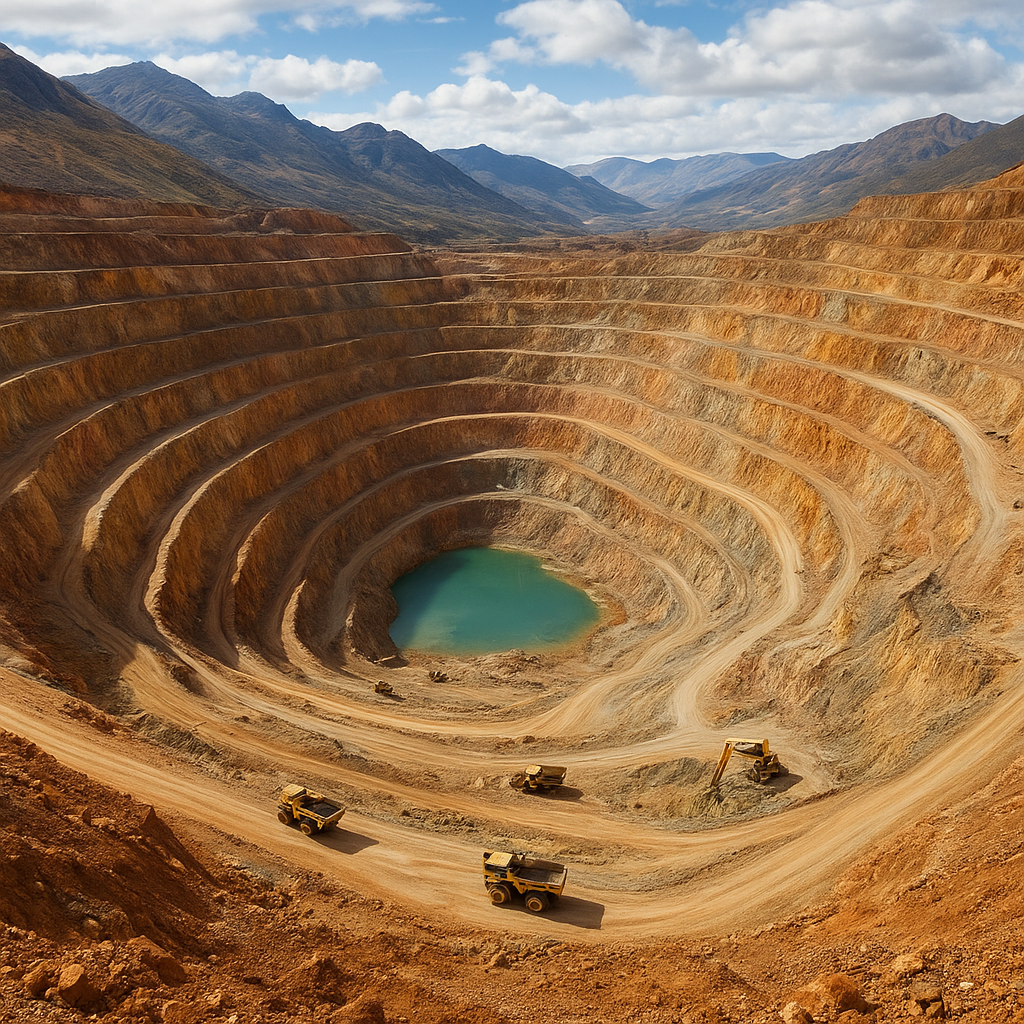
The La Arena mine is one of the notable mineral operations in northern Peru, known primarily for commercial production of gold with associated copper as a by-product. Located within the Andean foothills, the mine combines modern open-pit extraction, a conventional processing plant and ongoing exploration in surrounding concessions. This article outlines the mine’s setting and geology, describes how the operation functions and produces metal, considers its broader economic role, and surveys environmental and community aspects that make La Arena an interesting case in contemporary mining.
Location, geology and mineralization
La Arena is situated in the northern Andean region of Peru, in a landscape of rugged hills, river valleys and agricultural terraces. The mine sits within a belt of mineralized terranes that host a number of important gold and copper deposits. Geologically, the deposit is characteristic of many Andean systems: mineralization is closely linked to magmatic-hydrothermal processes that produced veins, disseminations and altered host rocks capable of hosting both gold and copper. The primary ore body exploited by La Arena has been developed as an open-pit operation, taking advantage of near-surface mineralization and relatively amenable topography.
From a technical perspective, the mineralization can be described in terms of structural controls and alteration zones. Zones of quartz veining, silicification and sulphide-rich halos are common, and these host the > gold values that support the mine. Copper typically occurs as chalcopyrite and other sulphide minerals, often in association with higher-sulphidation or intermediate-sulphidation mineral assemblages. Many deposits in this region show a vertical zonation in alteration and mineral content—an attribute that affects both mining strategy and processing decisions.
Exploration setting
Exploration around La Arena has focused on identifying satellite zones and extensions of the known mineralized envelope. Typical techniques include geological mapping, geochemical sampling, geophysical surveys and drilling. Discoveries of satellite pits or feeder zones can significantly extend the life of an open-pit mine and improve project economics by supplying additional ore to an existing mill and infrastructure. The presence of multiple structural trends has prompted ongoing drilling campaigns to test both near-mine and more distal targets.
Regional geological context
The mine lies within a metallogenic province that has produced numerous precious and base metal deposits over centuries. The tectonic history of the Andes—subduction-related magmatism, crustal shortening and uplift—created favorable conditions for porphyry and epithermal mineral systems. Understanding the regional structural framework and magmatic pulses is essential for building exploration models and for anticipating where additional mineralization may occur.
Operations, processing and production
La Arena operates as a classical open-pit mine feeding a central processing plant. The mining sequence typically involves drilling and blasting, loading with hydraulic shovels and haul trucks, and transport of ore to a crushing and grinding circuit. The plant commonly combines conventional gravity and flotation or cyanide leaching circuits to recover gold, with copper recovered either in concentrate or as a by-product depending on local metallurgy.
- Mining methods: open-pit benches, mechanized loading and hauling, staged stripping of waste rock.
- Processing: crushing, milling, gravity concentration, leaching and carbon-in-pulp or carbon-in-leach, and tailings management.
- Recovery: metallurgical flows are optimized to maximize gold recovery while also capturing significant copper as a credit to overall economics.
Operational efficiency is influenced by ore grade, rock competence, climatic constraints and availability of water and power. Mines like La Arena continually refine their mine plans to balance stripping ratios, ore sequencing and mill feed quality. In many modern gold-copper operations, fleet optimization, autonomous equipment and digital mine planning tools are used to drive down unit costs and improve reliability.
Supply chain and logistics
Operating in a relatively remote Andean setting imposes logistical demands. Concentrate or doré bars must be transported to refineries or ports, often over mountain roads. The mine’s connectivity to regional highways, availability of rail or port services, and access to skilled labor are all factors that determine how effectively product reaches international markets. Mines in Peru are integrated into global metal markets, and production from La Arena contributes to national export revenues.
Health and safety at the site
Health and safety management is a core element of day-to-day operations. Rigorous standards for explosives handling, heavy equipment operation and slope stability are required. Training programs, emergency response plans and health surveillance reduce risks to workers. Many modern operations invest in on-site medical facilities, regular safety drills and continuous improvement programs to meet internal and regulatory safety benchmarks.
Economic significance and regional impact
The presence of a mine such as La Arena carries both direct and indirect economic implications. Directly, the mine provides employment for hundreds to thousands of workers in operations, maintenance and administration. Indirect benefits include contracts for local suppliers, stimulation of regional services and infrastructure improvements. Mining royalties, taxes and community investments also channel fiscal benefits to local and national governments.
- Employment: local jobs in operations, contractors and service sectors support household incomes and stimulate commerce.
- Government revenues: taxes, royalties and export earnings are a significant part of national foreign exchange and fiscal budgets.
- Local procurement: procurement policies can favor local suppliers for goods and services, amplifying economic multipliers.
Beyond pure economics, mines can catalyze infrastructure development—improvements to roads, power lines and water systems that also benefit surrounding communities. However, these benefits are not automatic; careful planning, transparent benefit-sharing mechanisms and long-term strategies are needed to ensure that mining becomes a sustainable engine of development rather than a transient boom-and-bust phenomenon.
Fiscal and investment considerations
For investors and governments, a mine’s life-of-mine profile—reserves, resources, production rates and operating costs—determines its contribution to GDP and its attractiveness for capital deployment. Gold and copper are globally traded commodities; their price cycles affect project cash flows. Creditworthy environmental and social governance (ESG) practices increasingly influence investment decisions, particularly for projects in sensitive or densely populated regions.
Environmental management, community relations and social license
Extraction of metal inevitably raises environmental and social questions. La Arena, like other modern mines, must navigate water management, waste rock and tailings handling, biodiversity protection and the often-complex relationships with local communities and indigenous groups. Attaining and maintaining a social license to operate requires investment in dialogue, benefit-sharing and mitigation measures that are credible and sustained.
Water and tailings management
Water is a critical resource in mining. Processing circuits require water for milling and leaching, while tailings storage demands engineered facilities that prevent seepage and catastrophic failure. Best-practice tailings management involves robust design, regular monitoring, independent audits and, where feasible, progressive rehabilitation. Re-use and recycling of process water can reduce strain on local water supplies and lessen the environmental footprint.
Biodiversity and land rehabilitation
Mining disrupts land, but progressive rehabilitation—re-contouring waste dumps, soil replacement and replanting native vegetation—can restore ecological functions over time. Closure plans prepared from the outset of operations set out end-state visions for reclaimed land. Mines increasingly fund biodiversity offsets or conservation programs to compensate for residual impacts and to leave a positive legacy.
Community engagement and benefit programs
Successful community relations involve long-term engagement, transparent communication and partnerships on education, health, infrastructure and livelihood programs. Local procurement, workforce training and small-business development schemes help integrate communities into the economic value chain. Conflicts arise when expectations are unmet or when environmental impacts are perceived as disproportionate; preventing or resolving such disputes requires proactive outreach and inclusive planning.
History, milestones and recent developments
La Arena’s development followed the familiar pathway of exploration to feasibility studies, financing, construction and ramp-up to commercial production. Over its operating history, the site has undergone phases of expansion, metallurgical optimization and exploration-driven extensions of mineral resources. Periodic upgrades to the processing plant and changes in mine sequencing reflect an effort to improve recovery, reduce costs and extend mine life.
Like many projects in Peru, La Arena has sometimes navigated regulatory changes, fluctuations in metal prices and evolving expectations for social and environmental performance. Investment in exploration near the main pit has often been driven by the desire to convert inferred resources to measured and indicated categories that can underpin longer-term production plans. Technological innovations—such as improved ore-sorting, reagent optimization and digital monitoring—have also been applied to improve efficiency.
Resilience to market cycles
Gold’s role as a financial safe-haven often provides revenue stability during market turbulence, while copper’s sensitivity to industrial demand makes it cyclical. A gold-dominant mine with copper by-product credits benefits from gold’s price resilience while enjoying additional revenue when base metal markets are strong. Operators thus manage hedging strategies, cost controls and capital spending to navigate price volatility.
Interesting aspects and lesser-known details
La Arena illustrates several larger trends in modern mining that are worth noting.
- Integration of exploration and operations: Mines that prospect for nearby resources can extend their lives more cheaply than greenfield projects because infrastructure already exists.
- Technological adoption: The use of mining software, drone surveying, automated fleets and remote-sensing improves safety and efficiency, even at operations in complex terrain.
- Environmental innovation: Progressive tailings rehabilitation, water recirculation systems and community-driven conservation projects are increasingly common at modern mines.
- Workforce development: Skills training and education initiatives create a pipeline of local technicians and professionals, increasing local content and reducing reliance on imported labor.
- Local cultural connections: Mining operations often commission ethnographic and social studies to understand and respect local traditions, minimizing cultural friction and fostering cooperative programs.
Another notable facet is how regional logistics shape mining economics. Proximity to paved highways, ports and power grids can dramatically influence operating costs. Investment in regional infrastructure—whether by the private sector or public institutions—can unlock additional mineral potential in surrounding districts.
Finally, mining projects in Peru operate within a rich historical context. Pre-Columbian societies in the Andes worked precious metals and stones for ceremonial and ornamental purposes; today’s industrial operations extract the same elements but on a very different scale and with distinct technical, social and regulatory frameworks. The transition from artisanal to industrial extraction continues to shape local economies and social landscapes.
Future prospects and challenges
The future of La Arena will depend on several interacting factors: continuing exploration success, metal prices, operating costs, regulatory environment and the project’s capacity to manage environmental and social responsibilities. Extension of mineral resources through drilling can lengthen mine life and justify further capital investments. Conversely, rising costs, stricter environmental standards or local opposition could constrain expansion.
Adaptive management—flexible mine planning, incremental investments in processing technology and continuous stakeholder engagement—will be central to meeting these challenges. Many mining companies now embed sustainability into core business strategy, seeking to balance economic returns with measurable environmental improvements and tangible social benefits. This strategic orientation is likely to shape how La Arena and similar mines evolve over the next decades.
Opportunities for innovation
Opportunities include piloting low-water processing techniques, deploying renewable power sources to reduce greenhouse gas emissions, and applying machine learning to predict equipment failures and optimize ore blending. Such innovations can lower costs, reduce environmental impacts and improve social acceptance.
Broader regional implications
As a component of Peru’s mining landscape, La Arena contributes to national export earnings and to the livelihoods of local communities. Strategic coordination between mining companies, municipalities and regional governments can amplify benefits—through infrastructure projects, education and health programs—while minimizing negative externalities. The mine’s trajectory will be an example of how resource-rich regions can seek to translate mineral endowments into sustainable development outcomes.
In sum, La Arena is more than an extraction site: it is a focal point for geological science, engineering, local and national economics, and community relationships. Its continuing operation offers lessons about how modern mines can integrate technical excellence, environmental stewardship and meaningful community partnerships while producing metals that remain essential to the global economy.

