
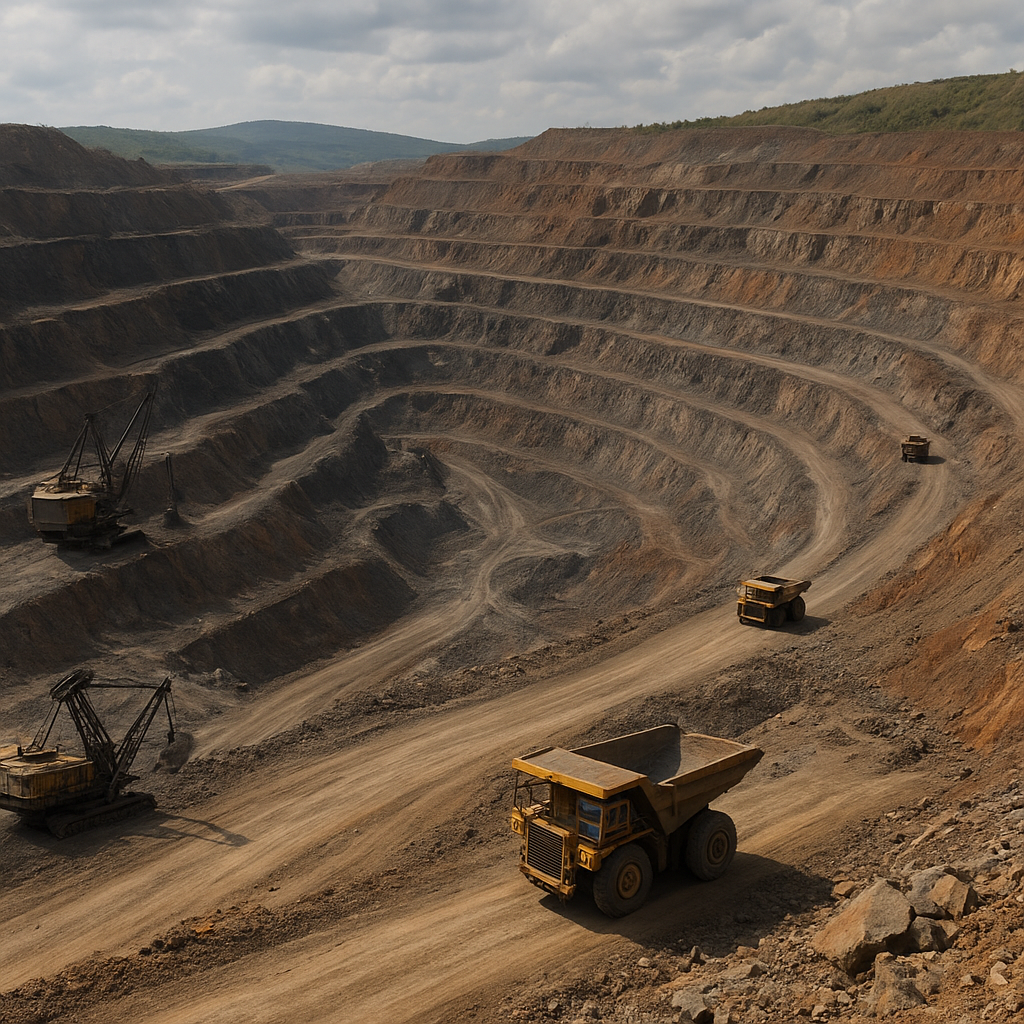
The Kovdor mining complex is one of the most recognizable industrial sites on the Kola Peninsula. Located in the far northwest of Russia, the mine extracts both phosphate-bearing and iron-rich ores from a distinctive igneous massif and processes them into concentrates that feed domestic industry and export markets. This article explores the mine’s location and geology, its mineral products and methods of extraction, the wider economic and strategic role it plays, and several lesser-known but compelling aspects of the Kovdor operation.
Location and Geological Setting
The Kovdor site lies in the southwestern part of the Murmansk Oblast, near the small town that gives the deposit its name. The area is part of the broader Kola Peninsula — a region famed for its complex alkaline and ultramafic intrusions and a long history of mineral exploration. The ore body exploited at Kovdor is associated with a deep-seated magmatic complex known as the Kovdor Massif, which formed through intrusive processes and hosts an unusual assemblage of minerals.
Geologically, the massif is notable for containing a mixture of **apatite**-bearing rocks and iron-titanium oxides, meaning that both phosphate and iron commodities can be recovered from the same deposit. The Kovdor massif is often described in scientific literature as an intrusion with carbonatite, ultramafic, and mafic components. This complex lithology produces ores with distinctive mineralogy: an abundance of apatite crystals combined with magnetite and titanomagnetite phases, and a varied suite of accessory minerals that sometimes include rare elements.
Because of its northern latitude, the mine operates in a subarctic climate. Winters are long and cold, summers short and cool, and the ground conditions include areas affected by discontinuous permafrost. These environmental parameters shape both the technology used in extraction and the logistics of ore transport to processing plants or export terminals.
What Is Mined and How It Is Processed
Kovdor is primarily known for two categories of products: phosphate (in the form of apatite-bearing rock that is processed into phosphate concentrates) and iron (magnetite-rich ore processed into iron concentrates). These two outputs are the backbone of the site’s industrial value.
Phosphate (Apatite) Production
The phosphate component of Kovdor’s ore occurs mainly as apatite — a calcium phosphate mineral that is the principal raw material for producing phosphate fertilizers. After extraction, the ore undergoes crushing and grinding followed by flotation or other beneficiation techniques designed to separate the apatite crystals from gangue minerals. The resulting apatite concentrates have high phosphorus content and are suitable feedstock for chemical plants that produce phosphoric acid and a range of phosphate fertilizers.
Iron (Magnetite) Production
The iron-bearing portion of the Kovdor ore is dominated by magnetite and titanomagnetite. These are magnetic iron oxides amenable to recovery by magnetic separation processes. The beneficiation circuit typically includes magnetic separators, flotation for removal of residual gangue, and pelletizing or concentrate drying as required by end-users. The iron concentrates are used directly in metallurgical processes or blended with other ores depending on steelmaking needs.
At Kovdor, the coexistence of phosphate and iron in one deposit enables an integrated processing approach that can optimize recovery of both products. This dual-production model is relatively uncommon and adds to the site’s industrial flexibility.
Economic and Strategic Importance
The Kovdor complex has multiple layers of economic significance. First, it supplies critical raw materials for the fertilizer industry. Phosphate feedstock is a strategic input for agricultural productivity, and domestic sources reduce dependence on imports for fertilizer manufacturers. In this role, Kovdor contributes to national food security and supports the agricultural sector indirectly.
Second, the iron concentrates produced are a component of the metallurgical supply chain. While the largest Russian iron ore deposits are located elsewhere, Kovdor’s output contributes to regional requirements and can be blended for specific steelmaking applications. The co-production of iron and phosphate adds resilience to the enterprise: when market conditions depress one commodity, the other may compensate.
Third, the mine is an important employer and economic anchor in a sparsely populated Arctic region. The processing plant and associated logistics provide jobs, infrastructure, and tax revenue for local municipalities. Towns and settlements that grew up around the mine depend on its continued operation for municipal services, schools, and local commerce.
Finally, Kovdor has strategic value beyond immediate economics. Mineral resources in the Arctic and near-Arctic regions are of long-term interest to national planners, and deposits that host multiple commodities acquire added importance. The ability to extract phosphate domestically supports strategic autonomy in agrochemicals, while iron contributes to broader industrial capabilities.
Infrastructure, Logistics and Workforce
Operating in the far north imposes distinctive demands on infrastructure. The Kovdor site is connected to the wider Russian transport network via road and rail links that feed into the Murmansk railway corridor. Seasonal factors such as winter snow and spring thaw influence maintenance cycles and transportation reliability.
- Processing infrastructure includes crushing, grinding, flotation, magnetic separation, and concentrate handling facilities.
- Supporting infrastructure comprises power supply systems adapted to cold climates, water treatment for mineral processing and tailings management, and workshop & maintenance facilities.
- Logistics chains typically route concentrates to regional metallurgical plants or ports for export; proximity to northern ports can shorten transit times for overseas shipments during ice-free months.
The workforce at Kovdor blends technical specialists (metallurgists, geologists, engineers) with skilled operators and maintenance crews. Training and workforce retention are constant priorities in remote settings; companies often provide housing, healthcare, and cultural amenities to attract and keep personnel.
Environmental and Social Considerations
Mining at Kovdor, as at any large mine, creates environmental challenges that must be managed. Tailings and waste rock require secure containment to limit the release of fine particulates and dissolved species into local waterways. Because part of the region may be underlain by permafrost, tailings design and water management must account for freeze-thaw cycles. Modern practices emphasize rehabilitation of disturbed lands, progressive reclamation of worked-out areas, and monitoring of water quality.
Socially, the mining company and local authorities collaborate to address community needs, ranging from healthcare and education to cultural and recreational services. The presence of the mine has shaped local identity: towns that formed around the enterprise have a history and social fabric tied to mining life. When market downturns reduce workforce needs, the social impact can be significant, which is why community engagement and forward planning are part of sustainable mine management.
Research, Mineralogy and Interesting Facts
Kovdor’s mineral assemblage makes it a subject of interest for geologists and mineralogists. The massif yields not only the major commercial phases but also a variety of accessory and rare minerals, making the area attractive for scientific study and for collectors. Detailed mineralogical studies have documented the textural relationships between apatite and oxide minerals and have investigated the processes that concentrated phosphorus and iron together in the intrusive complex.
Several points of interest that capture the uniqueness of Kovdor:
- The coexistence of economically recoverable phosphate and iron in a single massif is geologically intriguing and commercially advantageous.
- The deposit formed in an alkaline-igneous context, which is different from typical sedimentary phosphate deposits; this affects both mineralogy and beneficiation approaches.
- The area has produced a wide variety of accessory minerals, opening opportunities for specialized mineralogical research and occasional recovery of rare elements as by-products.
- Local museums and displays in the Kovdor area often exhibit specimens and educational materials that reflect the region’s mining heritage.
Researchers have explored the potential for extracting additional value from Kovdor ores through modern processing techniques, including more complete recovery of trace elements and improved energy efficiency in beneficiation. As commodity markets evolve and new technologies emerge, such adaptation can enhance the mine’s lifetime economic performance.
Challenges and Future Prospects
Like many mineral operations in northern latitudes, Kovdor faces a mix of challenges and opportunities. Market volatility for phosphate fertilizers and iron ore influences short-term production choices and investment decisions. Environmental regulations and the increasing emphasis on responsible mining require continual upgrades to tailings handling, water treatment, and emissions controls. On the other hand, rising global demand for fertilizers to support agriculture and potential niche markets for specialized iron products create demand-side opportunities.
Technological modernization — automation of certain operations, digitization of monitoring systems, and improvements in beneficiation circuits — can increase efficiency and reduce environmental footprint. Additionally, research into by-product recovery (for example, extraction of rare or critical elements from concentrates or tailings) could unlock new revenue streams and align the operation with broader resource-efficiency goals.
Strategically, Kovdor is likely to remain relevant as a regional supplier of phosphate feedstock and iron concentrates. Its long-term viability will depend on successful integration of environmental stewardship, technological upgrades, workforce development, and market responsiveness.
Final Observations
While not among the world’s largest single-commodity mines, the Kovdor complex stands out for its combined production of phosphate and iron from a geologically unusual massif in the far north of Russia. The site blends geological interest, industrial importance, and social significance in a challenging Arctic setting. Ongoing investment in processing technology, environmental management, and community infrastructure will determine how Kovdor continues to contribute to both regional development and the broader raw-material supply chains in the years ahead.

