
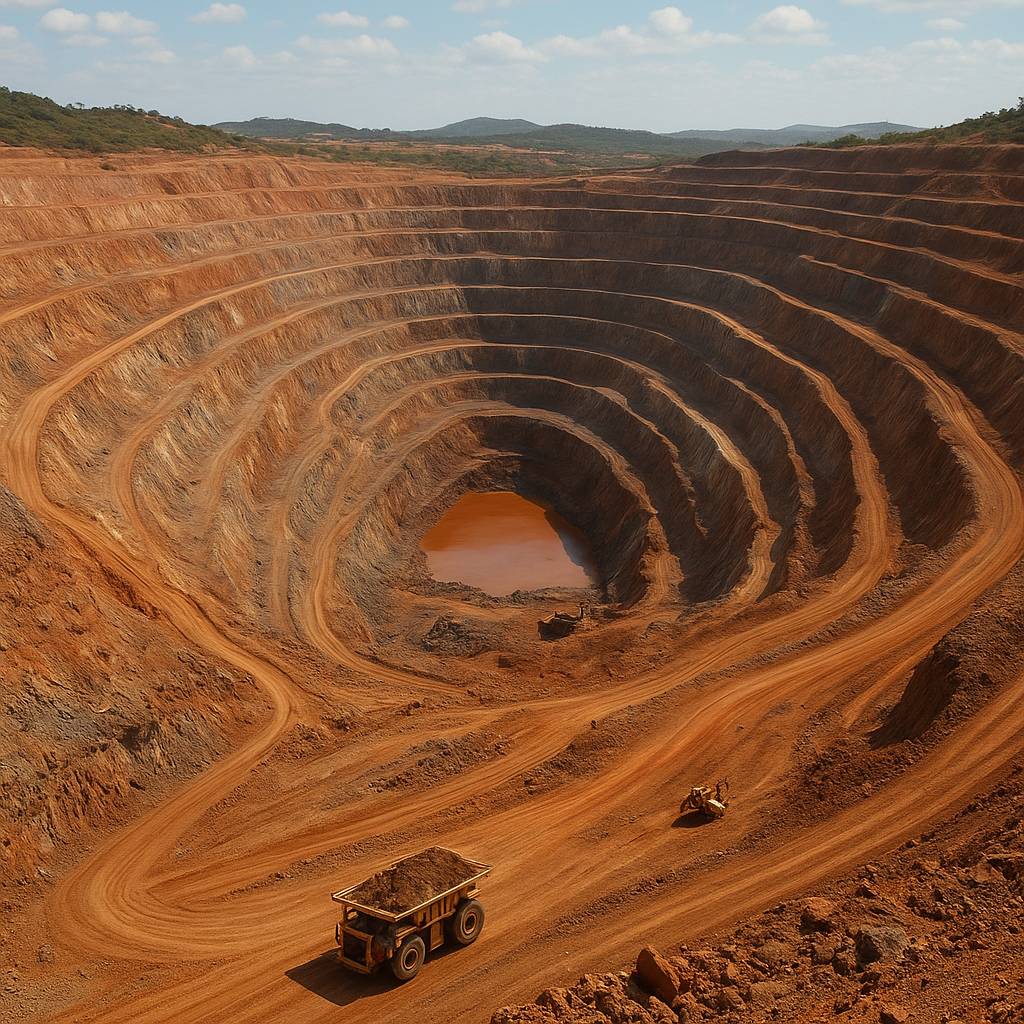
The following article explores the complex and long-standing story of the Konkola mine complex in the heart of the Zambian Copperbelt. It looks at where the mine is located, the geology and minerals present, how extraction has been carried out, and the mine’s broader economic, social and environmental significance. The goal is to give a rounded picture of why this site matters locally and internationally, and to highlight some of the most interesting and consequential aspects of one of Africa’s most important copper-producing areas.
Location and geological setting
The Konkola mining area lies in northern Zambia, within the highly mineralized zone known as the Copperbelt. The mine is situated near the town of Chililabombwe and close to the border with the Democratic Republic of Congo (DRC), a region long recognized for its rich stratiform copper and cobalt deposits. The local landscape is dominated by mining towns, processing facilities and transportation infrastructure built to service the industry.
Regional geology
The copper mineralization at Konkola is typical of the Zambian/DRC Copperbelt: it occurs in sediment-hosted stratiform deposits within Mesoproterozoic and Neoproterozoic sedimentary sequences. The ores are composed mainly of copper sulfides such as chalcopyrite and bornite, with cobalt commonly associated in lesser quantities. Mineralization is often found in relatively continuous, laterally extensive layers that make the region attractive for large-scale mining operations.
Ore bodies and reserves
The Konkola complex includes a number of distinct ore bodies and mining areas, including the high-grade underground zones often referred to collectively as Konkola Deep. These ore bodies have historically been prized for their relatively high copper grades compared with many other large deposits worldwide. Over decades of extraction, the focus has shifted from near-surface reserves to deeper, more technically challenging zones, requiring advanced underground mining methods.
Mining operations and production
The Konkola area has been mined for many decades and has hosted both open-pit and underground operations. Mining at scale in this part of Zambia has involved a combination of extraction, concentration and some downstream processing activities designed to convert ore into marketable copper products.
History of operations
Commercial mining in the Copperbelt began in the early 20th century and expanded rapidly during the mid-1900s. The Konkola operations became an integral part of Zambia’s copper industry. Over time, ownership and management structures changed several times, reflecting wider economic and political shifts in Zambia and the global mining sector. The mining complex has been operated in recent decades under the umbrella of Konkola Copper Mines (KCM), a company that has been central to the region’s output and employment.
Mining methods and processing
Mining methods have included conventional underground practices—drift and fill, long-hole stoping, and other mechanized methods—designed to safely extract ore from deep, narrow orebodies. Where shallower ore allowed, surface mining or open pit methods were also used. After extraction, ore is typically crushed and milled before flotation or other concentration processes produce a copper-rich concentrate. Depending on the configuration of smelters and refineries, some material may be further refined locally or exported as concentrate for refining abroad.
Products and by-products
- Main product: Copper in concentrate or cathode form, destined for global markets.
- Common by-product: Cobalt, often recovered at lower volumes but with rising strategic importance for batteries and clean-energy technologies.
- Other materials: some associated minerals, tailings, and rock waste requiring management.
Economic significance
The Konkola operations have long been a cornerstone of the regional and national economy. Copper is Zambia’s principal export commodity and is a major source of foreign exchange earnings, government revenues and employment. Konkola’s contribution has been through direct employment at the mine and associated processing plants, indirect employment in services and supply chains, and through taxes and royalties paid to the state.
Employment and local development
Mines like Konkola have been major employers in the Copperbelt, providing wages and livelihoods to thousands of workers and shaping patterns of urbanization. Mining towns cluster around production sites, and the presence of the mine has stimulated secondary businesses—transport, retail, housing and health services. For many local communities, the mine has been central to identity, economy and daily life.
Revenue generation and national importance
On a national scale, revenues from copper are critical for Zambia’s fiscal balance and public finances. Export earnings from major mine complexes help fund public services and development projects. As such, the performance and stability of operations at Konkola have implications that extend well beyond Chililabombwe and the immediate mining community.
Investment, ownership and governance
Ownership of the Konkola operations has been politically and economically sensitive. Investment by international mining groups has brought capital and expertise, but also raised questions about governance, local content and the distribution of benefits. High-profile disputes between mining firms and the Zambian government over taxation, environmental compliance and ownership terms have occurred periodically, illustrating the complex interplay between private investors and public interest in the extractive sector.
Environmental and social dimensions
Mining at the scale of Konkola inevitably raises environmental and social challenges. Addressing those challenges is crucial both for the well-being of nearby communities and for the long-term sustainability of mining operations.
Water, tailings and pollution
Processing sulfide ores produces tailings and wastewater that can contain heavy metals and acidic components. At several mining sites across the Copperbelt, concerns have been raised about contamination of rivers and groundwater, as well as the stability of tailings impoundments. This has led to public health worries and legal actions by affected communities. Ensuring proper tailings management, water treatment and monitoring is essential to reduce risks and mitigate impacts.
Community health and livelihoods
Beyond pollution, the presence of large mining operations affects community health and livelihoods through changes in land use, access to water and the local labor market. While mines create jobs, they can also displace traditional activities such as small-scale agriculture and fishing. Social investment by mining companies—schools, clinics and infrastructure—can provide benefits, but community relations have sometimes been strained by perceived or real inequities.
Regulation and remediation
Regulatory frameworks exist that require environmental impact assessments, monitoring and remediation, but enforcement capacity has varied over time. The need for robust regulation, transparent reporting and corporate accountability remains a recurring theme in discussions about Konkola and similar operations across the region. Where contamination or legacy pollution exists, remediation is costly and technically challenging, requiring long-term commitment from both operators and government.
Legal disputes, governance and recent developments
Konkola has been the subject of prominent governance and legal disputes involving the mine’s owners, the Zambian government and local stakeholders. These disputes have included questions about tax liabilities, environmental compliance, and investment obligations. At times, such disputes have led to administrative interventions, production interruptions or changes in management arrangements. Unresolved conflicts can create uncertainty for workers and investors and affect production levels.
Worker relations and safety
Worker safety is a perennial concern in deep underground mines. There have been tragic accidents and safety incidents in the Copperbelt historically, often prompting calls for improved standards, training and oversight. Maintaining high health-and-safety standards is a technical and managerial priority for any responsible mining operation.
Why Konkola matters beyond copper
There are several reasons why the Konkola complex attracts attention that go beyond simple tonnage figures. These include its role in global supply chains, its interface with climate and energy transitions, and its symbolic place in the politics of natural resource management.
Strategic minerals and the energy transition
Demand for copper is rising globally due to the energy transition: electrification, renewable energy systems, electric vehicles and expanded grid infrastructure all require substantial quantities of copper. Similarly, cobalt—often produced alongside copper in the Copperbelt—has become strategically important for batteries. Mines like Konkola therefore occupy a pivotal position in the broader shift toward low-carbon technologies.
Infrastructure and logistics
Mining complexes have historically driven infrastructure development—roads, rail links, power supply and ports—because the logistics of moving large volumes of ore and concentrate require substantial investment. The location of Konkola near regional transportation corridors has made it an anchor point for such infrastructure, benefiting other economic activities in the region.
Heritage and knowledge
The long operational history of the Copperbelt means that generations of workers and engineers have developed specialized skills in deep-level mining, metallurgy and mine management. That human capital is an intangible asset, and the stories and technologies that arise from decades of operations contribute to global mining expertise.
Interesting facts and lesser-known details
- High-grade ores: Konkola’s ore bodies have historically included relatively high copper grades, which makes extraction economically attractive even when commodity prices fluctuate.
- Complex metallurgy: Processing sulfide ores requires sophisticated flotation and smelting technologies; metallurgical performance can significantly affect profitability.
- Transnational neighborhood: The Copperbelt spans an international border; geology does not respect political boundaries, so mining activities often connect communities and economies across Zambia and the DRC.
- Community innovation: Local communities have adapted in creative ways to mining economies, developing small enterprises and service industries that supply the larger operation.
- Long-term legacies: Some environmental and social impacts of mining can last for generations, which is why rehabilitation and legacy management are increasingly central to planning.
Future outlook and challenges
The future of Konkola will be shaped by a mix of market forces, investment choices and public policy. On the market side, rising global demand for copper and cobalt offers opportunities—but prices are volatile and investment is capital intensive. Technological advances in ore processing, automation and safety can improve productivity but also change labor dynamics.
Investment and modernization
Upgrading aging infrastructure and expanding into deeper ore zones require substantial capital and technical expertise. Attracting and sustaining that investment depends on clear and stable regulatory regimes, fair fiscal terms, and constructive relations between investors, government and communities.
Sustainability and corporate responsibility
There is growing pressure on mining companies to adopt rigorous environmental and social standards, to manage tailings and wastewater responsibly, and to ensure transparent reporting. Mines that proactively engage with communities and invest in long-term remediation and social development are more likely to secure social license to operate.
Policy implications
For Zambia, the policy choices made around taxation, ownership structures, environmental regulation and skills development will help determine whether the long-term benefits of mining are maximized domestically. Balancing the need for foreign investment with the imperative to protect public interest is a continuing policy challenge.
Concluding reflections
As a major complex in the rich sedimentary copper province of the Copperbelt, Konkola illustrates many of the opportunities and challenges of modern mining. It generates critical export revenue and employment for Zambia, supplies materials essential to the global shift toward electrification, and also raises pressing questions about environmental stewardship, social equity and governance. The ongoing story of Konkola is therefore both a local saga and a chapter in the global narrative about how societies harness mineral wealth responsibly and sustainably.

