
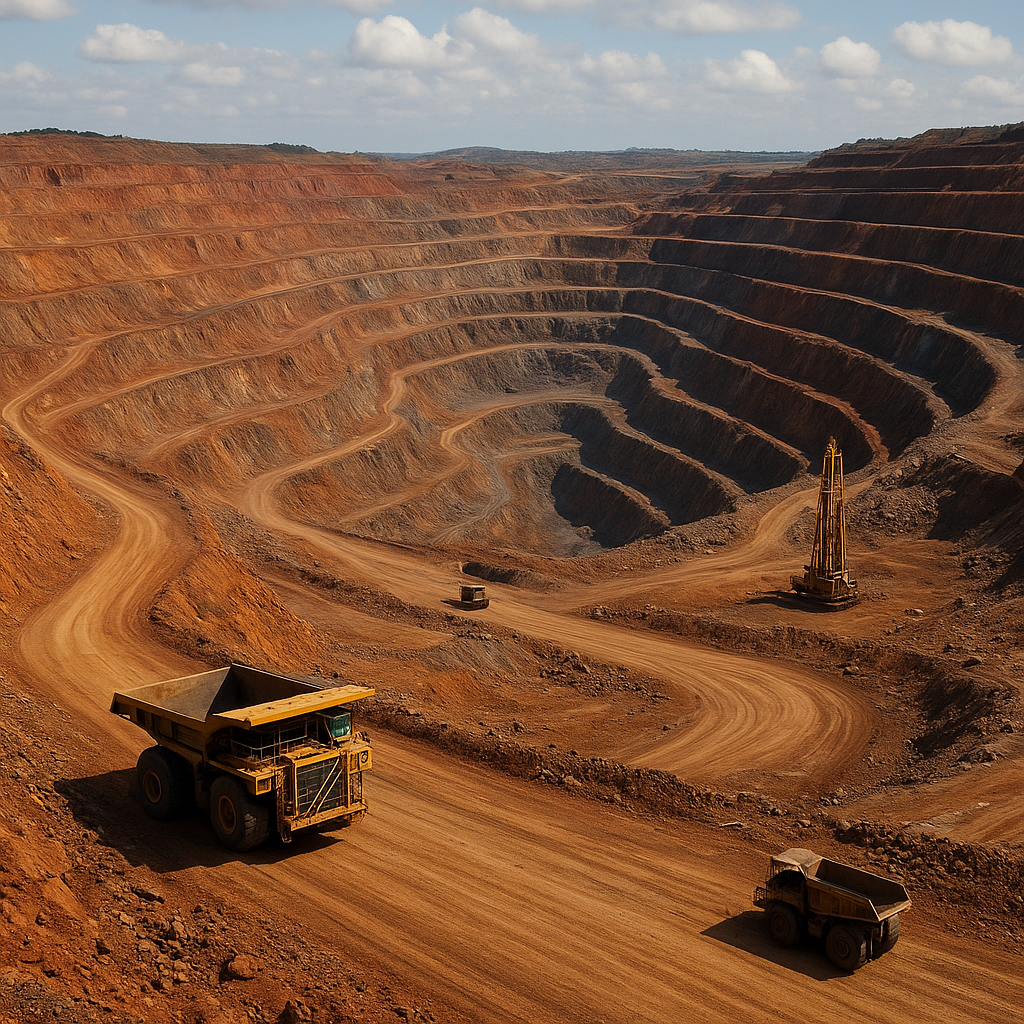
The Kolwezi mining area in the southeastern part of the Democratic Republic of the Congo is one of the planet’s most important sources of copper and cobalt. Nestled on the high, mineral-rich plateau of the Katanga region (today administratively part of Lualaba Province), Kolwezi combines deep geological significance, a long and complex industrial history, and a role in contemporary global supply chains for technologies from power grids to electric vehicles. This article examines where Kolwezi is located, what is extracted there, its economic importance for the DRC and the world, and several lesser-known but compelling aspects of the mining complex and its surroundings.
Location, geology and mine layout
Kolwezi sits in the southern Congo Basin, on the mineral-dense stretch known as the Central African Copperbelt, which stretches across the DRC and neighbouring Zambia. The town of Kolwezi is the regional hub for mining operations and services; the surrounding district contains numerous open pits, underground workings, processing plants and extensive tailings storage facilities.
The Copperbelt is a unique geological province formed over hundreds of millions of years. It hosts sediment-hosted stratiform deposits where copper and cobalt are concentrated within sedimentary rock layers and later modified by tectonic and hydrothermal processes. In Kolwezi, ores are often enriched in both copper and cobalt, the latter being a critical metal for modern rechargeable batteries. Typical copper minerals encountered include chalcopyrite and secondary copper carbonates such as malachite and azurite, while cobalt frequently occurs associated with cobaltite, carrollite and as a subordinate element in mixed sulfides.
Mining in the Kolwezi area is not a single pit but an aggregated complex of operations: historic open pits, several large-scale processing plants, underground mines and extensive tailings deposits from previous decades. Over time, some projects shifted focus to reprocessing old tailings because the deposited material often remains economically attractive due to changing metal prices and improvements in processing technology.
What is extracted and how
The primary commodities produced in Kolwezi are copper and cobalt, with cobalt frequently recovered as a by-product of copper extraction. Mining methods vary depending on the deposit type and depth. Both conventional open-pit mining and underground techniques are used. After extraction, ore is crushed and processed to produce concentrates, which may be refined locally into metal or exported for smelting and refining abroad.
- Copper: Extracted both as a target commodity and as a carrier for cobalt. Copper concentrates from Kolwezi are high-grade and feed global copper smelters.
- Cobalt: Often present at economically useful concentrations, cobalt is recovered through flotation and hydrometallurgical treatment of concentrates and tailings. Cobalt sulfate and other chemical intermediates are increasingly produced to meet battery-industry specifications.
- Tailings retreatment: Historic tailings deposits around Kolwezi contain significant residual metal. Several projects have focused on retreatment, which can reduce environmental hazards while recovering valuable metal.
Processing technologies have evolved: conventional smelting and leaching are complemented by hydrometallurgical circuits designed to extract and purify cobalt and copper salts suitable for modern industrial use. The region has also seen trials and implementations of newer, more selective leaching processes that attempt to lower environmental footprints and improve metal recovery.
Economic significance for the DRC and global markets
Kolwezi’s economic weight is felt at multiple scales. Locally, the mines provide employment, finance infrastructure and support secondary businesses in the town and surrounding villages. At the national level, mining revenues from copper-cobalt operations contribute a substantial share of the Democratic Republic of the Congo’s export earnings and fiscal receipts.
Globally, Kolwezi matters because the DRC supplies a very large share of world cobalt and a significant portion of copper. Demand for cobalt has surged due to its role in lithium-ion batteries used by smartphones and electric vehicles. Consequently, Kolwezi’s output links directly to the supply chains of multinational automakers, battery manufacturers and electronics companies. The area’s production therefore influences metal prices, investment decisions and strategic considerations for countries seeking secure supplies of battery metals.
Foreign direct investment and complex joint ventures have shaped the industry around Kolwezi. State-owned enterprises such as Gécamines (the historic Congolese mining company) have often been partners in projects alongside international miners, trading houses and private investors. This mix of partners reflects both the capital-intensive nature of large-scale mining and the DRC government’s desire to maintain local stakes in resource development.
Social, environmental and governance challenges
Mining in Kolwezi is associated with a range of social and environmental challenges that attract domestic and international attention. On the social side, the industry provides livelihoods but also creates pressures: rapid urban growth around Kolwezi has placed strains on housing, health services and local infrastructure. In the surrounding countryside, the presence of formal mines often coexists with extensive artisanal and small-scale mining activities, which are a major source of income for many families but can be informal, hazardous and poorly regulated.
Environmental impacts include land disturbance, water contamination from mine discharge and tailings, and air quality issues from dust and processing emissions. Tailings facilities and legacy waste dumps present long-term management challenges in a region with heavy seasonal rains. Efforts to mitigate environmental harm—such as containment improvements, water treatment and progressive rehabilitation—are ongoing but unevenly implemented.
Good governance and transparency are central to maximizing the benefits of mining. Revenue management, fair contracts, monitoring of environmental performance and the formalization of artisanal miners are priorities often highlighted by governments, NGOs and international partners. Corruption, unclear tenure, and weak enforcement of environmental and labor standards have periodically undermined potential gains, making institutional reform a recurring topic in discussions about Kolwezi.
Interesting and lesser-known facets
Kolwezi has many aspects that go beyond straightforward resource extraction. A few notable points:
- Historical flashpoints: The region’s mineral wealth has contributed to political and military tensions over decades. Kolwezi itself has been the scene of notable conflicts which intertwine local grievances, national politics and international interventions. These events shaped public perceptions of mining and prompted changes in security and governance approaches.
- Tailings as a resource: Unlike many mining districts where tailings are simply waste, Kolwezi’s tailings are sometimes considered a secondary ore body. Advances in recovery technology and higher metal prices have made retreatment projects economically attractive while also addressing environmental risks posed by old dumps.
- Art and mineralogy: The Copperbelt region is famous among mineral collectors for striking blue and green secondary copper minerals. These natural specimens have aesthetic and educational value and attract scientific interest in mineral formation processes.
- Energy and infrastructure links: Kolwezi’s mines require consistent power, water and transport. Investment in roads, rail links and local energy has spillover benefits for non-mining sectors, but it also ties regional development to the fortunes of commodity markets.
- Battery transition implications: As the world decarbonizes and electrifies transport, Kolwezi’s cobalt and copper become strategically important. This raises questions about how resource-rich regions can capture higher-value processing activity locally rather than exporting raw concentrates.
Workforce, communities and the informal sector
The workforce around Kolwezi includes a spectrum from large-scale, industrial miners to countless informal miners and traders. Employment in industrial mines typically requires technical skills and provides formal wages and benefits, whereas artisanal miners operate with simple tools and often face unsafe conditions. The informal mining economy supports many households through direct extraction, transport, trading and small-scale processing.
Community relations are therefore critical: mines that invest in local development, training and social services can foster more stable operating environments. However, distrust can grow if communities perceive that benefits are unevenly distributed or if environmental harms are not addressed. Programs aimed at formalizing artisanal miners, improving safety, and creating legal routes for small-scale operators to sell material to larger processors have been piloted in and around Kolwezi with mixed results.
Investment, ownership and recent trends
Ownership structures in the Kolwezi area have evolved over time. State entities, private companies, and international groups have all held interests in various assets. Investment cycles track commodity prices: high copper and cobalt prices attract capital to expand mining, build processing plants or buy concessions; lower prices lead to consolidation, cost-cutting or project delays.
Recent trends include a growing emphasis on downstream processing, increased interest from battery and technology firms in securing upstream supply, and a focus on sustainability metrics such as traceability, responsible sourcing and reduced carbon intensity of production. Some companies operating in the region highlight commitments to community development and environmental improvement as part of their strategy to access markets that demand ethically sourced minerals.
Infrastructure, logistics and export routes
Kolwezi is connected to regional infrastructure networks that enable export of concentrates and refined products. Key considerations include rail links, freight corridors, and proximity to smelters and refineries. Because raw and semi-processed materials are heavy and transport-sensitive, efficient logistics are a major factor in project economics. Investment in rail and road rehabilitation has been important for maintaining throughput and enabling the flow of exports to international markets.
Processing capacity near the mining areas reduces the need to ship raw concentrates long distances and can capture more local value. However, building and operating smelters and refineries requires stable power supplies and significant capital, which has limited the pace of downstream integration in some periods.
Research, innovation and future prospects
Ongoing research into improved mining methods, hydrometallurgical processing and environmental mitigation has implications for Kolwezi’s future. Innovations that improve metal recovery from low-grade ore and tailings, reduce water and energy use, and cut emissions can make previously marginal resources attractive and lessen environmental impacts.
The future of Kolwezi will be shaped by global market trends for copper and cobalt, political and regulatory choices in the DRC, technological change in mining and processing, and evolving expectations from consumers and buyers about the social and environmental footprint of minerals. If managed transparently and sustainably, Kolwezi’s resources could underwrite development and industrial diversification; if mismanaged, they risk perpetuating cycles of environmental degradation and social conflict.

