
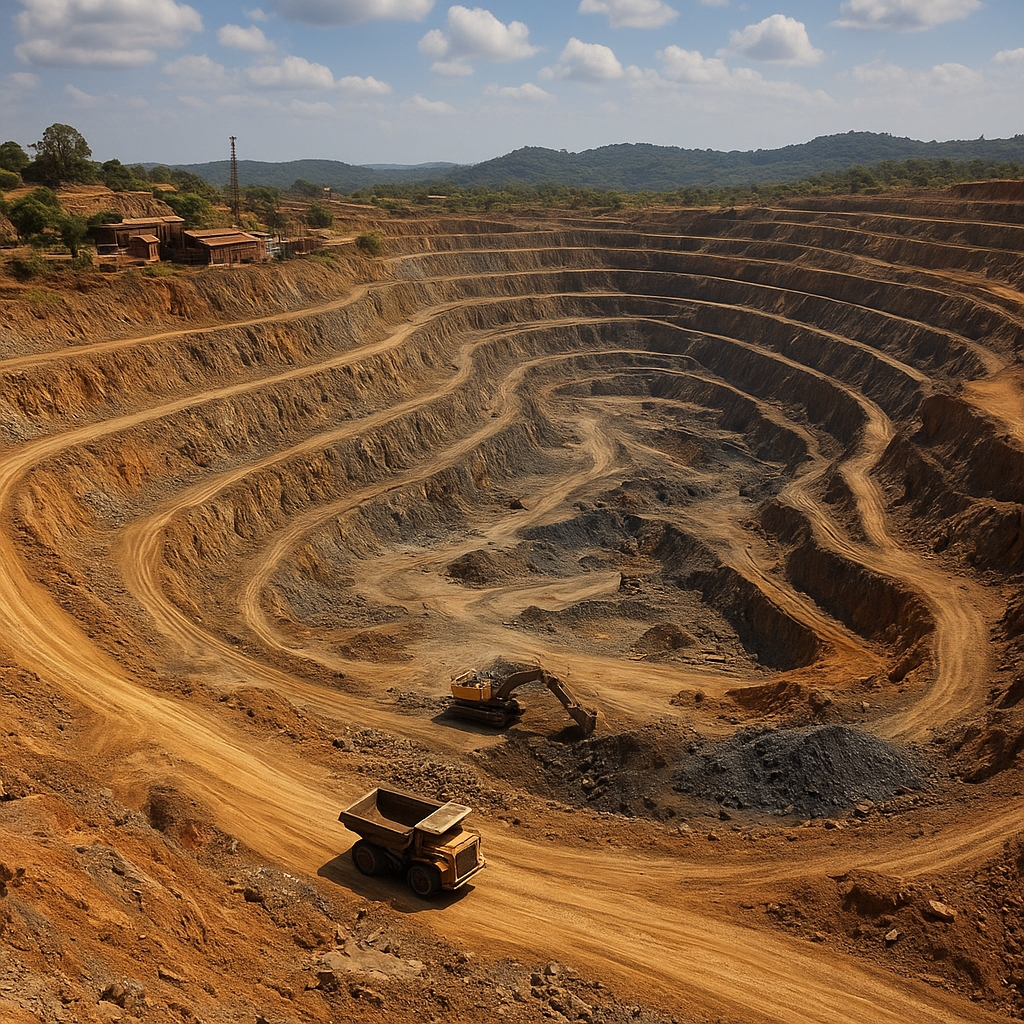
The Kolar Gold Fields (commonly abbreviated as KGF) occupy a singular place in the history of mining in India. Located in the eastern plains of the state of Karnataka, the Kolar belt has been a source of gold for centuries and later became the focus of intense industrial activity under British and Indian administration. This article traces where the mines are, what was extracted from them, the broader economic and social consequences of operations and closures, and several lesser-known but compelling aspects of KGF’s legacy.
Location and historical overview
The Kolar Gold Fields are situated in the Kolar district of southern India, roughly 60–100 kilometers east of the city of Bangalore. Geographically the mining area forms a band of mineralized quartz veins and reefs running across the lateritic plains. In pre-modern times the region was known for sporadic alluvial and shallow reef mining practiced by local communities and rulers. Mining at Kolar later evolved into an industrial enterprise.
Colonial expansion and modern mining
Large-scale modern mining began in the 19th century during British rule. Foreign mining companies and engineers developed deeper shafts and mechanized ore extraction methods. These investments transformed what had been a cluster of small workings into a formalized mining district with planned townships, shafts, and ore-processing facilities. Key mines and shafts were sunk to reach the concentrated gold-bearing reefs. The area came to be known for shafts that were among the deepest in India at the time, and for its extensive underground workings.
Administrative history
After independence, operations continued under Indian management. A government-owned company later managed the principal mines, working to maintain production while addressing labor and technical challenges. Over time, diminishing grades, rising costs, and technical difficulties with deep-level water inflow and ventilation contributed to a decline in production. Official mining activity in Kolar was scaled down and ultimately halted towards the end of the 20th century and into the early 2000s.
Geology and what was extracted
KGF’s value lies in a belt of gold-bearing quartz-reef systems hosted within older rocks. The ores occur primarily as narrow quartz veins and reefs that carry gold often associated with sulfide minerals. Understanding of the local geology enabled engineers to plan deep shafts that intersected multiple reef horizons.
Primary mineral — gold
The primary commodity was, of course, gold. Extraction targeted reef-hosted gold that required hard-rock excavation, crushing, and concentration. The geology produced ore bodies of variable width and grade, which required selective mining of the richer faces and careful processing to recover gold particles bound in quartz and sulfides. Although gold was the focus, ore processing and tailings sometimes contained traces of other elements and minerals as by-products.
Mining methods
- Underground shaft mining was the dominant method; multiple vertical and inclined shafts were sunk to access reef horizons.
- Stoping and reef mining techniques extracted the ore, which was then transported to surface crushing and concentration plants.
- Extensive pumping was required to manage groundwater inflow; ventilation and safety systems were critical parts of operations at great depth.
Given the narrowness of many of the gold-bearing veins, extraction required skilled underground labor and meticulous ground control. Mechanization improved productivity but also demanded high capital and maintenance expenses as workings deepened.
Economic significance and social impact
The Kolar Gold Fields were an economic engine for the region for over a century. Mining operations required a large, stable workforce and prompted the development of infrastructure, services, and ancillary industries. The social fabric of KGF was shaped by company town planning, labor migration, and a diverse workforce.
Employment and local economy
The mines provided direct employment to thousands of workers across various roles: miners, engineers, metallurgists, administrative staff, and service workers. In addition to direct jobs, a secondary economy flourished. Shops, transport services, schools, hospitals, and entertainment venues catered to the mining communities. The presence of a skilled mining workforce contributed to local economic development beyond the mines themselves.
Urban planning and community life
Company-built townships included planned housing, recreational clubs, churches, and schools. This gave KGF a distinctive character—an industrial township with elements of social infrastructure uncommon in rural surroundings. The company towns also created distinct social strata and a multicultural environment shaped by local and migrant labor.
Economic decline after closure
When operations wound down and the principal company ceased commercial mining, the closure had a pronounced economic and social impact. Loss of jobs precipitated out-migration, reduced demand for local services, and a decline in municipal revenues. Abandoned infrastructure, derelict shafts, and unresolved liabilities remain part of the legacy. Local stakeholders and policymakers have debated various revival options, balancing potential economic gains against environmental and financial feasibility.
Environmental legacy and attempts at revival
Like many historical mining districts, KGF left a mixed environmental record. Tailings and waste dumps, deep shafts, and altered groundwater regimes pose ongoing challenges. Pumping requirements during operations often altered local water tables; after closure many pits and shafts had to be secured or allowed to flood, raising both safety and environmental questions.
Pollution and rehabilitation
- Tailings dams and waste rock heaps require proper management to prevent erosion and heavy-metal leaching.
- Contamination risks, while variable, necessitate monitoring and, where needed, remediation to protect soils and groundwater.
- Rehabilitation of old mine sites can include re-vegetation, containment, and repurposing land for community use if safe.
Some proposals for revival have pointed to improved metallurgical processes, higher global gold prices, and better technology for dewatering and deep mining as reasons to reconsider KGF’s potential. However, any restart must face a complex calculus: remaining reserves must justify capital costs; environmental obligations must be addressed; and long-term social benefits must be balanced with risks.
Recent initiatives and debates
Over the years there have been periodic calls to reopen mines, either through public-sector initiatives or private investment. Feasibility studies, legal and environmental clearances, and questions about financial viability have slowed or stalled many of these efforts. In the meantime, community groups and local governments have explored alternative development paths for former mining townships, including tourism, industrial parks, and heritage conservation.
Cultural footprint and interesting facts
Beyond geology and economics, KGF has a compelling cultural and popular legacy. The mining townships produced a distinct local culture featuring Anglo-Indian influences, diverse local communities, and an industrial ethos shaped by decades of underground labor.
Architecture and heritage
Buildings and community structures from the mining era—clubhouses, old company offices, and workers’ quarters—offer a visible record of KGF’s past. Some structures have architectural significance and evoke the social history of mining life: recreation halls, hospitals, and schools that were once central to daily life.
KGF in popular culture
KGF has also entered popular culture. Modern media have taken inspiration from the dramatic setting—deep mines, boomtown life, and the struggle over natural resources. This has brought renewed attention to an otherwise quiet historic mining area, fostering interest in both the dramatic human stories and the industrial relics left behind.
Unique aspects and anecdotes
- KGF’s long history includes episodes where mines were worked sporadically over centuries, switching between small-scale local operations and industrial companies.
- The complexity of underground workings, interlinked shafts and galleries, and persistent groundwater issues made it a notable case study in deep-level tropical mining.
- The social makeup included local labor organized into skilled syndicates alongside migrant labor, creating a multilayered community with unique traditions tied to mining rhythms.
Challenges and future perspectives
Any future for the Kolar area must negotiate technical, environmental, economic, and social dimensions. Technically, deep mining requires robust dewatering, cost-effective extraction, and modern processing to make low-grade reefs viable. Environmentally, legacy contamination and landscape disturbance must be managed to safeguard local communities. Economically, the global price of gold and access to capital influence whether reactivation is sensible. Socially, local aspirations for employment and improved services must be reconciled with the realities of sustainable development.
Proposals to re-evaluate KGF occasionally surface—ranging from partial reactivation with modern technology to complete transformation of former mining areas into heritage zones or industrial hubs. Whatever direction is taken, the Kolar Gold Fields will remain a significant case in India’s resource history: an area that illustrates both the wealth and the costs that flow from extracting subterranean riches.
Notable names and terms linked to KGF:
- Kolar — the district and regional name most closely associated with the mines.
- KGF — widely used abbreviation that denotes the mining district and its townships.
- Champion — a name often associated with one of the principal reef zones and shafts in mining literature and local memory.
- BGML — the government company that managed operations in later years and a key player in the administrative history.
- mining — the central industry shaping the area’s economy and social structures.
- heritage — the cultural and industrial legacy that communities and historians seek to conserve.
- revival — the recurring conversation about whether and how mining might restart or the site be repurposed.

