
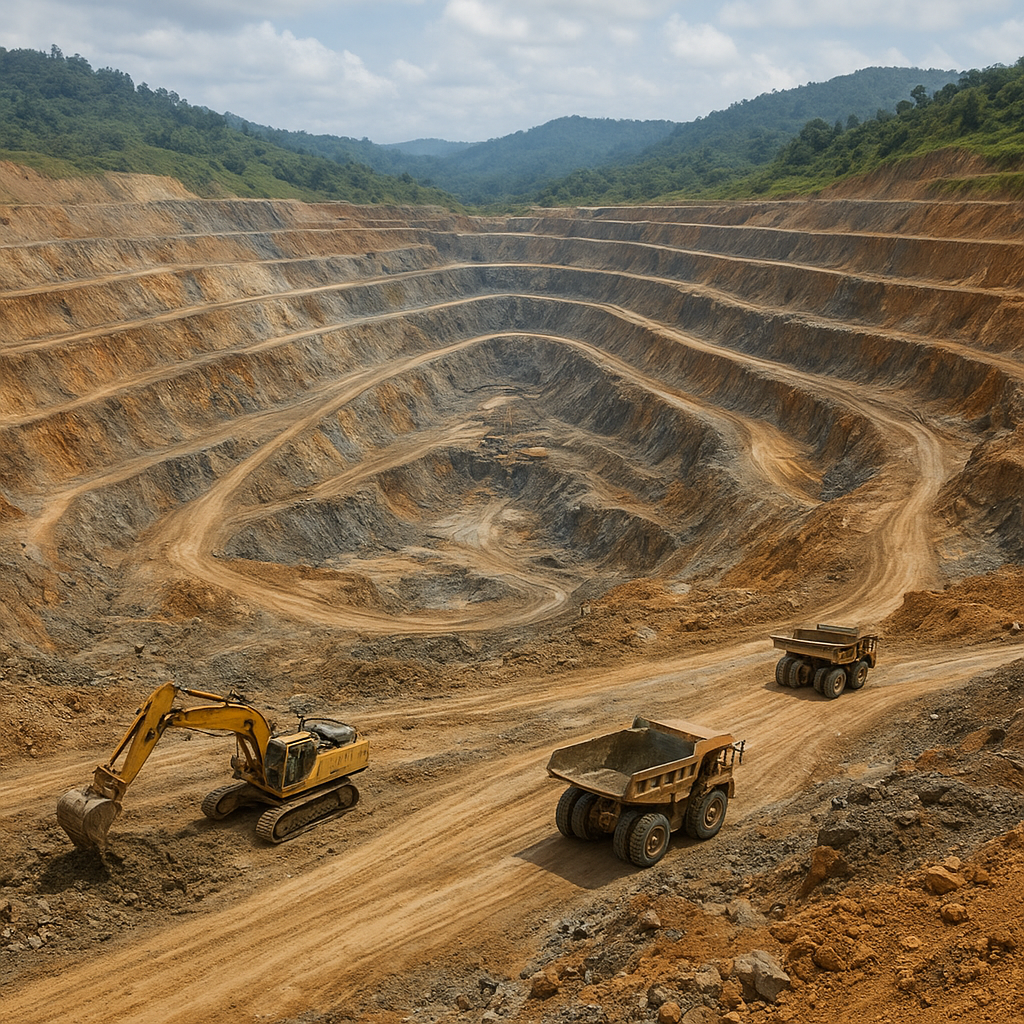
The Kibali mine is one of Africa’s most prominent and ambitious gold projects, located deep in the northeastern reaches of the Democratic Republic of the Congo. Combining large-scale open-pit and underground operations with a modern processing plant and extensive on-site infrastructure, Kibali has reshaped the local economy and reactivated a historic gold district. This article examines where Kibali is situated, what is extracted there, its economic importance, and a number of intriguing technical, social and environmental aspects surrounding the operation.
Location and geological setting
Kibali sits in the heart of the Kilo-Moto greenstone belt in the province of Haut-Uélé in the northeast of the Democratic Republic of the Congo. The project is located several hundred kilometres from the capital of Kinshasa, in an area that is remote by national standards and historically associated with artisanal and colonial-era mining activity. The terrain is tropical savannah and mosaic forest, dissected by seasonal rivers and subject to a pronounced rainy season that can complicate logistics.
The region’s geology is typical of Archean greenstone belts: a complex assemblage of metavolcanic and metasedimentary rocks intruded by granitoids and cut by quartz veins. Gold mineralization at Kibali is largely orogenic in style — structurally controlled, associated with quartz-carbonate veins and sulphide-bearing zones — and occurs both as discrete high-grade vein shoots and as more disseminated mineralization in host rock. This geological complexity has enabled the development of both large open pits where the mineralization is near-surface and an extensive underground operation targeting deeper, higher-grade shoots.
Strategic position and access
Because of its isolation, the project required significant investment in access and logistics. Roads, air facilities and power infrastructure had to be upgraded or created from scratch to reliably support a multi-million tonne-per-year processing plant and the workforce that runs it. The mine is close enough to regional towns to draw labour and services, but too remote to rely on existing grids and supply chains without major intervention.
Mining methods, processing and production profile
Kibali is an integrated mining complex that combines open-pit and underground mining methods. Initial development emphasized large open pits to access near-surface mineralization and build cash flow quickly. As the open pits matured, underground operations expanded to exploit deeper, high-grade veins using conventional mechanized stoping methods. The hybrid approach helps balance incremental capital expenditure, access to higher grades at depth and overall project flexibility.
The processing facility includes primary and secondary crushing circuits, grinding mills, gravity concentration and a carbon-in-leach (CIL) circuit for gold recovery. Gravity concentration is used to recover coarse gold and increase overall recovery efficiency, while CIL treats the finer fraction and refractory material that responds to cyanidation. The mine’s metallurgical circuits were designed to handle variable ore types and a spectrum of head grades produced by both pit and underground sources.
- Crushing and milling — multi-stage comminution to liberate gold-bearing particles.
- Gravity concentration — recovery of coarse free gold prior to leaching.
- CIL leaching — carbon-in-leach to recover dissolved gold.
- Tailings management — engineered storage facilities and progressive rehabilitation plans.
Since its commissioning, Kibali’s annual production has made it one of the largest single-site gold producers on the African continent. Production varies year to year as open pits are depleted and underground development ramps or phases change, but the mine has consistently contributed hundreds of thousands of ounces of refined gold per year to the global market during its principal operating years.
Ownership structure and economic importance
Kibali is operated by Kibali Goldmines S.A., a joint venture with international and local stakeholders. The principal shareholders include international gold producers — notably Barrick and AngloGold Ashanti — together with participation by the Congolese state-owned mining company, SOKIMO. This structure is intended to combine international technical and financial capacity with local ownership and economic benefit.
The mine’s economic significance extends at several levels:
- National revenue: Kibali contributes taxes, royalties and export earnings that are significant for the DRC’s mining income stream. Gold exports from Kibali help generate foreign exchange for the national economy.
- Regional development: The operation has created direct employment for thousands of workers and many more in contracted services. Local procurement, road and power upgrades, and social investment projects have a rippling effect on the provincial economy.
- Investment and exploration: Kibali’s success has renewed interest in the Kilo-Moto belt and stimulated exploration, attracting further investment into a historically under-explored region. That enhances the potential for long-term economic activity beyond the life of the current mine.
The mine’s capital and operating expenditures, along with related tax and royalty flows, mean that Kibali plays a strategic role in regional infrastructure and public service investment. In addition, by providing formal employment and structured wages, the operation can reduce local communities’ dependence on artisanal mining and offer alternative income streams.
Social and environmental considerations
Large-scale mining in a remote and economically fragile environment brings both opportunities and responsibilities. Kibali has implemented a range of social programs and environmental mitigation measures, but challenges remain.
On the social side, the company invests in community development initiatives such as healthcare clinics, schools, potable water systems and small business programs. Housing and services for workers, as well as skills training and employment preferences for local residents, are frequently highlighted components of their community engagement strategy. Nevertheless, tensions can arise around land access, relocation, expectations for jobs and the interaction with artisanal miners who depend on small-scale gold extraction for livelihoods.
Artisanal and small-scale mining activity in and around the Kibali concession has been a persistent feature for decades. While artisanal miners can be a source of chronic safety and security issues around active mining areas, they also represent a large informal economy that governments and companies need to engage with thoughtfully. Programs aimed at formalizing artisanal mining, providing safer working conditions, or creating alternative income are part of the broader social response, though success varies.
Environmentally, the project follows modern standards for tailings storage, water management and progressive reclamation, but the remote setting complicates monitoring and response. Forestry clearance, erosion control during the rainy season, and maintaining water quality in nearby rivers are ongoing operational priorities. Compliance with international environmental and social governance (ESG) benchmarks — and with the expectations of international financiers and partners — has driven the adoption of more stringent controls, although critics sometimes argue that risks are underplayed.
Safety, security and human rights
Operating in northeastern DRC means confronting local security dynamics that can include armed groups, illegal mining syndicates and cross-border smuggling. Security measures are aimed at protecting personnel, assets and local communities, but they must be balanced with human rights obligations and respect for the rule of law. Transparency around security practices and grievance mechanisms for communities are important for long-term social licence to operate.
Interesting technical and historical aspects
The Kibali mine sits within a historically rich gold district. Much of the Kilo-Moto area was exploited in the early 20th century during colonial rule, then largely dormant until modern exploration techniques and substantial capital reawakened interest. The resurgence is a reminder of how legacy regions can become central again when investment, technology and market conditions align.
- Scale and modernization: Kibali demonstrates how modern mining can reconstitute a historic district into a large-scale, mechanized operation with substantial processing capacity.
- Infrastructure first approach: Developers invested heavily in power, roads and air links early in the project lifecycle — a necessity in remote locations and a model for other large projects in undeveloped regions.
- Artisanal co-existence challenges: Kibali’s experience highlights the complex interplay between industrial and artisanal mining, and the importance of programs to formalize and improve small-scale operations.
- Exploration potential: The mine continues to host significant exploration targets along strike and at depth, meaning that the resource base can be extended by disciplined exploration and drilling.
Technical innovations used at Kibali include tailored ore-processing flowsheets to manage variable ore types and recovery challenges, as well as robust tailings and water management systems designed for tropical climates. The project has also made efforts to incorporate local supply chains and training programs to maximize the benefits of the mine for surrounding communities.
Future outlook and regional implications
Looking ahead, Kibali’s future depends on continued exploration success, careful management of underground development and the ability to balance social and environmental responsibilities with production targets. Several trends could shape its trajectory:
- Exploration-led extensions: Ongoing drilling campaigns have a reasonable chance of adding incremental reserves and extending mine life.
- Operational efficiency: Optimization of milling, recovery processes and cost control can improve the project’s economics even if head grades fluctuate.
- Energy and sustainability: Moves toward more sustainable power sources and reductions in carbon intensity can lower operating risk and align the mine with global ESG expectations.
- Community integration: Successful formalization of artisanal activities and deeper local economic linkages will be crucial for long-term stability.
Success at Kibali has ripple effects beyond the mine itself. It signals to investors that the DRC can host world-class mining projects under modern governance and technical standards, while also underscoring the need for strong public sector capacity to translate resource wealth into lasting development for citizens in resource-rich regions.
Key takeaways and notable figures
While precise figures for reserves, annual output and financial flows change over time with new reporting, several constants are clear: Kibali is a major gold producer in a historically important gold belt; its development required large-scale investment in infrastructure; it is operated by international partners including Barrick and AngloGold Ashanti alongside the Congolese partner SOKIMO; and the mine plays a consequential role in the economy of Haut-Uélé and the DR Congo more broadly. The presence of artisanal miners and the environmental sensitivities of the region make Kibali a complex case study in modern mining, where technical, social and governance dimensions intersect.
For observers of African mining, Kibali is notable both for its scale and for the lessons it offers about building and operating a large gold complex in a remote, logistically challenging setting. Its combination of open-pit and underground mining, multi-stage processing, heavy upfront infrastructure investment and intensive community engagement provide a template and a cautionary tale for similarly placed projects across the continent.

