
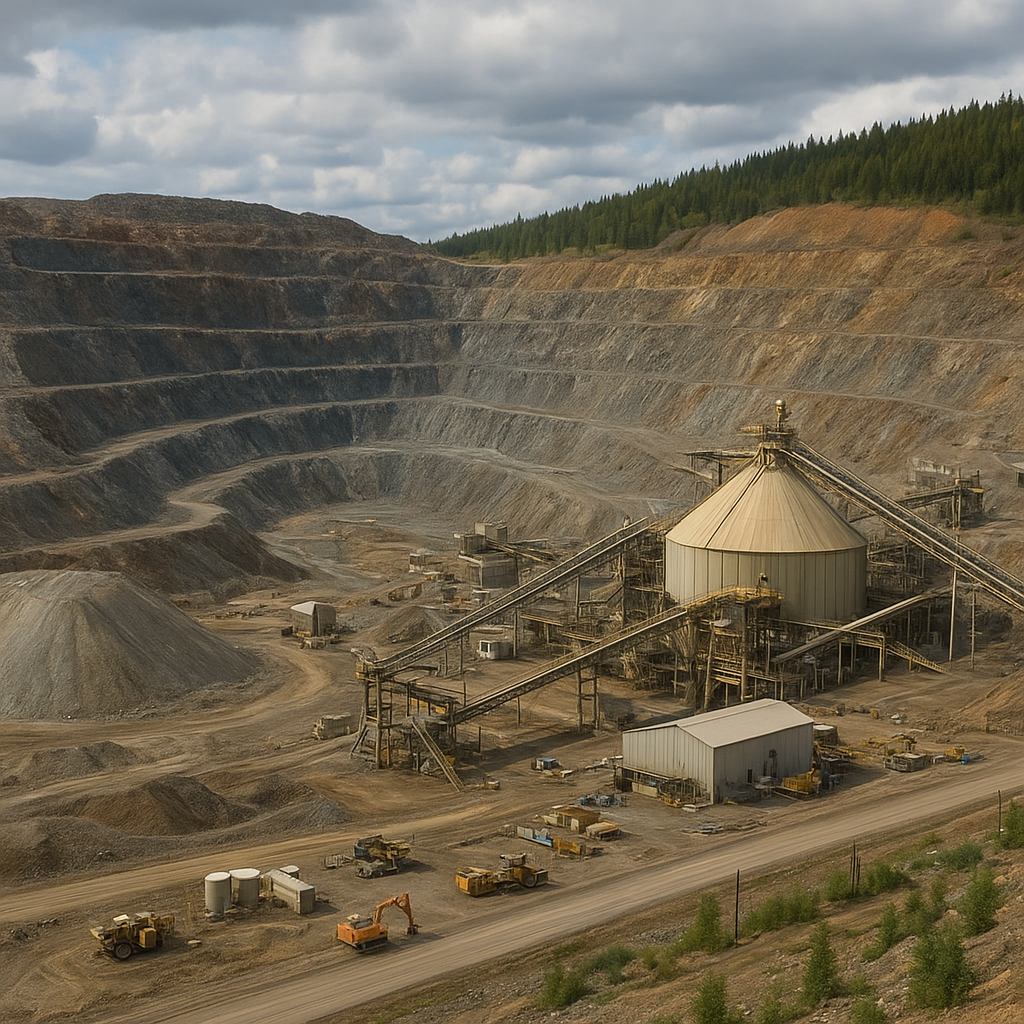
The Kennecott Eagle Mine is a modern underground mining operation in Michigan’s Upper Peninsula that has attracted attention for its production of critical metals, its comparatively small surface footprint, and the complex balance it represents between natural-resource development and environmental stewardship. Operated by a subsidiary of Rio Tinto, the mine extracts sulfide-hosted ore and produces concentrates that feed global smelters and manufacturers. This article examines where the mine is located, what materials are produced, its economic role locally and nationally, and several technical and social details that make the Eagle Mine noteworthy.
Location and geological setting
The Eagle Mine is situated in Marquette County in the Upper Peninsula of Michigan, roughly northwest of the city of Marquette and near the small community of Big Bay. It lies within a remote, heavily forested landscape of glacially scoured terrain, lakes and wetlands that characterize much of the region. The property sits in a part of the state known as the Yellow Dog Plains land form—an area that has been the focus of mineral exploration for many years.
Geology of the deposit
The deposit exploited at Eagle is a magmatic sulfide system associated with mafic and ultramafic intrusions. These geological environments commonly concentrate metals such as nickel and copper, often with associated elements like cobalt, platinum group elements (PGEs) and trace precious metals. The Eagle deposit is a relatively high-grade, compact sulfide body that permitted the design of an underground mine rather than an open pit, helping limit the site’s surface footprint.
Regional mineral context
While Michigan is better known for iron mining in the Upper Peninsula and for nonmetallic mining elsewhere, the Eagle deposit represented a particularly attractive target because it is a contained sulfide body with economic concentrations of multiple metals. The nearby geology includes other mafic intrusions and historical occurrences of nickel and copper mineralization, but Eagle is among the few modern, developed mines in the state focused on nickel-copper sulfide ore.
What is mined and how it is processed
The primary products recovered at Eagle are concentrates of nickel and copper. Ore is extracted underground, crushed and milled on-site, then processed by flotation to produce metal-rich concentrates. Those concentrates are then transported off-site to smelters and refineries for downstream processing into refined metals or alloys used in a wide range of industrial applications.
Mining method and infrastructure
Because the mineralization occurs as a discrete and relatively high-grade sulfide lens, operators chose an underground approach. The mine uses a ramp (decline) for access and for trucking ore to surface; common underground methods such as longhole stoping and mechanized drilling are employed where appropriate. One operational advantage of underground mining in this context is a reduced surface disturbance compared with an open pit, which is especially significant in a sensitive and sparsely settled area.
Processing and concentrate transport
On-site processing includes crushing, grinding and flotation circuits that separate sulfide minerals from the host rock to create concentrated products. The resultant concentrates contain the majority of the metals of interest and are shipped to smelters and refineries, often via a combination of truck and rail logistics. As concentrates typically contain sulfur, subsequent smelting must handle sulfur dioxide emissions and other environmental controls, which is why the choice of downstream partners and transport routes is an important part of the mine’s operational planning.
Economic significance
The Eagle Mine has several layers of economic importance, from local impacts in Marquette County to contributions to national supply chains for metals considered critical to modern industry.
Local and regional economic impacts
At the local level, the mine creates jobs directly in mining, processing and site services, and indirectly through contractors, suppliers and support services—everything from road maintenance to hospitality for visiting engineers and regulatory inspectors. Payroll and procurement lead to secondary economic activity in nearby communities, and tax and royalty payments contribute to municipal and state revenues. Given the Upper Peninsula’s relatively thin population and limited industrial base, a modern mine can be a significant economic driver during its operating life.
National and strategic value
Nickel and copper are important in many modern technologies. Nickel is used in stainless steels, specialty alloys, and increasingly in battery chemistries for electric vehicles (EVs) and energy storage systems; copper is critical for electrical wiring, motors, renewable-energy systems and electronics. Domestic production from mines such as Eagle helps reduce reliance on imports, supports industrial supply chains and can be part of national strategies to secure access to critical minerals. Even though the Eagle Mine is not a gigantic producer by global standards, every domestic source of nickel and copper contributes to resilience in supply chains.
Revenue, royalties and investment
Development of the mine required substantial capital investment in exploration, permitting, construction of underground access and processing facilities, and logistical infrastructure. Over the life of the operation the mine generates revenue from concentrate sales; portions of that revenue are returned to local governments, schools and state coffers through property taxes, royalties, severance taxes and similar mechanisms. These fiscal flows help justify and offset the environmental and social trade-offs that often accompany mineral projects.
Environmental management and permitting
Because the Eagle Mine is located in a region valued for its lakes, forests and outdoor recreation, environmental concerns were central to the permitting and operational planning. The mine was subject to a comprehensive permitting process including state and federal reviews that covered water quality, wetlands, habitat, emissions and reclamation obligations.
Water and waste management
Mining sulfide ores raises concerns about acid generation and metal mobilization if sulfide-bearing waste rocks or tailings are exposed to oxygen and water. To manage these risks, the mine incorporates engineered controls—such as controlled tailings containment, encapsulation of certain wastes, monitoring wells and active water-treatment systems—to prevent contamination of surface and groundwater. Continuous environmental monitoring is a regulatory requirement and a practical necessity to demonstrate that mitigation systems function as intended.
Closure and reclamation planning
Modern mine permits require robust closure plans and financial assurances so that the site can be reclaimed once operations cease. For Eagle, operators have planned reclamation measures that include regrading disturbed ground, revegetation with native species, long-term monitoring and maintenance of any engineered treatment facilities. The objective is to return affected areas to a stable, environmentally safe condition that supports appropriate post-mining land uses such as wildlife habitat and, where feasible, public access.
Community engagement and controversy
As with many mining projects, the Eagle Mine attracted vocal supporters and opponents. Supporters emphasized job creation, tax revenue and the economic use of a local resource. Opponents voiced concerns about water quality, ecosystem impacts and long-term stewardship. These tensions led to legal challenges and extensive public discourse during permitting. Over time, ongoing monitoring and transparency in reporting have played important roles in shaping public perceptions and demonstrating compliance with permit conditions.
Interesting technical and social aspects
- Modern technology: The mine uses contemporary mechanized mining and processing techniques that improve safety and efficiency compared with many historical operations. Automation, rock mechanics modeling and modern ventilation and monitoring systems reduce risk and increase productivity.
- Small surface footprint: Because the operation is underground, the visible, disturbed area on the surface is relatively small compared with an equivalent open-pit mine. This reduced footprint was an important factor in obtaining permits in a sensitive landscape.
- Critical mineral relevance: The mine’s production of nickel is particularly timely as nickel demand is expected to grow alongside the electrification of transport and expansion of battery manufacturing. Domestic nickel sources thus have strategic value.
- Integrated environmental controls: Operators designed water treatment and waste-management systems into the project from the outset, rather than treating them as afterthoughts. That integration reflects lessons learned from earlier generations of mining and from regulatory expectations.
- Community partnerships: The company engaged with local governments, Indigenous groups and stakeholder organizations through outreach programs, employment and contracting initiatives, and environmental monitoring partnerships. Those efforts aimed to build local capacity and address concerns early in the project lifecycle.
- Lifecycle planning: The mine life is finite, and planning for closure and post-mining land use was an explicit part of project approval. Ensuring funds and plans for closure reduces long-term liability for communities and taxpayers.
- Logistics in a remote area: Operating in a sparsely populated and variable-weather region required thoughtful logistics for concentrate transport, workforce housing and seasonal maintenance—a nontrivial aspect of project economics.
- Multi-metal economics: Because the deposit contains more than one economically valuable metal, the operation benefits from diversified revenue streams. Price variability in one metal can sometimes be offset by performance in another, helping stabilize operations.
- Regulatory precedent: The permitting and monitoring frameworks developed for Eagle have influenced how subsequent projects in similar jurisdictions are evaluated, particularly for sulfide-hosted deposits in environmentally sensitive settings.
Operational timeline and legacy considerations
Exploration and feasibility work preceded construction by several years, and the mine moved from permitting to construction and then into production in the 2010s. That timeline underscores the long lead times common to modern mineral projects—what begins as grassroots exploration can take a decade or more to reach commercial production. The legacy of the Eagle Mine will be judged on multiple axes: the economic benefits realized, the effectiveness of environmental protections over the long term, and how well the site can be turned back to productive or natural uses after closure.
Long-term monitoring
Regulatory agencies require continued environmental monitoring during and after mine closure to confirm the success of treatment systems and reclamation. The technical solutions used—such as passive or active water treatment and engineered covers—need periodic inspection and maintenance. Long-term stewardship plans, supported by financial assurances, help ensure protections remain in place beyond the operating life of the mine.
Knowledge transfer
Lessons from Eagle—about permitting in sensitive landscapes, best practices for underground sulfide mining, and community engagement—are valuable to future projects. Companies, regulators and communities can apply these lessons to improve outcomes for both resource development and environmental protection.
Final observations
The Kennecott Eagle Mine represents a modern instance of extracting metals that play vital roles in industry and technology from a geographically and environmentally sensitive setting. Its operation highlights the trade-offs inherent in mineral development: generating economic opportunity and national access to critical metals while managing complex environmental risks and community concerns. For students of resource economics, environmental policy, and mining engineering, the Eagle Mine offers a case study in contemporary mine design, regulatory negotiation and the integration of technical and social considerations into a single project lifecycle.

