
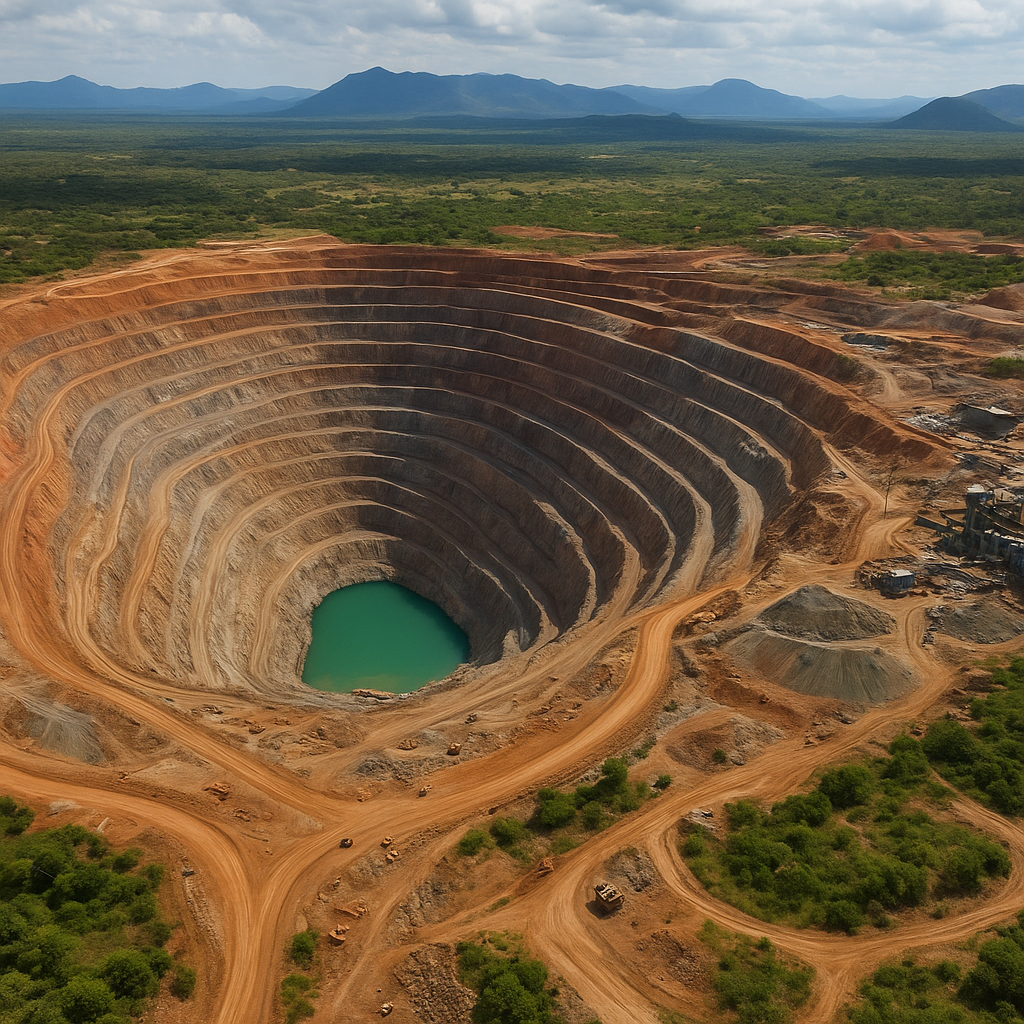
The Kalumbila (commonly referred to as the Sentinel) Mine stands among the most important modern mining developments in Zambia. Located in the north-western part of the country, the operation has reshaped the local landscape, economy and labour market. This article describes where the mine is situated, what is extracted there, how the operation functions in broad terms, its wider economic significance and a selection of particularly interesting or unusual aspects of the project. The text aims to balance technical, economic and social perspectives so the reader can appreciate both the scale and complexity of a major contemporary copper mining enterprise in Africa.
Where Kalumbila (Sentinel) Mine is located and its geological setting
The mine is situated in north-western Zambia, in Kalumbila District, a region that has become synonymous with recent copper development outside the traditional Copperbelt. The area lies within the Zambian portion of the Central African Copperbelt, a world-class metallogenic province with a long history of copper and associated mineralization. The district is relatively remote when compared to historic mining towns such as Kitwe and Ndola, but improved roads and mine-driven infrastructure have made the site more accessible.
Geologically, the Sentinel deposit and surrounding mineral occurrences are part of the sediment-hosted stratiform copper system typical of the Copperbelt. Mineralization is principally in the form of copper sulphides hosted in shale and dolomitic rocks, with copper occurring as chalcopyrite and other sulphide minerals. These deposits are notable for their lateral continuity and the potential for large, low-to-moderate grade ore bodies that are suitable for large-scale, mechanized open-pit mining.
The terrain around Kalumbila is a mixture of flat to gently undulating plateaus and seasonal drainage lines. The climate is tropical sub-humid with distinct wet and dry seasons, which has implications for mine planning, water management and road access. Local communities historically practiced subsistence farming and small-scale commerce; the arrival of a major mine has introduced new demographic and economic dynamics.
Mineral production: what is mined and how it is processed
The principal commodity produced at Sentinel is copper, generally recovered as a concentrate rather than refined metal at the mine site. The mining method is large-scale progressive open-pit excavation, employing modern earthmoving fleets for drilling, blasting, loading and hauling. Ore is hauled to a processing plant where mechanical and chemical separation methods are used to upgrade the copper-bearing material into saleable product.
Processing at a mine like Sentinel typically includes comminution (crushing and grinding), gravity or density separation where applicable, and flotation circuits to produce a copper-gold or copper-only concentrate. Flotation takes advantage of the different surface properties of sulphide minerals and gangue, creating a relatively high-grade concentrate that can be shipped to smelters and refineries for final metal extraction. Some mines also capture by-product metals such as cobalt, gold or silver depending on the exact mineralogy; such by-products can add value and diversify revenue streams.
Concentrate produced at Kalumbila is generally transported out of the region via road and rail networks to ports or smelters. Logistics management is a major component of operating costs and business continuity planning, especially in remote regions where long-haul transport and border crossings are required. The mine’s throughput, recovery rates, and operating efficiency determine how much saleable copper concentrate is generated per ton of mined material—factors that are closely watched by company managers and investors.
Supporting infrastructure on site
- Crushing and grinding mills sized to handle large ore volumes
- Flotation plant to produce copper concentrate
- Tailings storage facilities designed to contain processed waste
- Water management systems for process and stormwater control
- On-site workshops, maintenance depots and fuel storage
- Administrative buildings, worker accommodation and healthcare facilities
Large mining projects require an integrated infrastructure package covering power, water, transport and human resources. While some services are sourced from national grids and neighbouring towns, mines commonly develop internal systems and emergency capabilities to maintain production and safeguard staff.
Economic significance: local, national and international impacts
The Kalumbila (Sentinel) Mine carries considerable economic significance at multiple scales. At the local level, the project provides direct employment, secondary business opportunities and infrastructure development. For many households in the surrounding communities, the mine is a primary source of formal wages, training and improved services, such as clinics and schools supported through corporate social investment programs.
At the provincial and national levels, the mine contributes to export earnings, government revenue and industrial diversification. Copper has long been the backbone of Zambia’s export economy; new large-scale mines bring additional foreign exchange receipts, taxes, royalties and an opportunity to deepen sectoral capabilities, for example in geology, engineering and logistics. The operation can also stimulate local supplier markets—food, transport, construction and professional services—creating ripple effects through the economy.
Internationally, the mine feeds into global copper markets. Copper is a base metal with broad industrial demand—from electrical wiring and electronics to construction and renewables infrastructure. Completing the value chain from mine to smelter to refined metal connects Zambia to trading hubs and end-users worldwide. The strategic placement of mineral projects like Sentinel can influence supply balances, investment flows and geopolitical relations when demand surges or supply constraints appear.
Employment effects are both direct and indirect. Direct employment covers the skilled and semi-skilled mine workforce, plant operators, engineers and administrative staff. Indirect employment includes contractors, service providers and those who benefit from increased local spending. Mines also invest in training programs to build a locally sourced workforce, with long-term benefits for human capital in the region.
Revenue and public policy linkages
Government receipts from a mine typically include corporate taxes, royalties, and sometimes dividends or state participation. Those revenues are critical for public budgets in resource-rich countries, but their value depends on tax regimes, licensing arrangements and transparent fiscal management. Mines motivate improvements in public infrastructure—roads, electrification and telecommunications—that can be leveraged for broader development objectives. At the same time, balancing national development goals with investor certainty is a recurring policy challenge in mining jurisdictions.
Social and environmental dimensions
Large mines carry social responsibilities and environmental obligations. On the social side, meaningful engagement with affected communities is a prerequisite for long-term social licence to operate. This engagement often translates into livelihood programs, compensation for land use, resettlement planning when necessary, and community development projects such as water supply, healthcare and education. Companies increasingly seek to involve communities in planning and implement benefit-sharing arrangements to reduce conflict and improve outcomes.
Environmentally, mining operations must manage land disturbance, water use, waste rock and tailings, dust and emissions. There are several standard practices employed to reduce environmental risk: progressive rehabilitation of disturbed land, secure tailings storage facilities, water treatment and recycling systems, and monitoring programs for biodiversity and water quality. Internationally recognized frameworks and regulations guide these practices, and operators are typically required to produce environmental and social impact assessments and management plans as conditions of their permits.
Diligent environmental management is not only regulatory compliance but also part of responsible business strategy. Modern mines invest in monitoring technology, biodiversity offset measures and community-based conservation initiatives to mitigate longer-term risks. Given the arid-to-seasonal climate of the region, careful water management is particularly important for both operational reliability and community relations.
Community development and capacity building
Many mining companies adopt community development programs that target education, vocational training and small business support. Skills training in trades relevant to mining—mechanics, electricians, heavy equipment operation—enable local people to access higher-paying jobs. Procurement policies that favour local suppliers can stimulate entrepreneurship and create secondary employment. Over time, these measures can help diversify local economies so that communities are less reliant on mine wages once operations wind down.
Interesting facts, innovations and challenges
Several features make a project like Kalumbila (Sentinel) stand out. First, it demonstrates how copper investment is moving beyond long-established mining districts to more remote areas, encouraging infrastructure development and new regional economic hubs. Second, the scale of modern mining equipment and processing facilities means that relatively low-grade deposits can be mined profitably when treated at scale. This industrial dynamic has reshaped global copper supply patterns in recent decades.
Technology plays a growing role. Large mines adopt automation, digital monitoring and advanced process control to improve safety and recoveries. Remote sensing, drone surveys and digital mapping are used to speed up exploration and to manage environmental monitoring more effectively. Even where headline-grabbing autonomous fleets are not in use, the steady increase in remote diagnostic tools and predictive maintenance helps reduce downtime and extend equipment life.
Another interesting aspect is the supply-chain complexity: concentrate produced at a remote mine may pass through months of logistics before reaching a smelter in another country. This creates opportunities and vulnerabilities—logistics disruptions, fluctuating freight costs, and changing smelter demand can affect mine economics as much as ore grades.
Mines like Sentinel also illustrate the interplay between multinational corporations and national sovereignty over natural resources. Investments are often initiated by global mining firms, which bring capital, technical expertise and market access. Host countries seek the benefits of these investments while also aiming to capture a fair share of value and use the resource base to support long-term development objectives. Negotiating this balance—through fiscal policy, local content rules and environmental standards—remains a core public policy task.
Environmental and operational challenges
- Water security: managing process water while preserving community water sources
- Tailings stewardship: ensuring long-term safety and minimized tailings leakage
- Rehabilitation planning: restoring land for future productive or ecological uses
- Workforce transition: training local workers while maintaining operational standards
- Market volatility: copper price fluctuations affecting investment and operations
These challenges require integrated solutions combining engineering, community engagement, regulatory oversight and sound economics. They also underscore why mining projects are long-term endeavours: the typical lifecycle from discovery, through construction and production, to closure and rehabilitation spans decades.
Why Kalumbila matters beyond copper production
While the immediate output from Sentinel is primarily copper concentrate, the mine’s broader significance can be seen in multiple arenas. Socially, it demonstrates how large projects can catalyse changes in rural economies and service delivery. Economically, it contributes to national export earnings and employment while testing policy settings on local content and revenue management. Technologically, it shows how modern mining techniques and digital tools are applied in remote contexts. Environmentally, it highlights the importance of implementing robust mitigation and restoration measures.
Finally, the evolution of Kalumbila into a functioning mining centre reflects the continuing global appetite for copper, driven by urbanization, electrification and the energy transition. As demand for conductive metals grows—particularly for electrification and renewable energy infrastructure—projects that expand reliable supply capacity acquire strategic importance. For Zambia, Kalumbila is part of that story: a resource development that links a rural region to global commodity markets and places new demands on governance, infrastructure and community planning.
Selected terms and concepts to remember
- Kalumbila – the district and locality that gives the mine its common name
- Sentinel – the mine project itself
- First Quantum Minerals – the international mining operator most commonly associated with the project
- Copper – the principal commodity produced
- Open-pit – the primary mining method employed
- Concentrate – the saleable mineral product shipped to smelters
- Employment – a major social and economic benefit to local communities
- Infrastructure – roads, power and water systems developed or upgraded for mining
- Sustainability – the catch-all term for environmental, social and governance practices at modern mines
This overview captures the core features of the Kalumbila (Sentinel) Mine: its setting within Zambia’s expanding mining frontier, the basic technical approach to extracting and processing copper, the significant economic and social effects it produces, and the environmental and operational challenges it must confront. Understanding such projects requires attention to geology, engineering, markets, and the lived realities of communities and workers—each of which shapes the ultimate legacy of the mine.

