
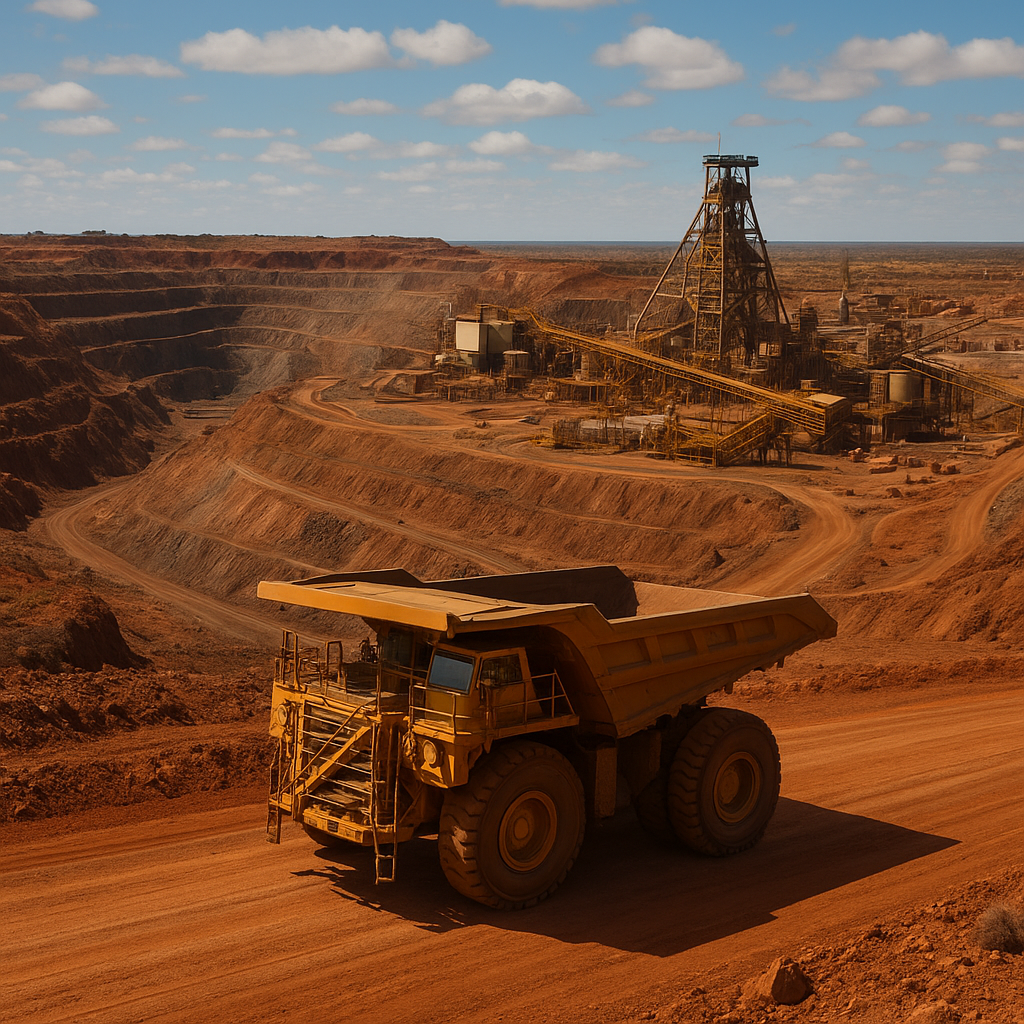
The vast open expanse a few hundred kilometers east of Perth hides one of the most iconic and productive mining landscapes in the world. This article explores the history, geology, operations and wider significance of Kalgoorlie Consolidated Gold Mines, the company and site best known for the enormous Super Pit near the town of Kalgoorlie-Boulder. Here you will find an overview of where it is, what is extracted there, how it is mined and processed, its role in the regional and national economy, and a selection of fascinating details that underline why this place matters to Australia and to the global gold industry.
Where it is and how it began
The operations associated with Kalgoorlie lie in the heart of the Eastern Goldfields region of Western Australia, about 600 km east-northeast of Perth. The settlement of Kalgoorlie-Boulder grew rapidly after gold was discovered in the 1890s, and the rich mineralized ground that underpins the town is known globally as the Golden Mile. Over the 20th century numerous underground and small open-pit workings developed throughout this district, each exploiting lenses and shoots of mineralization along a complex network of quartz veins and sulphide bodies.
Sometime in the late 20th century many of the small, adjacent mines were consolidated into larger, more efficient operations. The modern enterprise that operates the open-pit complex commonly called the Super Pit represents the culmination of decades of amalgamation and modernization: instead of many small shafts and underground networks, a single, massive open pit extracted the dispersed ore bodies more economically. That consolidation changed the scale of mining in the district and created one of the best-known surface mines in the world.
Geology, reserves and what is mined
The Eastern Goldfields belong to an ancient greenstone belt with rocks formed more than 2.5 billion years ago. Gold in the Golden Mile occurs primarily in structurally controlled quartz veins and in host rocks altered by metamorphism and hydrothermal fluids. Mineralization is commonly associated with sulphides, notably pyrite and arsenopyrite, and the gold can occur as free nuggets or finely disseminated particles locked in sulphide matrices.
The main commodity extracted is, unsurprisingly, Gold, but the ore often contains associated metals and minerals—silver is a typical byproduct, and trace amounts of copper, lead and zinc can appear depending on the exact ore body. The grade of ore varies across the pit and the broader district; historically the Golden Mile delivered exceptionally high grades in many of its veins, which contributed to Kalgoorlie’s reputation as a prolific gold producer.
Mining methods and processing
Open-pit mining at scale
The hallmark of the contemporary operation is the large-scale open-pit extraction that characterizes the Super Pit. Extraction at this scale involves systematic drilling and blasting to break the rock, followed by loading with huge excavators and haul trucks that move millions of tonnes of material annually. Waste rock and low-grade material are managed to optimize economic returns while high-grade ore is trucked to processing facilities.
Ore treatment and recovery
Once rock containing valuable mineralization reaches the processing plant it goes through several stages. Crushing and grinding reduce the material to a fine particle size. Physical and chemical methods—gravity concentration, flotation where appropriate, and chemical leaching such as carbon-in-pulp or carbon-in-leach—are used to separate and recover gold from the ground rock. Final refining steps convert concentrate into saleable products like doré bars or refined metal delivered to market. The processing flowsheets have evolved over time to increase recovery rates and to manage environmental risks from reagents and tailings.
Technology, safety and efficiency
Large modern operations use advanced technologies to improve safety and productivity. GPS and fleet management systems optimize haul routes; automated drilling rigs and, increasingly, autonomous haul trucks reduce human exposure to hazardous conditions; and remote operations centers allow certain functions to be monitored or controlled off site. Continuous improvement in geometallurgy, ore-sorting, and water reuse helps reduce costs and environmental footprint while extending the life of the mine.
Economic significance
The presence of a major gold mining complex near Kalgoorlie has far-reaching economic effects. At the local level it provides substantial direct employment across mining, processing, maintenance, and administration. Indirect employment is also significant: contractors, equipment suppliers, service companies, transport operators and local businesses all rely on the mine’s activity. Payroll dollars help sustain schools, hospitals, retail and hospitality in the town and nearby communities.
At the state and national level, gold production contributes to export earnings, royalties and taxes. The industry supports broader supply chains, stimulates the engineering and manufacturing sectors, and funds infrastructure in remote regions. The steady demand for gold as an investment, and in some industrial and decorative uses, means that consistent production from deposits like the Kalgoorlie area plays a role in commodity markets and in balancing trade accounts.
Social, cultural and environmental dimensions
Mining at the scale seen near Kalgoorlie inevitably raises social and environmental questions. Companies operating in the area engage with local communities, Indigenous groups, and government regulators to negotiate land access, heritage protection, and community benefits. Cultural heritage is particularly important in Australia; some sites of significance to Indigenous peoples lie within or near mining leases, requiring careful assessment and management.
Environmental management focuses on dust control, water use and protection of groundwater, containment and rehabilitation of tailings and waste dumps, and progressive rehabilitation of disturbed land. Advances in water recycling and dust suppression, and commitments to progressive rehabilitation, have become standard parts of environmental stewardship plans. Nevertheless, the large physical footprint of a deep open pit and its associated infrastructure means legacy issues can persist for decades unless suitably addressed.
Interesting aspects and lesser-known facts
- Historic continuity: The Kalgoorlie area has been producing gold commercially for more than a century. The overlay of old shafts and workings beneath and around the modern pit provides an unusually visible record of evolving mining technology and economics.
- Integrated town life: Kalgoorlie-Boulder is a rare example of a sizeable regional town whose identity and economy are intertwined with a single dominant mineral resource. This produces both resilience when the industry does well and challenges when commodity cycles turn down.
- Tourism and education: The enormous scale of the Super Pit draws visitors. Lookouts and interpretive displays allow the public to observe blasting schedules and learn about geology and mining methods. The town also hosts museums and heritage buildings that reflect the gold-rush era.
- Underground legacy: Beneath the super pit and surrounding areas lie remnants of the many underground operations that predated open-pit consolidation. These remnants have shaped decisions on pit design, sequencing and safety, and they present engineering challenges when old workings are encountered during excavation.
- Innovation driven by extremes: Operating in a remote, arid environment and handling large volumes of material has driven innovation in haulage, power management, and water conservation—solutions that are applicable to other large-scale mineral projects worldwide.
Community relationships and regional development
Mining operations in the Kalgoorlie region typically engage in multiple community initiatives: funding local education and health projects, supporting cultural events, and partnering on infrastructure improvements. Workforce strategies vary, with some roles filled by local residents while others use fly-in fly-out arrangements from larger cities. Companies often run training programs and apprenticeships to develop a locally based skilled workforce where possible.
The fiscal benefits—royalties and taxes—help fund broader public services in Western Australia, and the presence of the mine promotes supplier diversification and business growth in the region. However, social planners and company leaders must coordinate to manage housing, transport, and the social impacts of transient workers to maintain community cohesion and long-term sustainability.
Future outlook and longevity
The longevity of a major mining complex depends on remaining resources, commodity prices, technological advances, and regulatory or environmental constraints. Exploration in and around the Golden Mile continues to seek extensions and new high-grade shoots that could support further mining well beyond current plans. Improvements in processing, ore-sorting and recovery efficiency can also make lower-grade material economically viable, effectively extending the operational life of the site.
Given gold’s role as both an industrial metal and a financial asset, global market factors—central bank policies, inflation expectations and investor demand—affect the mine’s strategic planning. At the same time, evolving environmental performance expectations and community standards mean that future operations will increasingly emphasize transparency, rehabilitation success and low-carbon approaches to remain socially licenseable.
Closing observations
The mining landscape around Kalgoorlie stands as a powerful example of how geology, entrepreneurship and engineering shape human settlement and economic destiny. The operations of Kalgoorlie Consolidated Gold Mines—and the famous Super Pit that symbolizes it—showcase the technical complexity, economic importance and social responsibilities that accompany large-scale resource extraction. For students of geology, engineers, policymakers and casual visitors alike, the site offers lessons in natural history, industrial innovation and the balancing act required to sustain resource-based communities into the future.

