
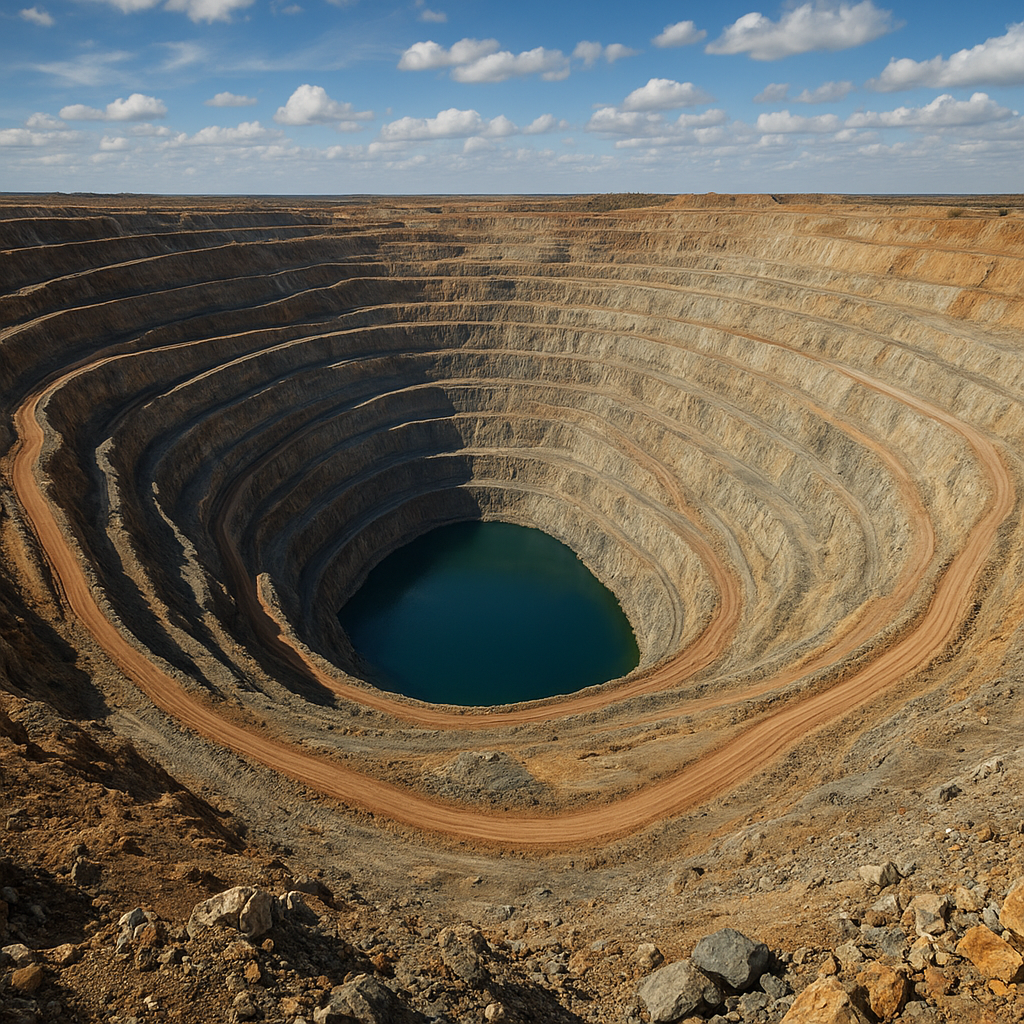
The Jwaneng mine in Botswana is one of the most important and remarkable mining operations on the African continent. Situated in the southern part of the country, this mine is renowned for producing exceptionally high-quality diamonds and for its outsized role in the national economy. The story of Jwaneng blends geology, modern engineering, corporate strategy and social policy: it is a place where underground processes that took millions of years meet contemporary questions about sustainable development, local beneficiation and the global gem trade.
Location and geological setting
Jwaneng lies in the southern highlands of Botswana, roughly southwest of the capital, Gaborone, and is accessible via paved roads that connect the site to the rest of the country. The mine sits near the town that adopted its name — a community that developed primarily to serve the needs of the mining operation and its workforce. Geologically, Jwaneng is hosted in a cluster of kimberlite pipes: vertical, carrot-shaped volcanic intrusions that surfaced from great depth millions of years ago and brought diamonds from the Earth’s mantle into the crust.
Kimberlite pipes and diamond formation
Diamonds at Jwaneng are contained in kimberlite rock, a type of igneous rock that is the primary host for natural diamonds worldwide. These diamonds crystallized at depths of more than 150 kilometers under conditions of extreme temperature and pressure and were transported to the surface in very rapid, explosive volcanic eruptions. Over geological time, erosion and secondary transport redistributed some material, but the bulk of economic diamond concentration at Jwaneng remains within the primary kimberlite bodies.
The mine is noted for an unusually high grade of diamonds by value. Grade in diamond mining can mean either carats per tonne or — perhaps more importantly — the dollar value produced per tonne of rock processed. Jwaneng’s mineralization is characterized by a combination of favorable factors: a large, relatively continuous orebody, high diamond abundance, and a significant proportion of higher-value stones. These geological strengths underlie the mine’s global reputation.
History, ownership and operational structure
Ownership and management of Jwaneng reflect a national strategy that has been central to Botswana’s post-independence development. The operation is run by a partnership between the national government and an international diamond company under a joint venture structure that has been credited with aligning local development goals with global market expertise. The operating company provides technical and managerial capacity while the government ensures that a substantial share of the mine’s value flows into national revenues and public investment. The joint-venture model at Jwaneng has become a reference point in discussions about resource governance and equitable benefits from extractive industries.
Mining method and processing
Jwaneng is primarily an open-pit operation. Large, bench-style pits are excavated using heavy machinery: hydraulic shovels, haul trucks, and specialized support equipment. The extracted kimberlite ore is transported to a processing plant where it is crushed, milled and subjected to a sequence of concentration steps designed to recover diamonds efficiently. Techniques such as dense media separation, X-ray sorting and grease table recovery — along with modern optical sorting and advanced automated technology — are commonly used across the industry to maximize recovery while limiting waste.
- Primary extraction: open-pit benches and systematic drilling and blasting.
- Transport: haul trucks and crusher conveyors move ore to the plant.
- Processing: a combination of crushing, milling, separation and sorting.
- Tailings and waste management: engineered facilities to store and rehabilitate non-economic material.
Investments in efficient processing equipment, continuous monitoring and plant optimization help preserve value by improving recovery rates and reducing the proportion of diamonds lost in tailings. Modernization and periodic expansion of the processing infrastructure are typical at a large, long-lived project such as Jwaneng.
Production profile and economic importance
Jwaneng is often described as the world’s richest diamond mine by value. Its contribution to Botswana’s export earnings, public finances and employment cannot be overstated. Because of the high value of its output, even relatively modest volumes convert into substantial foreign exchange inflows, which support government budgets, infrastructure projects and public services. The revenue derived from diamond sales has been a cornerstone of Botswana’s economic transformation from a low-income, landlocked country to one of Africa’s more stable middle-income economies.
Macroeconomic role
The mine contributes directly to national income through taxation, royalties and the distribution of joint-venture profits. Indirectly, it supports numerous downstream and ancillary sectors: transportation, construction, retail, hospitality and local services in the mining town and surrounding districts. Government planning in Botswana has historically channeled mining income into long-term investments — schools, hospitals and roads — which has helped broaden the benefits beyond the mine’s immediate workforce.
Jwaneng’s output also affects the global diamond market. High-quality stones recovered from the mine feed into the international supply chain, serving cutters, polishers, traders and luxury jewelry houses worldwide. Market shifts — such as changes in consumer demand for particular sizes, colors and clarities — are felt upstream at producing mines and downstream in diamond trading centers.
Local development, employment and social programs
The presence of a large mine like Jwaneng shapes community life. The mine provides direct employment to thousands of workers and supports additional jobs indirectly through service contracts and local businesses. Beyond wages, the mine and its operating partners typically invest in housing, education, health services and community development projects. These programs can include vocational training for local residents, public health initiatives, scholarships, and infrastructure upgrades such as electrification and water supply improvements.
Beneficiation and value addition
Botswana has pursued policies to capture more value from its diamond resources by encouraging beneficiation — the local cutting, polishing and trading of diamonds rather than exporting rough stones exclusively. Supporting domestic cutting facilities, training local artisans in lapidary skills and establishing trading hubs are part of a broader industrial strategy to create more high-value employment and retain a larger share of the value chain within the country. While achieving a fully integrated domestic diamond industry is challenging, Jwaneng’s production provides the raw material that makes these ambitions feasible.
Environmental management and sustainability measures
Large-scale mining inevitably raises environmental concerns. At Jwaneng, operators manage water use, control dust and emissions, stabilize slopes, and operate tailings storage facilities with engineered safeguards. Rehabilitation planning is an essential element of responsible mine management: operators prepare progressive rehabilitation plans so that disturbed land is returned to a stable and useful condition as mining advances.
- Water management: recycling and conservation to reduce freshwater demand.
- Energy: efforts to improve efficiency and reduce greenhouse gas intensity per carat recovered.
- Waste management: secure storage and monitoring of tailings, with engineered liners and seepage controls.
- Rehabilitation: progressive contouring, topsoil replacement and revegetation.
Community consultation, transparent reporting and adherence to national and international environmental standards are part of the modern operating environment. The goal is to minimize negative impacts while maximizing long-term benefits for local communities once mining ends.
Technical challenges and lifecycle planning
Operating a large open-pit diamond mine poses complex technical and logistical challenges. Maintaining ore grade and recovery rates over decades requires continual geologic evaluation, careful mine planning and investment in new mining areas or deeper benches. As surface ore is depleted, companies must design expansion projects or transitions to underground mining where appropriate. Lifecycle planning includes not only extraction schedules but also closure strategies, alternative land uses and financial provisions for post-closure monitoring.
Infrastructure and logistics
Because Jwaneng is located in a sparsely populated region, robust infrastructure is essential. Reliable roads, power supply, telecommunications and accommodation facilities are necessary to sustain operations and support employees. The mine’s logistics network must handle heavy equipment, large volumes of ore and inbound supplies — a task that requires careful scheduling and coordination with contractors.
Interesting facts and broader significance
Several facets of Jwaneng make it especially noteworthy beyond its raw production numbers:
- Global reputation: Jwaneng is frequently cited as one of the world’s most valuable diamond mines due to a combination of tonnage and exceptional stone value.
- Town and community: A purpose-built town serves the mine’s workforce, complete with schools and healthcare facilities; the social fabric of the area is closely entwined with the mine’s fortunes.
- Technology adoption: Jwaneng has incorporated modern mining and processing technology over time, improving safety and recovery while driving operational efficiency.
- Policy model: The ownership and benefit-sharing structure at Jwaneng is often studied as an example of how resource-rich countries can partner with private companies to advance national development goals.
Beyond these points, the mine plays a role in conversations about the future of mining in an era when resource governance, environmental sustainability and local economic diversification are increasingly prioritized. Jwaneng’s experience highlights both the opportunities and the responsibilities that come with extracting high-value natural resources.
Market linkages and diamond supply chain
Once recovered, diamonds from Jwaneng enter an intricate international supply chain. Sorting, valuation and sales are conducted in controlled environments. Global demand — influenced by consumer tastes, fashion trends and broader economic conditions — feeds back into decisions about production levels, marketing strategies and investment in new mining phases. The mine’s output supports cutting and polishing centers, wholesalers and retail jewelry businesses globally.
Traceability and ethical sourcing
In recent decades, consumers and regulators have emphasized the importance of transparency and ethical sourcing in the gemstone trade. Certification frameworks and industry initiatives aim to ensure that diamonds are not associated with conflict, that miners and workers receive fair treatment, and that environmental and social standards are respected. Producers and marketing organizations increasingly provide documentation and chain-of-custody assurances to reassure buyers about origin and ethical practices.
Future prospects and strategic considerations
Looking forward, Jwaneng’s future depends on several variables: the continued discovery of economic ore, the price environment for diamonds, operational efficiencies and the broader policy goals of Botswana. Strategic priorities include maintaining high recovery rates, extending the life of the operation through well-planned expansions, continuing local value addition, and ensuring that the benefits of mining are distributed in a way that supports long-term national development.
As the global diamond market evolves — with technological changes in synthetic gems, shifting consumer preferences and new luxury trends — producers must adapt. For a mine like Jwaneng, the combination of geologic endowment, established infrastructure and institutional support gives it a strong platform to meet these challenges.
Final reflections on significance
Jwaneng stands as an exemplar of how a single natural resource project can shape a nation’s trajectory. It combines geological fortune with deliberate policy choices and professional mine management to generate substantial economic benefits. The mine’s influence extends beyond carts and carats: it informs debates about how to manage finite resources responsibly, how to invest mining revenues for broader social gain, and how to balance extraction with environmental stewardship. Observers of resource-rich economies often look to Jwaneng and Botswana for lessons about aligning mineral wealth with national development, and its legacy will likely continue to be studied by policymakers, geologists and industry leaders alike.

