
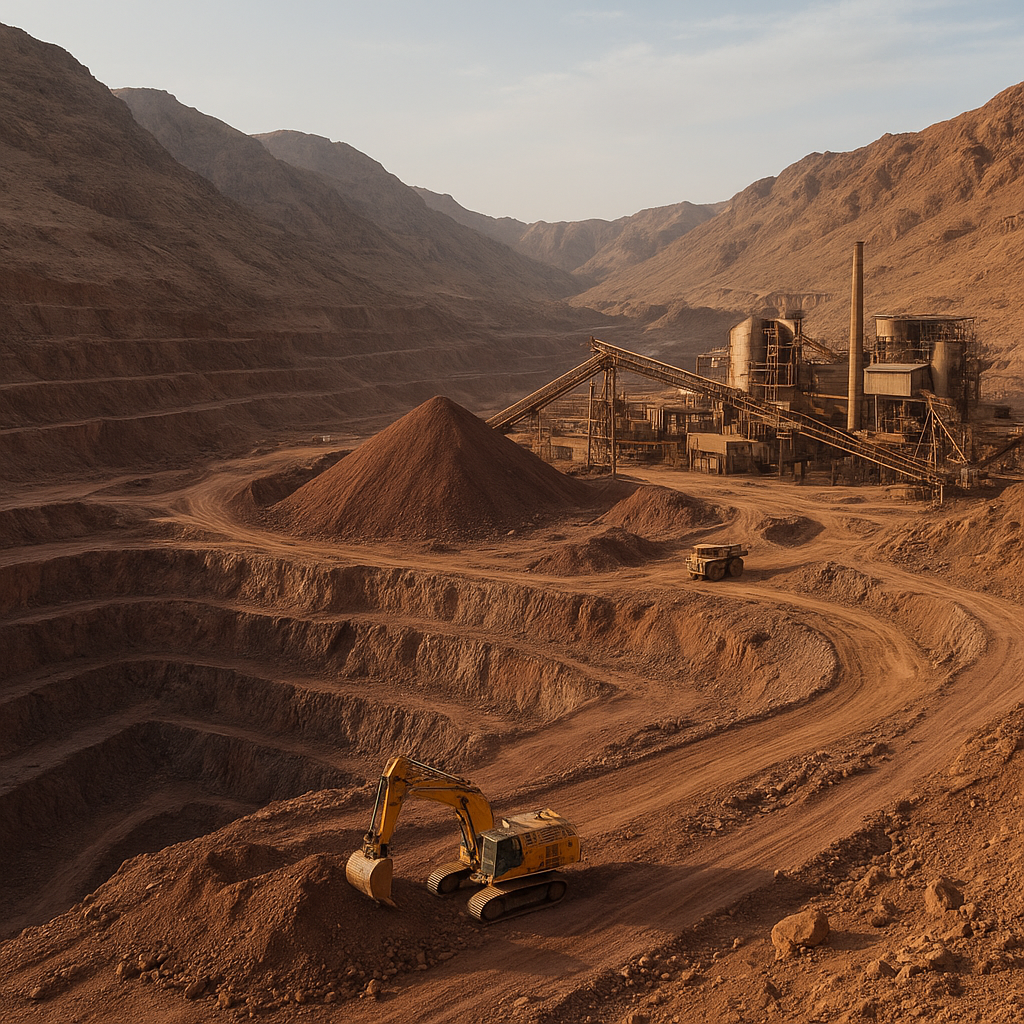
The Jbel Irhoud site in Morocco occupies a unique place at the intersection of **archaeology**, **geology** and the story of human origins. While often discussed for its remarkable paleontological discoveries, the name sometimes appears in mining literature in contexts that can create confusion about the site’s industrial role. This article examines the real nature of Jbel Irhoud, clarifies misconceptions about iron mining there, and situates the site within Morocco’s broader **mineral** and **economic** landscape. Along the way, it highlights geological setting, the historical uses of local resources, contemporary significance and several surprising or little-known facts that make Jbel Irhoud noteworthy.
Location and geological setting
Jbel Irhoud is located in the western part of the Kingdom of **Morocco**, within a landscape of rolling hills and eroded limestone and clay formations. The area lies in a geological transition zone where Pleistocene deposits and karstic systems have preserved archaeological and paleontological remains exceptionally well. The site’s sediments, including flint-bearing layers, are part of a broader sequence that records multiple phases of occupation and environmental change during the Middle and Late Pleistocene.
From a geological perspective, the interest of Jbel Irhoud stems less from massive metallic mineralization and more from its preserved **sedimentary** and lithic contexts. Flint nodules and siliceous horizons, typical of many North African sites, furnished raw material for prehistoric toolmakers. The preservation of bone and charcoal in certain layers has allowed for radiometric dating and paleoenvironmental reconstruction, making the locale especially valuable to both geologists and archaeologists.
What has been extracted at Jbel Irhoud?
Contrary to some mentions that couple the site to industrial mining, the primary extracted materials historically and prehistorically at Jbel Irhoud are non-metallic. Most notably:
- Flint — prehistoric inhabitants exploited flint nodules for tool production, leaving behind dense scatters of knapped stone, cores and flakes that testify to repeated occupation and specialized lithic industries.
- Burnt flint and charcoal-rich deposits — evidence of controlled fire use and hearths provides context for behavioral interpretation rather than industrial extraction.
- Fossil-bearing sediments — while not “extracted” commercially, these layers have been the subject of careful excavation, removal and conservation by scientific teams.
There is no widely documented, large-scale **iron ore** operation at Jbel Irhoud. If references to iron occur, they are often general discussions of metal use and trade in Morocco or misattributions arising from confusion with other mining districts. The site’s significance is overwhelmingly archaeological, rather than metallurgical or industrial.
Mining and resource context in Morocco (why confusion may arise)
Morocco is a country with a rich and varied mineral endowment. While the nation is globally best known for its dominant role in **phosphate** production, a broad array of other minerals—ranging from polymetallic deposits to industrial minerals—are distributed across its territory. The presence of many named “jbel” (Arabic for mountain) deposits and historical small-scale mines across regions can cause names to be conflated.
Important points that help explain possible misperceptions:
- Morocco hosts scattered iron occurrences, often at modest scales, typically associated with **metamorphic** belts or iron-rich horizons in the Atlas and Anti-Atlas ranges.
- Local, artisanal exploitation of minerals sometimes lacks extensive documentation, and older maps may list small occurrences that are not economically viable today.
- Many archaeological localities, including Jbel Irhoud, sit in landscapes also explored for minerals; however, scientific excavations are distinct from commercial mining operations.
Economic significance: direct and indirect
While Jbel Irhoud is not a major industrial mine, its economic significance should not be underestimated. The contributions fall into several categories:
- Scientific and educational value — discoveries from Jbel Irhoud have reshaped understanding of early **Homo sapiens** evolution; this intellectual capital attracts funding, researchers, and international collaborations.
- Cultural tourism potential — well-curated archaeological sites can become focal points for cultural tourism, supporting local services, guides and hospitality providers.
- Heritage and identity — the site enhances national and regional prestige, which can indirectly influence investment in infrastructure and conservation.
The economic impact of these contributions is different in character from the revenues generated by a large industrial **mine**, but they are nonetheless meaningful. Scientific publications, museum exhibits, and international attention convert Jbel Irhoud’s archaeological capital into tangible benefits: grants, cultural exchange, and sustainable tourism opportunities. For remote or rural communities, even modest tourism linked to a world-renowned paleoanthropological site can augment livelihoods.
Mining techniques and environmental considerations (generalised)
Because Jbel Irhoud’s principal resource is archaeological rather than metallurgical, conventional descriptions of iron ore mining techniques do not directly apply. Nevertheless, it is useful to outline how mineral extraction would differ from archaeological excavation, and the environmental considerations for each:
Archaeological excavation
- Methodical, layer-by-layer removal of sediments with documentation of context.
- Focused on preservation of fragile materials; use of sieving, sampling and conservation methods.
- Strict permitting and oversight to protect heritage values.
Typical iron ore mining (contrast)
- Large-scale open-pit or underground operations using heavy machinery, blasting and bulk hauling.
- Require beneficiation, smelting or shipping infrastructure.
- Pose risks of landscape alteration, water table impacts, dust and waste-rock management challenges.
From an environmental governance perspective, the preservation of Jbel Irhoud’s research value requires protection against any industrial activity that might irreversibly damage stratified deposits. Where mineral exploration occurs near archaeological localities, coordinated planning between cultural heritage agencies and mining authorities is essential to prevent loss of scientific information.
Social and cultural implications
The discoveries at Jbel Irhoud resonate beyond geology and economics. They have profound cultural and educational implications:
- Global narrative of human origins — fossil finds from the site pushed back the estimated age and widened the geographic scope of early Homo sapiens, influencing curricula and museum displays worldwide.
- Local engagement — involving local communities in site protection, tourism services and interpretive programs fosters stewardship and tangible benefits.
- Ethical stewardship — balancing scientific access with respect for local values and legal frameworks is an ongoing concern, especially when finds have global significance.
Because archaeological sites can generate pride and a sense of belonging, their protection serves social cohesion and cultural continuity. This is a different, but complementary, form of value compared with extractive industries.
Interesting and lesser-known facts about Jbel Irhoud
Jbel Irhoud attracts attention for several striking and sometimes surprising reasons:
- Early modern humans — excavations revealed human remains that are among the oldest attributed to Homo sapiens in Africa, challenging previous east-African-centric models of emergence and dispersal.
- Complex toolkits — stone tools recovered at the site show a sophisticated technological repertoire, including prepared-core techniques and diverse tool forms.
- Long-term occupation — stratigraphic sequences indicate intermittent yet recurrent occupations spanning many thousands of years, offering a deep-time view of behavior and environment.
- Multidisciplinary research — Jbel Irhoud is a model of collaboration between archaeologists, paleoanthropologists, geochronologists and sedimentologists. Advances in dating techniques (thermoluminescence, ESR and others) were crucial to refining the timeline.
- Conservation challenges — the same openness that makes the site accessible for research also exposes it to weathering and potential human disturbance, highlighting the need for protective strategies.
Comparisons with mineral-producing areas in Morocco
Placing Jbel Irhoud in the broader Moroccan resource map clarifies why it is exceptional. Major Moroccan mining activities revolve around:
- Phosphate basins — Morocco is a world leader, with vast reserves concentrated in the Atlas and eastern basins.
- Metals and industrial minerals — manganese, lead, zinc, barite and other commodities are mined at various sites across the country.
- Artisanal mining — small-scale operations for precious metals and industrial minerals occur in mountainous areas and have local socioeconomic importance.
Jbel Irhoud’s archaeological prominence distinguishes it from these commercially exploited districts. Where extractive industry brings mass employment and fiscal revenue, archaeological sites create distinctive forms of value: scientific knowledge, cultural capital and heritage-based economic opportunities.
Opportunities and recommendations for the future
Recognizing Jbel Irhoud as a heritage asset suggests several practical steps to maximize its value while protecting its integrity:
- Strengthen legal protection and buffer zoning to prevent incompatible industrial activities near key deposits.
- Invest in onsite interpretation, a visitor center and community-based tourism that channels benefits locally.
- Promote interdisciplinary research funding to continue refining chronologies and environmental reconstructions.
- Encourage educational programs for local schools and universities to build capacity and foster stewardship.
These measures would ensure the long-term preservation of Jbel Irhoud’s scientific and cultural resources while allowing for responsible, community-led economic development.
Concluding observations
Jbel Irhoud stands as a powerful reminder that value in landscapes can be multifaceted. The site’s primary claim to global significance lies in its contribution to understanding early **Homo sapiens** and Pleistocene lifeways rather than in the extraction of industrial **iron ore**. Appreciating that distinction matters: it shapes protection priorities, funding mechanisms and the ways local communities can benefit. Whether approached as a geological archive, an archaeological treasure or a potential focal point for sustainable cultural tourism, Jbel Irhoud embodies the intertwining of deep time and contemporary opportunity.

