
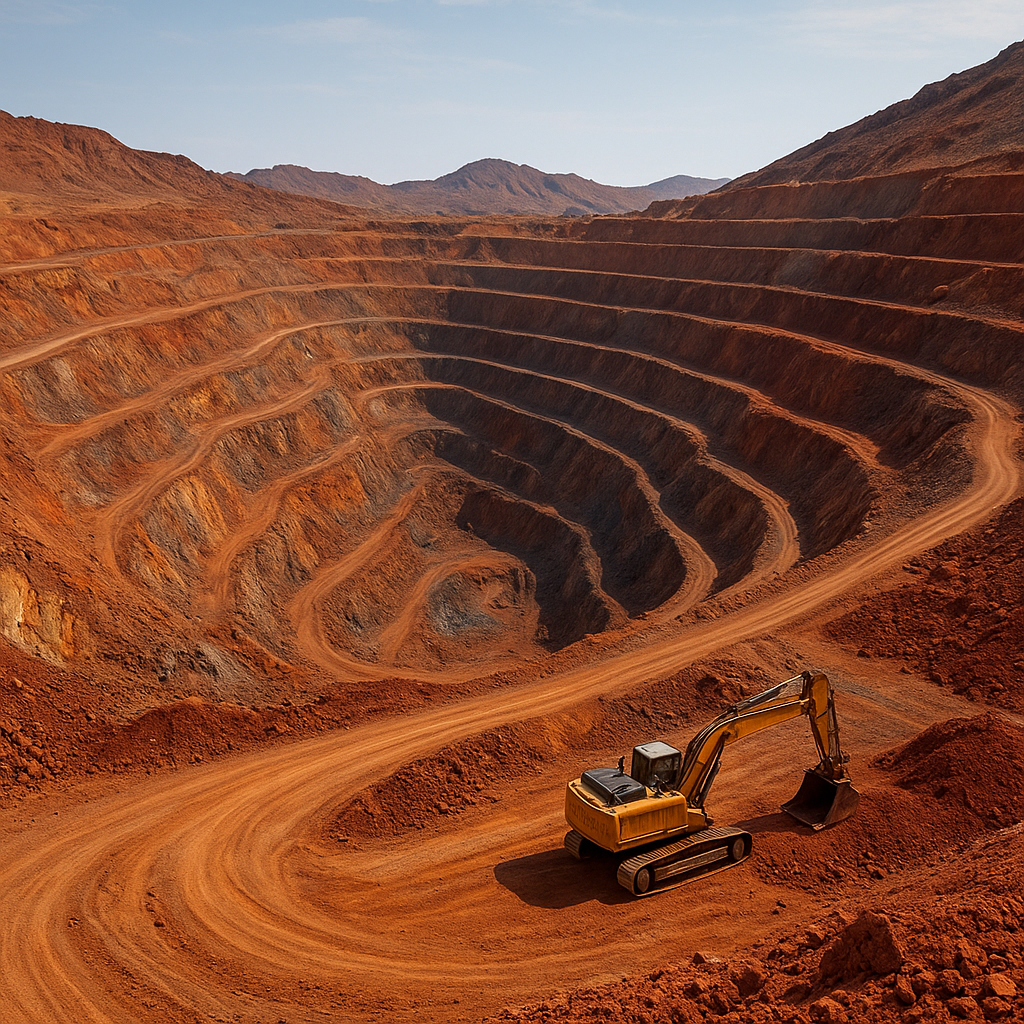
Jebel Irhoud is best known internationally as one of the most important paleoanthropological sites in Africa, but public documentation of a dedicated commercial iron-ore mine operating under the name “Jbel Irhoud” is scarce or non-existent in open sources. This article presents a careful overview: first clarifying the known facts about Jebel Irhoud as a place, then placing the idea of an iron-ore deposit there in the wider geological and mining context of Morocco, and finally exploring the potential economic and cultural implications if iron-ore extraction were present or developed in the area. The narrative combines verified background, regional mining realities, and informed analysis rather than asserting specific production figures or ownership where reliable data is not publicly available.
Location and historical background
Jebel Irhoud (sometimes written Jbel Irhoud or Djebel Irhoud) is a site in Morocco that rose to global prominence after paleoanthropological excavations uncovered early Homo sapiens remains and Middle Stone Age tools. The archaeological discoveries shifted scientific understanding of human origins by providing evidence for very early modern human morphology dated to roughly 300,000 years ago. Because of its paleoanthropological significance the name Jebel Irhoud is primarily associated with archaeology and human evolutionary research rather than contemporary industrial mining.
The precise toponym “Jebel” or “Jbel” indicates a hill or mountain in Arabic, and many places in Morocco include that prefix—so some geographical ambiguity can occur in casual references. Where the paleoanthropological site sits, it has been studied carefully and protected to various degrees because of its heritage value. For this reason, any discussion of large-scale mining activity in that immediate locality must account for archaeological sensitivity, legal protection, and community interests.
Geology and the potential for iron mineralization
To assess whether a location like Jebel Irhoud could host iron ore, it helps to consider broader Moroccan geology. Morocco sits at the interface of several major geological zones—the Atlas ranges, the Rif belt, and the Saharan Platform—each with distinct rock assemblages and mineralization histories. Iron ore in Morocco has historically been extracted from a variety of deposit types including:
- magnetite-hematite bodies associated with metamorphic and igneous units;
- hydrothermal iron deposits related to tectonic structuring;
- lateritic iron formed by intense weathering in some southern and tropical-margin settings;
- and iron-rich sedimentary horizons in older basin successions.
The occurrence and economic viability of an iron deposit depend on a number of geological variables: host-rock type, grade (concentration of ferrous minerals), tonnage, depth and geometry of the deposit, ease of beneficiation (how easily ore can be concentrated), and proximity to infrastructure like railways, ports, and energy. If Jebel Irhoud or its immediate foothills contained economically interesting iron mineralization, exploration would typically proceed through a documented sequence: geological mapping, geochemical sampling, geophysical surveys (magnetics and gravity are often useful for iron), drilling, and resource estimation compliant with international reporting standards.
At present, authoritative mining atlases and major producer reports emphasize established iron-producing regions in Morocco and North Africa rather than referencing an active “Jbel Irhoud” iron operation. That does not preclude small-scale or informal extraction historically being present in the wider region, but it does mean that any claim of an industrial iron ore mine at Jebel Irhoud requires verification in national mining registries, company disclosures, or academic literature.
Mining, processing and logistics: what an iron project would involve
Describing a hypothetical iron-ore mine at Jebel Irhoud is useful to understand how such a project would function and what its impacts could be. Typical stages and components include:
- Exploration and resource definition — detailed drilling to establish grade, tonnage and continuity of the orebody.
- Mine design — selection between open-pit and underground mining depending on depth, and planning for waste-rock handling.
- Beneficiation — crushing, grinding and magnetic or flotation separation to upgrade ore to a concentrate suitable for steelmaking.
- Infrastructure — development of roads, water supply, power lines, and often a conveyor or rail link to a processing plant or port.
- Environmental and social management — plans for dust control, water management, rehabilitation, and engagement with local communities and cultural heritage custodians.
From a logistics standpoint, Morocco benefits from an extensive Atlantic coastline and established ports (such as Casablanca, Jorf Lasfar, and Safi) that make export of bulk commodities feasible. For a mine in the interior or a mountain location, the economic viability would depend heavily on distance to the nearest railhead or port, road conditions, and the costs of beneficiation required to meet international iron-ore specifications. The nearest port accessibility is often determinant for profitability when global iron prices move and freight costs become decisive.
Economic significance at local, regional and national levels
Iron ore development anywhere can generate several layers of economic impact. Those are widely generalizable to a Jebel Irhoud scenario but should be read as conditional on whether a commercially viable deposit exists and is permitted to operate.
- Local employment — mining projects typically provide direct jobs (miners, technicians, engineers) and indirect jobs (services, transport, supplies). For remote communities, a well-managed mine can be a major employer.
- Infrastructure improvements — road upgrades, electrification and water projects undertaken for mining can have spillover benefits for nearby towns and agriculture, provided access is equitable.
- Fiscal revenue — royalties, corporate taxes, and export earnings contribute to municipal and national budgets; these funds can support schools, clinics and public works when transparently managed.
- Industrial development — availability of local iron feedstock can promote downstream industries such as steelmaking; Morocco already hosts some metallurgical and industrial capacity that could benefit from domestic raw materials.
However, these benefits are accompanied by costs and trade-offs. Mining projects can disturb landscapes, affect groundwater regimes, and compete with other land uses. In the specific case of Jebel Irhoud, any industrial activity must contend with the area’s immense value to scientific research and cultural heritage; damage or restricted access to fossil-bearing strata would be a major concern for heritage authorities and the international scientific community.
Environmental, social and heritage considerations
Mining in an archaeologically sensitive area raises special questions. Jebel Irhoud’s status as an important human-evolution site elevates the precautionary principle: before approving any exploration or extraction, authorities and companies would be expected to carry out exhaustive impact assessments that include:
- heritage impact assessments with the participation of archaeologists and paleontologists;
- comprehensive environmental impact assessments (EIAs) addressing water, biodiversity, air quality and dust;
- social baseline studies and stakeholder engagement, especially with local communities, indigenous groups and academic institutions;
- clear mitigation, monitoring and management plans, and legally binding commitments for site rehabilitation and scientific access.
Sustainability principles increasingly shape how mining projects proceed worldwide. Responsible operators aim to avoid or minimize adverse impacts and to deliver tangible community benefits through employment, training, local procurement, and infrastructure handed to public authorities. For a place associated with human origins, the reputational stakes are particularly high; institutional investors, export markets and academic partners could exert pressure to protect the site, or conversely to ensure that research is supported by any mining-related revenues.
Regional mining context: iron ore and Morocco’s mineral sector
Morocco’s mineral sector is diverse: phosphate is the country’s flagship commodity, complemented by significant output of metals and industrial minerals. Iron ore resources in North Africa are not as globally dominant as those in Australia or Brazil, but the region contains important deposits and a legacy of mining activity. In Morocco, historical and modern mining operations target a range of metals and minerals, and the national mining code and investment climate shape exploration and development.
Key considerations in the regional context include:
- competition for water and land use between mining, agriculture and local communities;
- regional transport corridors that link mineral-bearing interiors to Atlantic ports;
- the role of state-owned and private mining companies and the framework for foreign investment;
- opportunities to add value domestically by processing ores rather than exporting raw bulk commodities.
If iron ore were to be formally discovered or developed at a site called Jbel Irhoud, it would be evaluated against these regional dynamics. The potential for forward integration (for example, local concentrate production feeding national steelmakers) would be a major factor in public and private decision-making.
Interesting intersections of science, culture and industry
One of the most compelling aspects of any conversation about mining near a place like Jebel Irhoud is the juxtaposition of deep-time human history and modern extractive industry. Several points are noteworthy:
- Scientific value vs. economic value — the priceless scientific information about early Homo sapiens embodied in fossil-bearing deposits is non-renewable and globally significant. This creates moral and policy questions about the extent to which such areas should be opened to exploration or extraction.
- Archaeological tourism and education — protecting and interpreting sites like Jebel Irhoud can create alternative economic opportunities, from research partnerships to cultural tourism that emphasises education and long-term stewardship.
- Collaborative models — there are precedents worldwide where mining companies, governments and academic institutions collaborate to ensure that archaeological sites are properly excavated, documented and conserved before any development continues. Such partnerships can produce win-win outcomes but require trust, transparency and adequate funding.
- Heritage-led planning — planning frameworks that prioritize heritage conservation can steer mining investment toward less sensitive areas, while also creating compensatory development budgets to support local communities.
From a purely human-interest perspective, the idea that the same outcrops that yielded evidence of our species’ deep past could also contain valuable mineral resources highlights the multilayered nature of landscapes: geology, ecology, human history and modern economies are deeply interwoven.
Practical steps to verify and further investigate the existence of a mine
If your interest in a “Jbel Irhoud Mine” relates to investment, research, or journalism, the most reliable approach is to consult primary sources and authoritative registries. Useful steps include:
- check the Moroccan Ministry of Energy, Mines and Environment or the national mining cadastre for registered concessions and titles;
- search corporate filings and press releases from mineral exploration and mining companies active in Morocco;
- review academic publications and geological surveys that map mineral occurrences in the region;
- contact local universities, museums or archaeological institutions that have worked at Jebel Irhoud for insights into site protection status;
- consult satellite imagery and publicly available geophysical data as preliminary screening tools (bearing in mind they cannot replace on-the-ground verification).
These steps will clarify whether there is a formally recognized iron-ore mining operation at Jebel Irhoud or whether references to a “mine” are informal, historical, or mistaken identifications of nearby mineral activity.
Concluding observations and why the topic matters
The interplay between mineral wealth and cultural heritage is a recurring theme in resource-rich countries. Whether or not a distinct commercial iron-ore mine exists under the name Jbel Irhoud, the site symbolizes broader tensions and opportunities: the potential for local economic development through mineral resources, versus the global importance of preserving sites of archaeological and scientific significance. Decision-making in such contexts benefits from transparent governance, rigorous environmental and heritage assessment, and stakeholder participation that includes scientists, local communities and industry.
Ultimately, the story of Jebel Irhoud—both as a landmark in the story of humanity and as a landscape that may also contain geological resources—reminds us that places can carry multiple forms of value. Thoughtful policy and collaborative frameworks are essential to ensure that short-term extraction does not erase long-term knowledge and that any benefits from natural resources are shared equitably with the communities and institutions that steward those places for future generations.

