Jasper is a ubiquitous and visually striking variety of microcrystalline quartz that has captivated humans for millennia. Its diversity of colors and patterns, combined with a durable nature, make it valuable for practical uses and artistic expression alike. This article explores where jasper forms and where it is found, how it has been used throughout history, its role in modern lapidary work and industry, and a number of fascinating facts and care tips associated with this remarkable stone.
Geology: How and where jasper forms
Jasper is a dense, opaque variety of chalcedony, which itself is a microcrystalline form of silica. It typically owes its distinctive colors and patterns to trace elements, mineral inclusions, and the presence of iron oxides, manganese, or organic material. Unlike banded agates, jasper tends to be more uniformly colored or marked by swirling, brecciated, or orbicular patterns.
Formation environments
- Hydrothermal settings — Jasper can form from silica-rich fluids that precipitate within fractures or cavities in rocks. These fluids often deposit silica in multiple pulses, producing intricate patterning.
- Volcanic contexts — Many jaspers are associated with volcanic activity, forming where silica-laden solutions replace volcanic tuffs or fill vesicles in basalt and andesite.
- Sedimentary processes — In some cases, jasper forms as a siliceous cement in sedimentary rocks or as nodules in chert-bearing sequences.
The porosity and fine-grained nature of jasper are important: typical jasper exhibits porosity low enough to take high polish, yet enough variability to lead to strong visual textures. Its hardness around 6.5–7 on the Mohs scale, comparable to other quartz varieties, makes it resilient in both natural and worked contexts.
Global occurrences and famous localities
Jasper is found worldwide. Different regions produce distinct types with local names that often reflect appearance or provenance.
- Australia — The Pilbara and Mooka Creek areas yield bold red, yellow, and mixed-color jaspers prized for jewelry.
- United States — California, Oregon, Idaho and Arizona are well-known jasper sources. Oregon’s ocean jasper and the brecciated jaspers of Jasper County are notable.
- Madagascar — Produces vividly patterned jaspers and orbicular varieties that are popular in the designer market.
- Russia — The Ural Mountains and Siberia have historic deposits producing deep red and green jaspers associated with decorative arts.
- India — Supplies a wide range of jasper material used in mass-market cabochons and carved objects.
Collectors often seek specific localities because of consistent patterns or colors tied to the geological history of a region. Provenance can affect value, especially for rare patterns.
Varieties, colors and unique patterns
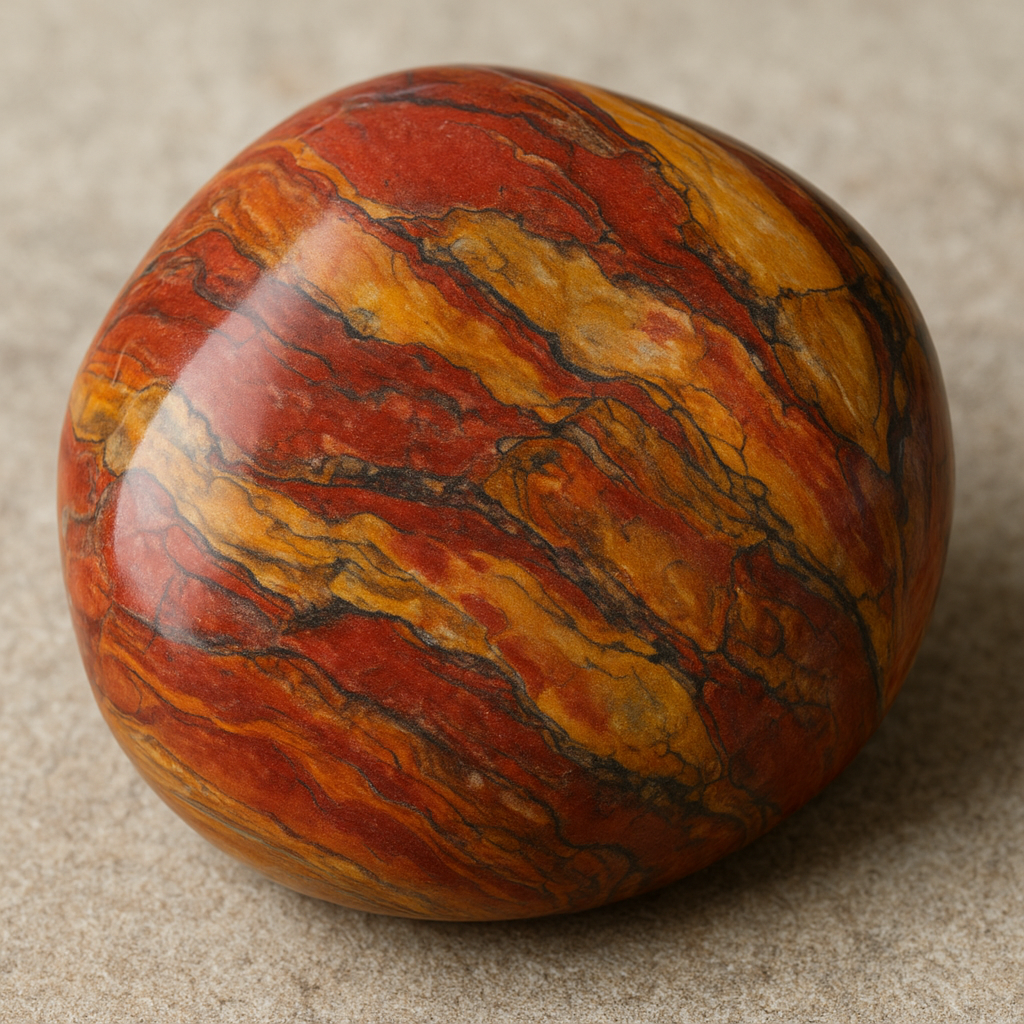
One reason jasper remains so popular is the almost endless variety of appearances it can present. Common colors include red, brown, yellow, green, and rarely blue or purple. The palette depends on trace minerals and the oxidation state of iron-bearing compounds.
Notable types
- Red jasper — Color from hematite; historically used for seals and amulets.
- Picture jasper — Striations and landscape-like scenes created by mineral deposition; prized for artistic cabochons.
- Ocean jasper — Characterized by orbicular patterns and circular formations.
- Brecciated jasper — Fragmented and re-cemented, producing dramatic, angular patterns.
- Leopardskin jasper — Spotted patterns resembling animal pelts.
Certain jaspers combine with other minerals to create hybrid names: for example, jasper-agate or jasper-rhyolite. Such combinations reflect transitional forms between fully opaque jasper and more translucent chalcedony varieties like agate.
Historical and cultural significance
Jasper’s role in human culture stretches back to prehistory. Because it takes a fine polish and is relatively hard, early humans fashioned tools, beads, and decorative objects from jasper. Across civilizations, jasper acquired symbolic meanings.
- Ancient Near East — Used for seals, intaglios, and amulets; inscriptions appear on jasper in archaeological contexts.
- Egypt and the Mediterranean — Jasper was associated with protection and was incorporated into jewelry and religious artifacts.
- Medieval Europe — Often used in reliquaries and carved devotional items due to its durability and rich color.
Because of its long association with ornamental uses, jasper frequently appears in museum collections, both as raw specimens and as worked artifacts.
Jasper in jewelry, lapidary and art
Jasper’s combination of color variability and polishability makes it a favorite among lapidaries and designers. It is commonly cut into cabochons, beads, and small sculptural pieces. The stone’s opacity means that lapidaries emphasize surface pattern and polish rather than faceting.
Techniques and treatments
- Cabochon cutting — The most common form: domed cuts that showcase pattern and color.
- Intarsia and inlay — Jasper pieces fit together like a mosaic to create pictorial panels or boxes.
- Stabilization — Porous jaspers may be impregnated with resin to improve durability and polish; this should be disclosed by sellers.
High-end designers use unique patterns—such as dramatic picture jasper sections—to create one-of-a-kind pieces. The lapidary community values jasper for both practice work and museum-quality objets d’art.
Metaphysical, symbolic and healing associations
In contemporary crystal and metaphysical communities, jasper holds a prominent place. Although these beliefs lack scientific verification, they contribute to jasper’s market demand and cultural footprint.
- Grounding — Jasper is often described as a grounding stone, helping users feel connected to the earth.
- Protection — Many traditions attribute protective qualities to jasper, using it in amulets and talismans.
- Creativity — Picture and orbicular jaspers are sometimes used to stimulate imagination and artistic insight.
Even outside spiritual circles, jasper’s vivid aesthetic qualities make it a popular choice in feng shui, decorative arts, and personal accessories where symbolic value complements visual appeal.
Practical and industrial applications
While jasper is primarily valued as a gemstone and decorative stone, it has modest practical applications where hardness and abrasion resistance are useful.
- Abrasive tools in small-scale contexts — Historically, jasper and chert were used as cutting and scraping tools in prehistoric technologies.
- Architectural elements — Polished jasper slabs may appear in high-end interiors, countertops, and mosaics.
- Collectibles and educational uses — Geological specimens and polished slices serve both educational and decorative functions.
Despite these uses, jasper does not see mass industrial application comparable to quartz sand or engineered silicon; its value lies mainly in aesthetics and cultural use rather than commodity functionality.
Identifying jasper, imitations and synthetic alternatives
Distinguishing true jasper from imitations requires attention to texture, pattern, and physical properties. Natural jasper is typically opaque with a smooth, glassy to waxy luster when polished. The stone will scratch glass due to its hardness, and it lacks the banded translucency of agate.
Common imitations
- Dyed agates, jaspers and chalcedonies — Color enhancements can create unnatural uniformity; careful inspection under magnification often reveals dye concentrations along cracks.
- Glass and plastics — High-quality glass can mimic jasper’s appearance; however, glass is generally softer and may show internal bubbles under magnification.
- Reconstituted stone — Small jasper fragments bonded with resin can create slabs of “reconstituted jasper”; these often have uniform matrix textures and resin glazes.
Gemological testing — including microscopic examination, streak tests (when appropriate), and fluorescence under UV — can help differentiate natural jasper from fakes. Ethical sellers disclose treatments such as dyeing or stabilization.
Care, cleaning and lapidary best practices
Maintaining jasper is straightforward thanks to its robust nature, but a few precautions extend the life and appearance of pieces.
- Cleaning — Use warm water, mild detergent, and a soft cloth or brush. Avoid harsh chemicals and prolonged exposure to acidic solutions.
- Avoid thermal shock — Rapid temperature changes can create hairline fractures, especially in stabilized or porous jaspers.
- Storage — Store polished pieces separately to prevent scratches; soft pouches or cloth-lined trays work well.
- Treatment disclosure — If a piece has been stabilized, dyed, or bonded, handle with extra care and avoid ultrasonic cleaners that might infiltrate and damage the treatment layer.
Regular gentle maintenance preserves the high polish that makes jasper so appealing in jewelry and decorative objects.
Collecting jasper: tips and considerations
Collecting jasper can be both accessible and rewarding. Whether you are a beginner assembling a small cabochon collection or an advanced collector seeking rare localities, consider the following:
- Study local geology — Understanding the host rock and formation environment helps in locating promising outcrops.
- Network with lapidaries and rock clubs — Local clubs often organize field trips and can offer practical advice and access to private claims.
- Ask for provenance — For polished pieces and museum-grade specimens, provenance can add historical and monetary value.
- Inspect for treatments — Request disclosure of any stabilization, dyeing, or reconstitution before purchase.
Field collecting often yields unexpected finds: jasper may occur as nodules, veins, or cavity fillings that reveal surprising patterns when cut and polished.
Legal, ethical and environmental issues
Responsible collecting and trade are important. Some jasper localities lie within protected areas or indigenous lands where collection is regulated. Overcollection can damage delicate outcrops and local ecosystems.
- Respect land access rules — Obtain permits or landowner permission where required.
- Support ethical suppliers — Choose vendors who disclose sourcing and avoid materials from conflict or environmentally damaging operations.
- Consider sustainability — Large-scale quarrying for decorative slabs can have significant environmental footprints; small-scale, artisanal sourcing is often more sustainable.
Adopting ethical practices helps ensure that jasper remains available for future generations of collectors, artisans, and scientists.
Interesting facts and lesser-known uses
Beyond jewelry and decorative items, jasper has appeared in surprising contexts:
- Ancient toolmaking — Before metalworking, jasper and chert were essential for flaked tools and projectile points due to their conchoidal fracture.
- Micromosaic art — Small jasper tesserae were used in miniature mosaics and intricate inlay work in historical decorative arts.
- Scientific specimens — Polished thin sections of jasper contribute to studies of silica precipitation and paleoenvironmental conditions when organic inclusions record ancient pigments.
Finally, the sheer visual variety of jasper makes it a perennial favorite among artists who use stone slices as canvases for natural landscapes and abstract compositions. The interplay between geology and human creativity is one reason jasper continues to fascinate both specialists and casual admirers.