Howlite is a quietly fascinating mineral that sits at the crossroads of geology, craftsmanship and popular culture. Often overlooked because of its modest hardness and unassuming white color, this stone has a rich story: it is a product of unique geological processes, a favorite among artisans for dyeing and carving, and an object of interest in metaphysical and collecting circles. Below you will find an exploration of howlite’s identity, where it forms, how it is used, and several intriguing facts and practical notes that might surprise both newcomers and seasoned mineral enthusiasts.
What Howlite Is: Mineralogy, Appearance, and Formation
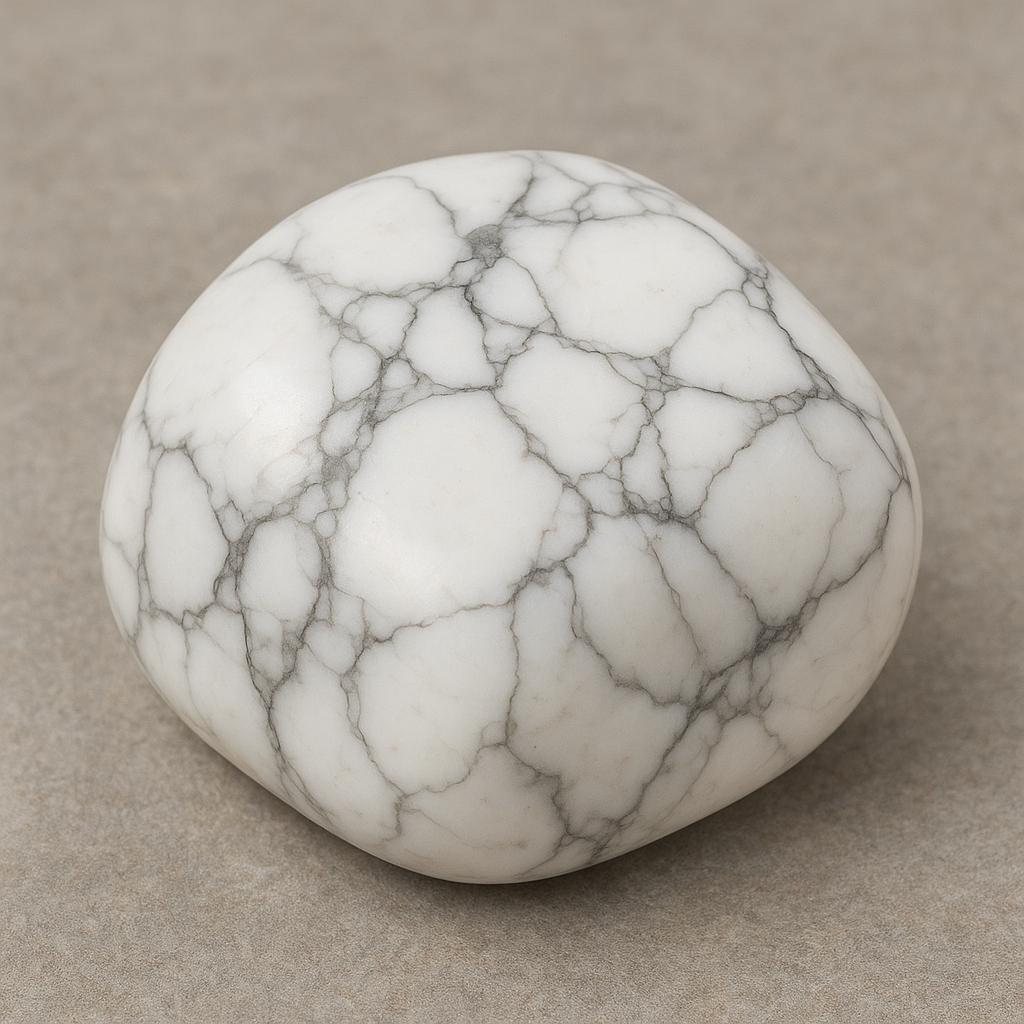
Howlite is a borate mineral with the chemical formula Ca2B5SiO9(OH)5. It typically forms in irregular nodules or crystalline masses rather than as large individual crystals. Its base color is usually a chalky white or off-white, often characterized by distinctive dark grey or black veins that create a striking, web-like pattern across the surface. These contrasting veins are one of the reasons howlite is aesthetically appealing and frequently used in decorative items.
Physical and Chemical Properties
- Chemical formula: Ca2B5SiO9(OH)5 (a calcium borosilicate hydroxide).
- Hardness: around 3.5 on the Mohs scale — relatively soft compared to many gemstones.
- Specific gravity: generally low to moderate, commonly near 2.53.
- Crystal habit: typically botryoidal, nodular, or massive; rarely forms well-developed crystals visible to the naked eye.
- Optical properties: generally opaque to translucent in thin slices; a vitreous to dull luster when polished.
Howlite develops in evaporitic environments where boron-rich fluids interact with calcium-bearing host rocks, often within sedimentary settings. It can also form in hydrothermal veins, particularly where borates are concentrated. The mineral’s porous nature and network of fine cracks make it an ideal candidate for dyeing and stabilization treatments, a feature that has had a major influence on its commercial use.
Where Howlite Occurs: Localities and Geological Context
The type locality for howlite — the place where it was first identified and described — is in Nova Scotia, Canada. It was discovered and named in the mid-19th century after the Canadian geologist Henry How, who first documented the material. While Nova Scotia remains a historically significant source, howlite is not restricted to a single region.
Notable Occurrences
- Nova Scotia, Canada — the type locality and an important historical source where nodules and masses were first described.
- Parts of the western United States, particularly in areas associated with borate deposits and hydrothermal activity. Mines in California and Nevada have produced material prized by collectors and lapidaries.
- Small occurrences worldwide — howlite appears as scattered deposits in various countries, typically where boron-rich environments have existed in the geologic past. These occurrences tend to be localized and of limited economic size.
Geologically, howlite is most commonly associated with borate minerals found in evaporite basins and arid environments where evapoconcentration of boron occurs, or in the cavities of volcanic rocks influenced by boron-bearing fluids. Because its formation requires specific chemical conditions, howlite is not as ubiquitous as many silicate minerals, but its distinct nodular habit makes it easy to recognize where it does occur.
Applications and Uses: Jewelry, Craft, and Industry
Howlite’s most visible role is in the decorative and jewelry markets. Its aesthetic versatility — a neutral white canvas with striking veining — combined with its porous nature, opens the door for a wide range of creative treatments. Below are the principal uses and notable practices related to howlite.
Jewelry and Ornamental Uses
- Beads and Cabochons: Howlite is widely used to make beads and cabochons for necklaces, bracelets, and earrings because it is easy to cut, shape and polish.
- Carvings and Decorative Objects: The stone’s softness allows detailed carving, making it popular for small sculptures, inlays, and decorative knobs or buttons.
- Dyed Imitations: One of the most common commercial practices is dyeing howlite to resemble more expensive stones — most famously, turquoise. Dyed howlite sold as “imitation turquoise” or under descriptive names has been popular because it offers the appearance of a sought-after gem at a fraction of the price.
When dyed, howlite takes color exceptionally well, producing convincing imitations of various stones. Because of this, it’s important for buyers to know how to recognize treated material versus natural turquoise or other gemstones.
Practical and Industrial Uses
Howlite has modest use outside the world of jewelry. Due to its borate content, it has been examined for roles in certain industrial contexts, but it is not a major ore of boron. Its main industrial relevance is more indirect: its presence in museum and educational collections, and its utility as a teaching specimen for minerals formed in boron-rich environments.
Metaphysical and Cultural Uses
In spiritual and metaphysical communities, howlite is prized for attributes that are part belief and part cultural tradition. It is often associated with calming energy, the facilitation of patience, and improvement of memory and awareness during meditation. These claims are part of contemporary crystal-healing practice and should be understood as cultural or subjective experiences rather than scientifically proven effects.
- Common metaphysical claims include aiding restful sleep and reducing anxiety.
- Used in meditation tools and worry stones because of its smooth, soothing feel when handled.
Identification, Treatments, and Care
Because howlite is often dyed or stabilized, being able to identify untreated natural material is valuable for collectors and jewelers. Below are practical guidelines for recognition and maintenance.
How to Identify Howlite
- Look for the characteristic white or creamy base color with grey-black veining. The patterning often resembles a spiderweb or tree-like network.
- Test hardness: at about 3.5 on the Mohs scale, howlite is softer than most traditional gemstones. Careful scratching tests (preferably in controlled settings) will show it scratches more easily than quartz or turquoise.
- Porosity and dye uptake: howlite readily absorbs dye; uncharacteristically intense colors in the veins or along fractures may signal a dyed treatment.
- Compare with similar minerals: magnesite can look similar but often has different physical properties and reaction to certain chemicals. Laboratory tests (X-ray diffraction, spectroscopy) provide definitive identification.
Treatments
The most common treatment is dyed howlite. Stabilization with resins or polymers is also used to improve durability for use in jewelry. Treatments are acceptable industry practices when disclosed to buyers; nondisclosure can lead to misunderstandings about value and care requirements.
Care and Maintenance
- Avoid harsh chemicals and ultrasonic cleaners; howlite’s porosity and lower hardness make it vulnerable.
- Store howlite jewelry separately to prevent abrasion against harder stones and metals.
- If a piece has been dyed, avoid prolonged exposure to sunlight and harsh solvents to prevent fading.
Market, Value, and Ethical Considerations
Howlite is generally affordable compared with high-end gemstones, which contributes to its popularity. Its value is influenced by several factors: the quality of the matrix pattern, the size and symmetry of beads or cabochons, whether the piece is natural or dyed, and craftsmanship. Because dyed howlite can mimic sought-after stones, ethical disclosure by sellers is central to fair trade practices.
Sustainability and Collection Ethics
Unlike some precious gemstones whose extraction can cause significant environmental or social impacts, howlite mining is typically small-scale and localized. However, any mining activity carries potential for landscape disturbance, habitat disruption, and local social effects. Responsible sourcing practices — including transparency about locality and treatment — are increasingly expected in the mineral and jewelry markets.
Interesting Facts and Lesser-Known Details
- Howlite was named after Henry How, a respected 19th-century naturalist and geologist who first described the mineral in Nova Scotia.
- Its porous, veined surface makes howlite a favorite substrate for dyes; some gem sellers market dyed howlite under creative trade names rather than labeling it as dyed material, so buyer awareness is important.
- Collectors prize unusual specimens where the nodular habit displays particularly attractive or striking veining patterns — sometimes rivaling high-end marbles in visual appeal.
- Howlite’s composition places it among borate minerals, connecting it chemically to an interesting family of minerals important for both geology and industrial chemistry.
Comparisons with Similar Stones
Howlite is often compared with turquoise and magnesite because of similar appearances when treated. The differences typically lie in hardness, specific gravity, and the nature of the matrix. A cautious buyer, armed with basic tests or trustworthy gemological appraisal, can distinguish among these materials.
Practical Advice for Collectors and Buyers
If you are interested in acquiring howlite — whether for jewelry making, metaphysical use, or collecting — here are pragmatic tips:
- Ask for disclosure: confirm whether the piece is natural, dyed, stabilized, or treated in any other way.
- Insist on locality information when possible — knowing the source can add context and value for collectors.
- For jewelry, choose protected settings (bezel rather than prong) to reduce the risk of chips or abrasion because of howlite’s softer nature.
- Use gentle cleaning methods: a soft cloth and mild soap, avoiding aggressive cleaners and heat exposure.
- Consider pieces that combine howlite with harder materials or metals, which can create durable and attractive designs when well executed.
Final Observations and Cultural Resonance
Howlite occupies an interesting niche: it is at once a simple white stone and a canvas for artisans; a modest mineral by geologic standards and a chameleon in jewelry markets. Its accessibility makes it an important teaching and craft material, while its adaptability through dyeing and polishing keeps it relevant in fashion trends. Whether appreciated for its natural patterns, its role as an affordable substitute for more expensive stones, or its place in contemporary spiritual practice, howlite continues to be a stone of quiet but persistent interest.
Across geology, commerce and culture, the story of howlite illustrates how a mineral’s intrinsic properties — porosity, color, and chemical composition — influence human creativity and market practices. From the cliffs of Nova Scotia to artisan workshops and meditation circles, howlite’s journey highlights the many ways a single mineral can shape aesthetic, scientific and social narratives.