
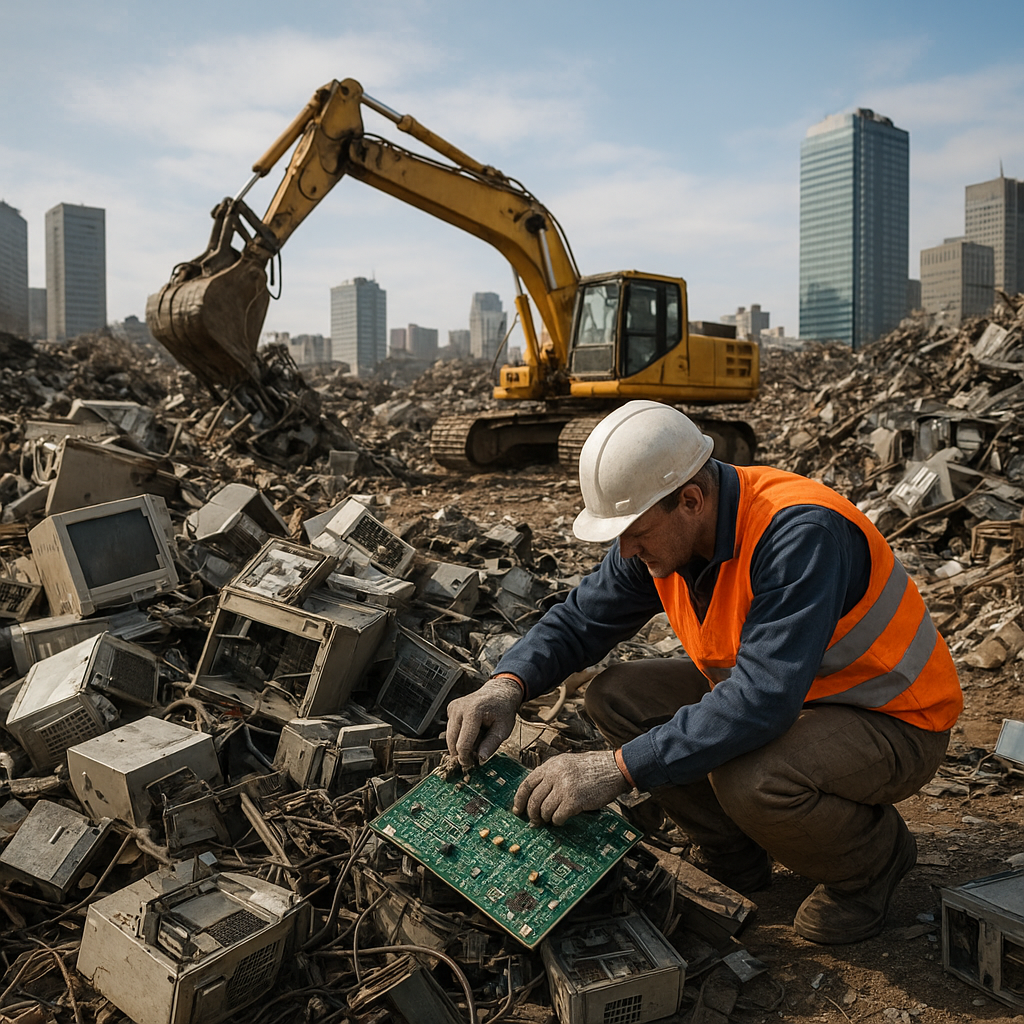
The shift from traditional ore extraction to recovering metals from urban environments is gaining momentum. This article explores how urban mining can reshape the way societies secure essential metals, reduce environmental footprints, and strengthen local economies. By looking at technologies, supply-chain implications, and policy levers, we examine practical pathways to scale up recovery of valuable materials from electronic devices, buildings, vehicles and other urban waste streams.
The idea and scale of urban recovery
Urban mining reframes cities as repositories of recoverable raw materials rather than merely consumption centers. Appliances, smartphones, vehicles and discarded infrastructure concentrate a wide range of elements—common ones like copper and aluminum as well as critical metals such as cobalt, lithium, nickel and rare earths. Many of these materials are present at higher effective grades in waste streams than in some primary ore deposits, which makes recovery attractive from both technical and economic standpoints.
Quantifying the opportunity helps to understand its potential. Contemporary studies estimate millions of tonnes of recoverable metals are locked in urban waste and in-use stocks across developed regions. For example, end-of-life electronics and battery packs represent a rapidly growing reservoir of e-waste rich in precious and strategic elements. Similarly, decommissioned buildings and infrastructure offer substantial quantities of copper, steel and aluminum that could be reclaimed if dismantled and processed with recovery in mind.
Technologies and processes enabling material recapture
Advances in materials processing, sorting, and analytical methods make urban recovery increasingly feasible. Techniques span from mechanical separation to sophisticated chemical and biological processes:
- Mechanical pre-processing and automated sorting, including sensor-based separation and robotics, to concentrate target streams.
- Hydrometallurgical methods that dissolve and selectively precipitate or extract metals using tailored solvent systems and ion-exchange resins.
- Pyrometallurgical routes for smelting and refining metal-rich fractions at scale.
- Emerging bio-based approaches, like bioleaching, which use microorganisms to mobilize metals from complex matrices with lower energy input.
- Urban-scale mapping and digital tools—material passports and blockchain-enabled traceability—to track stocks and prioritize recovery.
Combining these techniques into integrated flowsheets allows processors to maximize yields while reducing waste. For example, a mixed stream of e-waste may first be manually disassembled to remove batteries and hazardous components, then shredded and sorted using eddy-current and X-ray fluorescence systems to separate copper- and gold-rich fractions that are then treated by hydrometallurgy to recover pure metals.
Economic and environmental implications
Recovering metals from urban sources can deliver multiple economic and environmental benefits. On the environmental side, recycling reduces the need for energy-intensive primary mining and associated disturbances such as land degradation, water consumption and greenhouse gas emissions. Replacing a fraction of primary supply with secondary material contributes directly to sustainability goals and lowers the life-cycle impacts of products.
Economically, urban recovery can help diversify supply and reduce dependence on geographically concentrated mines. That contributes to resource security and shields manufacturing from geopolitical shocks. Localizing parts of metal supply chains also creates opportunities for new industries and skilled employment in collection, sorting, remanufacturing and refining.
However, there are economic challenges to address. The heterogeneity and dispersed nature of urban stocks create higher collection and processing costs compared with centralized mining. Contamination of material streams can complicate refining and lower product value. Overcoming these barriers often requires supportive policy, upstream product redesign, and vertical integration from manufacturers who can guarantee volumes and quality for recyclers.
Design, business models and policy actions that accelerate uptake
Scaling urban recovery demands changes across product design, business models and regulations. Product designers can enable easier disassembly and material separation by specifying modular assemblies, standardized fasteners, and clear labeling of component materials. This approach, sometimes called design for recycling, reduces downstream processing costs and increases recoverable yields.
Business model innovation is equally important. Extended Producer Responsibility schemes, deposit-return systems and pay-as-you-throw incentives can mobilize consumers to return end-of-life goods. Manufacturers adopting circular models—leasing, refurbishment, or buy-back programs—retain material ownership and create steady feedstocks for urban recovery operations.
Policy measures also play a critical role. Standards for product material reporting and material passports support traceability and quality assurance. Subsidies, tax incentives or public procurement preferences for products with verified recycled content can create demand signals that justify upfront investments in urban recovery infrastructure.
Social and urban planning dimensions
Urban mining interacts directly with cities and communities. Effective collection networks require convenient drop-off points, reverse logistics, and collaboration with informal sectors where they exist. Informal recyclers already perform significant recovery in some regions; integrating them into formal value chains with health, safety and fair compensation improvements multiplies social benefits.
Urban planning can support industrial symbiosis—co-locating material recovery facilities near manufacturing clusters to reduce transport and facilitate heat and by-product exchange. Redevelopment projects that mandate material recovery during demolition can turn construction into a steady source of secondary materials for building new infrastructure, closing loops at the neighborhood scale.
Practical barriers and how to overcome them
There are several technical, economic and institutional obstacles to widespread urban mining:
- Collection logistics and low participation rates raise costs; targeted incentives and convenient infrastructure can increase capture.
- Material heterogeneity and contamination require advanced separation and purification; investment in R&D and scalable processing is needed.
- Regulatory gaps around waste classification and cross-border movements of secondary materials can hinder trade; harmonized standards help markets grow.
- Market volatility for recovered commodities makes investment risky; long-term offtake contracts and recycled-content mandates can stabilize demand.
Addressing these hurdles often involves coordinated action: governments signal demand and set quality rules, industry commits to design changes and supply guarantees, and technology developers lower processing costs and improve yields. Public–private partnerships can de-risk pilot projects and scale successful models.
Examples and early successes
Several jurisdictions already demonstrate tangible benefits from urban recovery efforts. Municipal electronics take-back programs and advanced battery recycling facilities have increased material recapture rates in parts of Europe and East Asia. Automotive dismantling for high-value components and metals has long been a feature of the car industry, and those methods are now being extended to electric vehicle battery packs to recover cobalt, lithium and nickel.
Beyond formal recycling, circular procurement policies in some cities favor products with verified recycled content, creating local markets for secondary metals. Technology companies and manufacturers that redesign products for disassembly report lower end-of-life processing costs and higher recovery yields, offering a positive feedback loop that makes urban mining more attractive.
Future outlook: integrating urban mining into global metal supply
As global demand for certain metals continues to rise, especially those used in clean energy and digital technologies, urban recovery will become an essential complement to primary mining. The transition will not happen overnight, but incremental scaling—driven by innovation, regulatory clarity and shifts in supply chains—can steadily increase the proportion of metals coming from urban sources.
Key milestones that would accelerate the transition include wider adoption of circular economy principles by industry, mandatory material reporting and recycled-content targets, and improved economic signals for recyclers. With coordinated action, cities can become resilient hubs of materials supply rather than end-of-life burdens, turning past consumption into future inputs for sustainable production.
